We had driven this stretch of highway several times before. No drama, not a great deal of interest, a good road.
Refuelled at Erldunda RH – $1.57cpl. John just topped up the tank with 15 litres, to make sure we had enough to get to Alice Springs with no worry. Being at the corner of the road to Ayers Rock, this Roadhouse was always busy.
On to Alice Springs, with no other stops.
Our powered site at the McDonnell Ranges Caravan Park cost $27 a night, after discount. It is a large park, with modern amenities. Sites were only average size but with good shade trees. We like this park for its cleanliness and for some interesting activities put on for guests, like pancake breakfasts. And – best of all – it was a bit out of town and thus less noisy and, we thought, more secure.
After setting up, we drove off to the town centre and the shops.
M had been having trouble with the lilo she used for a bed in the back of the Troopy – it kept going down and she couldn’t find the source of the leak. She bought some foam from a swag maker, to replace the lilo. Problem solved!
We checked at the PO for our mail – not in yet. Bought some groceries and fresh foods.
At a camera shop, I ordered a new battery for my Pentax Optio camera – so I would be able to have a spare one charged up all the time.
I was looking forward to borrowing some library books and having a reading binge, so went to the town library. Discovered that it charged $25 for non-residents to borrow books – non-refundable. Thought that was a bit steep, but maybe it was a reflection of the nature of the town with a high number of transient tourists.
John found a $5 note in the street, so bought a lottery ticket with it. He sussed out the bowls club and lost no time booking us in for games on Saturday and Sunday. Damn! Suspected that would stir the Achilles’ up again, nicely.
Now that he did not need to conserve the van’s battery power at nights, John played computer games until after 1am.
Another really cold night. At least, with 240v power, we could now run the little electric fan heater in the van.
We were getting pretty good at efficient morning starts, without pressure, after a few in a row.
Continued west on a reasonable gravel road. The Driver – and I – were ever so glad that there was no need to cross the Arkaringa Creek again. But my Road Guide and map did show a number of watercourses to be crossed , so we hoped they were just little, minor ones.
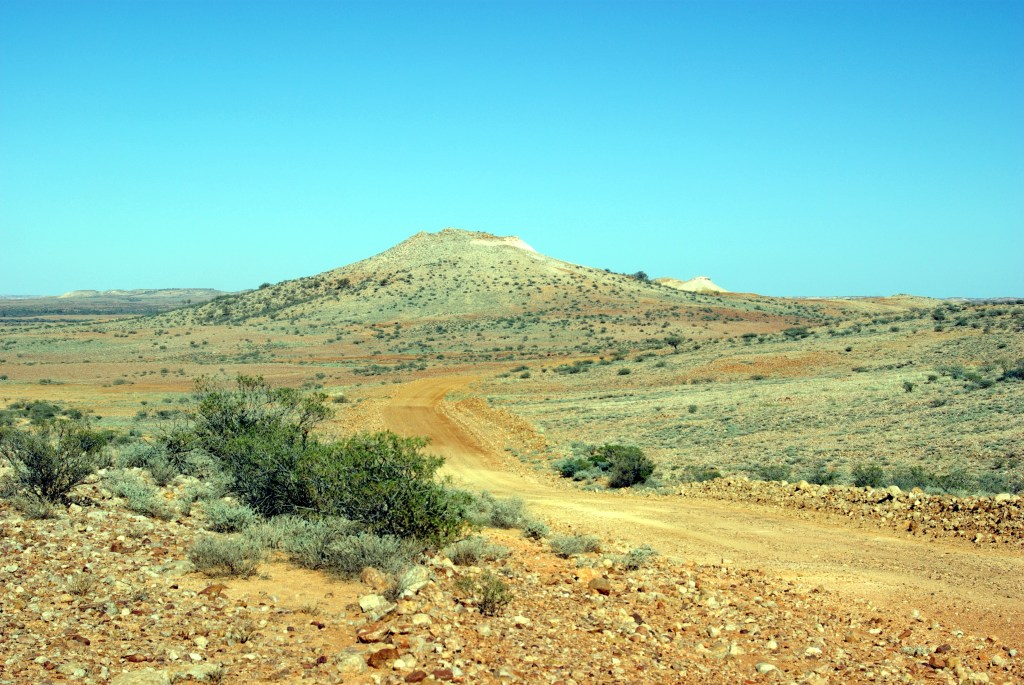
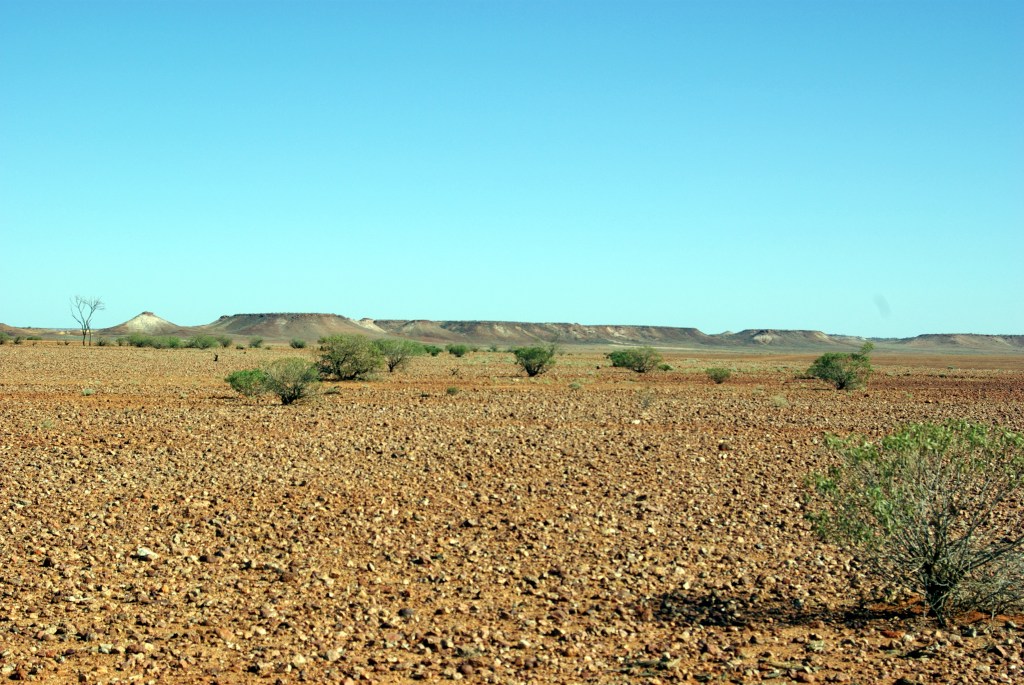
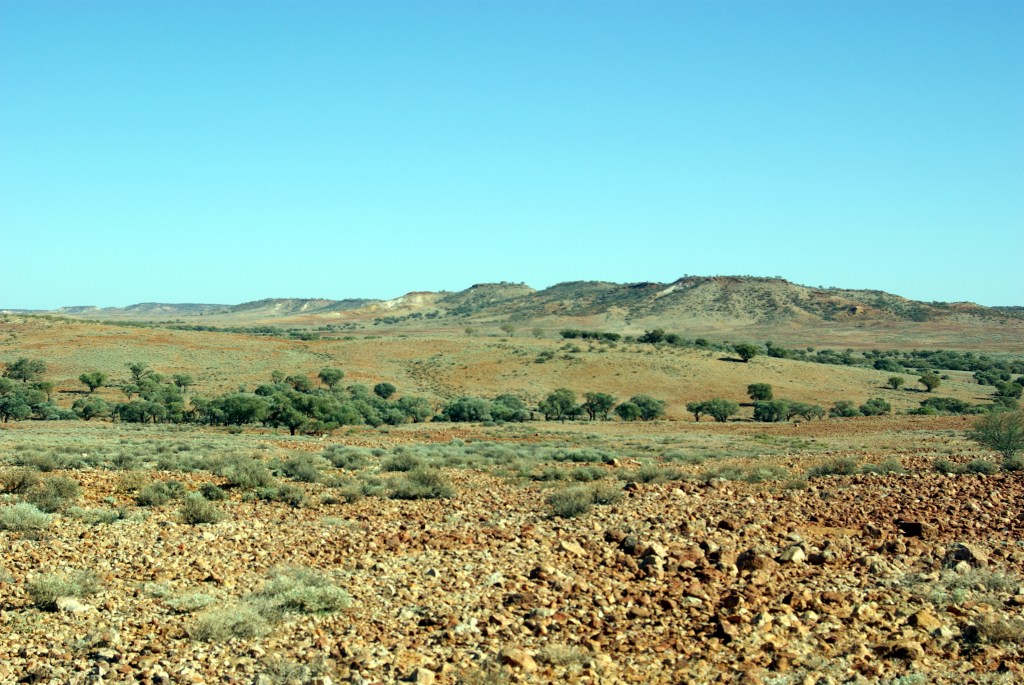
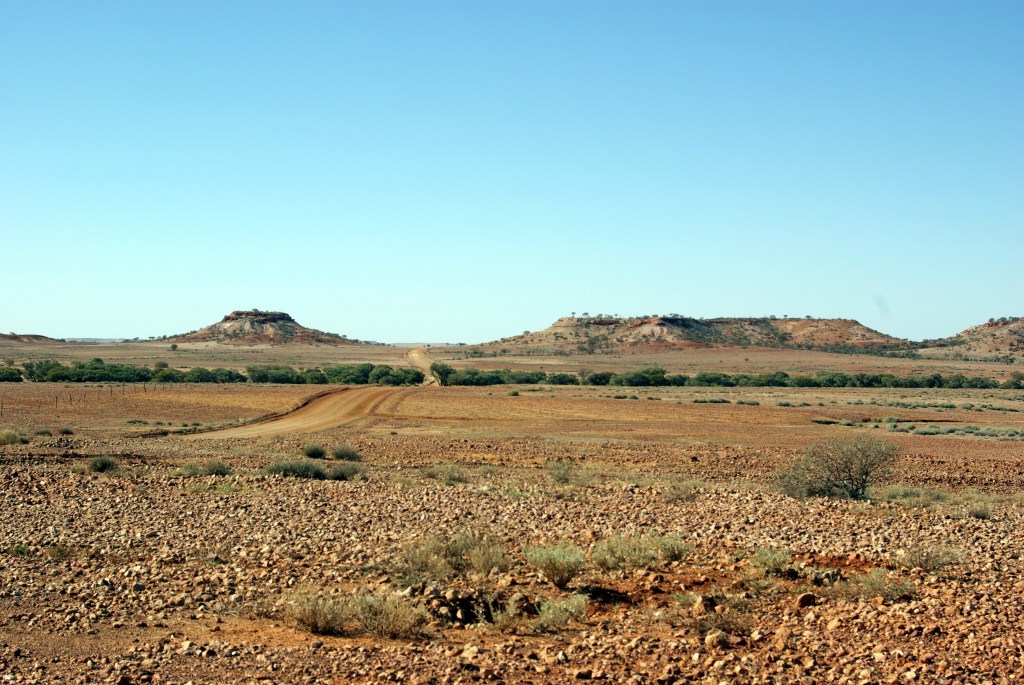
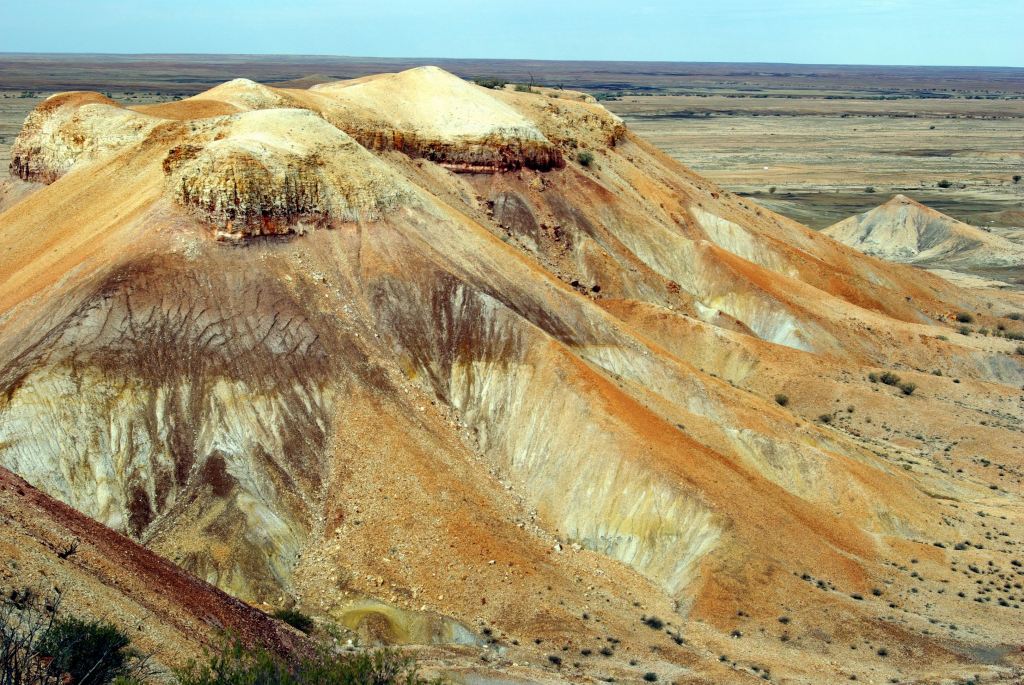
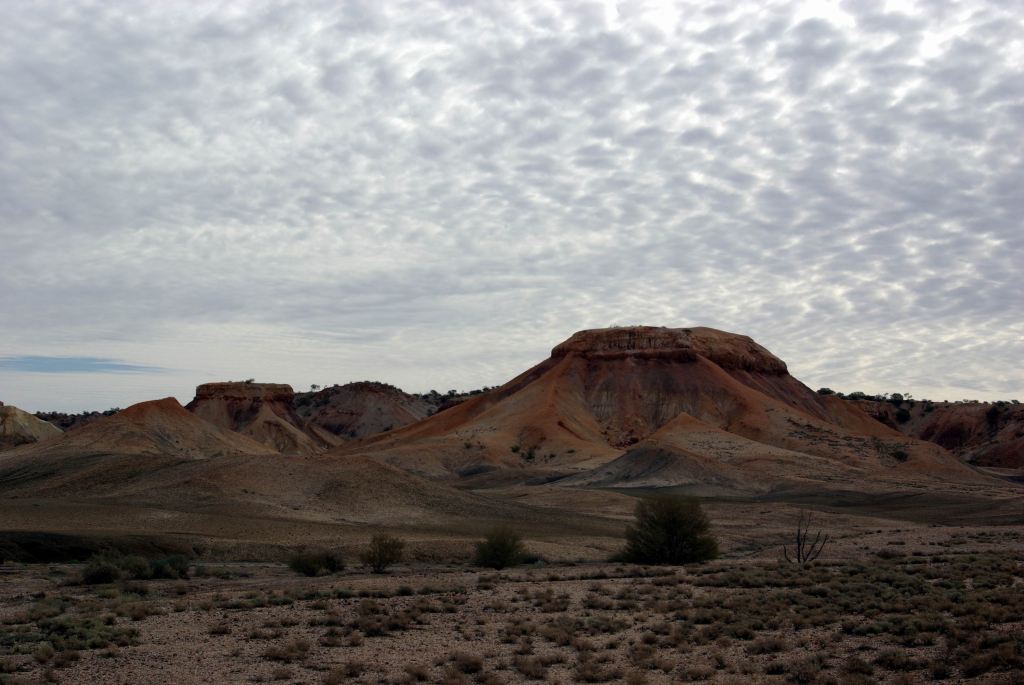
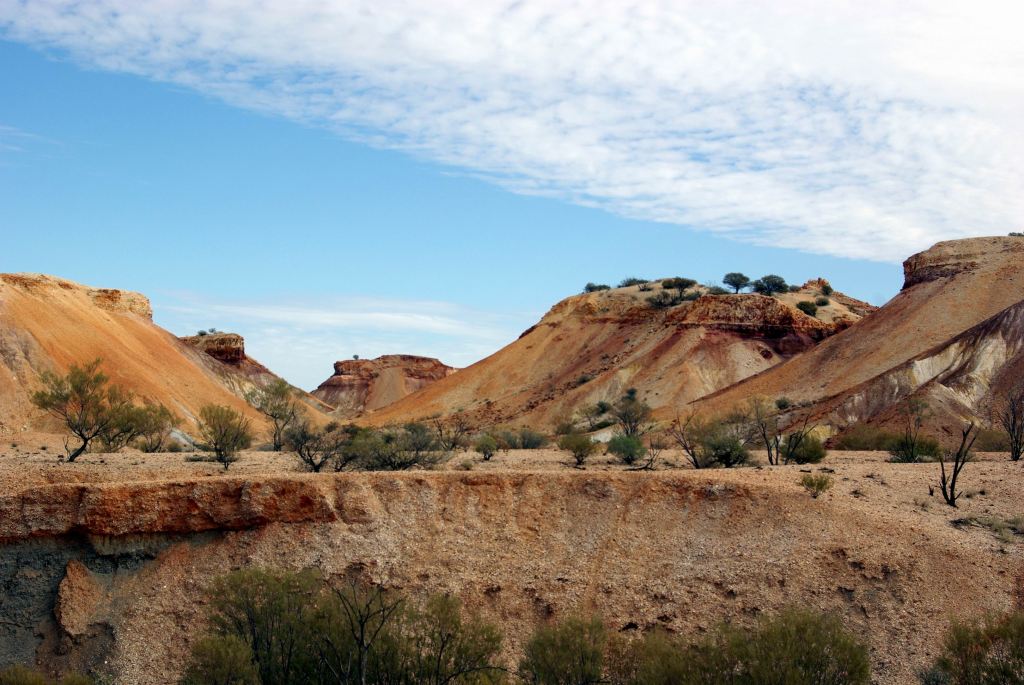
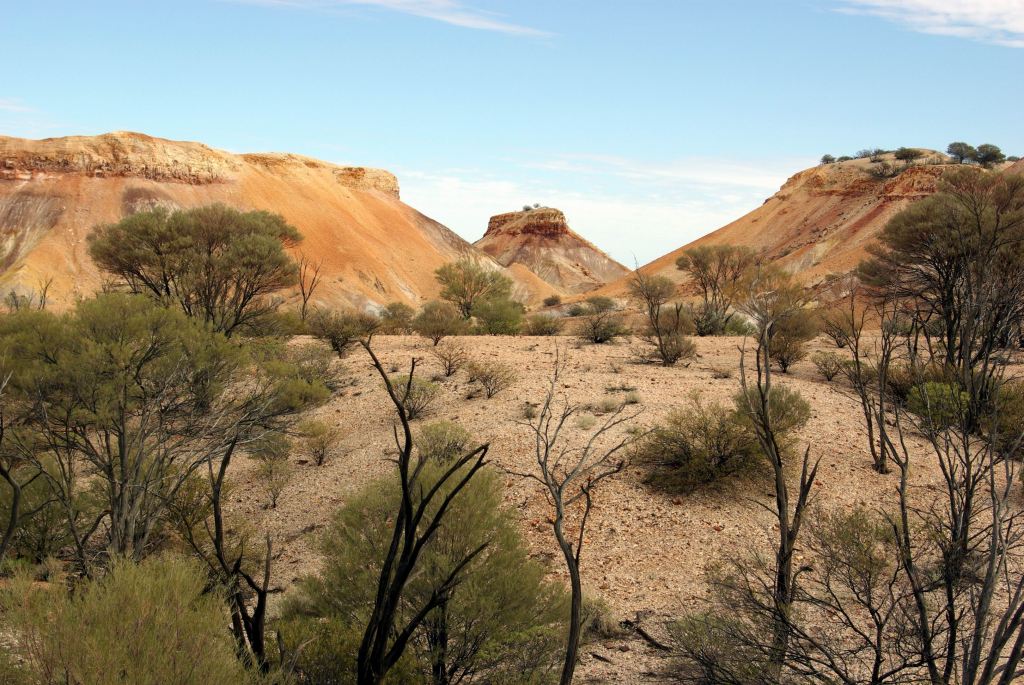
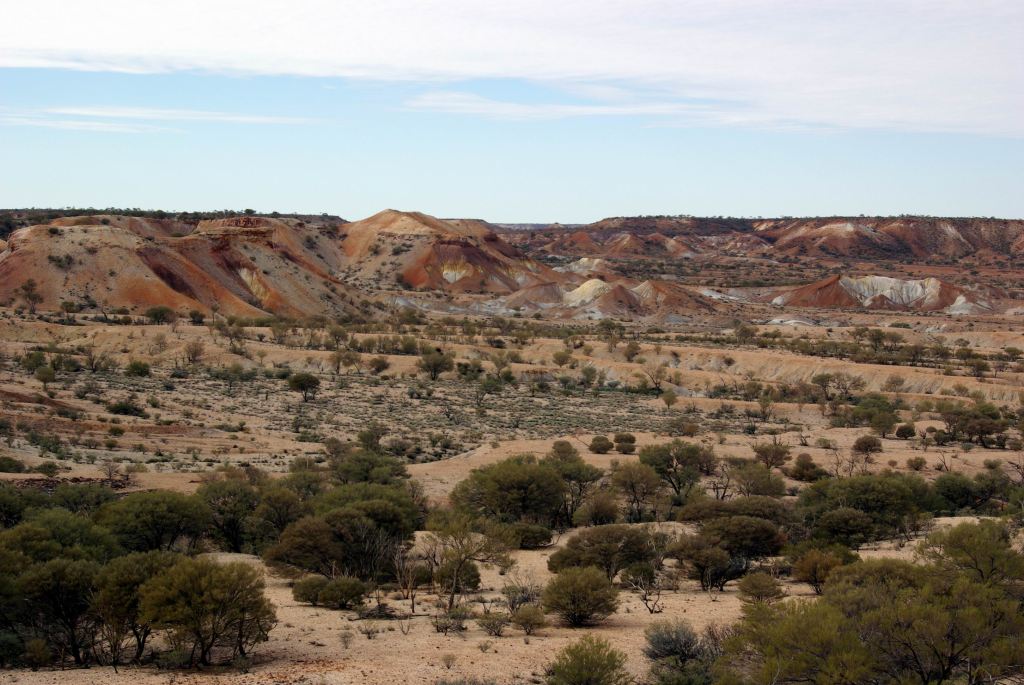
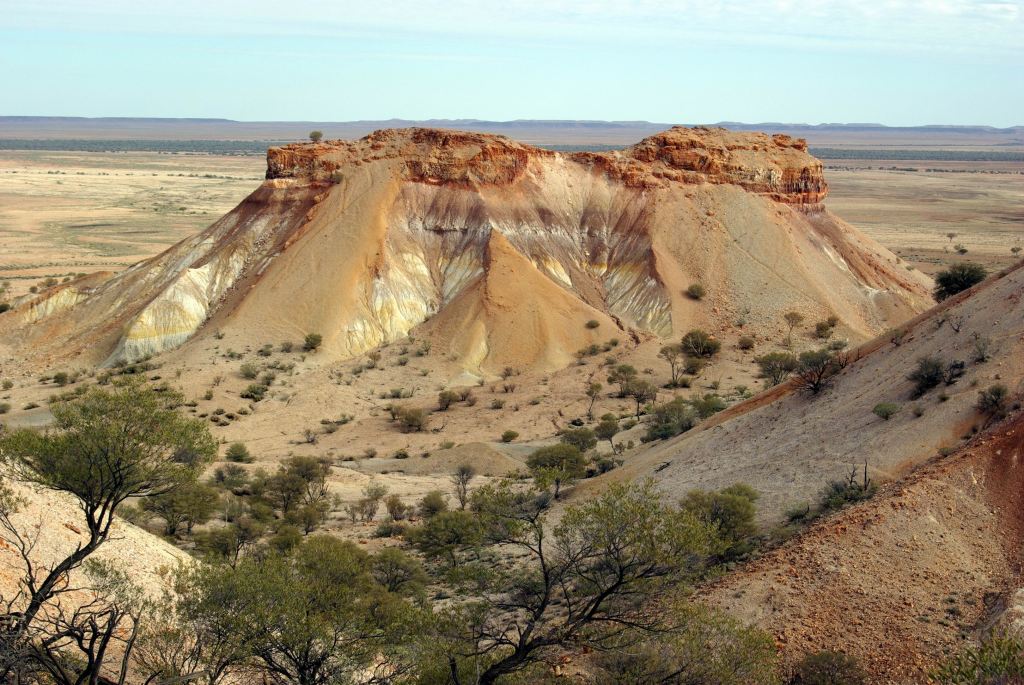
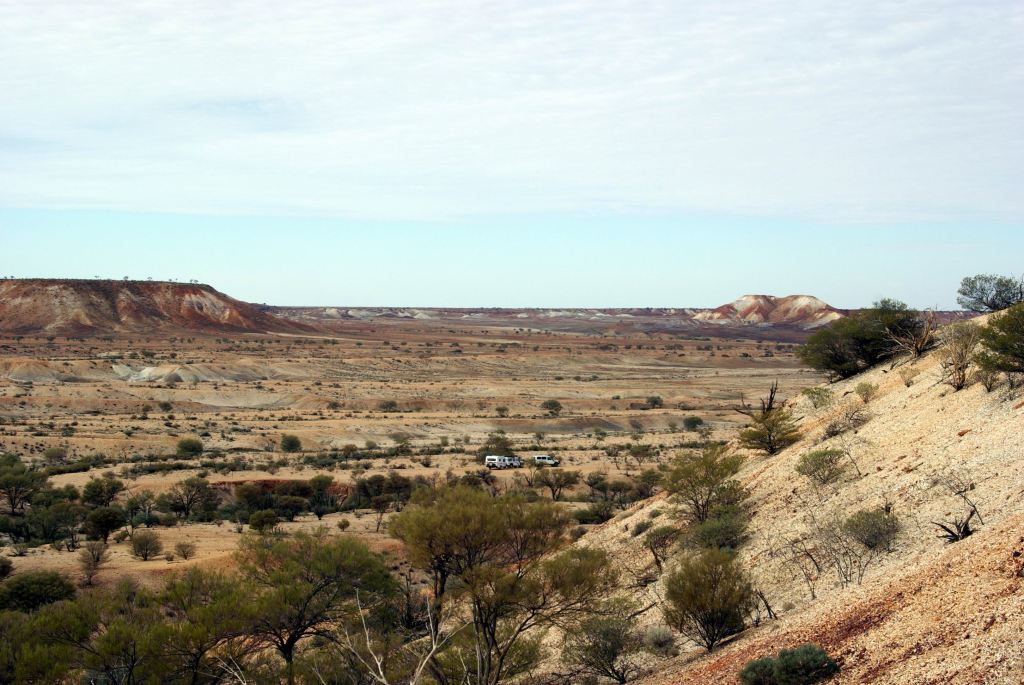
The first part of today’s driving was brilliant for scenery. The mesa like formations of the Painted Desert were replicated in a range that stretched along to the north of our route, and in isolated other formations.
There were regular creek lines with mulga and low trees along them, and lots of wide vistas.
Despite our concerns, there were no more wet and boggy creeks.
We passed the Copper Hills Homestead. This was a small, private, conservation area, excised from Evelyn Downs Station’s normal activities. A camp area had been established there, that I’d read about, back in the late 90’s, at what was reputed to be an especially beautiful area. I had wanted to camp there when we were passing nearby on the highway, a couple of times, but on both occasions John was in a hurry to get south. Now the camp ground was no more, so the opportunity was past. Apparently the place had been bought by a professional person from Adelaide as a private retreat.
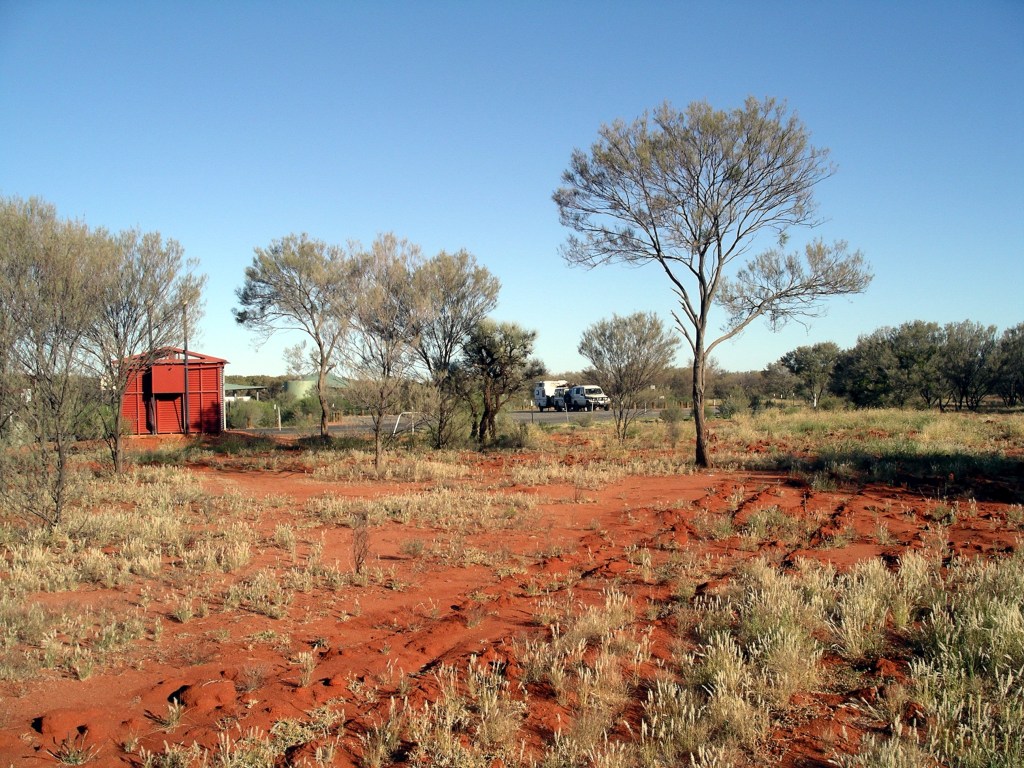
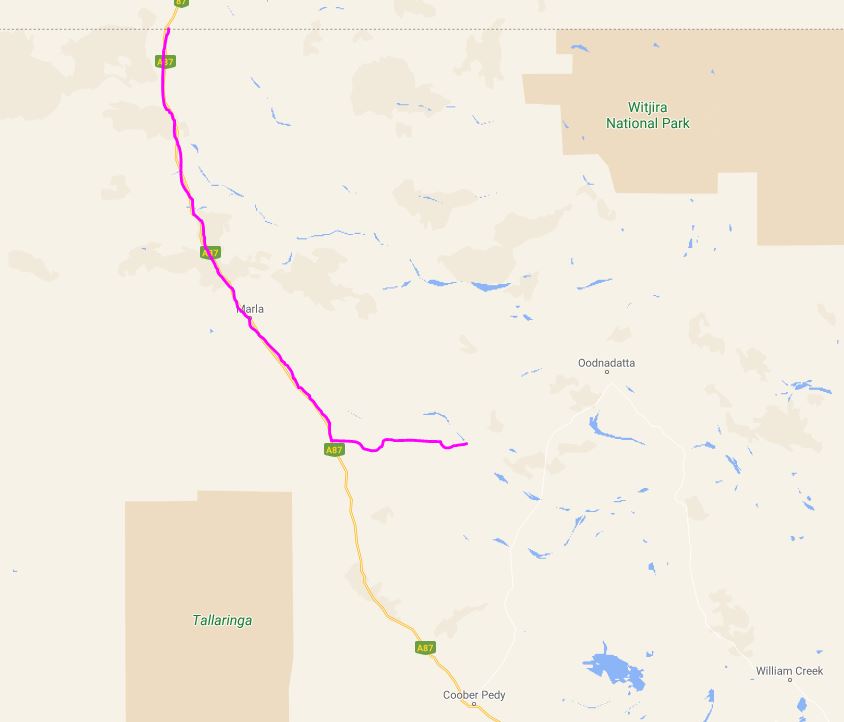
Our track emerged onto the Stuart Highway just south of Cadney Park Roadhouse. A sealed road again!
We stopped briefly at the Roadhouse. I phoned and booked us into the Mc Donnell Ranges Caravan Park in Alice Springs, for a week from tomorrow. At this time of year, thought it advisable to book, especially as we had a preference for sites close together. It was a longer time than I would have chosen to spend there, this trip, as we had spent considerable time there before, but John had visions of playing lots of bowls!
Stopped again at the next roadhouse up the Highway – Marla – to refuel. $1.62cpl. It was ridiculous that the fuel cost here – with all the volume it must do – was more expensive than that at William Creek!
Since Cadney Park we’d had the “new” Ghan Railway off to our left, often not far from the road. North of Marla we crossed it on an elevated section of road, not to be seen again until the outskirts of Alice Springs.
We had decided, last night, that we’d try to offset a little of what the week in Alice would cost, by free camping tonight. I thought that the area at Agnes Creek, about 100kms north of Marla, read in my camps book as though it was pleasant, but John was not quite ready to stop then. So, after a slightly tedious run up the highway to the SA/NT border, we checked out the roadside stop there.
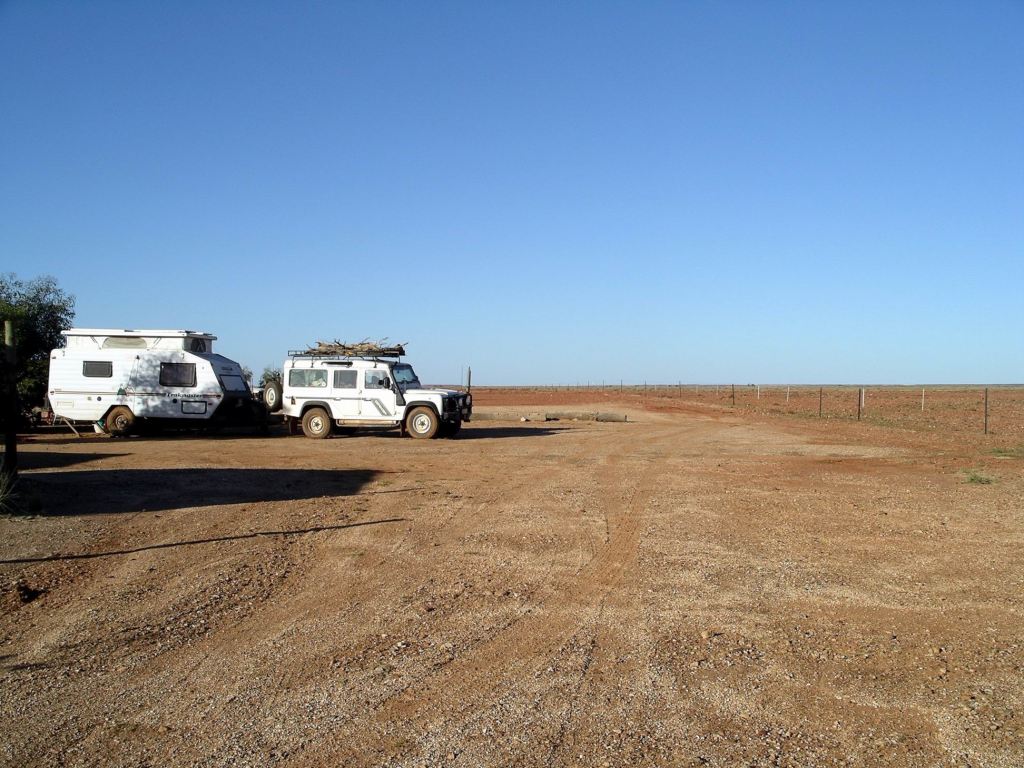
The large area was sealed, and there were composting toilets. There wasn’t much in the way of shade, but it was getting late in the day anyway. It would have been much nicer back at Agnes Creek, I thought. However, it would do for the night. We parked up, put out the table and chairs, and considered ourselves set up – at a prudent distance from the toilets!
I was pleased when another van pulled in and set up for the night, and then another one after that. There was some security in numbers, with a main highway so close.
Kulgera Rest Area – on SA/NT border
The couple who came in not long after us had a fire container made from a sawn off gas bottle. Great idea this. The ring stand on the base of the gas bottle meant it could sit on the sealed surface, and have a fire going without doing any damage, or leaving any trace. I wouldn’t mind one of those!
They invited us over, after tea, and we sat round their “campfire”, talking. It was all very pleasant.
The place was not as noisy from traffic through the night, as I had feared.
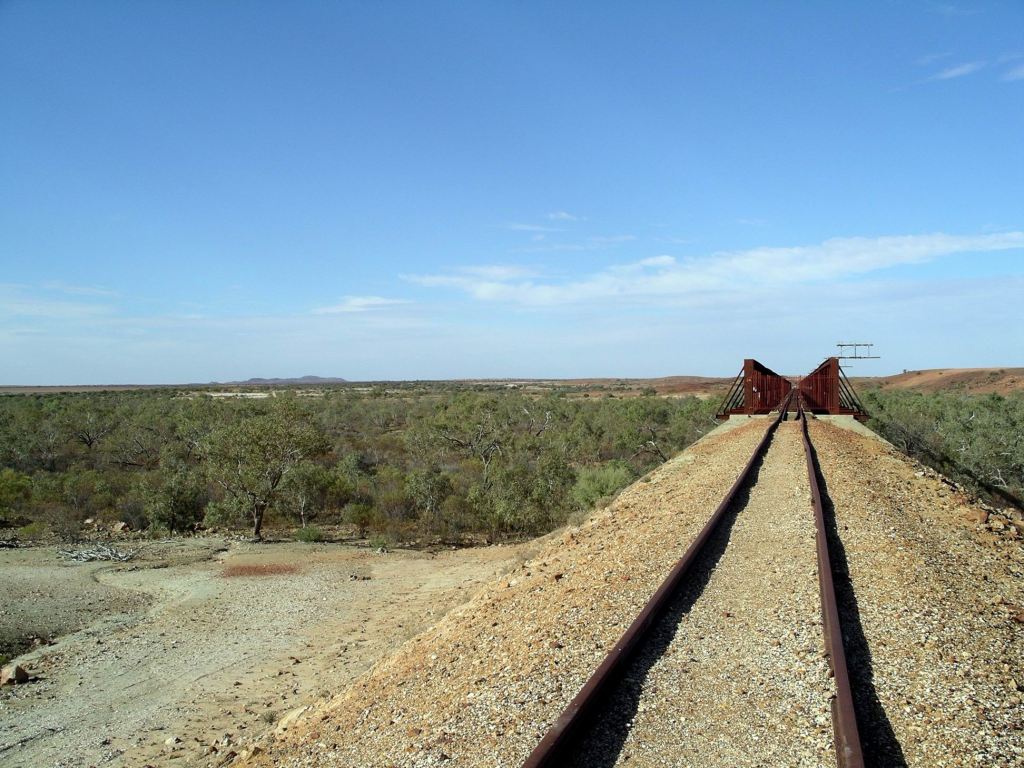
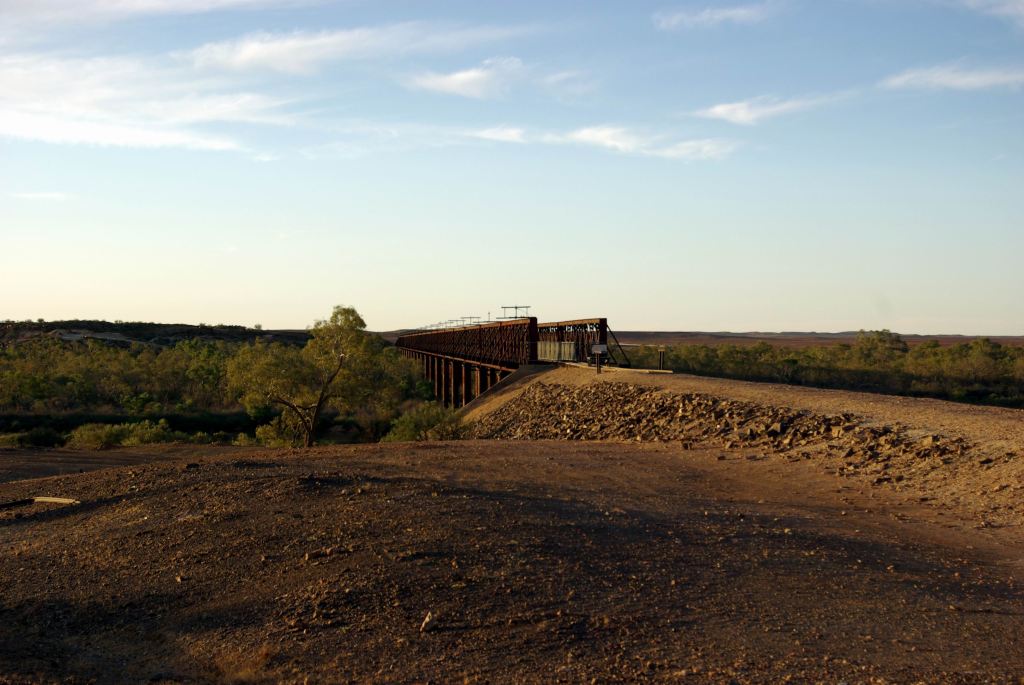
After a fairly early breakfast, we walked back to the bridge, to view it in a different light from last afternoon. Spent some time wandering about there and also around the northern end of the bridge.
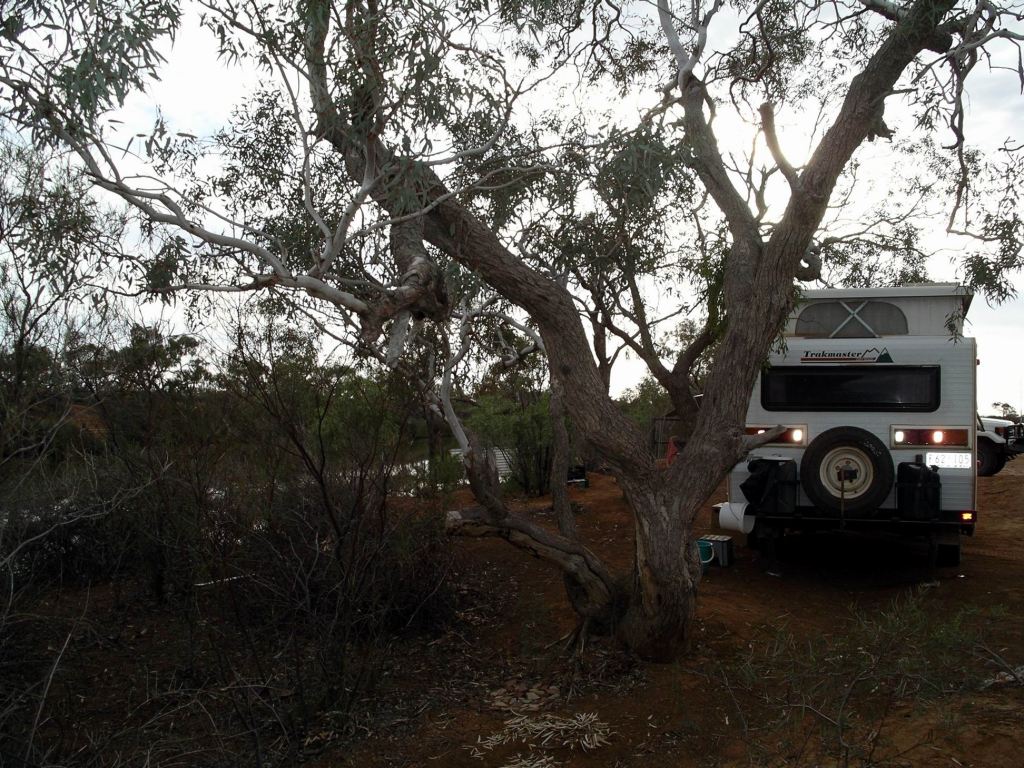
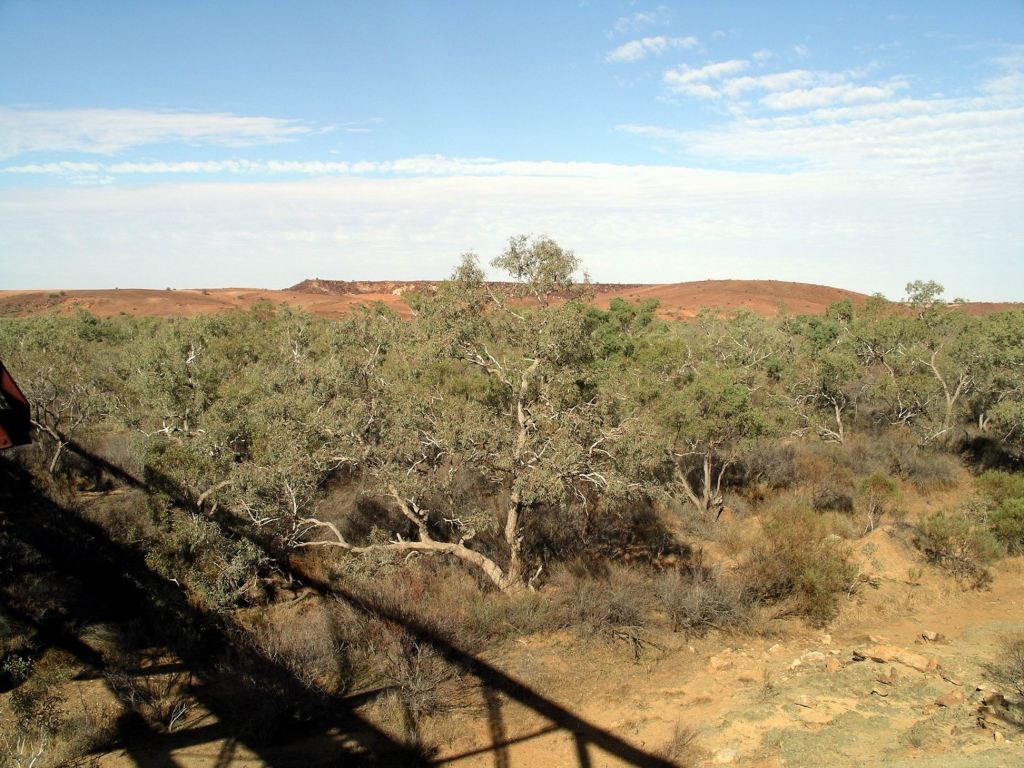
Early morning, AlgebuckinaOur secluded riverbank camp in the morningThe train driver’s perspectiveNeales River from the bridge approach
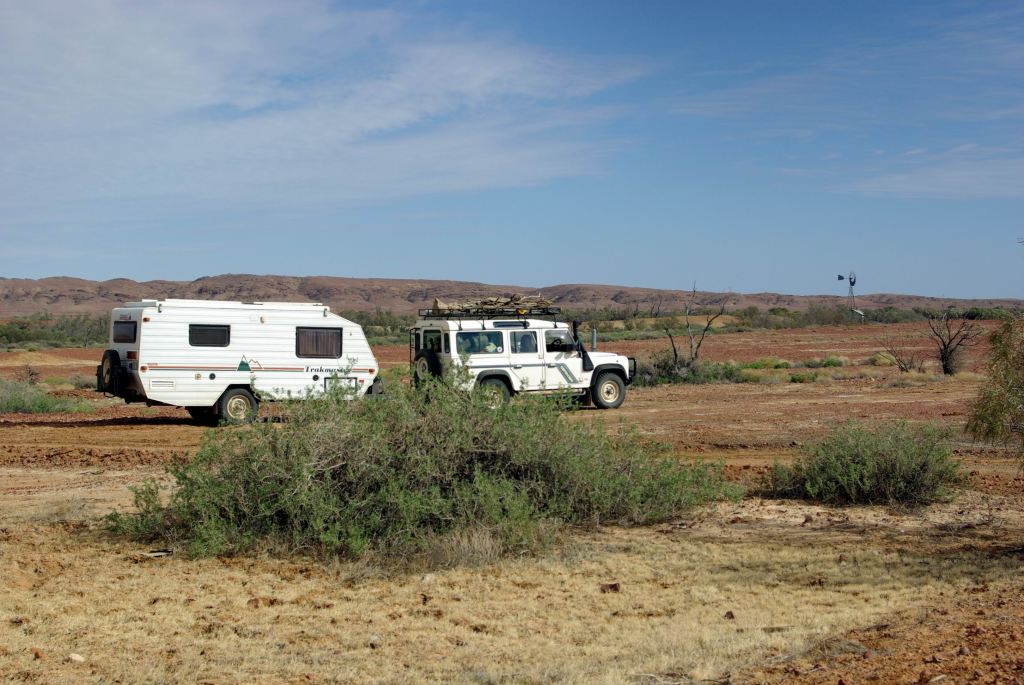
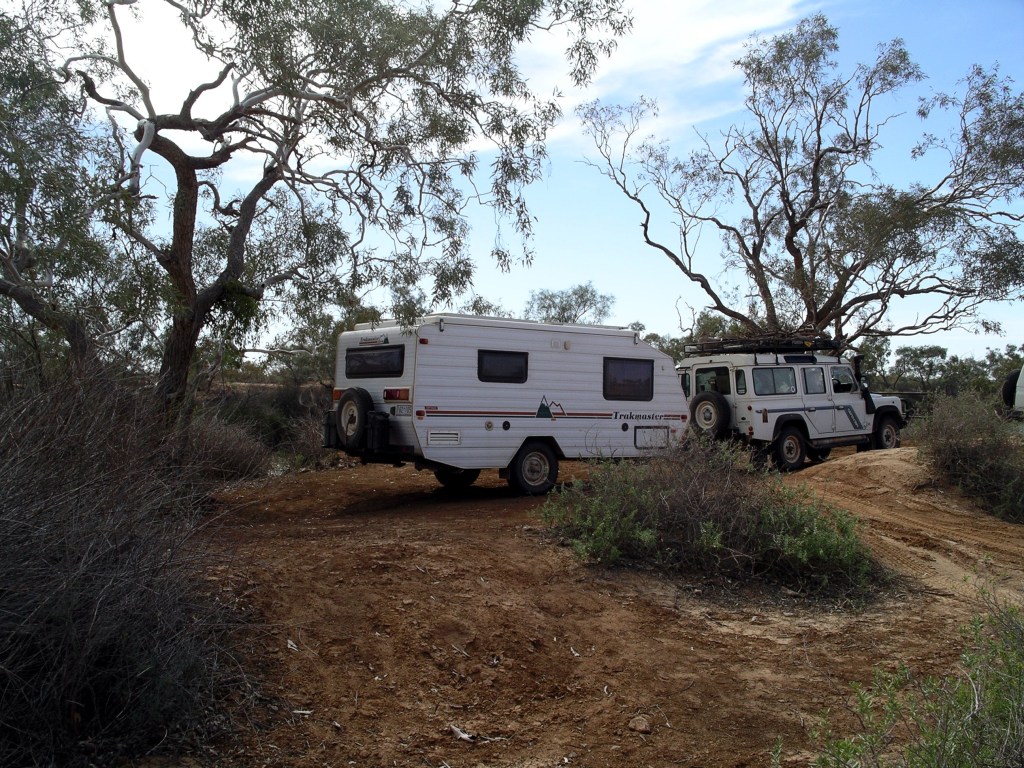
The Trakmaster group was away from camp well before us, as a result. That pleased us – meant they would probably be clear of Oodnadatta before we arrived there. We would not be tailing along in their dust.
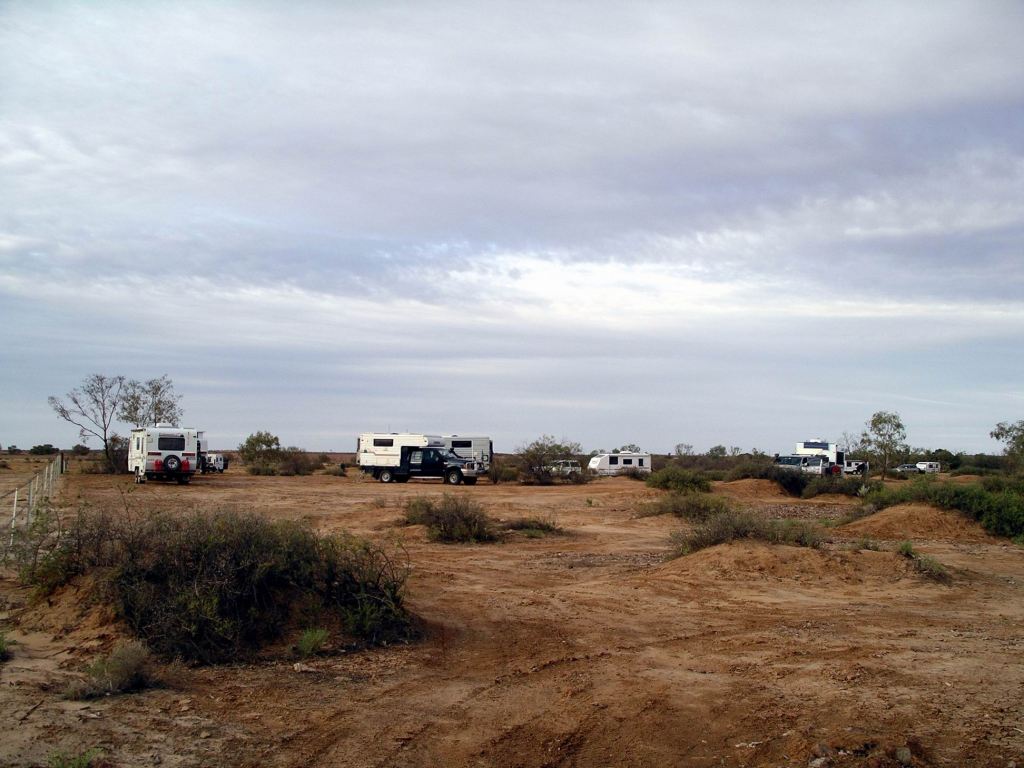
Trakmasters’ camp at Algebuckina
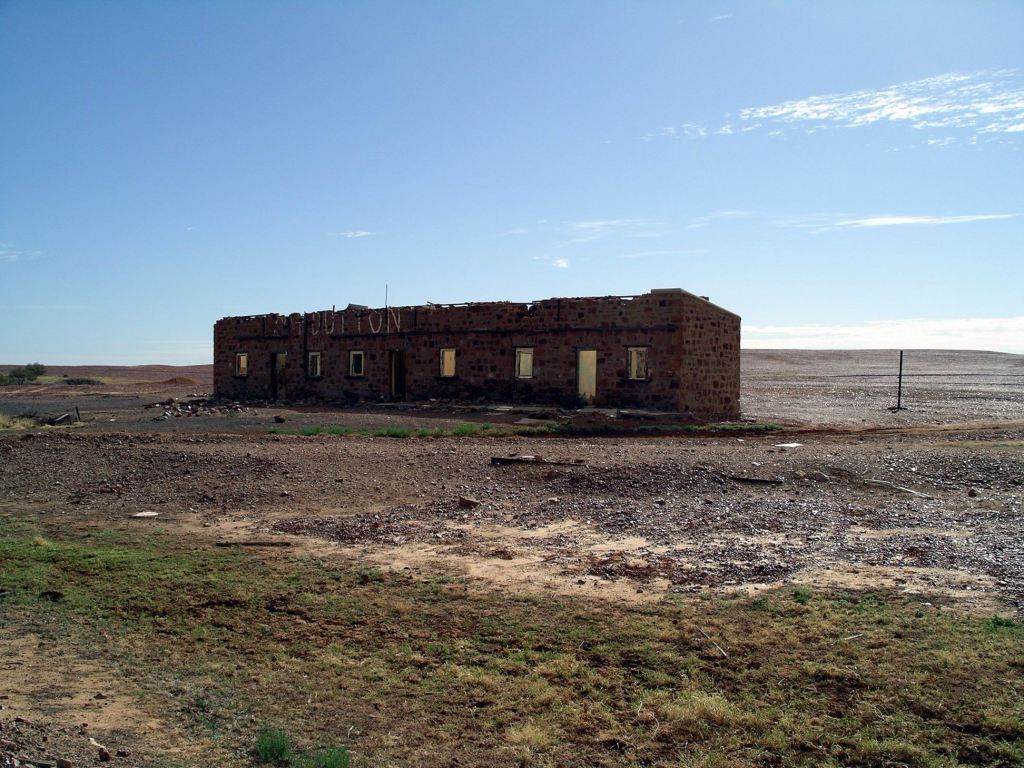
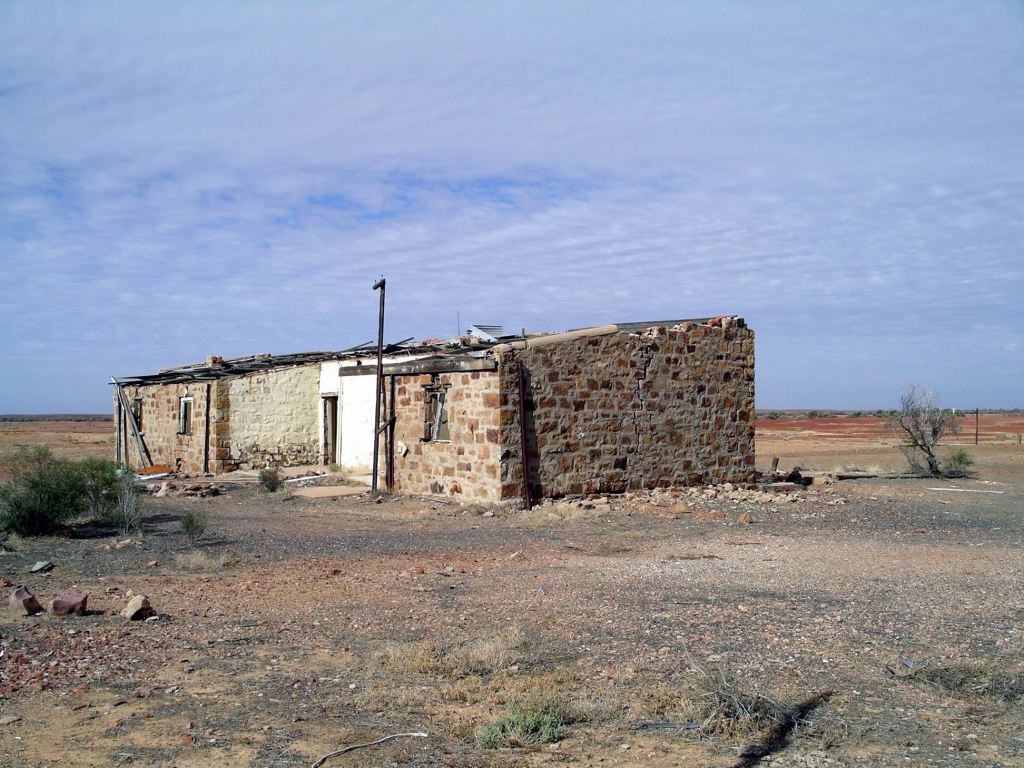
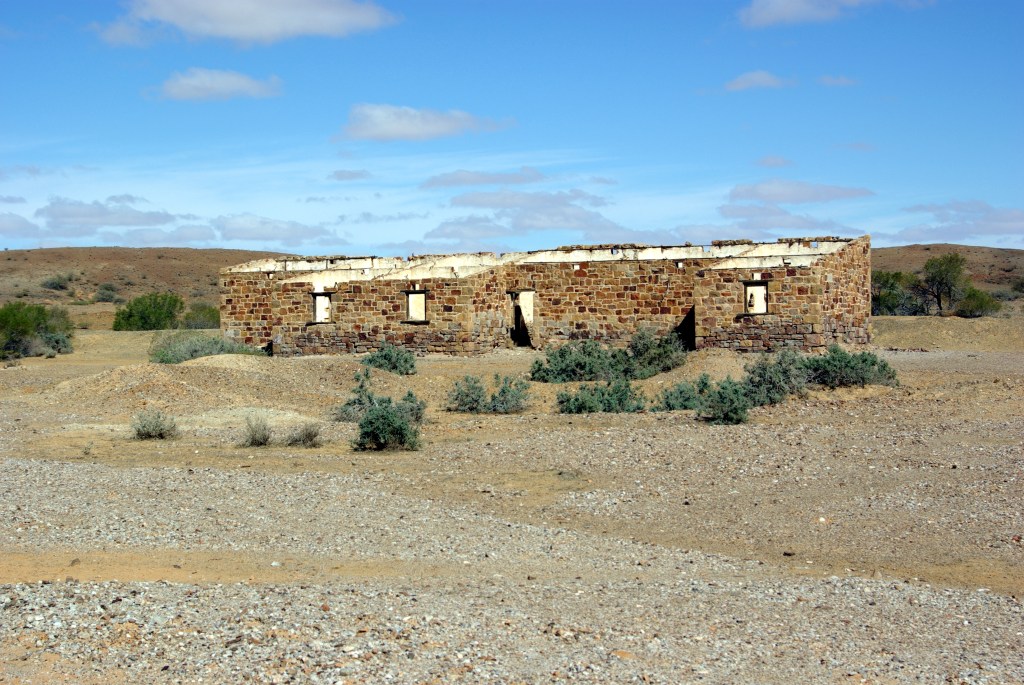
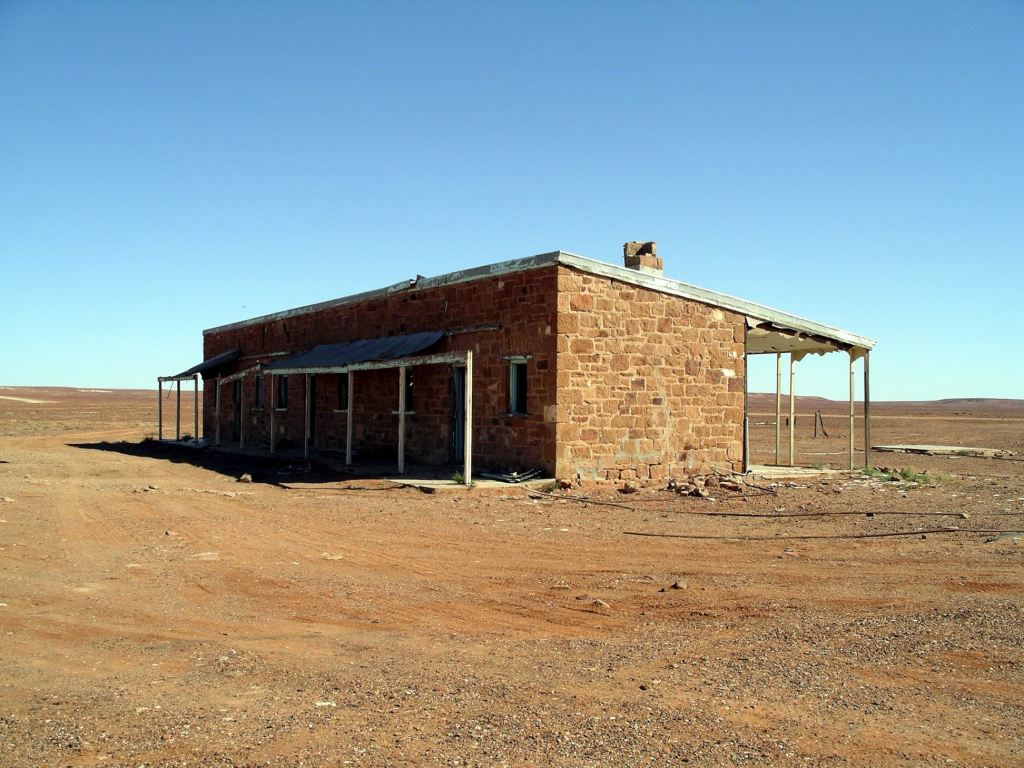
We only had about 60kms to go, to Oodnadatta. Along the way, stopped to have a look at the Mt Dutton Siding ruins.
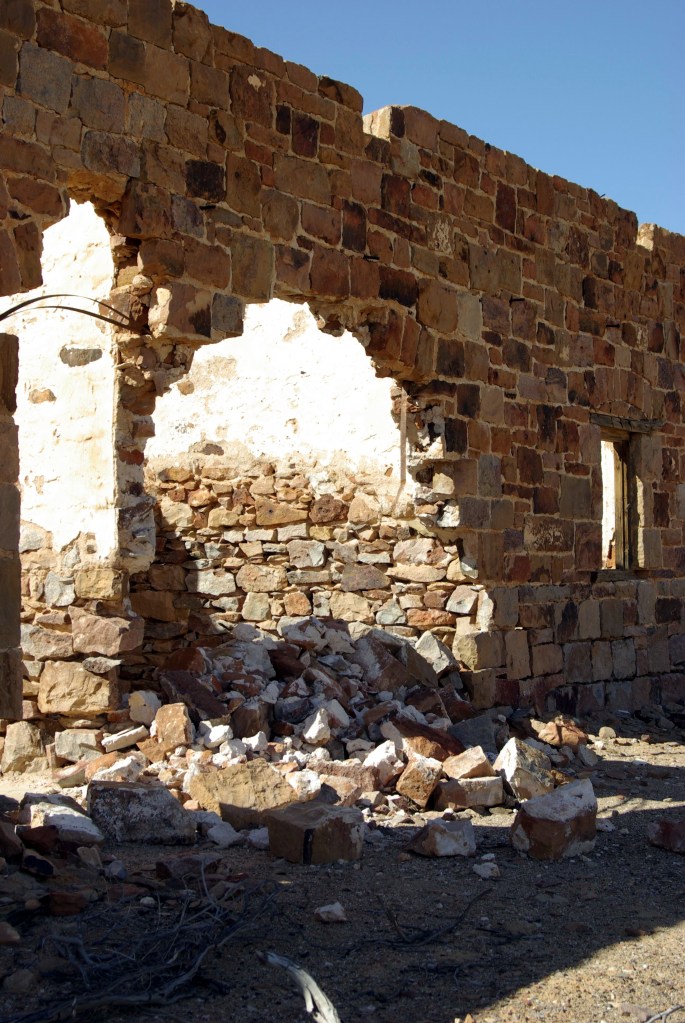
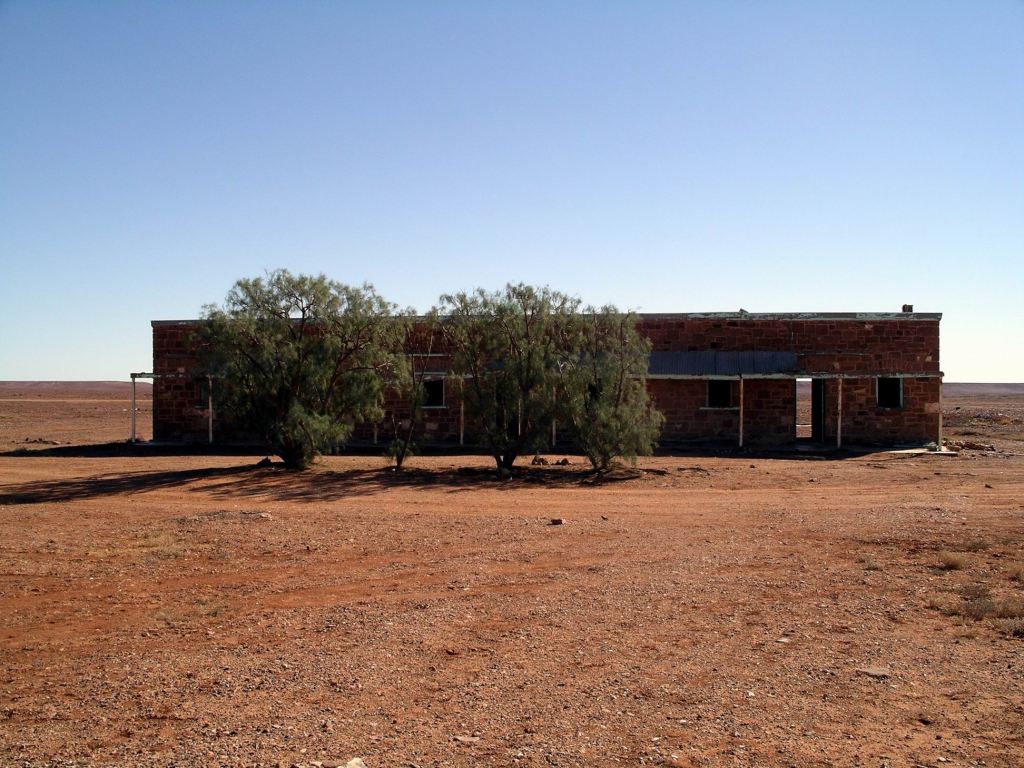
This siding was in a really open, exposed positionPartly demolished, like so many of the old siding buildings along the Track
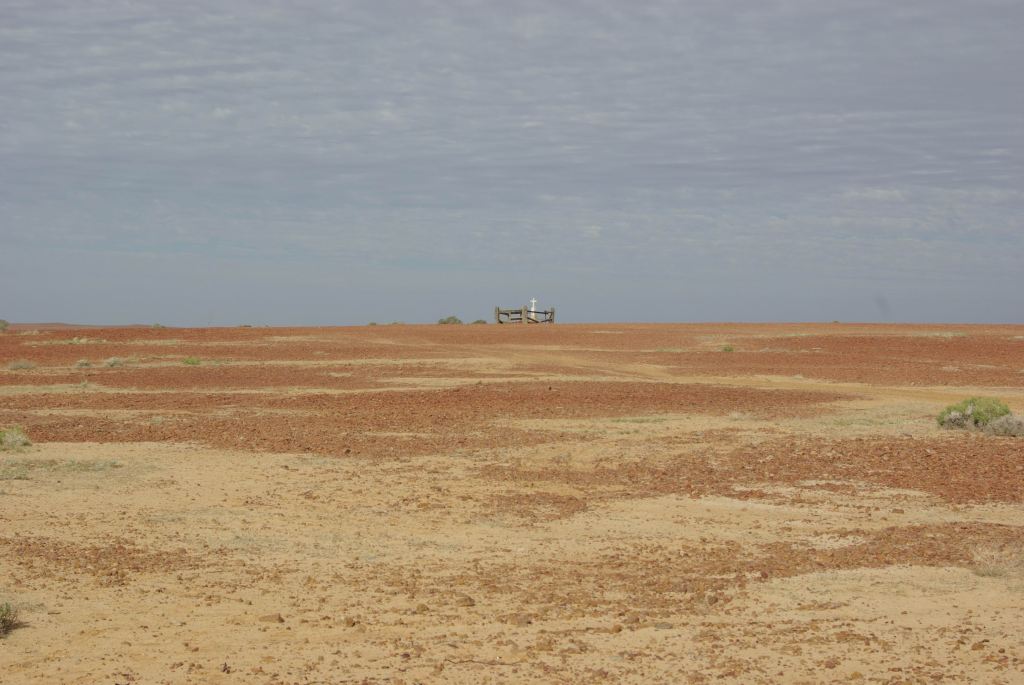
There was one lonely grave here – evocative of the loneliness and isolation of the place.
The desolate graveThe Mt Dutton bore that sustained the railway – and siding – here
And so on into Oodnadatta, like Marree, once a significant settlement on the Ghan Railway line. Now it had shrunk to having about 200 people living there, half of them indigenous.
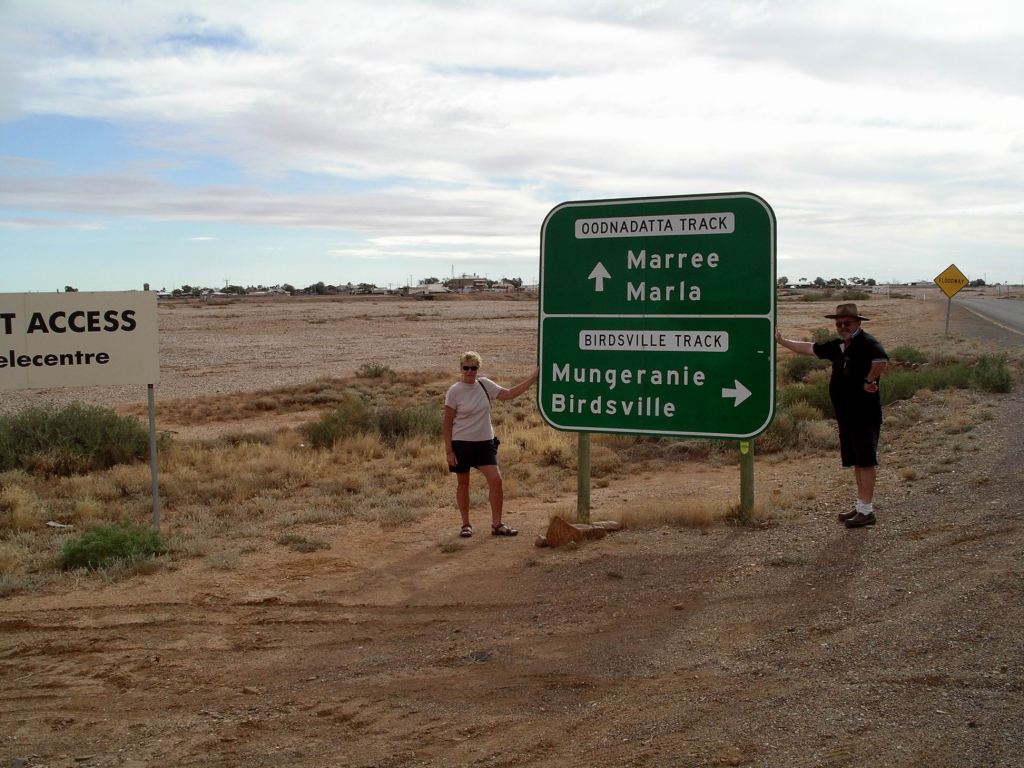
A lot of travellers – like us – end their time on the Oodnadatta Track at the township. and from there head west to the Stuart Highway on unsealed roads either to Marla or Cadney Park or SW to Coober Pedy. The Old Ghan Track north of Oodnadatta becomes rougher and more of a challenge to vehicles, heading up to Finke and thence on to Alice Springs. We had driven part of that section back in 1999, as part of our trip across the Simpson Desert.
We refuelled at the iconic Pink Roadhouse at Oodnadatta – $1.67cpl.
The establishment of this Roadhouse arose from an interesting history, which originally involved Adam and Lynnie Plate walking down the Ghan Railway track, with camels, in the 70’s. The building and the vintage car in front of it, were painted pink to attract custom, and to stand out in people’s minds. Adam Plate was instrumental in the Oodnadatta Track being so named and becoming a must-do on the list for adventurous travellers. They have done travellers to these parts a great service by placing their distinctive pale pink direction signs all over remote northern SA. We’d found these of great help when we drove across the Simpson Desert’s Rig Road, in 1999.
We browsed the tourist offerings in the Roadhouse. John bought Pink Roadhouse Tshirts for his two grandsons, and a soft, life-sized toy galah for the younger one’s birthday, had them packaged up and mailed from there. I wondered how many mail items had ever been received in Brussels, from Oodnadatta? I bought a stubby holder. M bought a soft toy blue heeler dog – destined to keep her company in “Bessie”, her Troopy.
Despite what we had heard on the road reports, the Road Conditions sign at Oodnadatta said that the Cadney Park road was closed! Bugger!
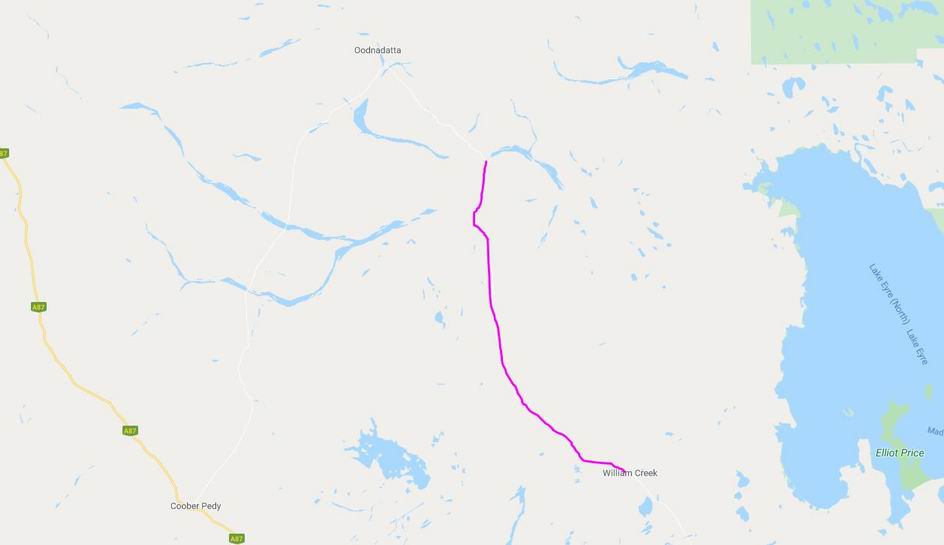
Then, at the Roadhouse – the source of all accurate information for these parts – we were told that was wrong. The road really was open, but the policeman with the key to change the sign had gone to William Creek for the Cattle Drive start.
So, feeling reassured – and legal – we ventured forth.
Along the road to Arkaringa
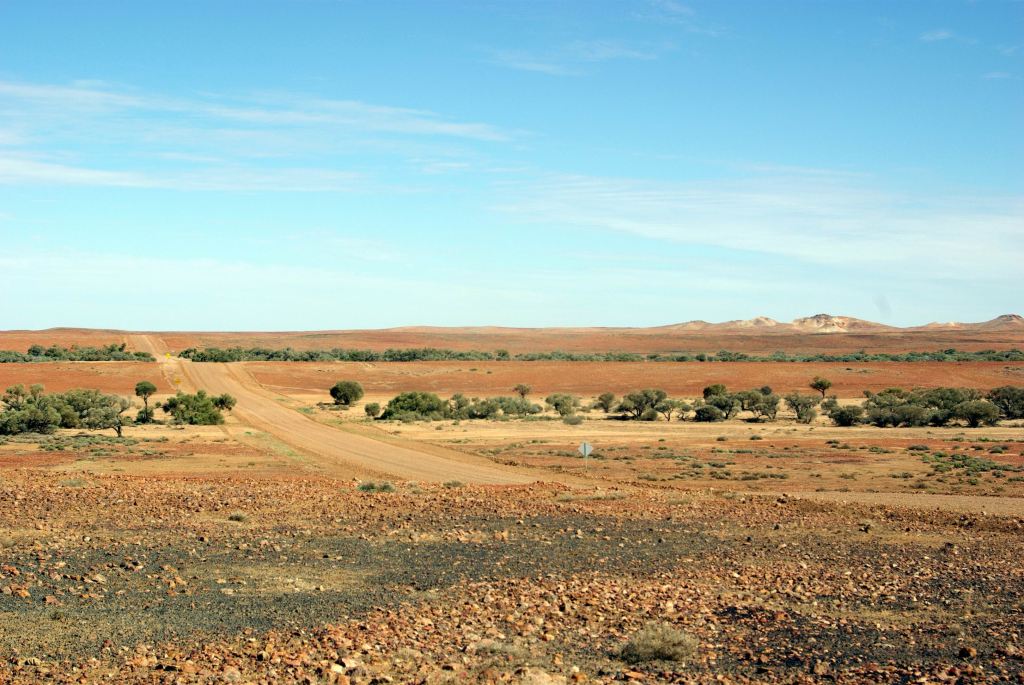
Backtracked for 5kms, then went SW on the Coober Pedy road. It was a good gravel surface. There were a lot of little floodways and creek crossings, some of which showed signs of having been wet, but were dry now.
Regular dry little floodways….
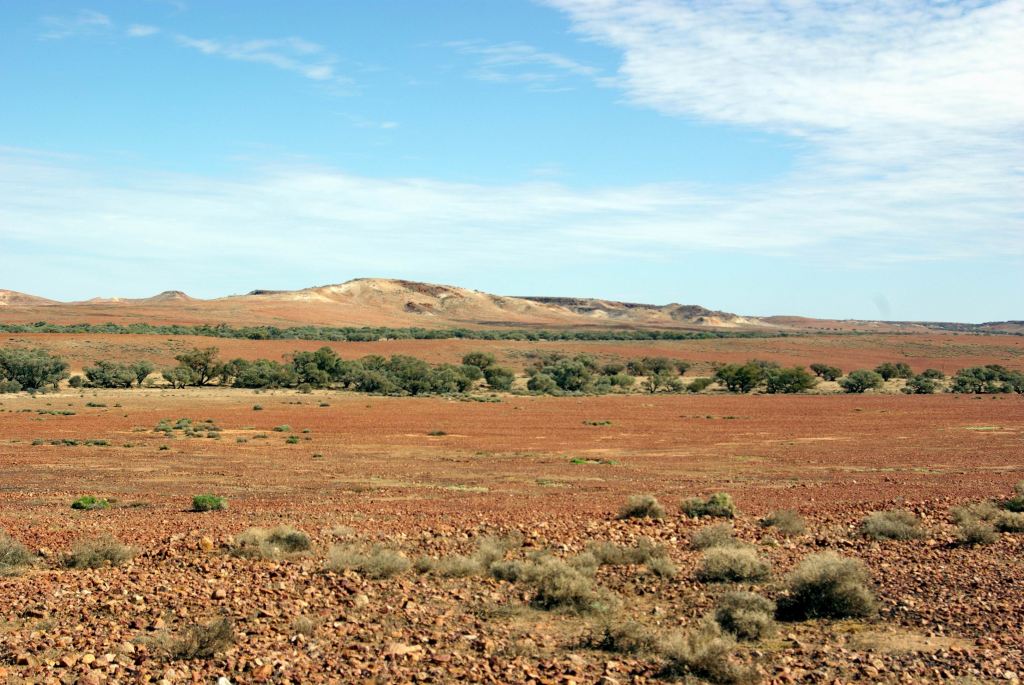
The country had subtly changed and was less desolate.
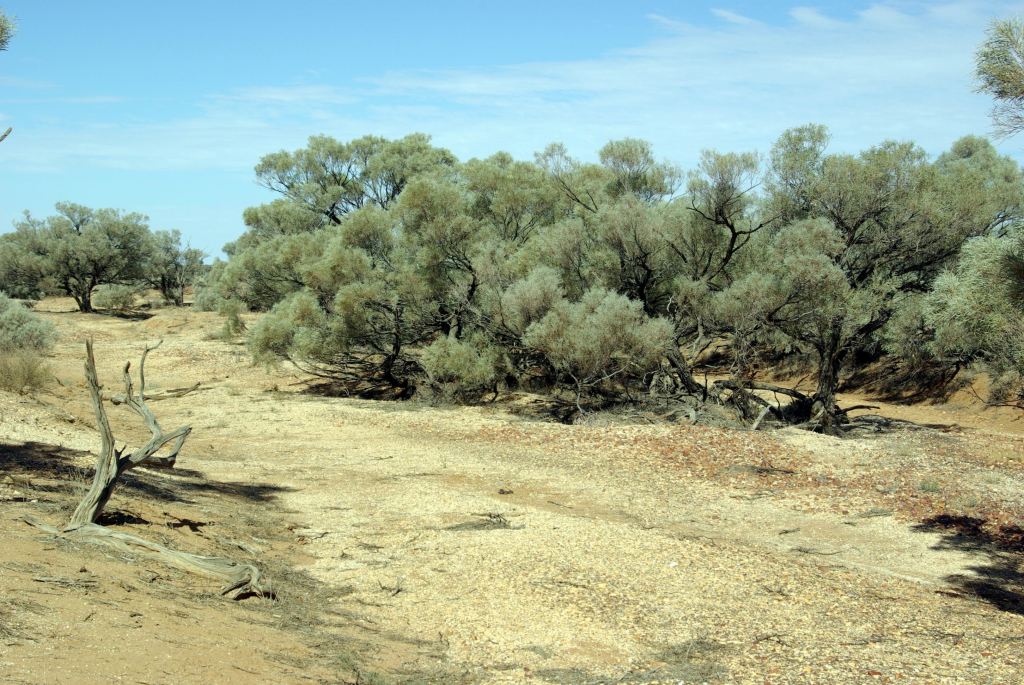
We stopped by a dry creek bed that was attractively vegetated, to eat lunch.
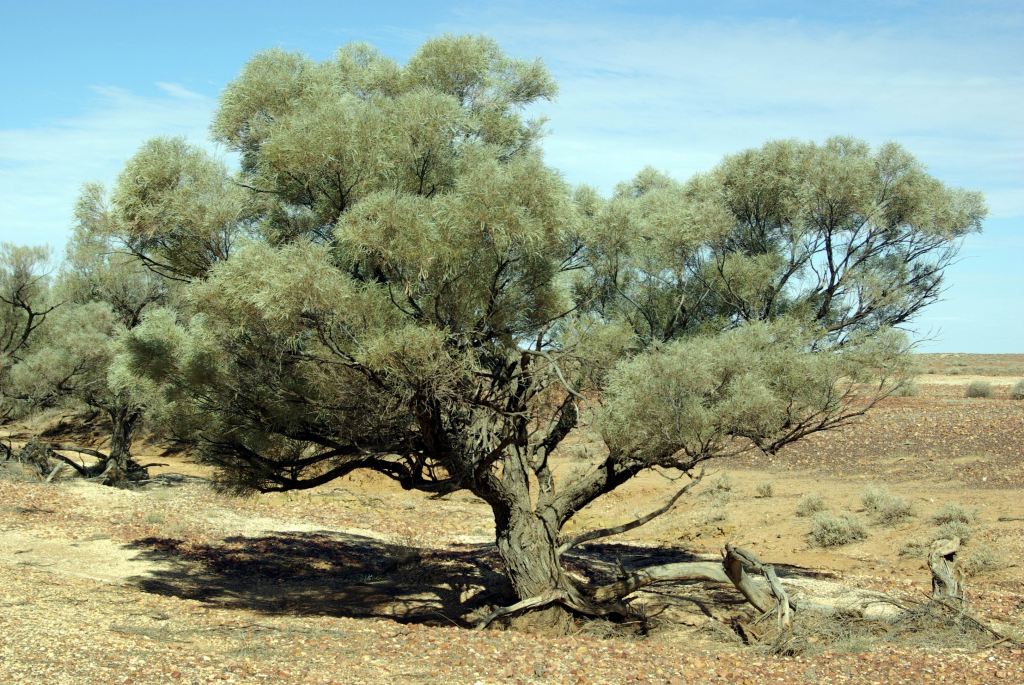
It was actually a really interesting and attractive spot for a lunch stopA live tree this time!
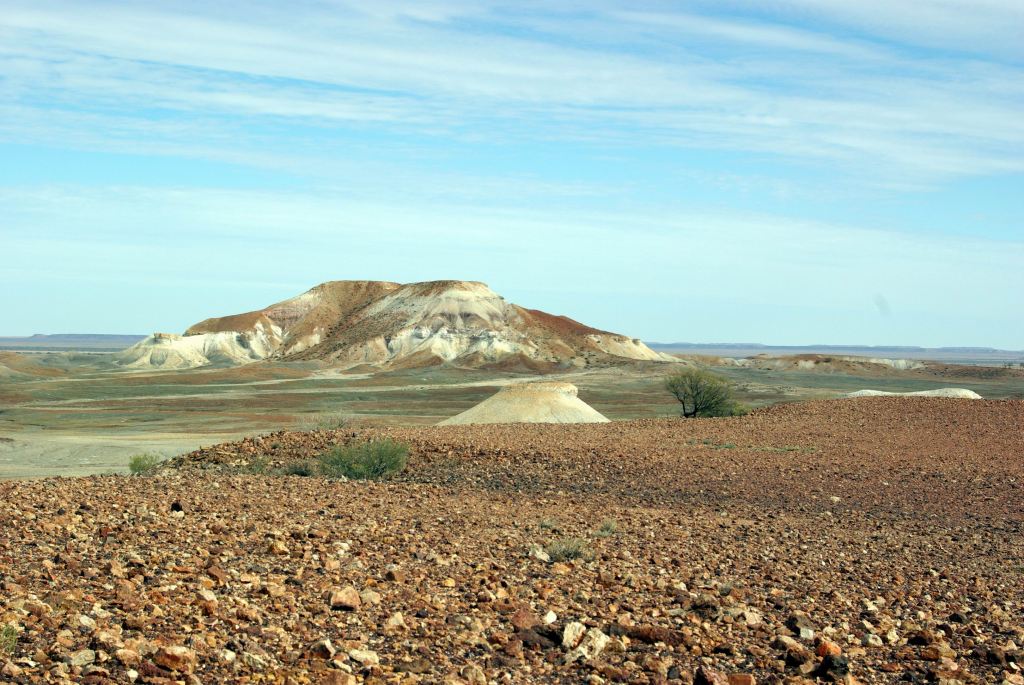
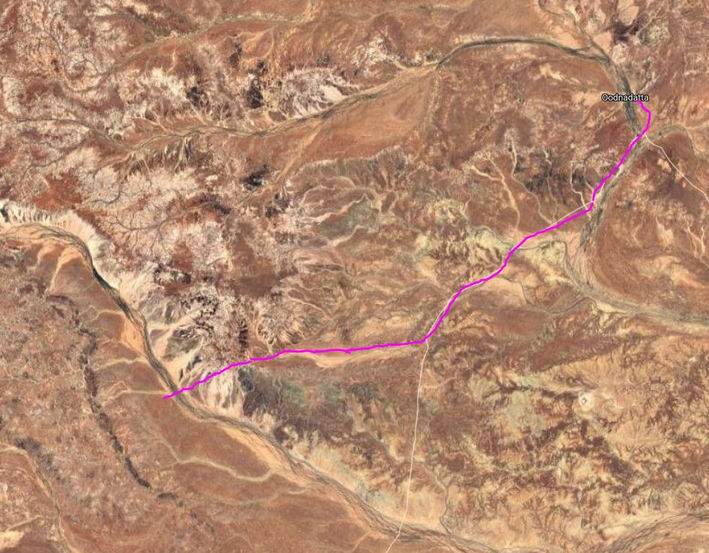
Fifty kms from Oodnadatta, we turned west onto the Cadney Park road. There were starting to be some dramatic, jump-up type hills in the distance. It became obvious that we were heading for these – the Painted Desert.
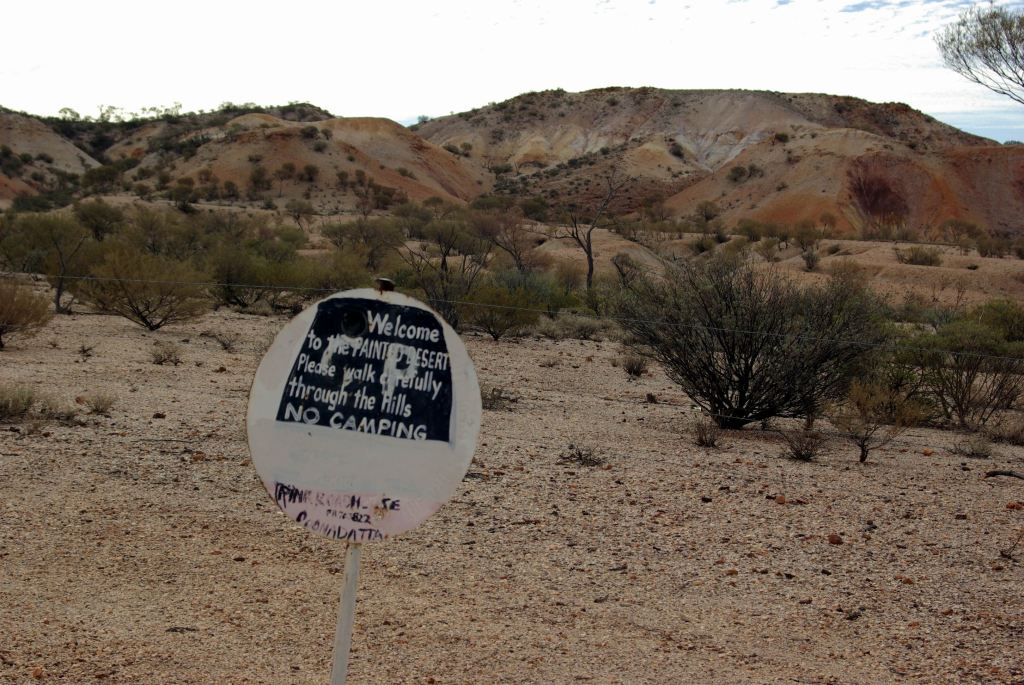
Took a short side track to a parking area for the Painted Desert.
The area was covered by gibber stones.
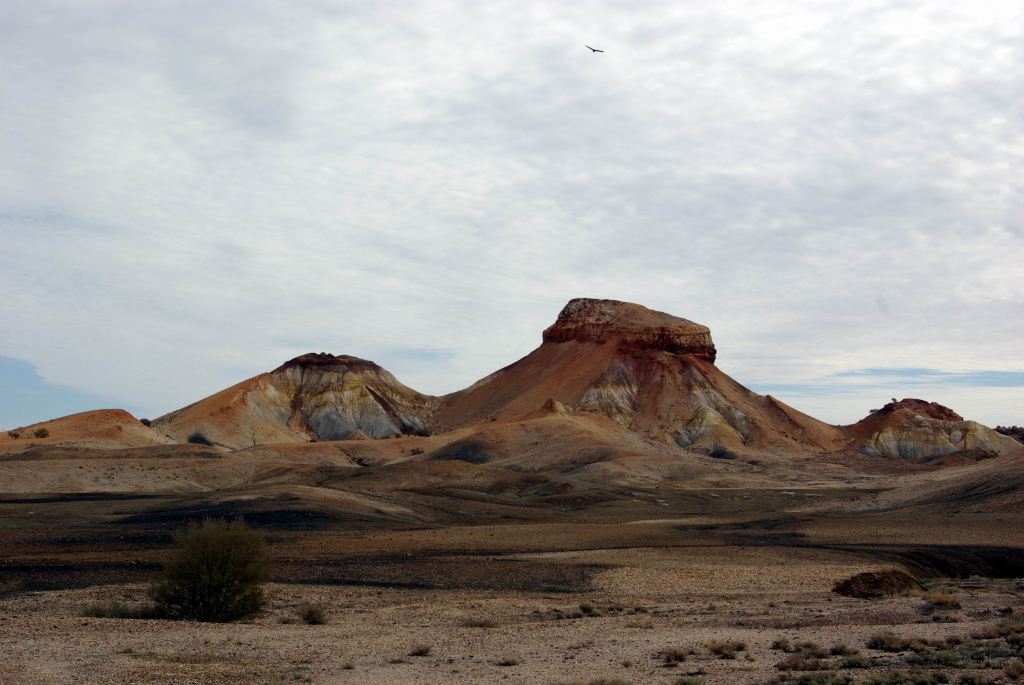
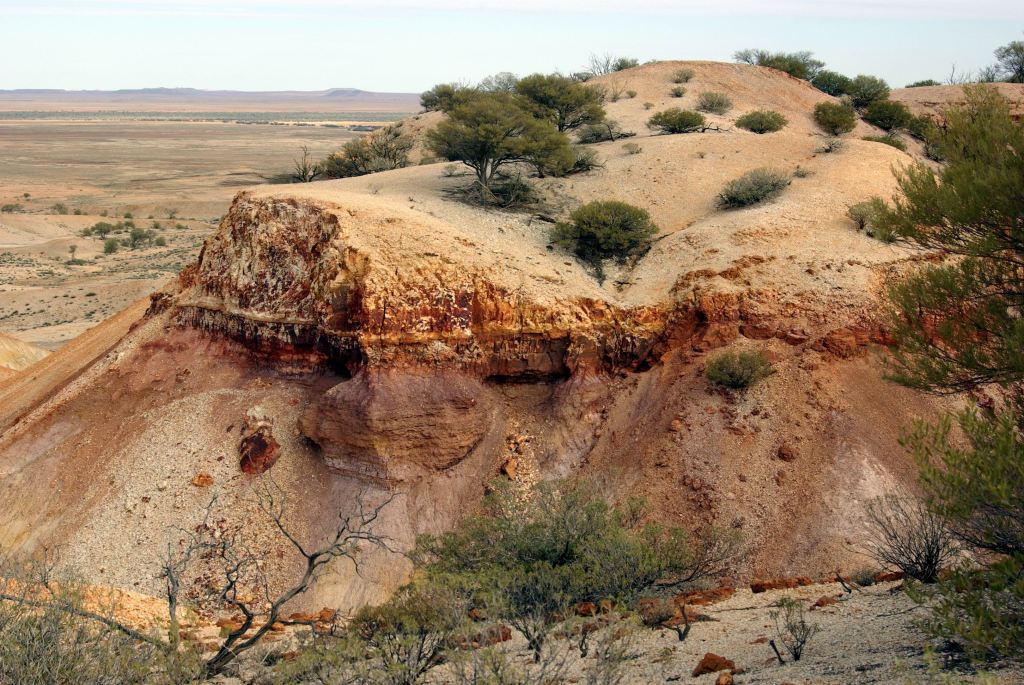
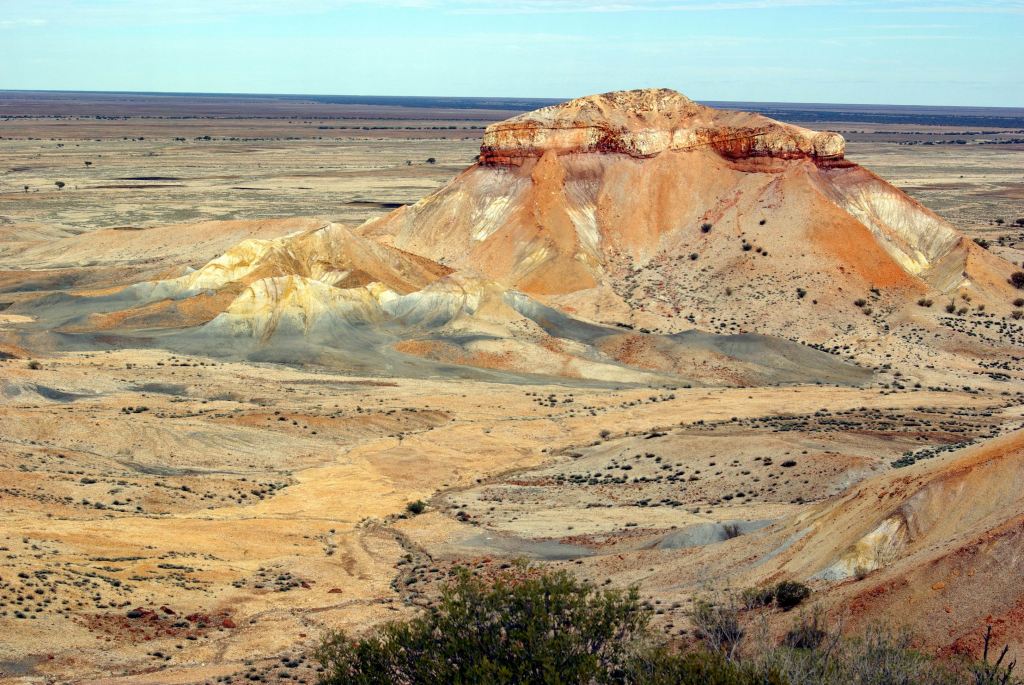
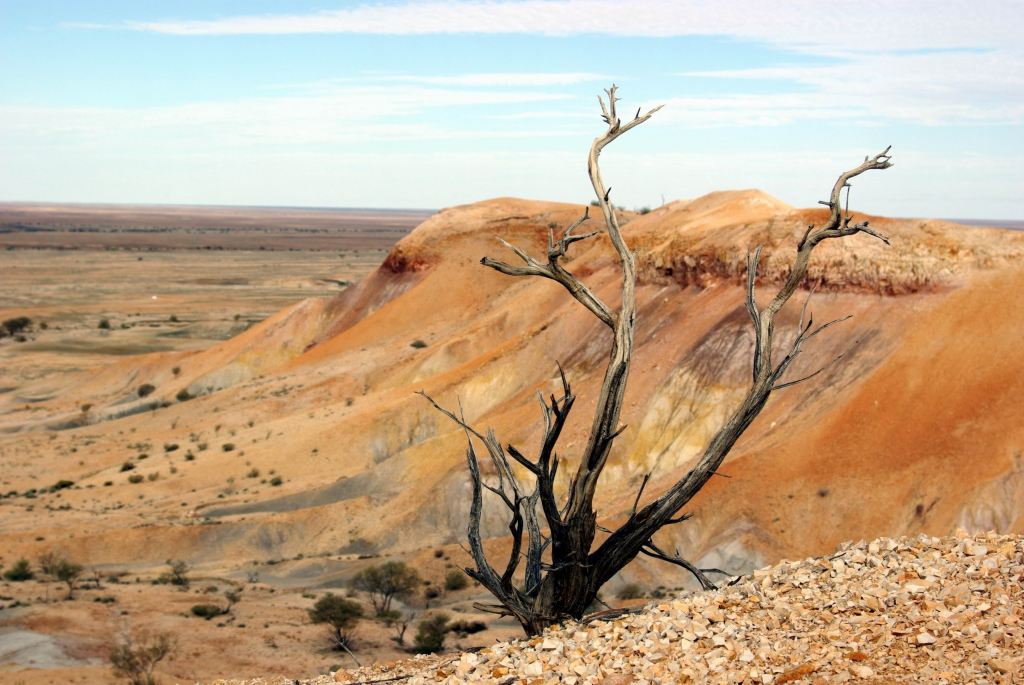
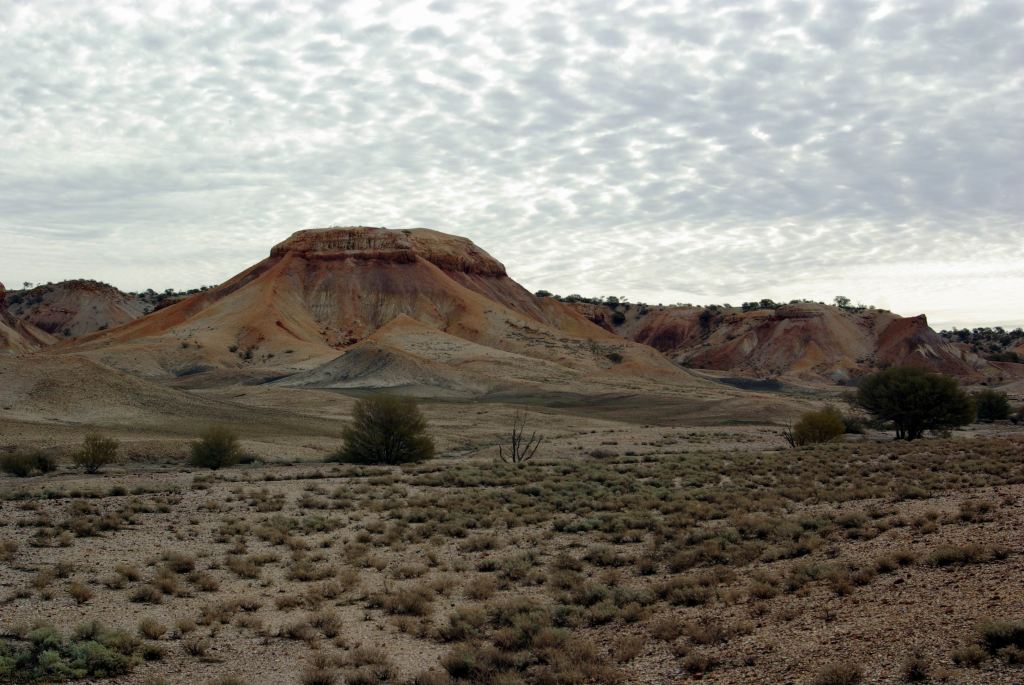
The Painted Desert was once part of an ancient seabed. Uplift and differing erosion rates on hard and soft strata, plus staining from minerals in some of the rocks, have created this rather unique, surreal, and very picturesque little area.
One of the widespread and typical Pink Roadhouse signs
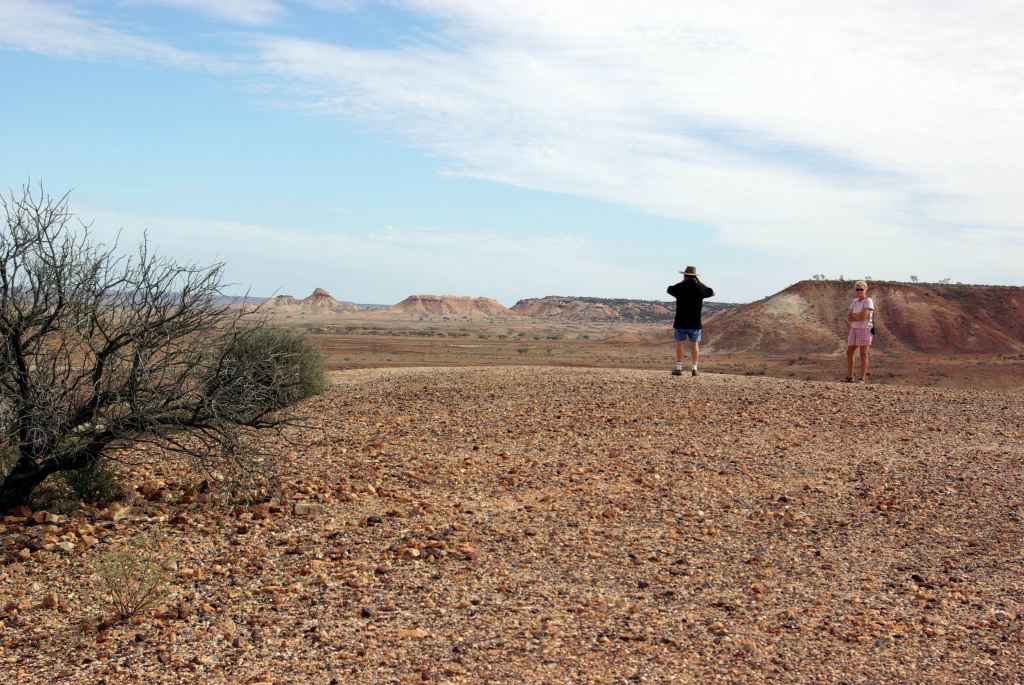
We set out to walk the 2km circuit track that wound around through the hills and gullies.
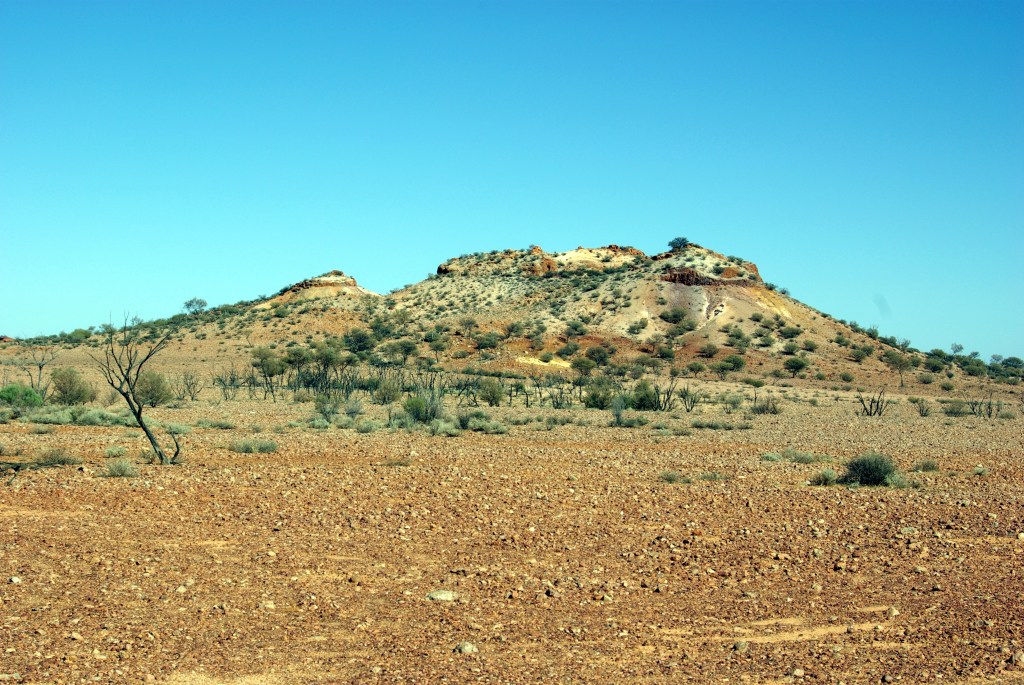
The varied colours of the mesa formations were strongly contrasting, from deep red-browns, through to white.
I wondered if the indigenous peoples of the area had any particular stories or legends about it?
Some of the exposed underlying rock material looked really soft and fragile. It was clearly easily eroded.
This really was a very different place to any we have visited before, although maybe there was a little similarity to some of the country around Winton, in Qld. It would have to go on my list of my Top Ten Places in Australia. It was so superbly dramatic.
More mesa formations in the distance
I loved the stark dead mulga standing against the bare terrain. Yes, I know…. more dead mulga!
The little walk took us the best part of two hours, because we stopped so often to admire the outlook round the next corner, and the next……and take heaps of photos.
Eventually, we dragged ourselves away to continue on to where we intended to camp for the night, at Arkaringa Station.
It would have been fascinating to spend the night here, and see the sunset and sunrise on the hills, but there was no camping allowed. This is station property, so one should obey their edicts.
The Arkaringa Homestead was only about 12kms away. We had some ideas of returning to the Painted Desert formations for sunset, or sunrise, or both, to take photos. But these ideas were quickly abandoned after we had churned through the quagmire that was the multiple channels of the Arkaringa Creek.
We could see why this road had been closed, until so recently! Actually, we were rather surprised that it was open! The fact that the creek base seemed fairly firm was perhaps the saving factor. But it had clearly been flowing recently.
I was sometimes surprised at what Truck will tow the van through. In this instance, John had put Truck into low range before tackling the wide expanse of the creek ford – and hoping! Perhaps if we hadn’t known that the homestead was quite close – and therefore, presumably help if we got stuck – we might not have braved what looked quite nasty.
So, not wanting to cut up this part of the road any more, we decided to forego returning to the Painted Desert formations.
We paid $15 to stay in the Homestead camp area and were able to plug into power. This was a rather basic place, but the showers and toilets were adequate. Good use of corrugated iron on the building of these…..
Arkaringa Station was owned by the same pastoral company – the Williams’ – that owned Nilpinna, of the sign we’d photoed over on the Ghan Track. Seems they owned a lot of this part of the country!
It was great that we were able to recharge my camera battery, and also John’s laptop, which he had run down playing computer games last night!
Arkaringa camp
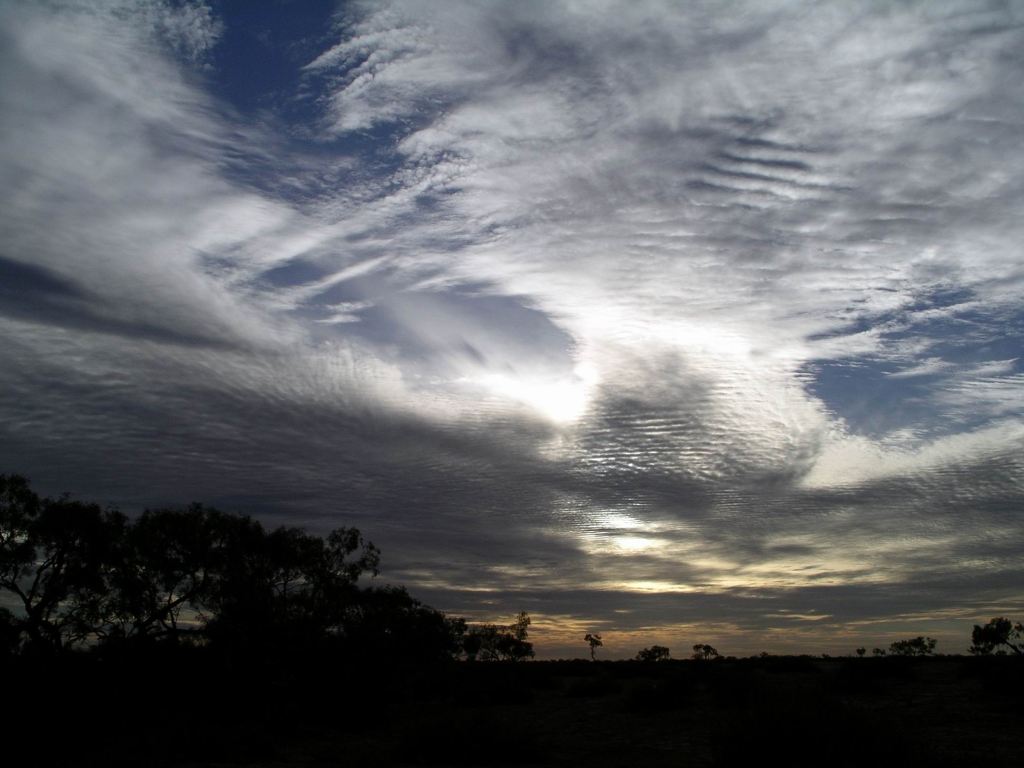
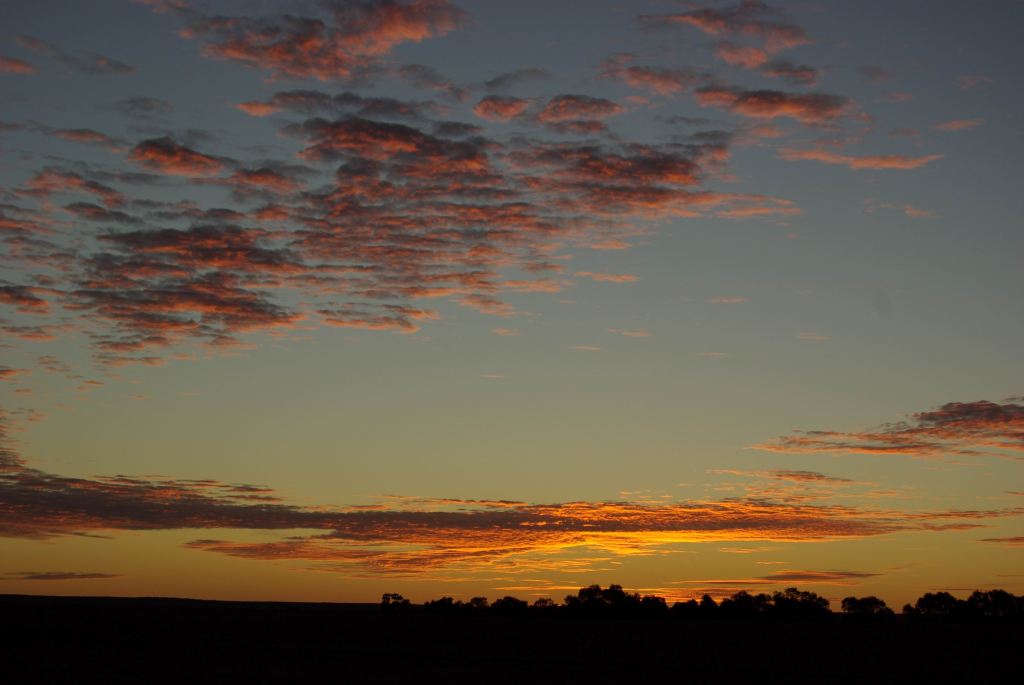
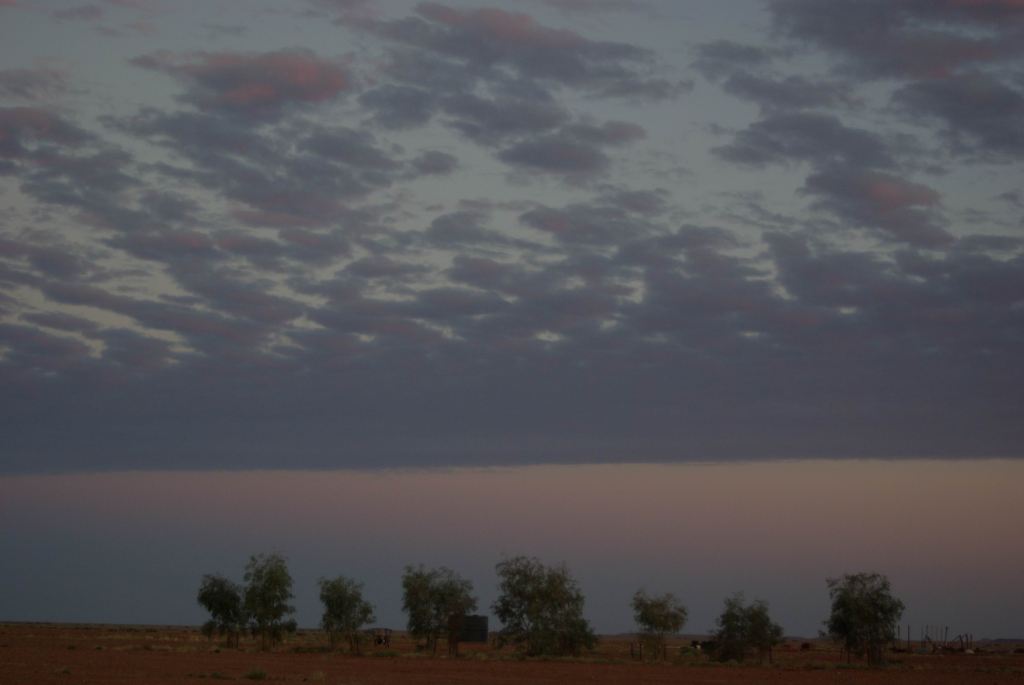
The sunset here was rather interesting, anyway. Vast skies, enough cloud about to make it really interesting.
No campfire tonight.
There was a drilling crew staying in the accommodation section – cabins – who were a bit noisy into the night. Seemed there was a big coal exploration project happening just to the south of here. I hoped that any mining venture in the future did not impinge on this very special environment around here.
MONDAY 21 MAY WILLIAM CREEK TO ALGEBUCKINA BRIDGE 136kms
Although we did not race to get going in the morning, we did get away before the Trakmaster party – for which we were grateful. Did not really want to be playing tag with them along the Track. Some of their members were doing morning plane flights, so the group waited for them.
Refuelled Truck – $1.56cpl.
In much the same way as the previous days, we continued on up the Track.
Stopped several times, to look at ruins, scenery and bridges.
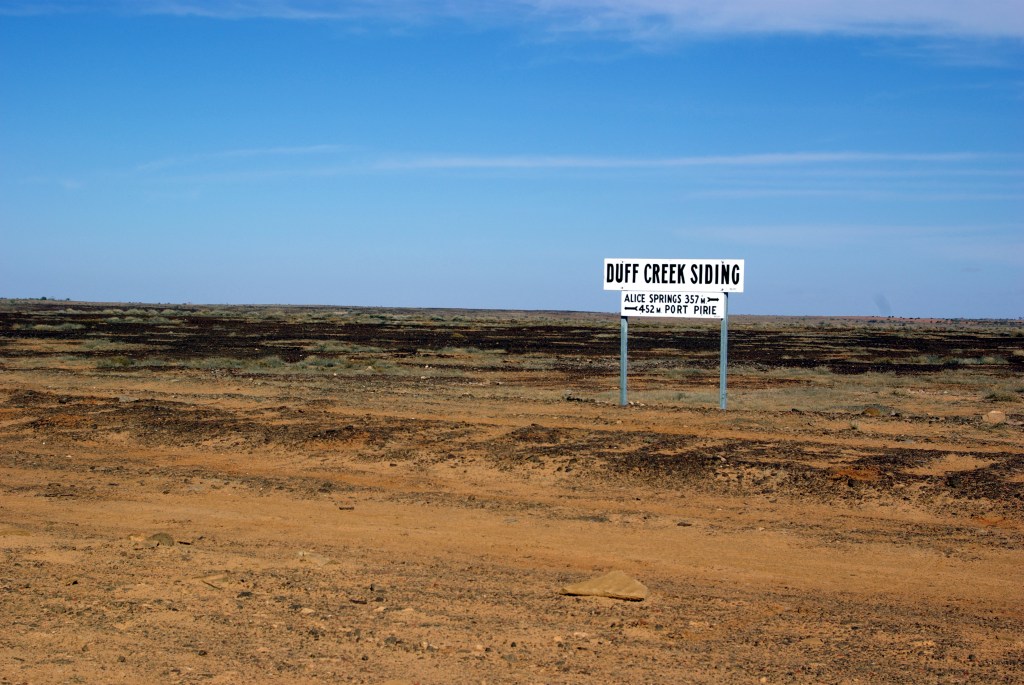
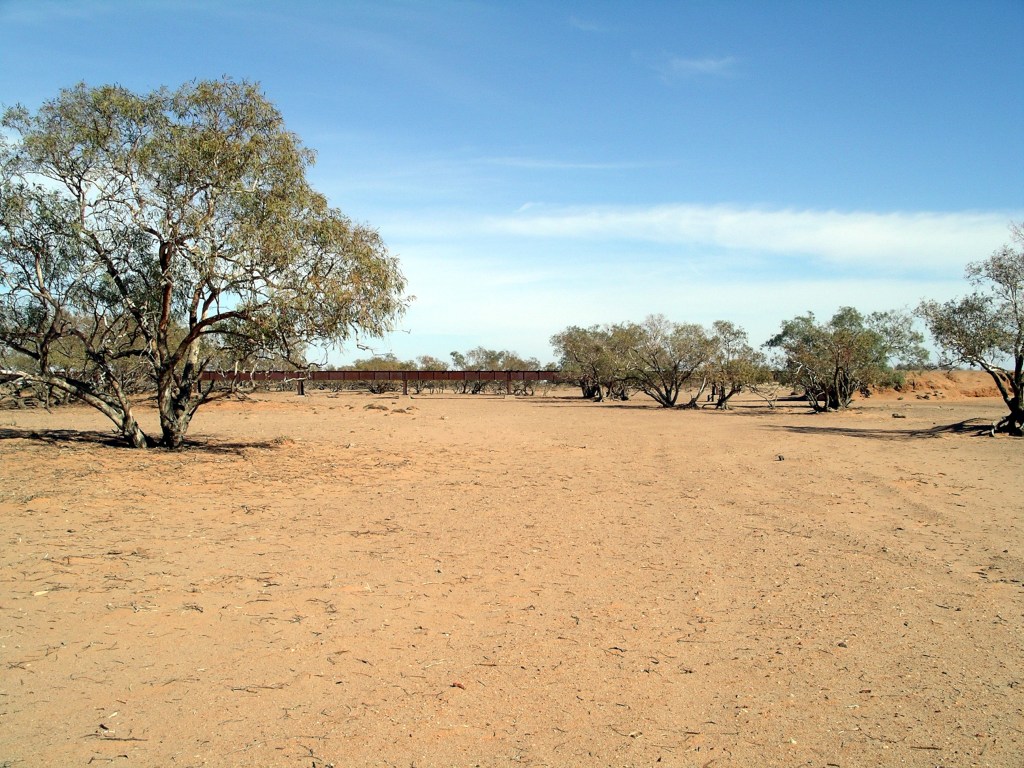
Love the name…….Long rail bridge over the dry Duff Creek
For much of today’s way, there were very low ranges in the eastern distance – the Denison and Davenport Ranges.
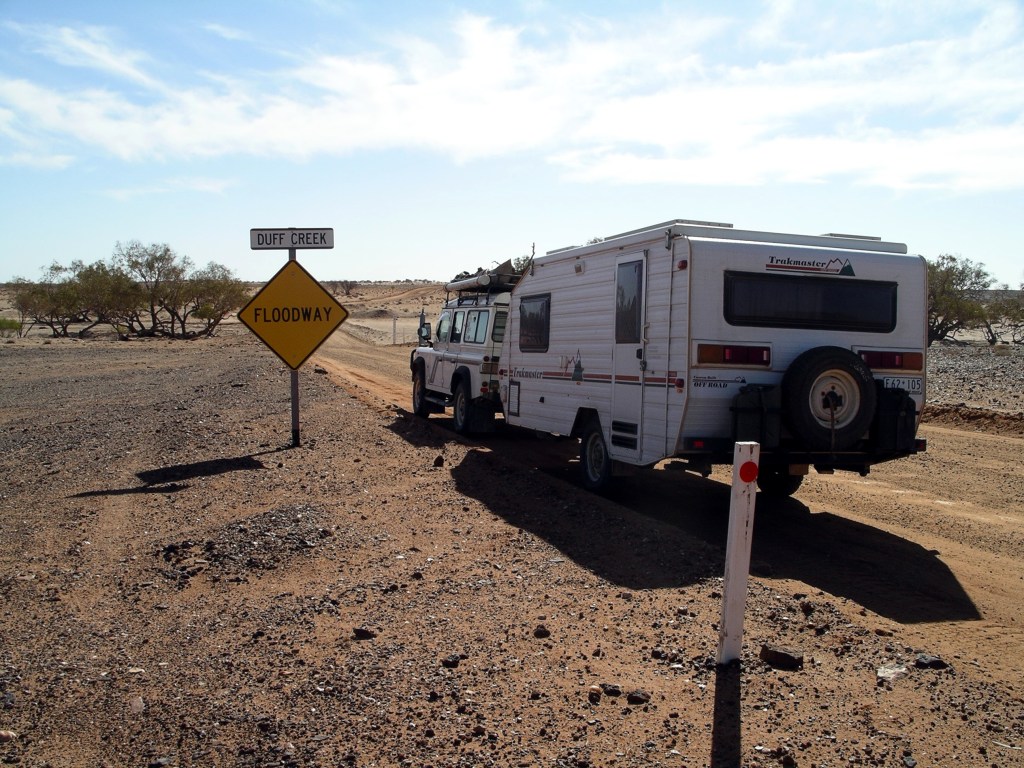
The Duff Creek floodway across the Oodnadatta Track
Not far past the Duff Creek floodway, there was an entrance track and sign for Nilpinna – a Williams Cattle Company property of some 5000 square kms. This group was one of the large players on the Australian pastoral scene.
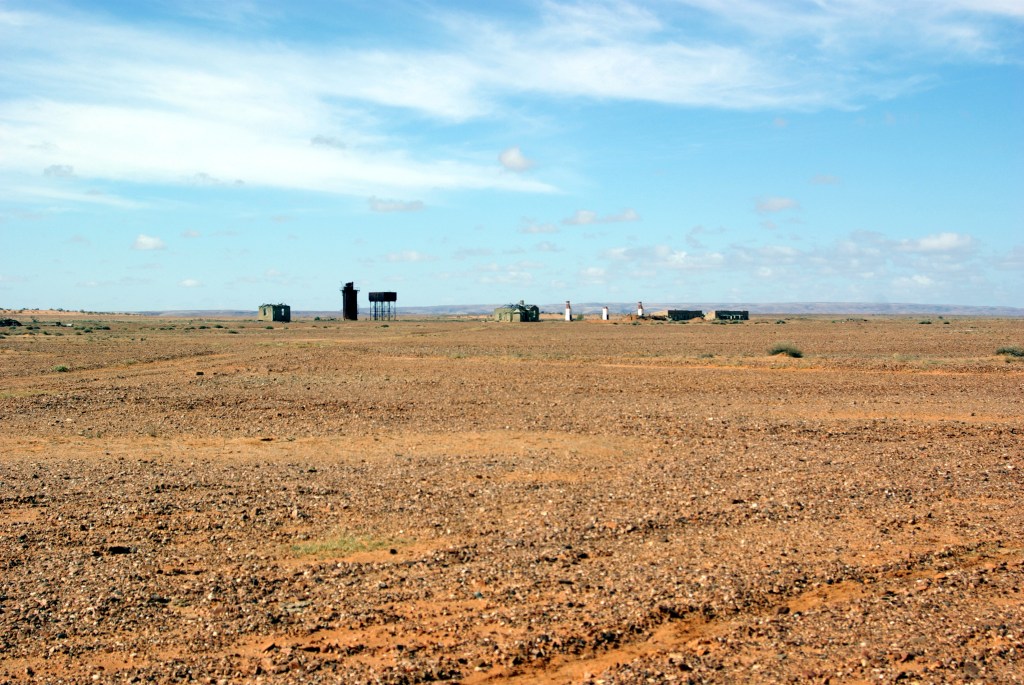
Hard to believe that this was any sort of grazing country…..What’s left at Edwards Creek siding
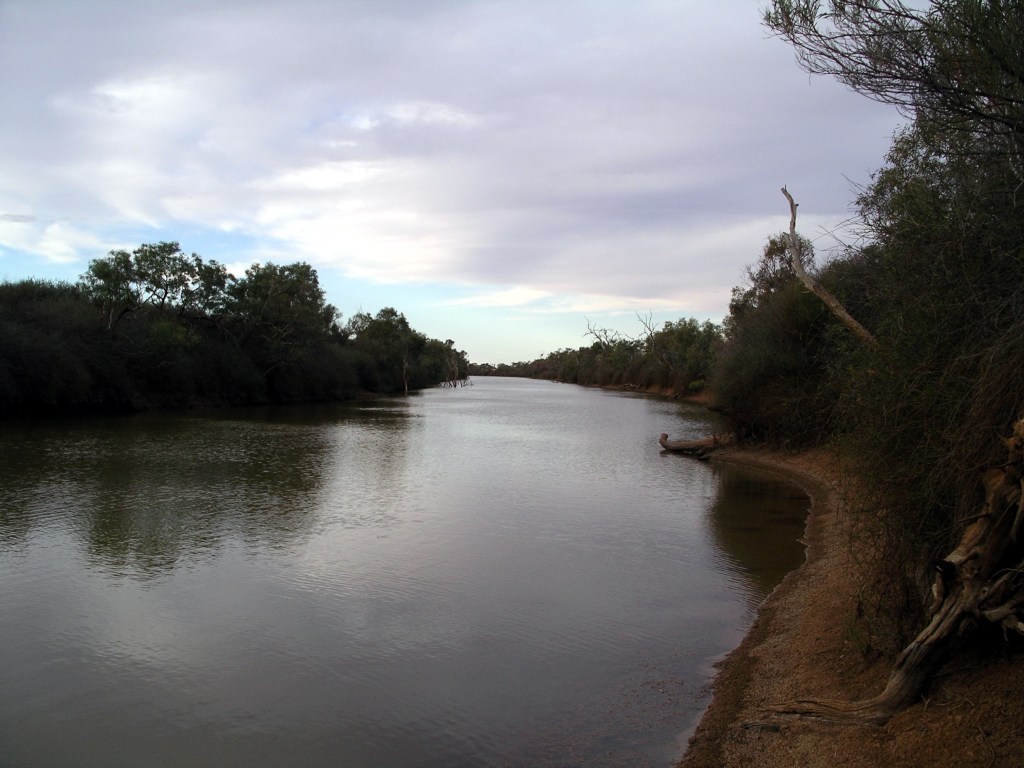
Early afternoon, we came to the Algebuckina Siding ruins and nearby Algebuckina Waterhole, on the Neales River. This really was a river, with substantial lengths of waterholes.
Algebuckina Siding ruinsSome interesting craftmanship in the old stone buildings
Really liked the look of the bush camping area to the east of the Track. I’d hoped to find it so, rather than go on to stay at Oodnadatta.
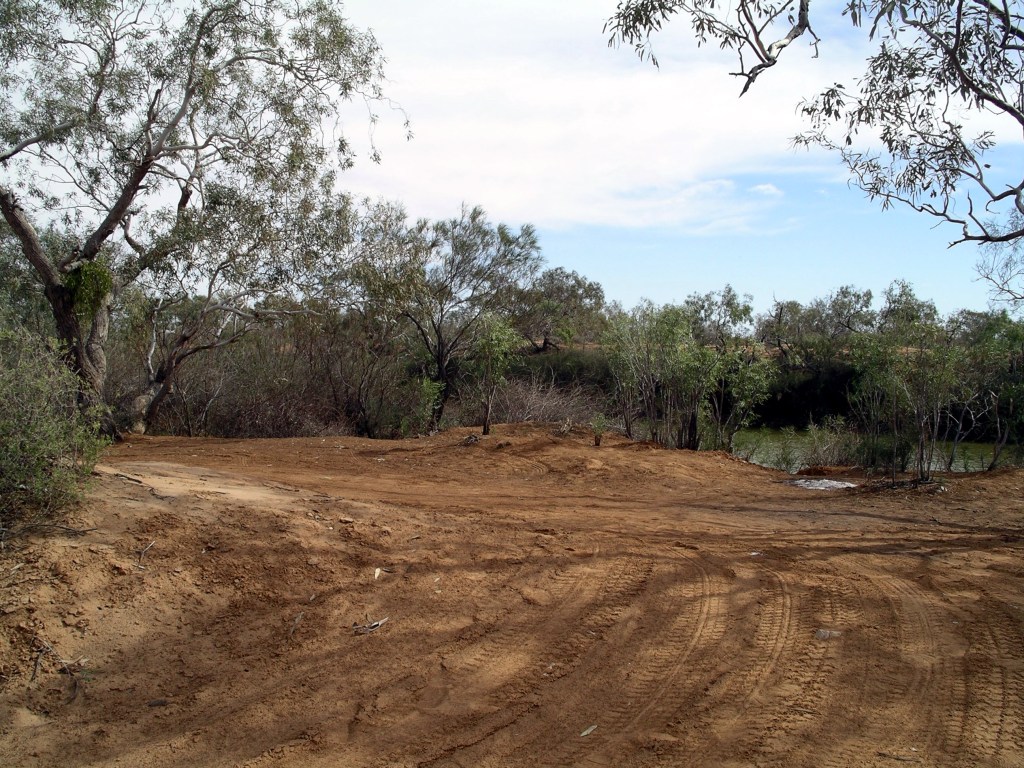
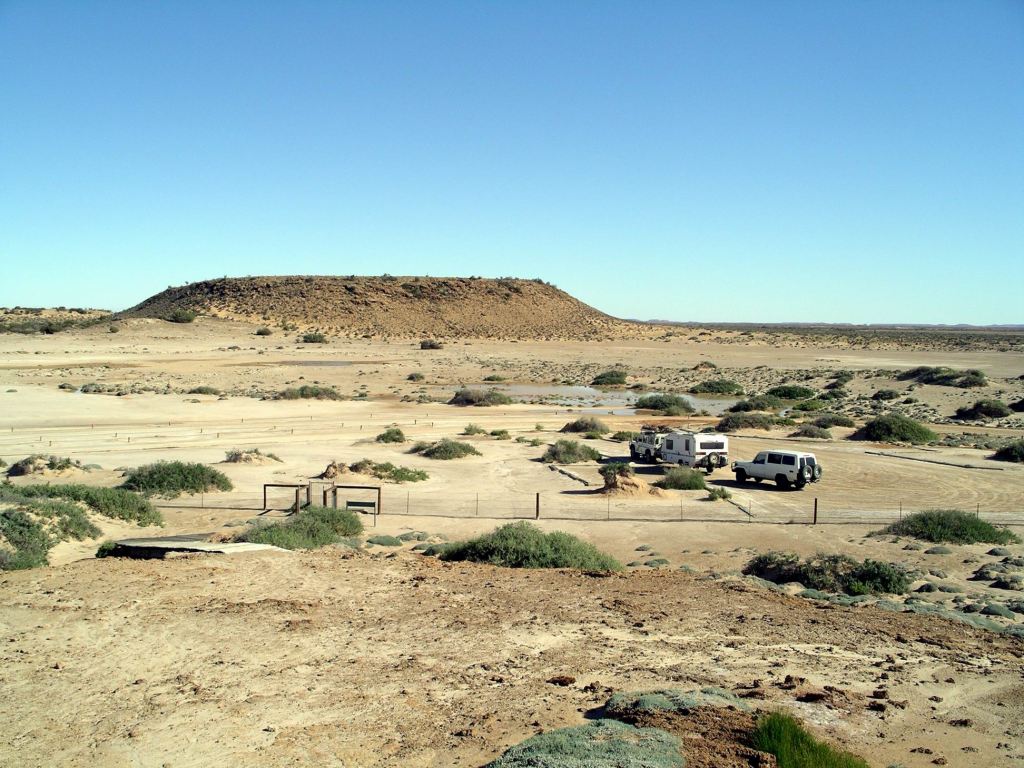
There was a spot, right up by a fence that marked the boundary of the camp area, up on the bank above the waterhole, that would just fit us and the Troopy. Prime local real estate it was! It was one of the few spots in the otherwise rather open camp area, that had a water view.
This is the place for a camp……
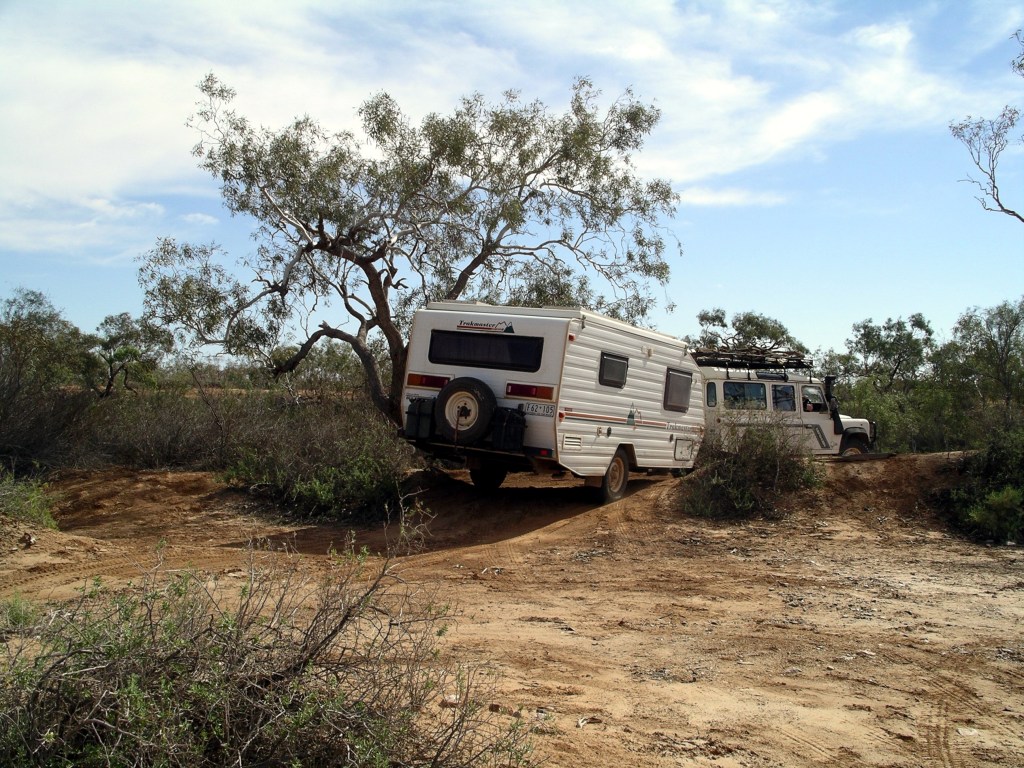
It took a little manoeuvring ( well, quite a bit) to get the van in so that it was reasonably level, and still left room for M to put the Troopy on a flat part of the clearing. Side on to the river, we had a lovely outlook over the waterhole. As well, there was rather a sense of privacy from the rest of the open camp area.
……if we can get the van in there!
There were no amenities of any kind here, so it was out with the spade and head off into the distance to dig a hole in the ground! I noted that my knees were not managing this particular camp activity too well, any more!
Set up overlooking the river. Van level-ish, doesn’t matter about Truck.
The Trakmasters arrived some time after us and set up in various places around the open camp area. Apart from them and us, there were only two other rigs there. I had expected this place would be more popular, but maybe would-be travellers had been deterred by the recent rains.
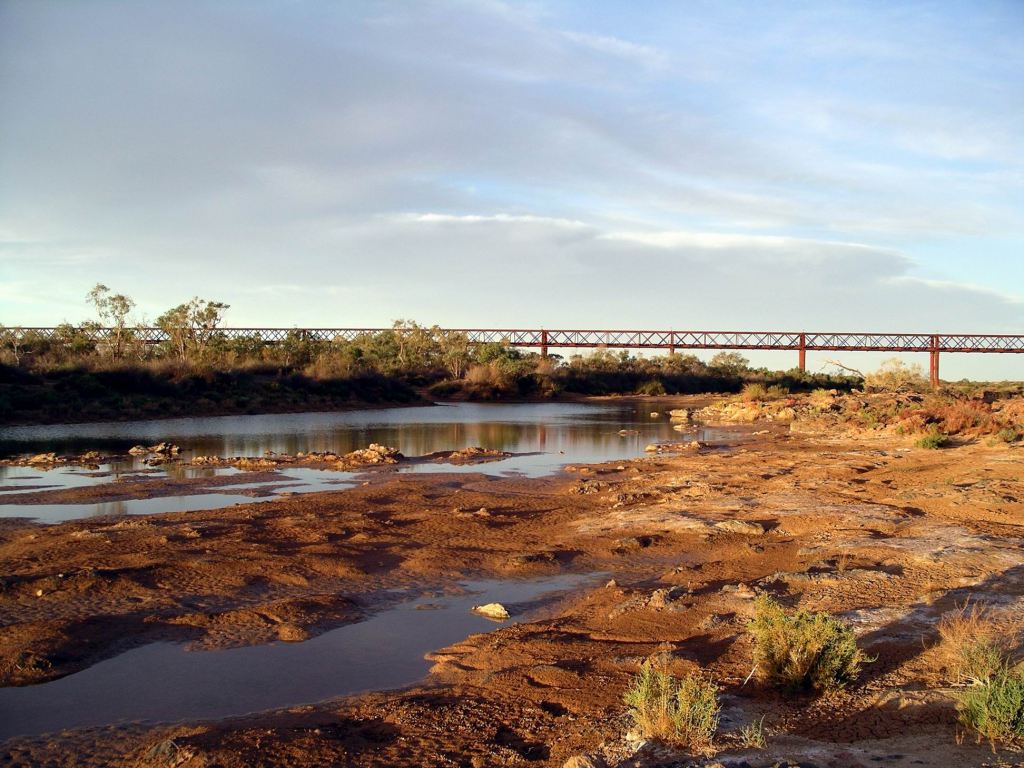
Algebuckina Waterhole
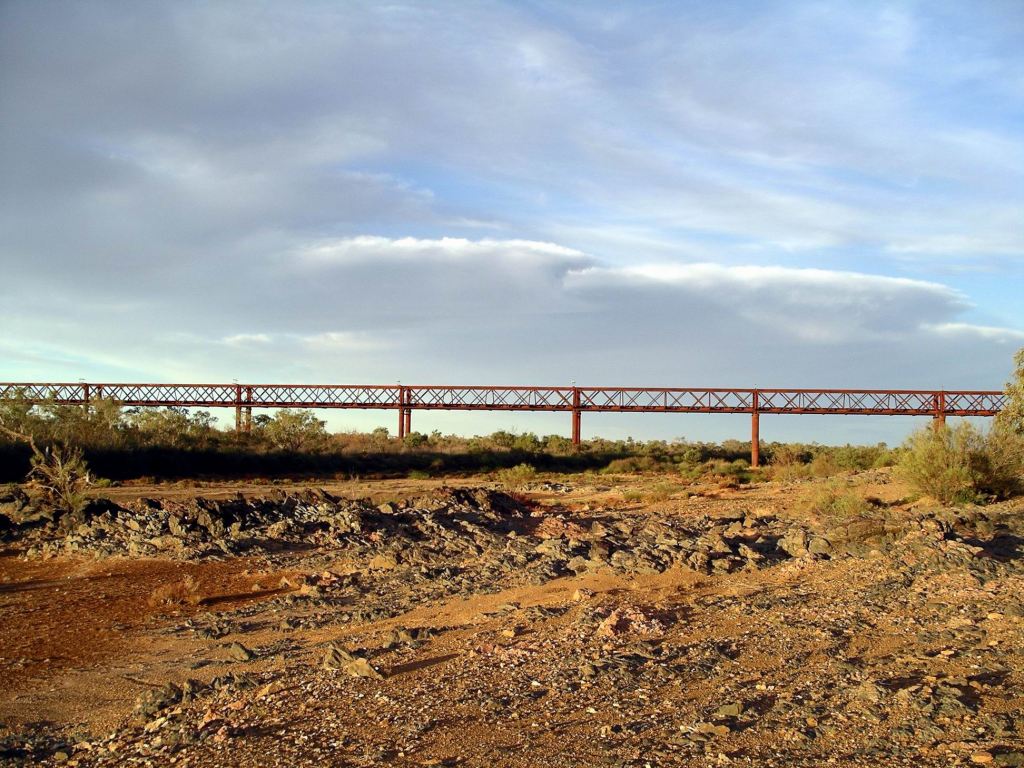
We walked along beside the river and across the Track to the superb old Algebuckina Railway Bridge. It was about a km away from our camp. The ruins of the railway siding that was here, were nearby.
I was surprised that, during the couple of hours we spent around the bridge, exploring and photographing, hardly anyone from the Trakmaster group came along to look.
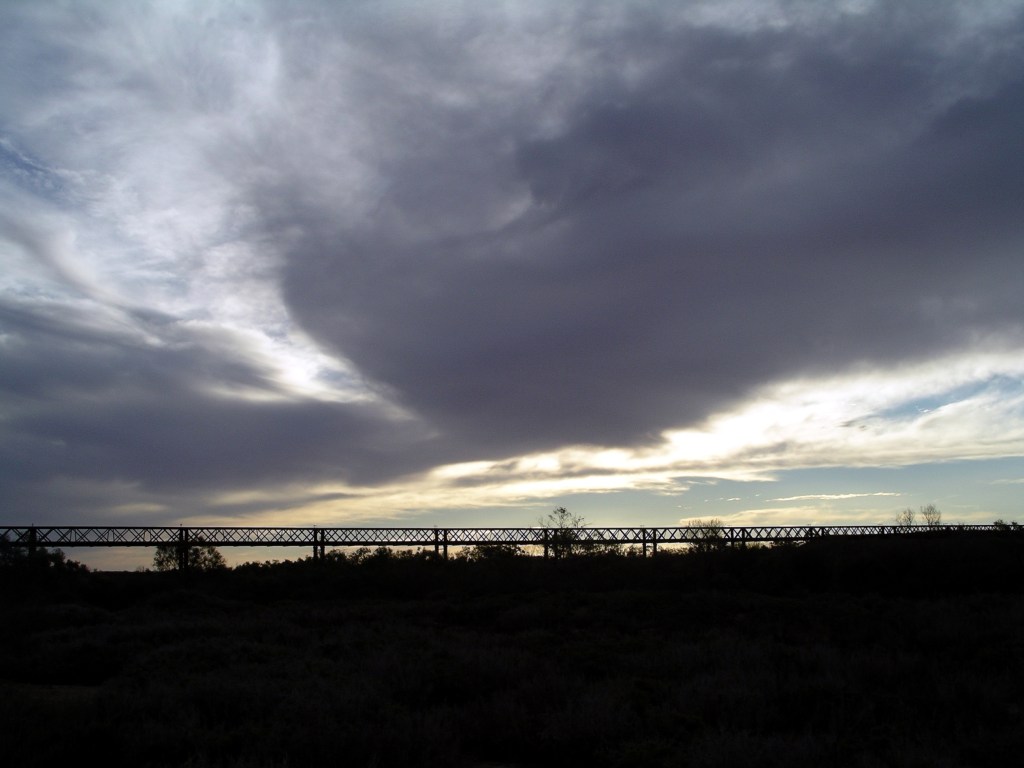
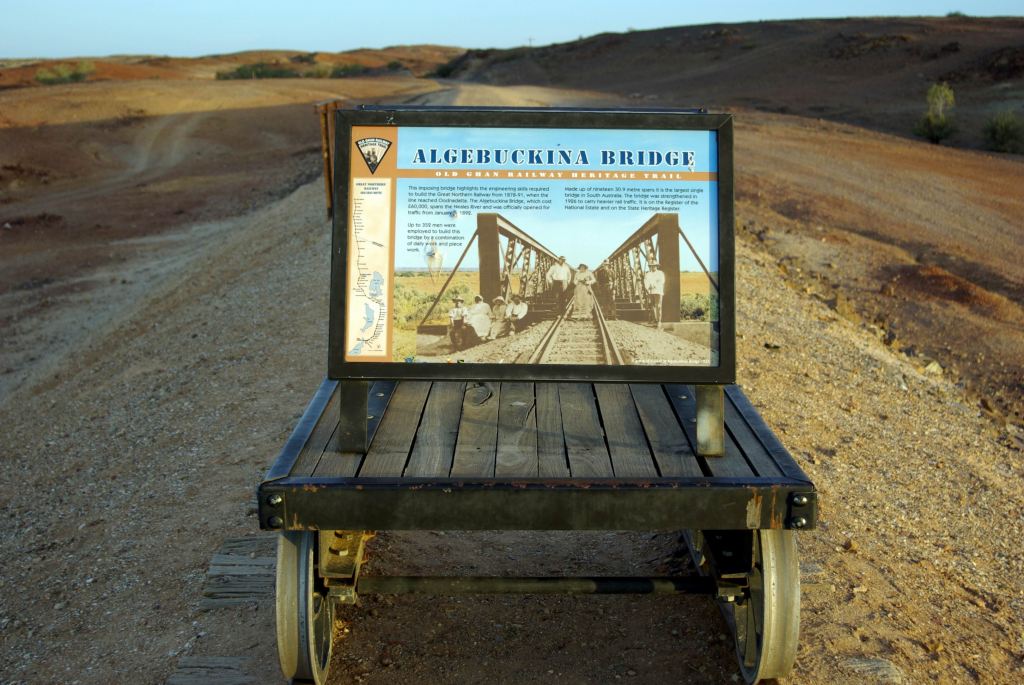
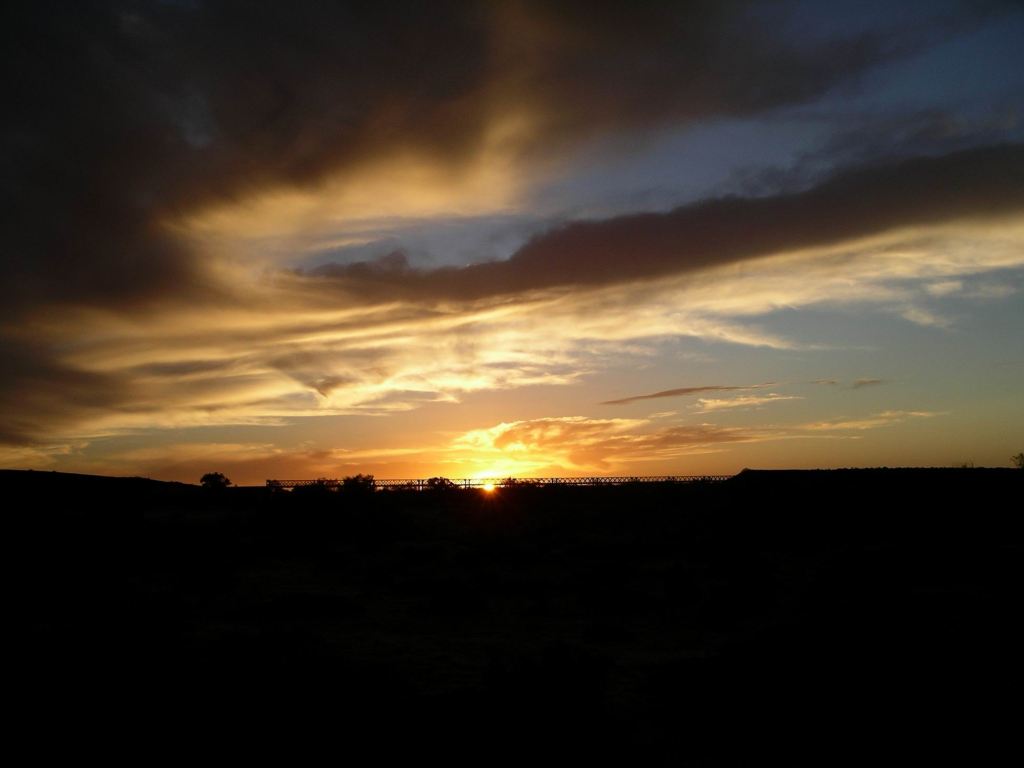
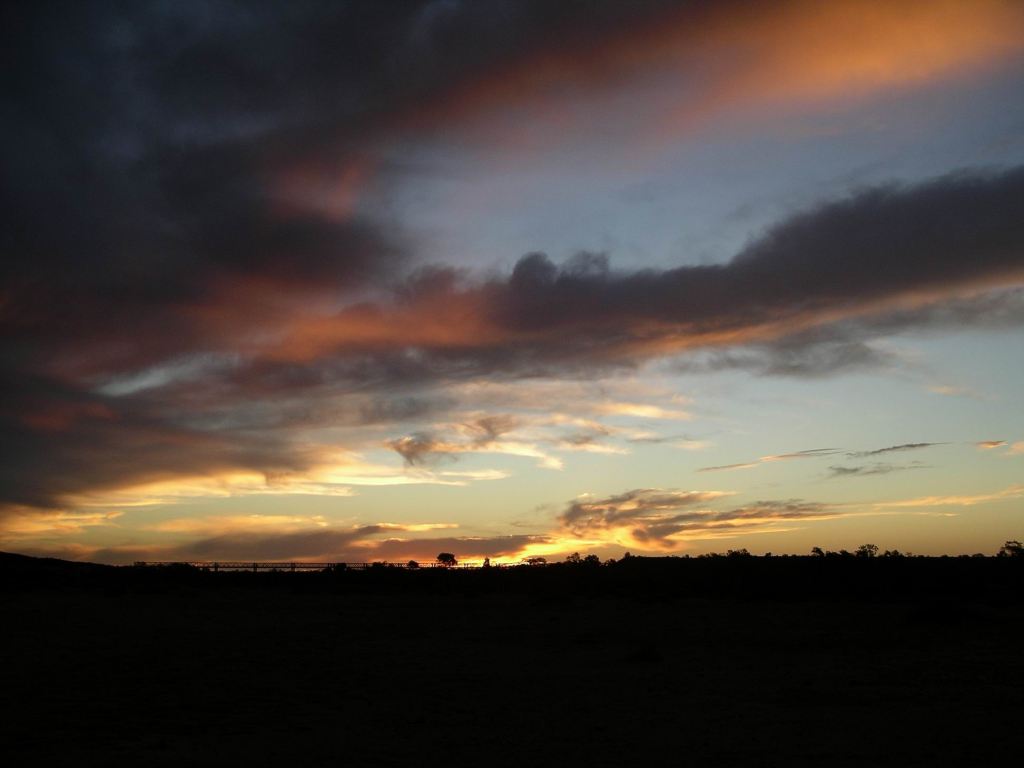
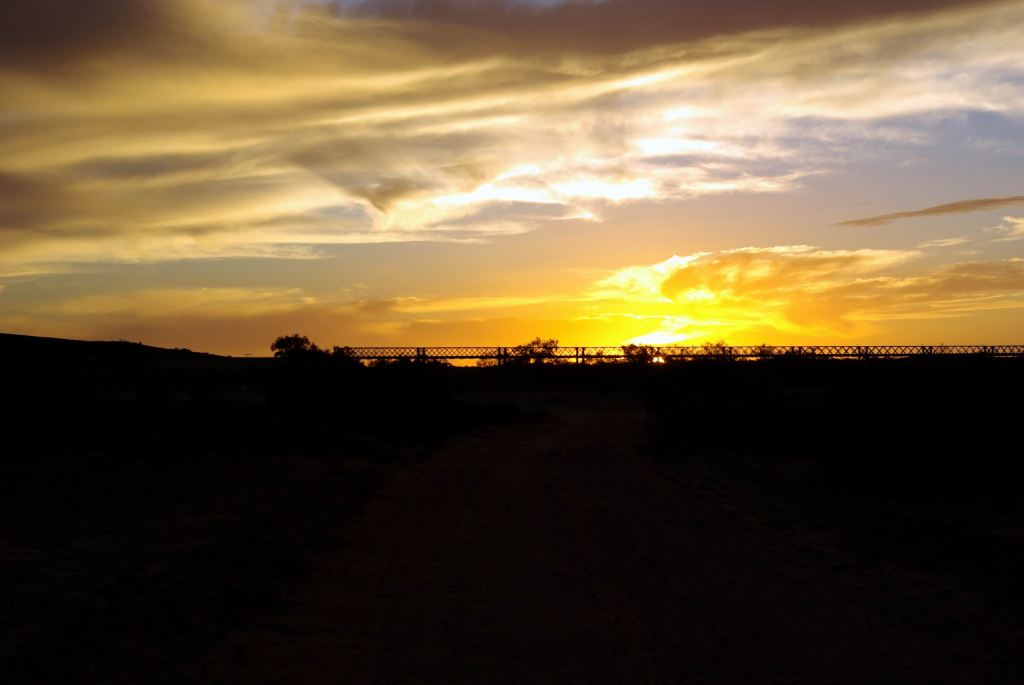
The bridge is high and almost 590kms long. It is a wonderful subject for photos, especially silhouetted against the setting sun.
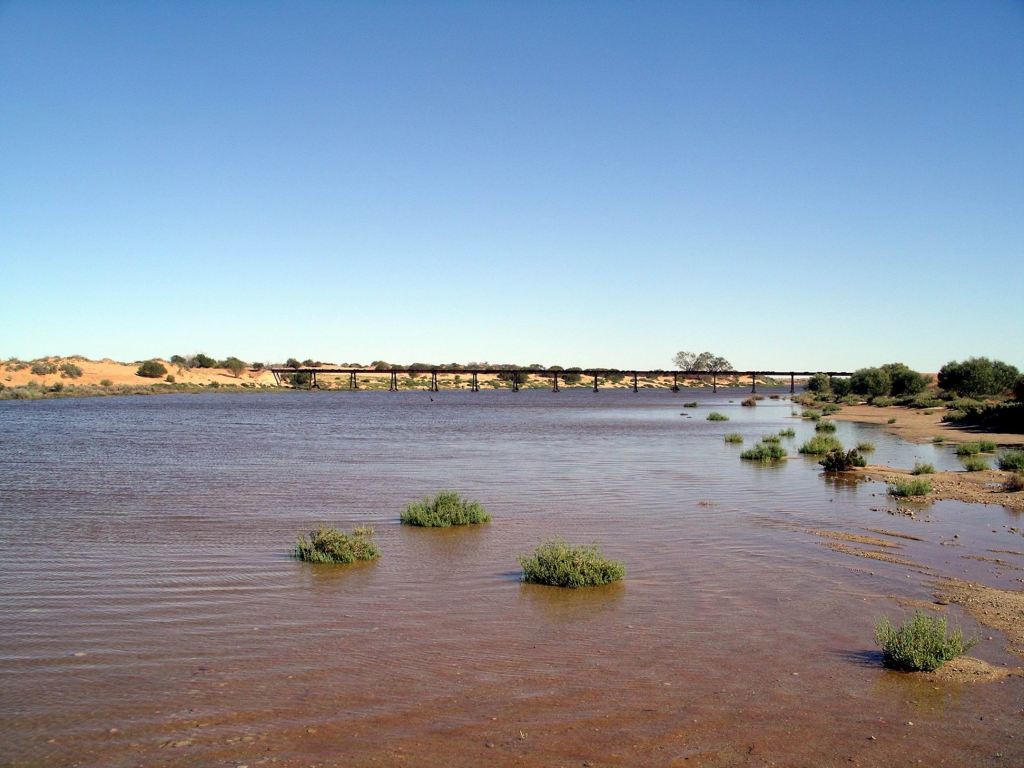
The bridge was opened in 1899 and is the longest bridge in SA. Despite its height, the big flood of 1974 reached almost to its decks!
The remains of a wrecked Holden were still there, from 1976. The motorist attempted to cross the flooded river, via the rail bridge, by putting down some planks, moving his car onto them, then taking up the ones behind and repeating the process. Unfortunately, the works train came along, while he was only part way across, and ran over his car. He lived. The wreckage was pushed off onto the creek bed below the bridge.
One could think up a new variation on the signs one sees about not attempting to drive through flooded creeks!
We took a heap of photos. It was the sort of place that just lent itself to being photographed in the changing light of late afternoon.
It was dusk by the time we’d walked back to our camp.
Our site even had room for a campfire, in a place where there had obviously been ones before us, so we sat outside for a while after tea, chatting and enjoying looking out over the waterhole. There were some occasional nocturnal sounds from frogs and waterbirds – lovely.
We were hoping that each day that goes by was allowing the Cadney Park track that we wanted to take, to dry out.
SUNDAY 20 MAY COWARD SPRINGS TO WILLIAM CREEK 80kms
After breakfast, we walked around to view the developments since we were last here, eight years ago. The Engine Drivers’ Cottage was now fully restored and open as a museum, with some really interesting exhibits about the railway, and about this place.
The Engine Driver’s Cottage
The Station Master’s House was the other restored building, and where the owners lived, so it was off limits for viewing, except from a little distance. They certainly have been doing a wonderful preservation job here.
We went for a wander around a section of the old rail route, where there were still some sleeper remains left. A lot of these had been utilized in the building of the camp facilities at Coward Springs; probably more had been utilized as firewood.
Some remnant sleepers on the rail bed
On our first trip this way, John acquired some red gum sleeper from the old route, near here. It had now been made into a pepper grinder that was in regular use at home. I like, when using it, to think about its history…….and feel privileged to have it.
And so onward. The old rail alignment crossed and recrossed the track a few times on this section.
The old Ghan rail bed – and surface water
There was some surface water in places today.
Warriners Creek
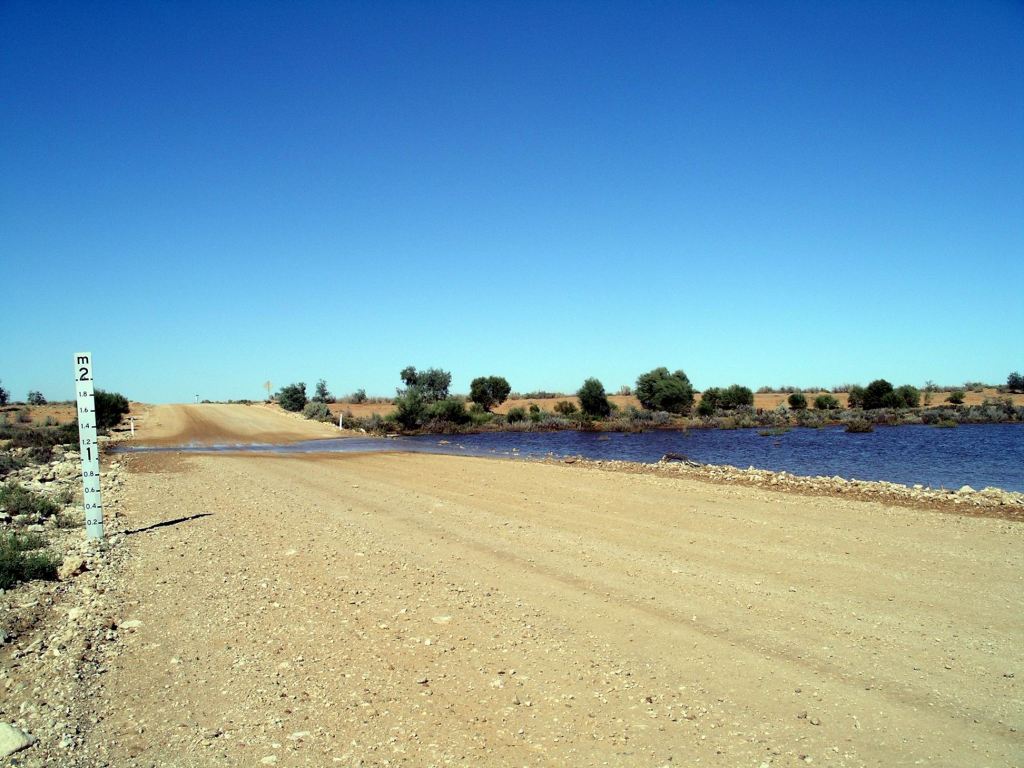
Warriners Creek was flowing shallowly across the track. There was a depth measurement sign; it was hard to beleive that water could get to 2 metres deep in this country………However, there was plenty of water under the old bridge there. Clearly, there had been a heap of rain up this way, not too long ago.
Old railway bridge at Warriners Creek
Today’s stage was short, because we wanted to stay at William Creek, so some of us could take a sight seeing flight over Lake Eyre, where we knew water was entering the north-east lake from the Warburton Groove; the flight would also go over the Painted Hills, an area not accessible to travellers in any other way.
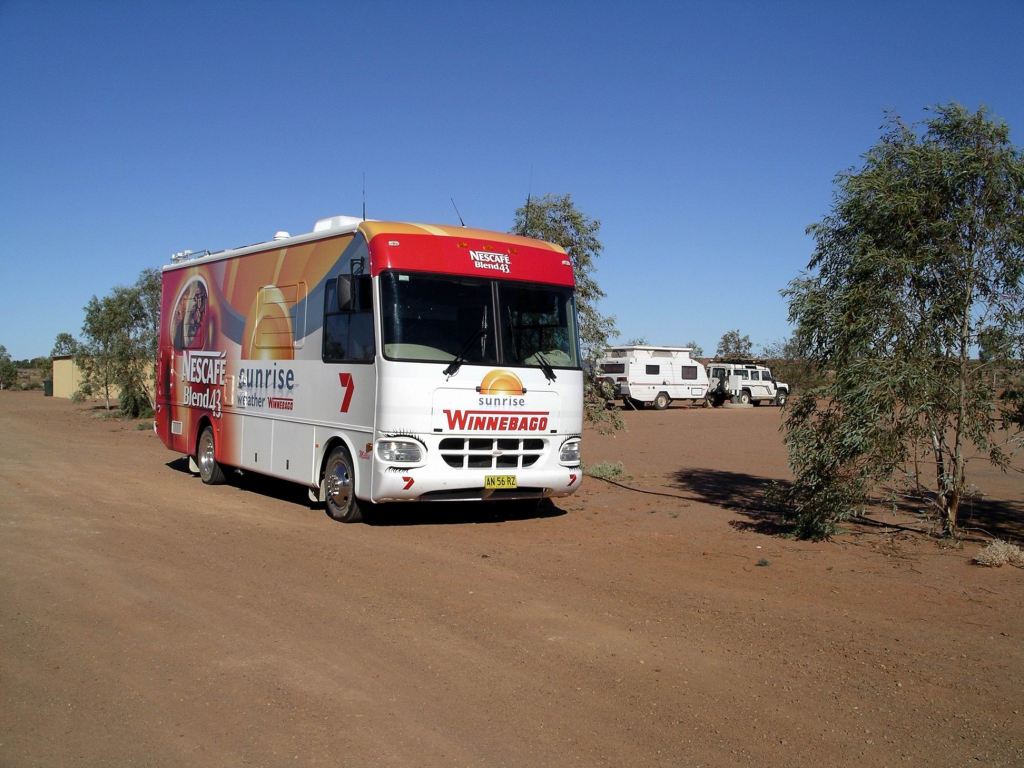
As we drove into William Creek, an unexpected sight was the Channel 7 (TV) Sunrise Bus. It had come to the hamlet to cover the start of the Great Australian Cattle Drive. This was the first that we had become aware that this was happening – and thus there would be a lot of extra people around.
The first of these Cattle Drives – to commemorate the feats of the old time drovers – was held in 2002, the brainchild of boss drover Eric Oldfield, and used the Birdsville Track. Tourists could join the droving expedition for a few days at a time – for a fee. It was so successful that it was repeated in 2005. This third one had moved away from the Birdsville Track, and would drove the cattle from William Creek to Oodnadatta.
By sheer fluke, not knowing about the imminent event, with its associated crowds, we had managed to get in here just before the start – lucky. A few days later and we would have been mixing it with the drove up along the track!
William Creek, with a usual population I could count on my fingers, was SA’s smallest town, surrounded by Australia’s largest cattle station – Anna Creek. Today, this tiny place of one hotel was humming!
We booked into the very new Dingo’s Caravan Park – $20 for our powered site. We thought this place would be removed from the rowdiness of the camping area right by the pub. It looked to have a lot of promise, with a lovely new amenities block. There were no formally marked out sites, only power poles to mark places, so as we were the only occupants of the place, we pulled in each side of one such pole.
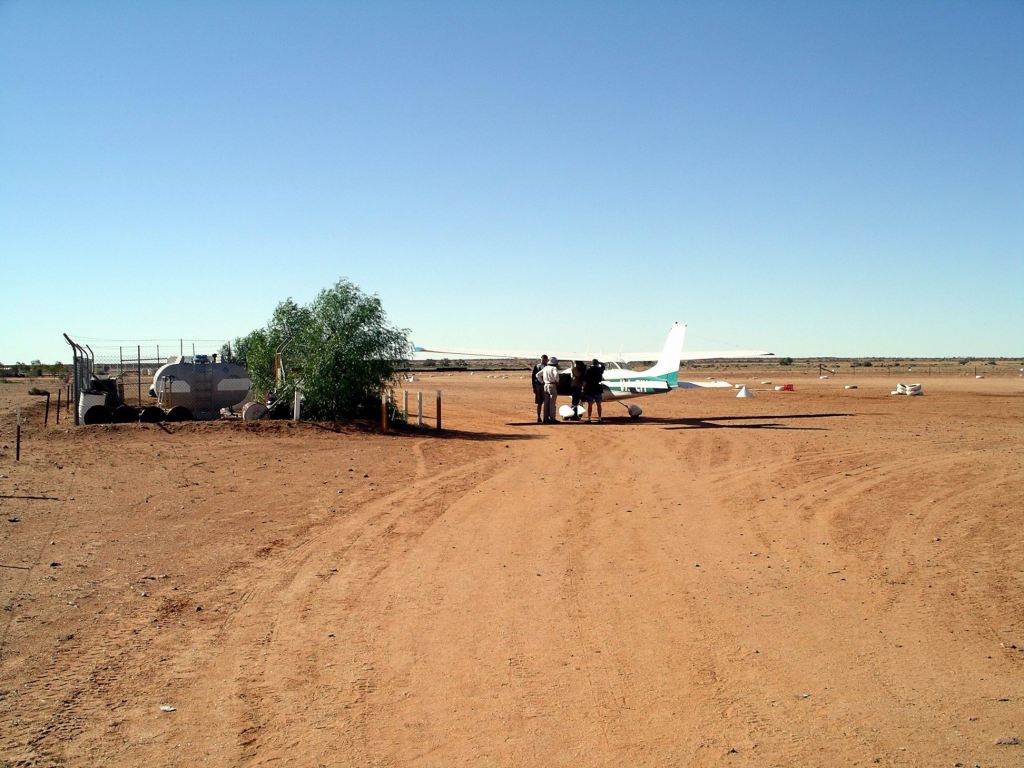
After a very quick basic set up, we walked over to the airstrip.
Wrights Air was the operation offering sightseeing flights from here. A wee bit of negotiating saw M and John offered what we thought was a good deal on flights – $150 for an hour, usual price $180. After they had booked, their flights were upgraded to two hours – for an extra $30 – in order to fill up planes.
All three planes based here went out for the afternoon flight. M and John were put onto different planes. They were very little planes……
Organising to go flying…….
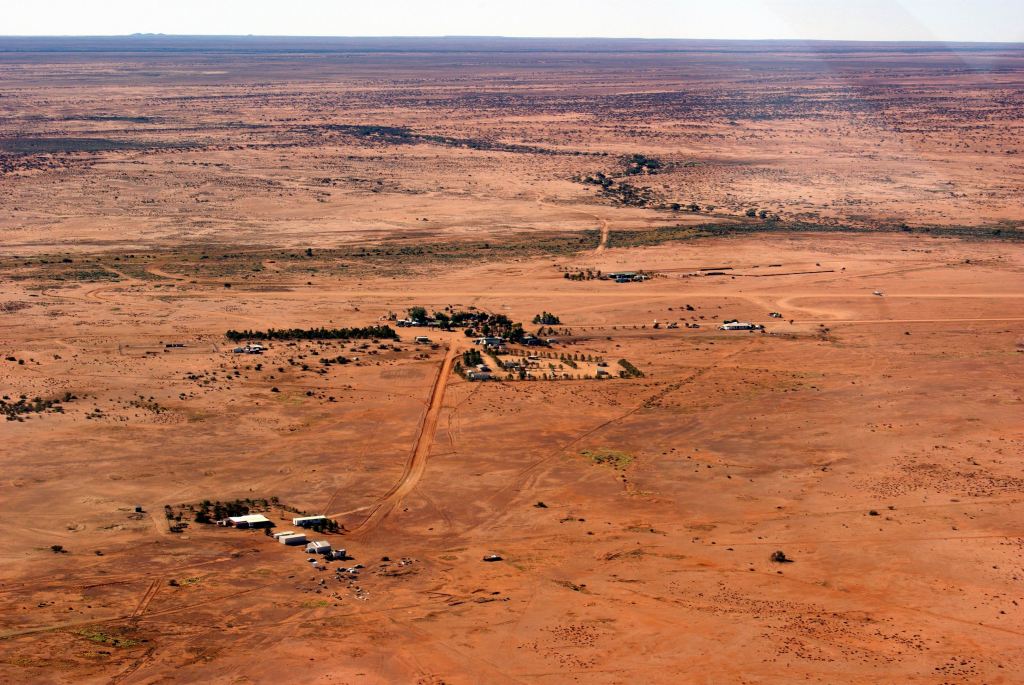
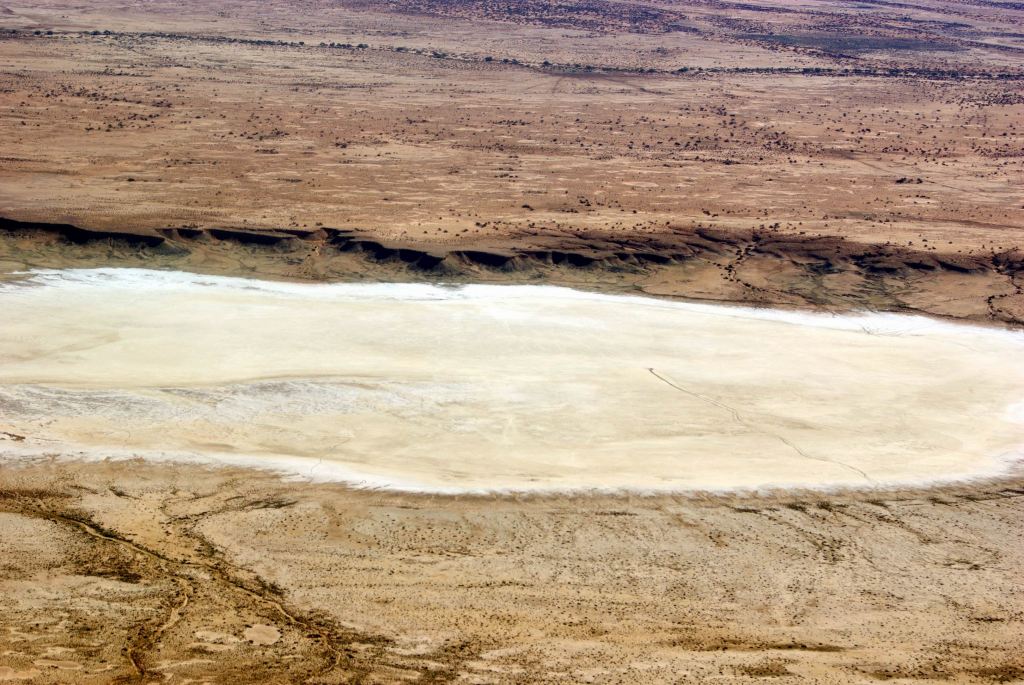
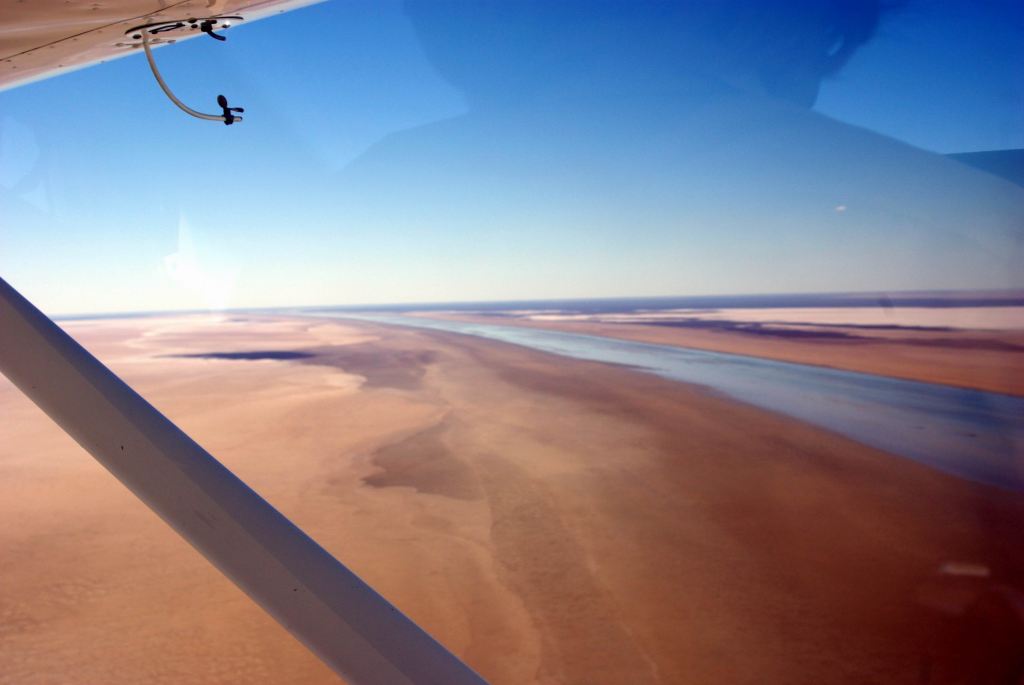
They both got to see Lake Eyre and the Painted Hills (on Anna Creek Station and not open to the public), from the air, but John’s flight went even further – up to the Warburton Groove, in the NE corner of Lake Eyre. He was away for nearly three hours! So, it was a really good deal – and John was given a CD that covered the flight area, too.
William Creek from the air. Caravan Park central, hotel in trees just beyond it
John took along “my” still unfamiliar DSLR Pentax camera to take photos from the plane. Unfortunately, he somehow managed to get the focus all wrong. Results were very blurry.
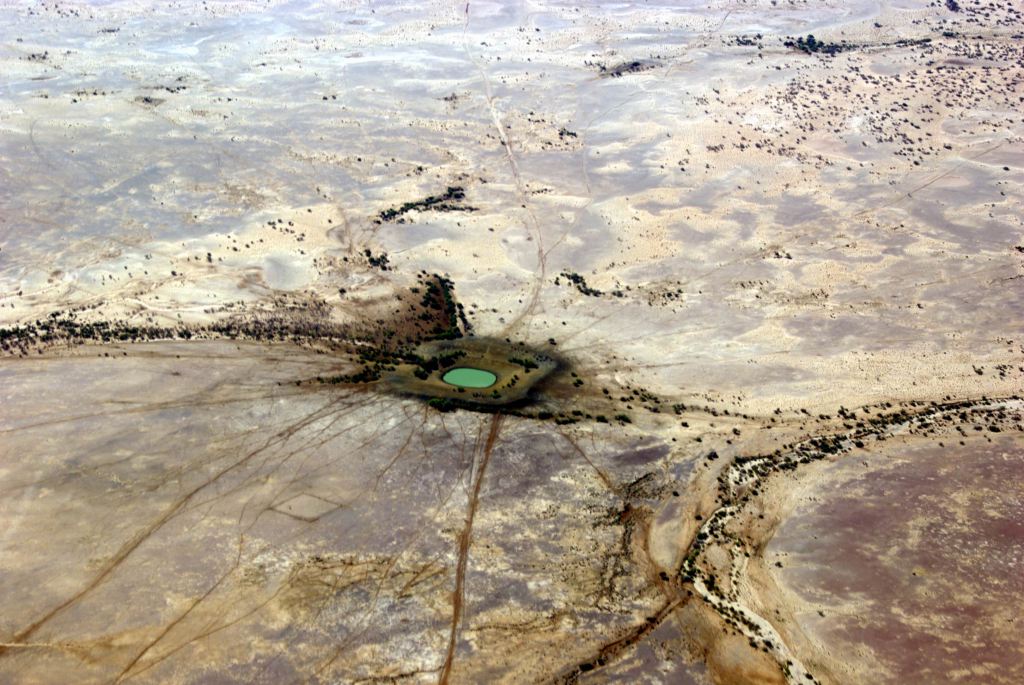
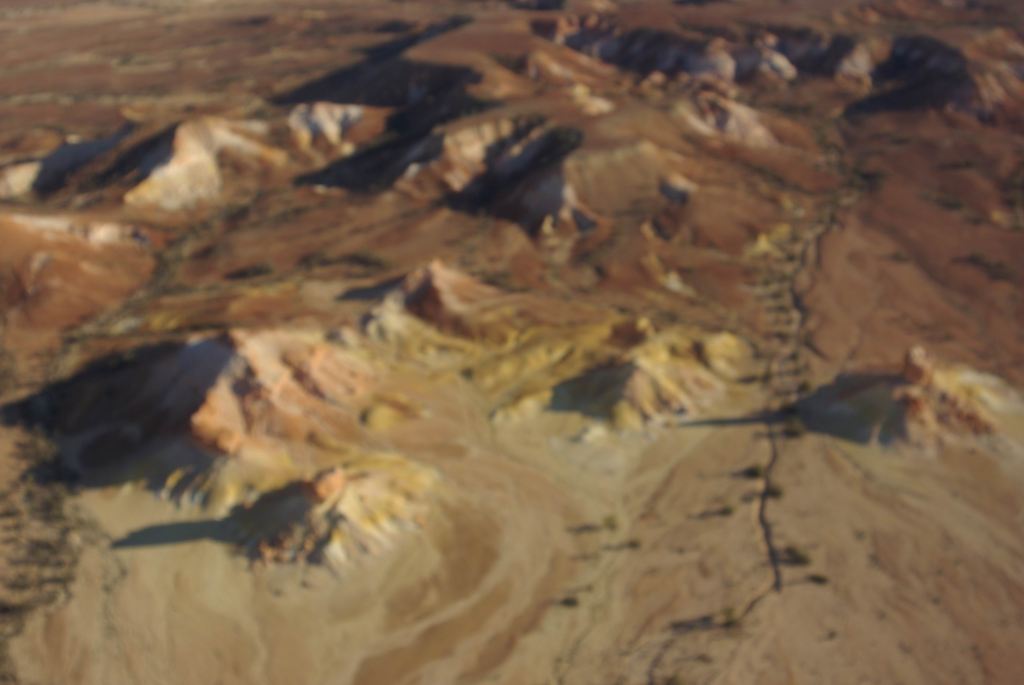
Water filling into Lake EyreA cattle watering point, with cattle tracksThe Warburton Groove, bringing water to Lake EyreThe Painted Hills and creek channel – reminiscent of aboriginal art depiction.
For several reasons, I do not enjoy being shut up in a small motorized box that leaves the apparent security of terra firma. In other words, I do not usually “do” small plane flights. So, after I’d watched the planes disappear into the distance, I wandered around to the institution that was the William Creek Hotel. This was one of those establishments featuring memorabilia from previous visitors – all over the walls and ceiling. I bought myself a polo shirt – a somewhat cheaper “treat” than the others were having.
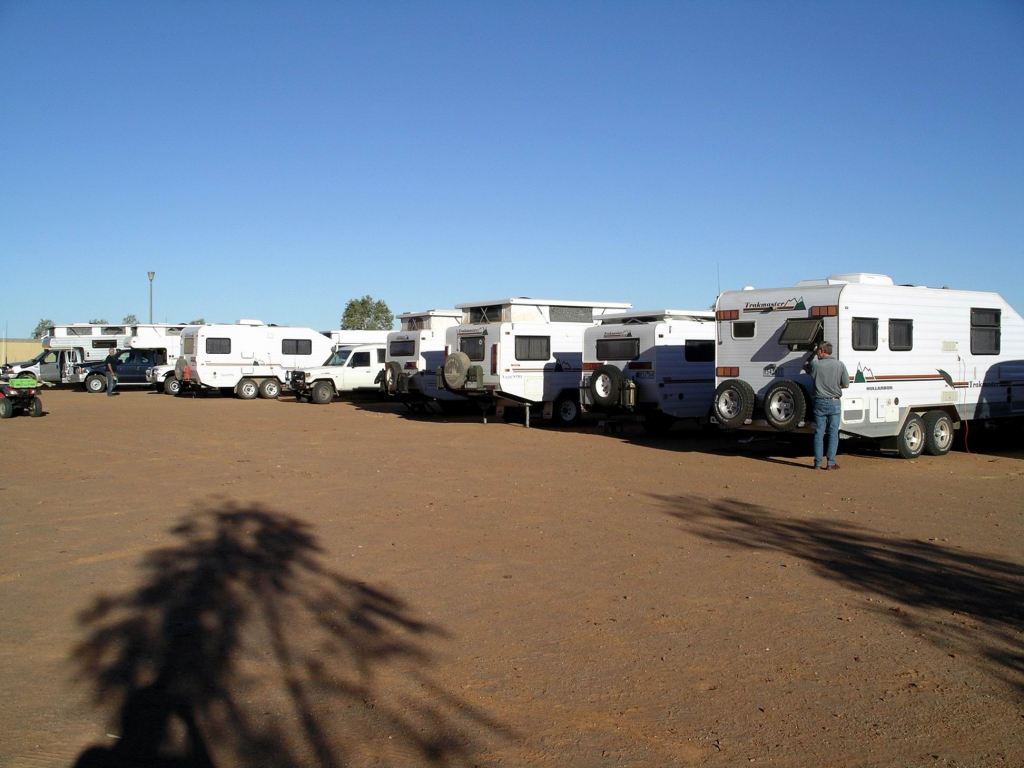
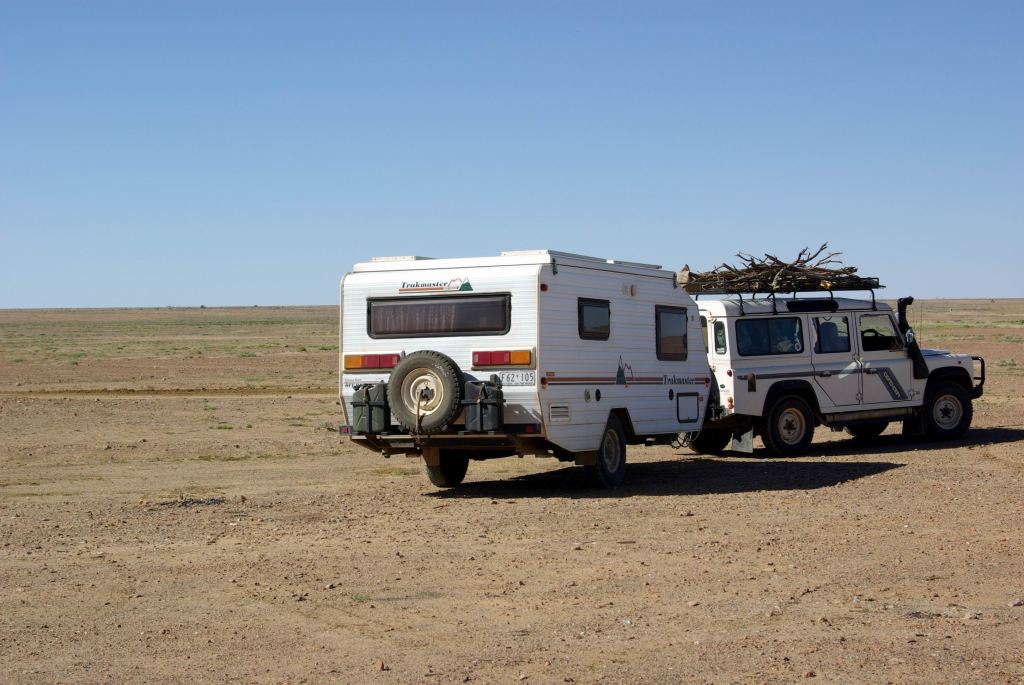
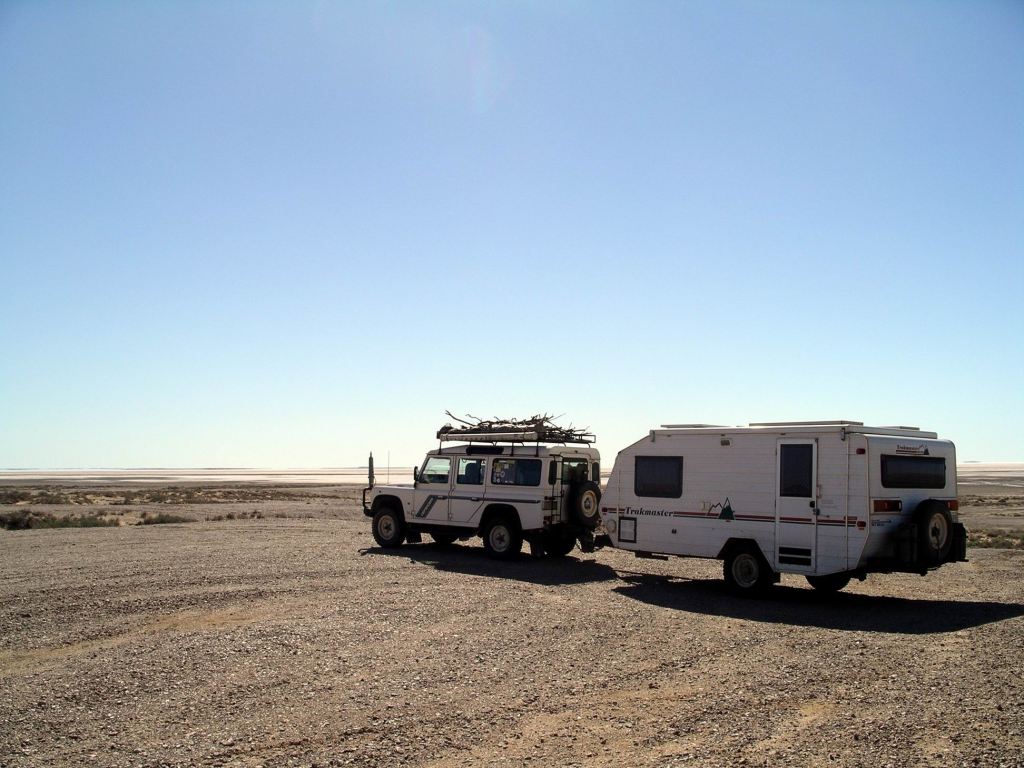
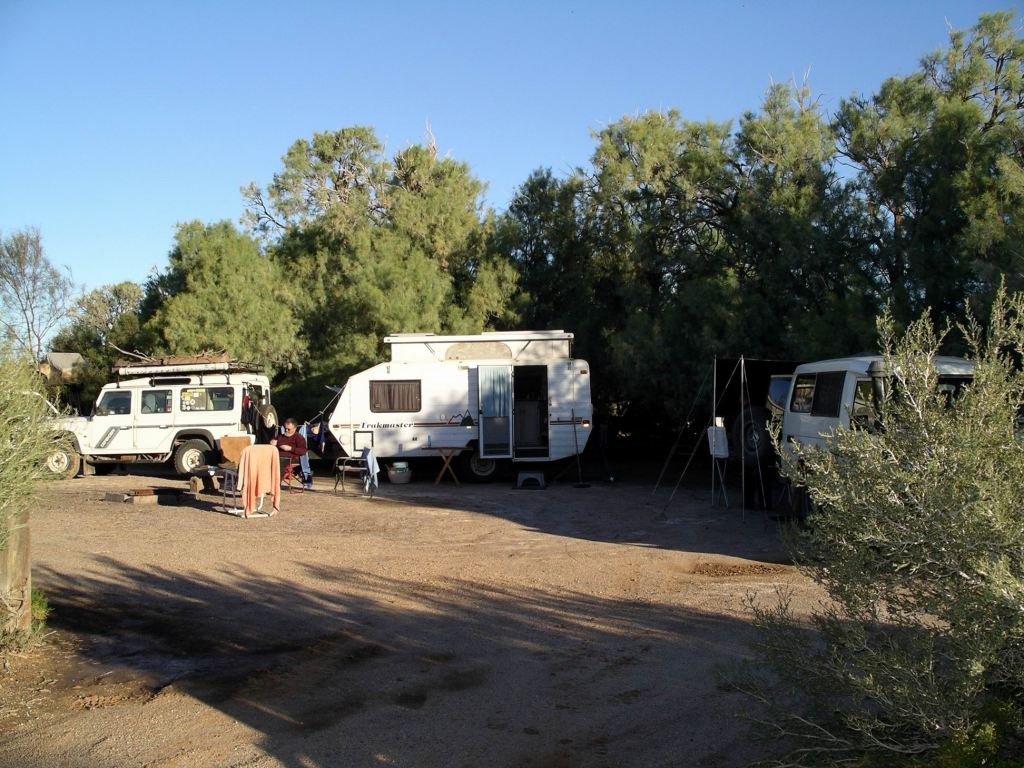
I received a big surprise when I walked back to the camp ground. Our formerly isolated van and Troopy were surrounded – by Trakmaster caravans! Ten of them had somehow managed to sneak into Dodge whilst I was otherwise occupied. It was like we had suddenly been cloned! It was the annual Trakmaster Trek – across the desert to Marble Bar in WA.
Ummm…….mine is in there somewhere!
The fliers arrived back, one at a time, both equally taken aback by the way our van had multiplied in their absence. Both were really exuberant after their flights, and there was much comparing of the experiences. I think M was rather envious of John’s extended flight.
We found out that, when you have eleven Trakmasters all in a row, and very little lighting in the camp ground, it ain’t easy to find “home” in the dark!
Today, we meandered up the first part of the Oodnadatta Track, otherwise known as the Old Ghan Track.
This route followed, broadly, that of some of the early explorers through this way, and was dictated by the availability of water in a series of naturally occurring springs. Because of available water, the Overland Telegraph line to Darwin and thence the rest of the world, was built along this route, in 1872.
Not long after, work began on a railway that was intended to link Adelaide with parts north, and eventually Darwin. Because the steam engines of the time needed supplies of water for their boilers, the railway route followed that of the Telegraph. Railway building began from Port Augusta in 1878, reached Marree in 1884, Oodnadatta in 1891.
From Oodnadatta, northbound passengers had to travel by camel to Alice Springs, until that section of the railway was finished in 1929. It is hard to find much in the way of description about what that was like, but a person must have been really motivated to get to Alice Springs, to undertake that camel ride section!
Railway sidings and fettlers’ accommodation were built at the watering points along the railway. Eventually, water towers were constructed at some sidings, to de-mineralize the bore water.
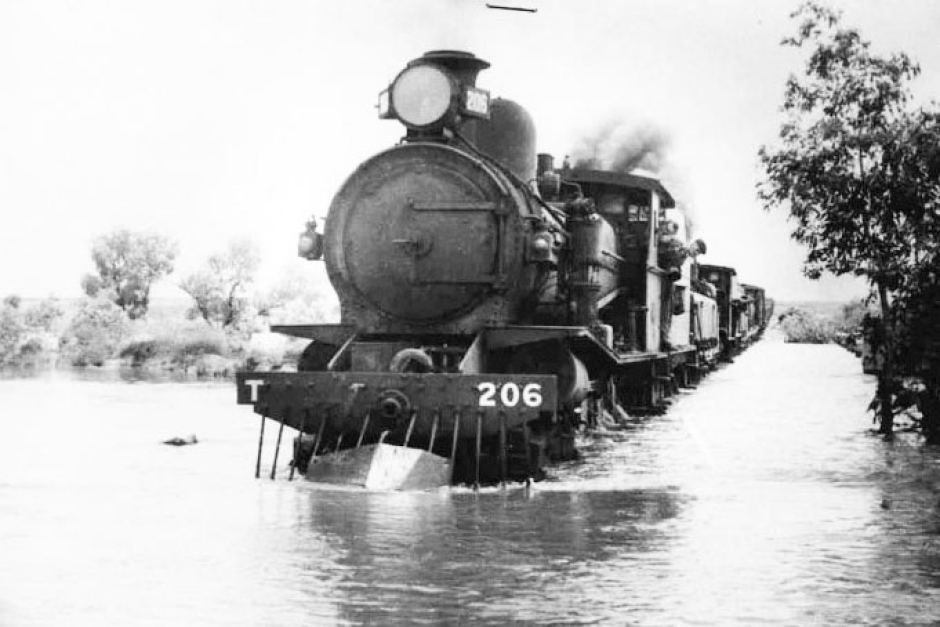
The railway was prone to floods and track wash aways and hence considerable delays at times. Ghan rail travel could be an unpredictable adventure, with extended periods of passenger strandings not uncommon.
Ghan train in flooded creek (ABC Site)
Because of the importance of camel transport in the region, and the railway’s early associations with same, the railway became known as The Ghan, for the pioneering Afghan cameleers of the inland.
With the coming of diesel powered railway engines, the days of the Old Ghan route were numbered. A road, of sorts, had been constructed from Port Augusta to Darwin during WW2, following higher ground well to the west of the train route. That was to become the Stuart Highway. In 1980, a new rail line was opened that roughly paralleled the highway, and avoided the flood prone sections of the old railway. The Old Ghan line and its associated infrastructure, fell into disrepair; the townships that had serviced the railway, shrank to either ghost towns or small, mostly indigenous, settlements.
The modern track that follows the route of the Old Ghan Railway is, mostly, a good gravel road.
There tend to be the ruins of a former rail siding every 20kms or so. We stopped at a number of these, wandered about, took photos.
We did the same at some places where creeks (mostly dry) crossed the track – and where there were bridges left from the old railway.
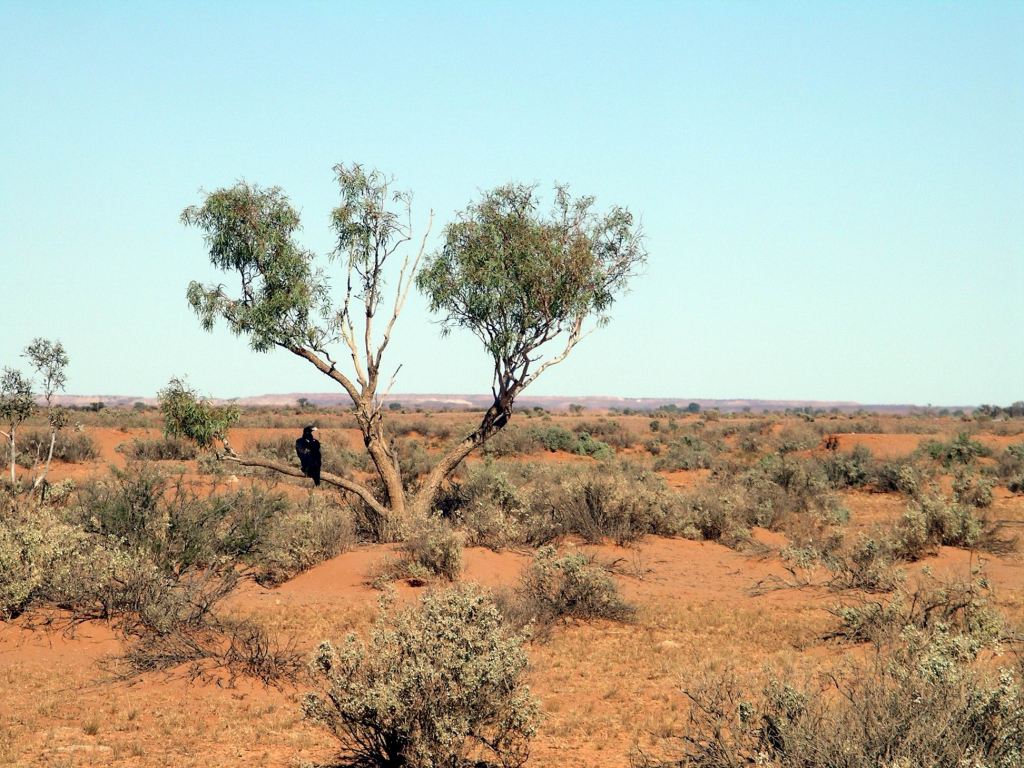
In possession of one of the few trees…….wedge tailed eagle
Although the siding buildings were in various degrees of ruin, they were interesting. Life out here – particularly in the heat of summer – must have been so hard.
What was left of each siding’s buildings had been vandalized and grafittied – this had to have been done by travellers. What is it about some people, who can’t leave a piece of our heritage standing , be it natural or man made, without decorating same with their initials? We really don’t give a damn that Ignorant Joe was here, whenever! Given the good condition of this track, it was not really an achievement to boast about either, by tagging places. It was probably harder driving in suburban Melbourne!
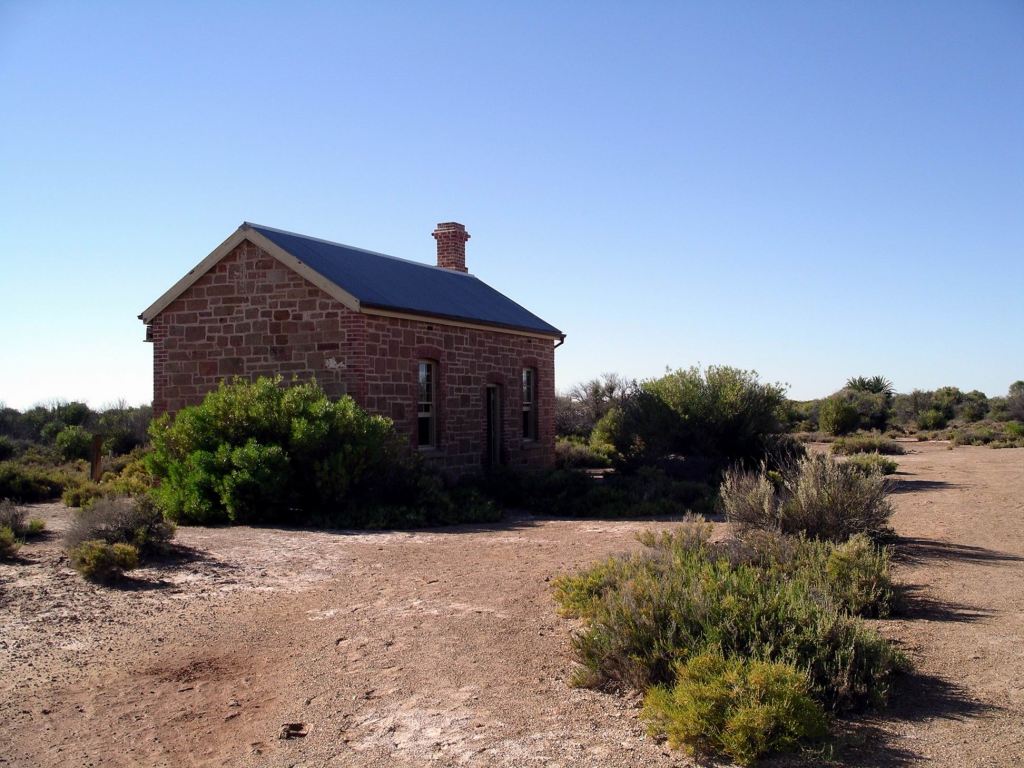
The first of the sidings we stopped at was Wangianna, about 35kms north of Marree. Here, the old fettlers’ accommodation was still in good enough repair for us to be able to see what it would have been like. It was a pity, though, that other structures associated with that siding , had gone.
So desolate…...….yet some trees survived
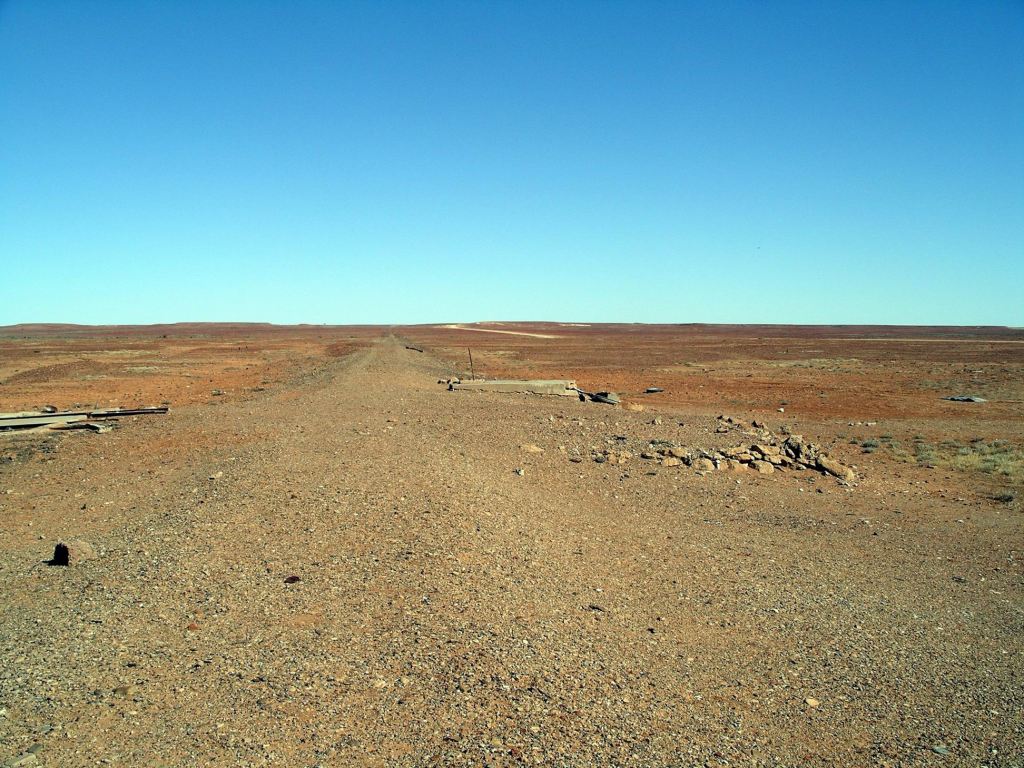
It was perfectly possible, wherever we stopped by some feature of the former railway, for us to see the railbed of the line. In most of the accessible parts of the line, the red gum sleepers had been removed, as had the rails.
Old rail alignment at Wangianna; our road in the distance
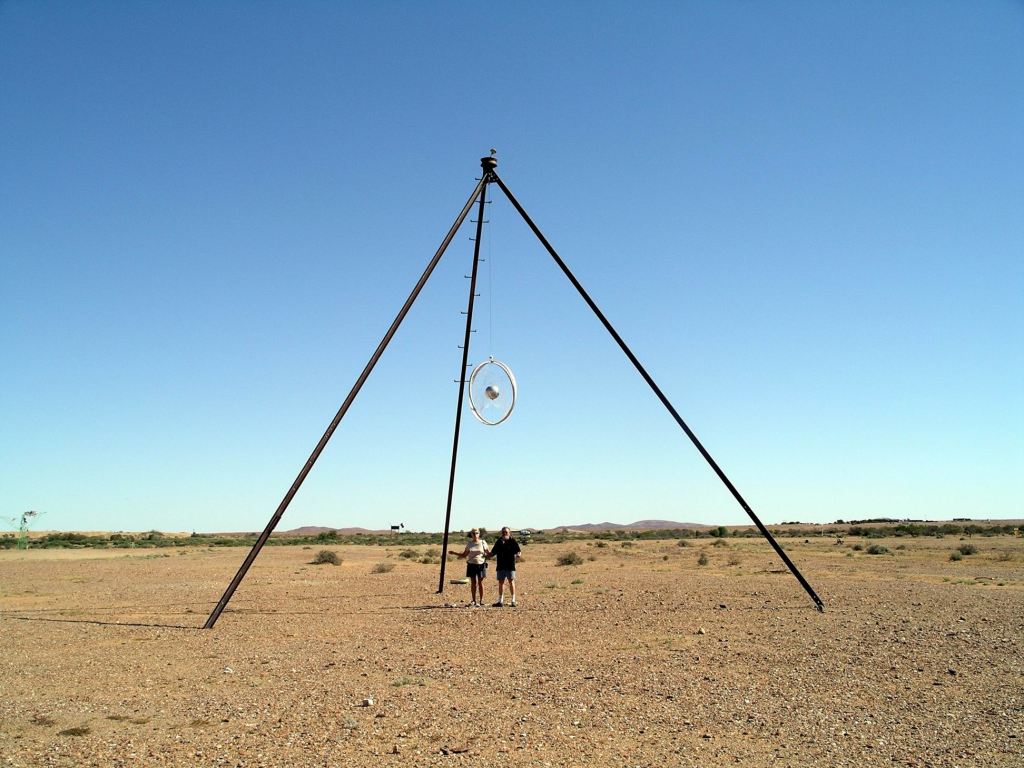
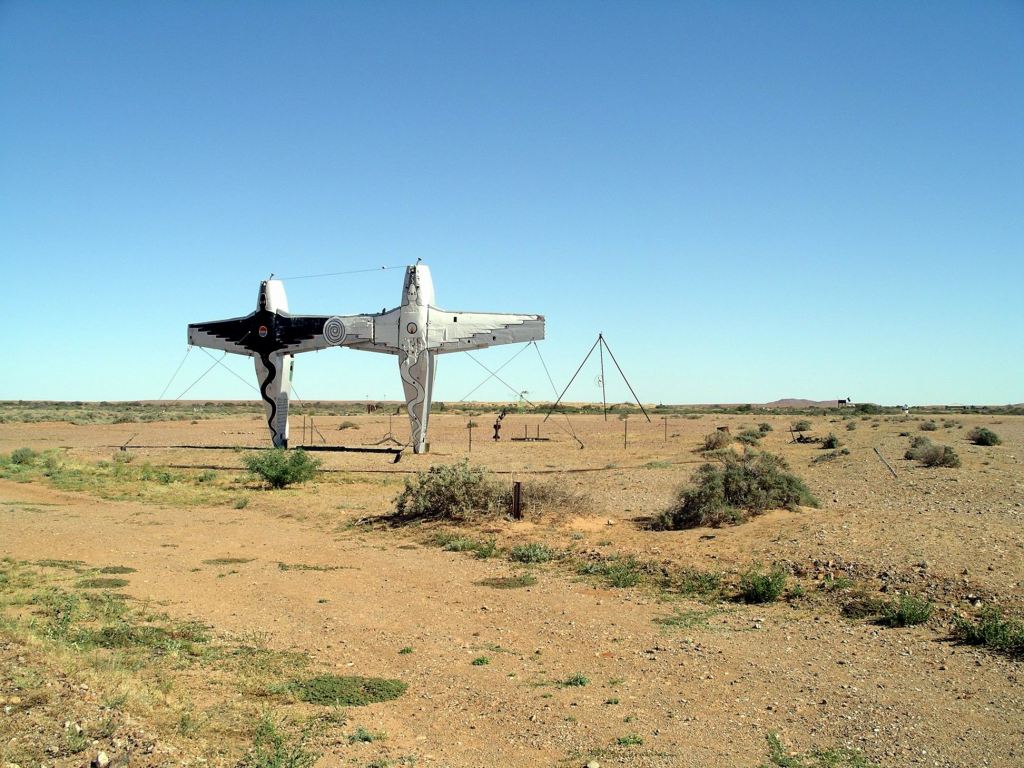
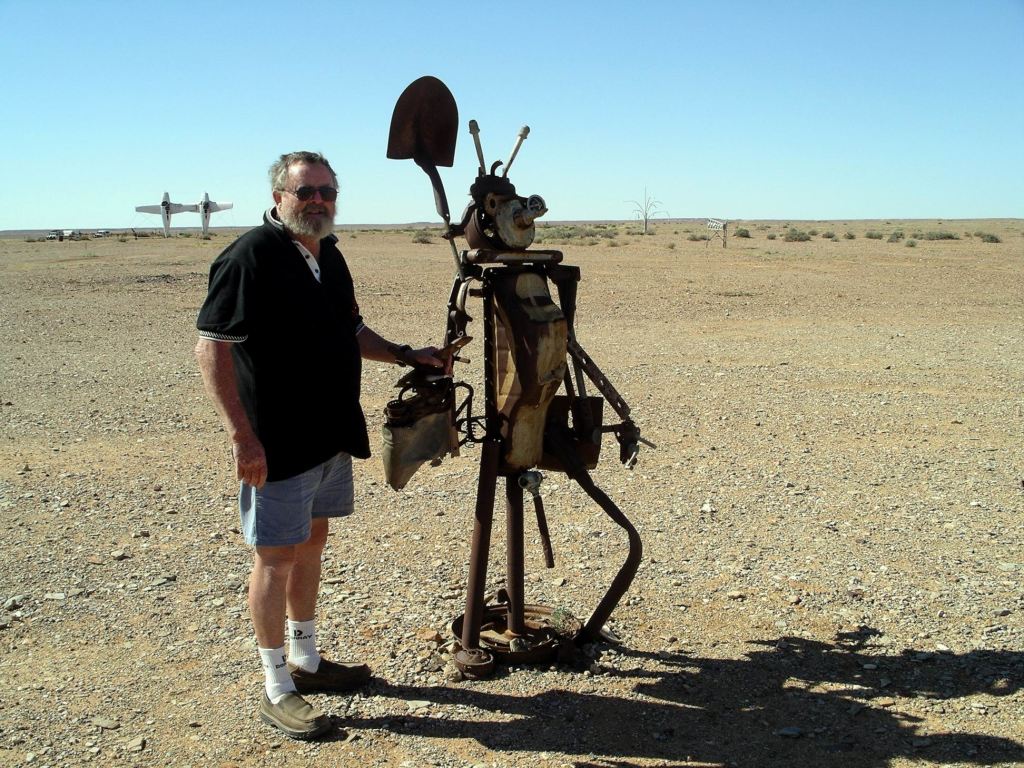
Another 16kms on brought us to one of the most unusual – and most recent – landmarks along the Old Ghan Track: “Plane Henge”, or the Mutonia Sculpture Park.
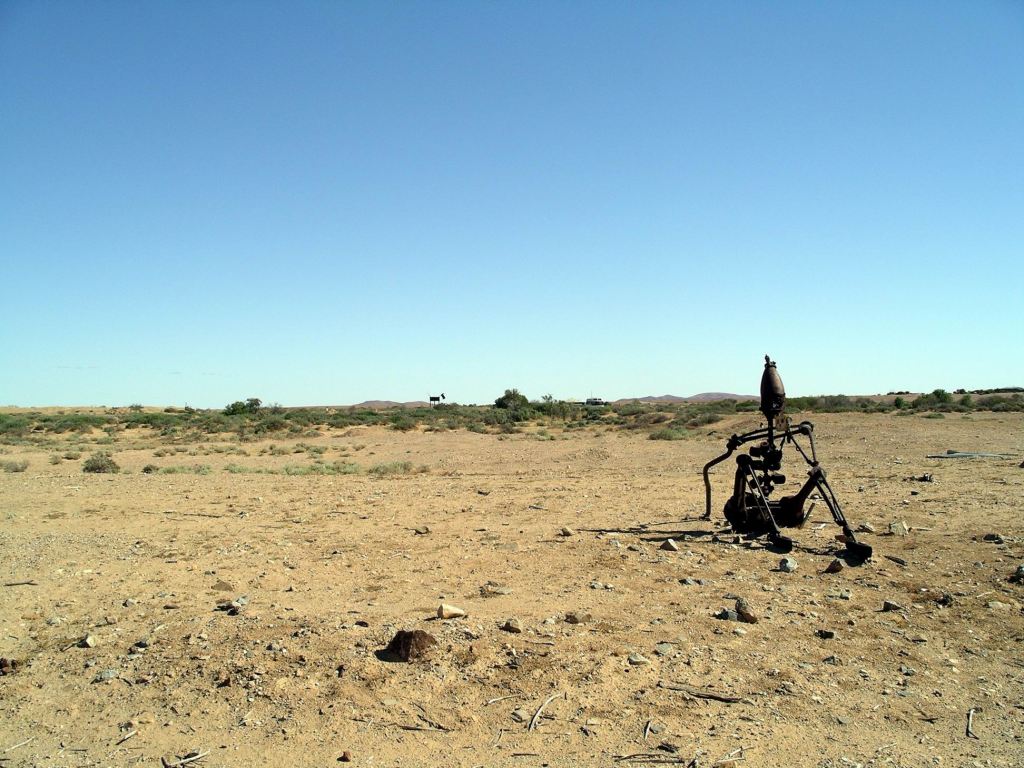
This was the work of a former mechanic, Robin Cooke, apparently inspired by “mad Max”. Here, all sorts of weird and wonderful installations have been created out of waste or unwanted materials.
Down on his luck…..
The most striking of these installations, especially so because of the flatness of the land and hence it being visible for a long way, was the pair of old planes, standing on their tails, wingtip to wingtip. This was the sort of sight that made one doubt their eyesight. As in, “I’ve gotta be seeing things!”
Also strikingly visible was a huge dog/dingo (visible in the background of the photos above).
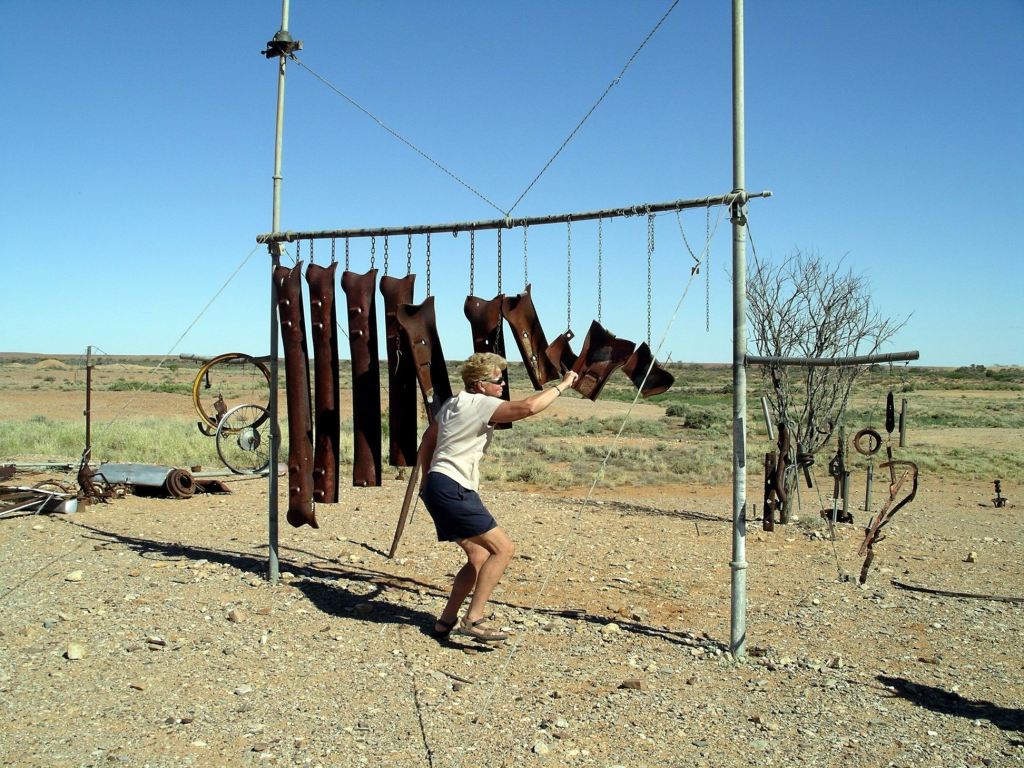
Some of the pieces were interactive.
Making music – of a sort…..
We wandered about, marvelling at the creativity.
I guess, if one has a vision, the urge must be scratched…….
Further along, the old rail line – and hence our current road – passed right by the shore of Lake Eyre South, so we were able to view that from this point. Now we were travelling with the old rail bed to our right; it had been on the left since Marree, but crossed the road track here.
Lake Eyre South beside the Oodnadatta Track
Curdimurka Siding was the only one where much of the siding as it was, has remained intact. It is owned by the Ghan Preservation Society. A fund raising event, the Curdimurka Outback Ball, is held – somewhat informally – every two years, and reportedly attended by several thousand people.
Curdimurka – restored
Curdimurka was an evocative place to wander about. The flat plain stretched in all directions, almost totally devoid of vegetation.
The old water tower stood stark against the sky, with an associated water tank collapsed at its foot.
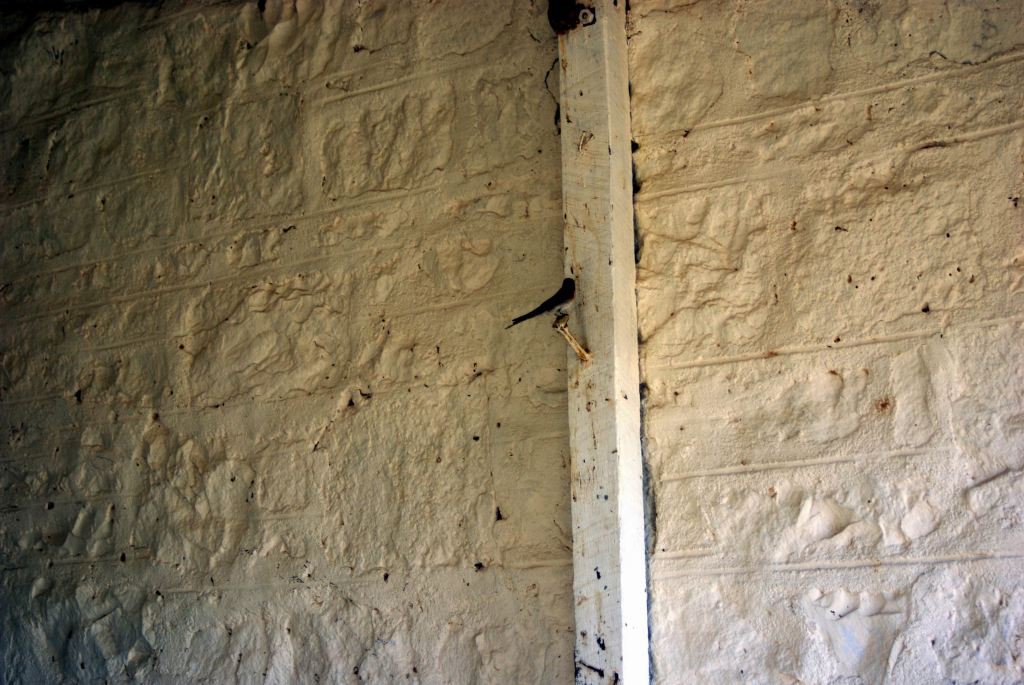
The rails of the siding were intact, as was the fettlers’ cottage. Here, despite the surrounding aridity, a pair of swallows had made their home under the veranda.
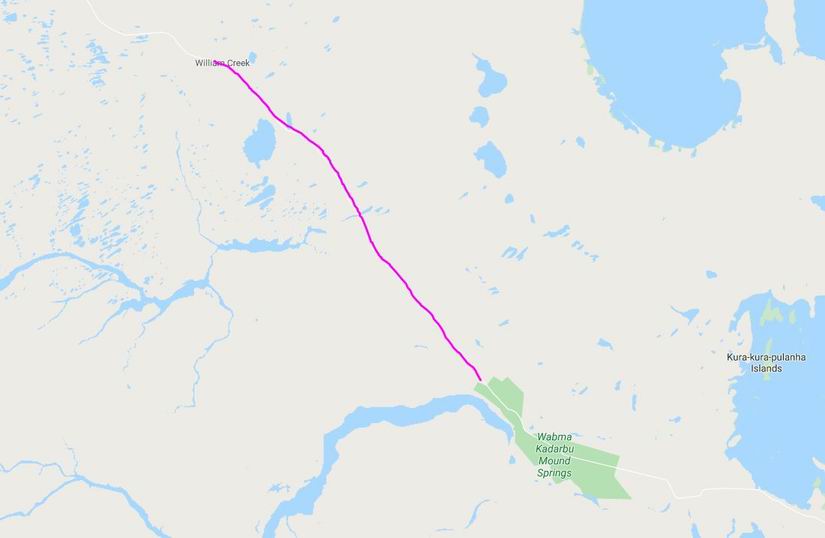
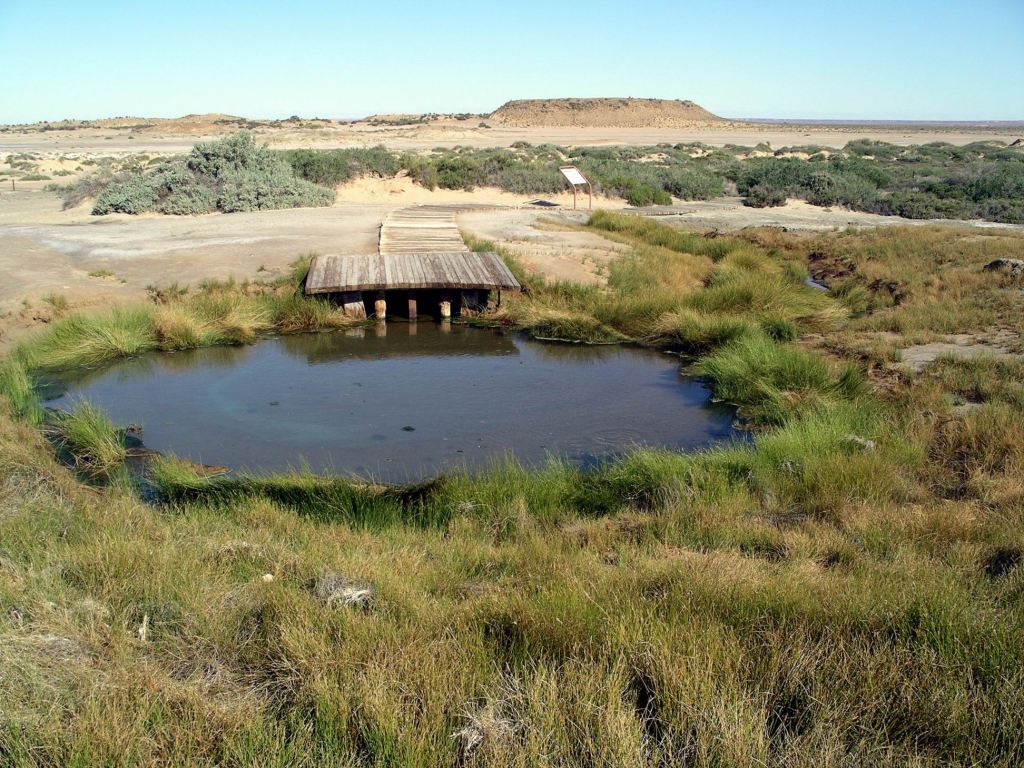
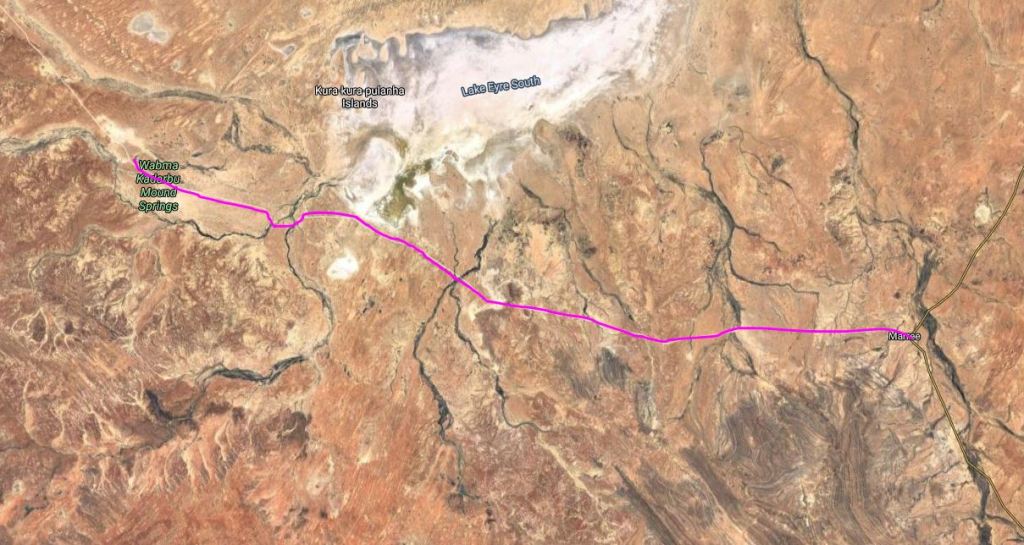
Another 15 or so kms and we were into the Wabna Kadarbu Conservation Park. I can’t say some of these names flow smoothly off the tongue! The point of this Park is to protect two mound springs – the Blanche Cup and the Bubbler.
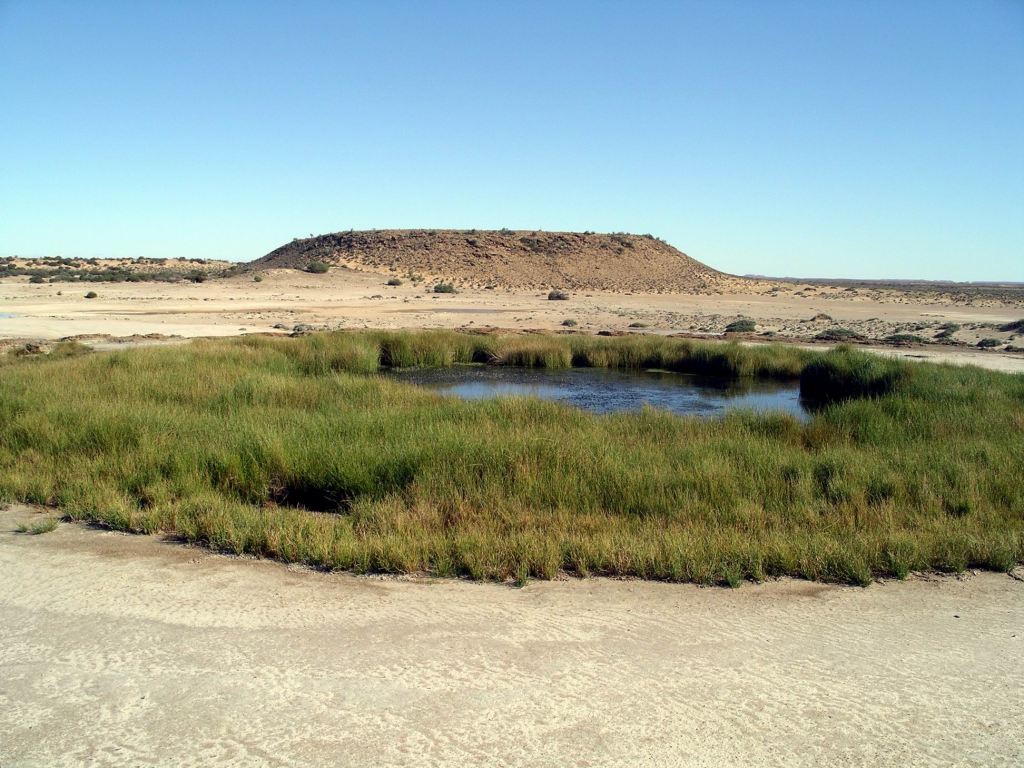
Mounds springs occur where minerals in the naturally occurring springs have, over time, been precipitated out by evaporation to create a mound, with the spring in the centre of the “cup” thus created. Hamilton Hill, in the distance from the two currently active springs, is an extinct one, and shows the size the mounds can reach.
Hamilton Hill
These springs, like the Dalhousie Springs much further north, are fed by the Great Artesian Basin. In past times, before widespread tapping into this for water supplies, and the consequent reduction of its levels and pressure, there would have been a chain of such springs through this country.
We took the 5km side track into the springs, parked in the designated area and walked to look at the two features. Because of the permanent water provided by the springs here, the surrounding area was patchily vegetated and green – a real contrast to the surrounding country. The line of the short outflow channel from the springs was similarly marked by a line of green.
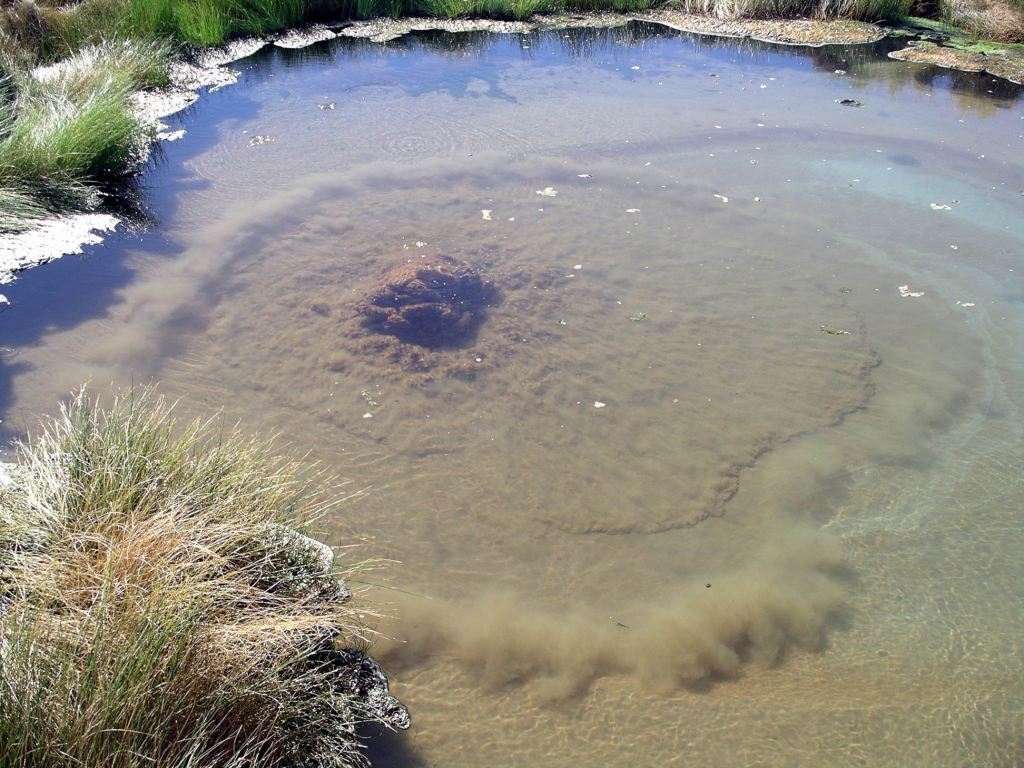
The Bubbler was aptly named. Through the totally clear water in the spring, we could see the bubbling effect in the sandy bottom, where the underground water was welling up. We’d seen a similar effect in the Bubbling Sands springs at Pungalina, a couple of years ago. There was a viewing platform so visitors could watch this, without trampling the greenery at the edge.
The Bubbler and Hamilton HillWater erupting in the Bubbler Spring
Blanche Cup was more deeply enclosed within its green nest, and did not have the same frequent bubbling happening.
Blanche Cup
After a good wander around here, it was onwards – only a few kms – to tonight’s destination of Coward Springs, which we reached in the early afternoon.
Coward Springs was another of the former sidings. It has been saved from the decaying fate of the other sidings along the rail route. In 1991 it was privately acquired. Then, there was an extensive wetland area here, arising from the uncontrolled outflow of a broken bore, and the ruins of only two of the original buildings – the Station Master’s house and the engine drivers’ cottage. The bore was rectified and capped, leaving only a regulated outflow to sustain a smaller wetland. The two buildings were restored and heritage listed. The campground was set up.
The campground is a wonderful oasis in the dry surrounds. Trees have been planted and bush style amenities built, including hot showers – sustained by a wood burning “donkey”. I suspected that it was the former wooden sleepers of the old railway that were providing me with the luxury of a hot shower!
Our night at Coward Springs cost $16. There are no powered sites, of course. The camping is in informal areas, amongst stands of tamarisk trees and date palms. It was very pleasant – the sort of place I would have enjoyed just relaxing at, were it not for a Driver who was determined to get out of SA.
The campground had, obviously, been quite wet recently.
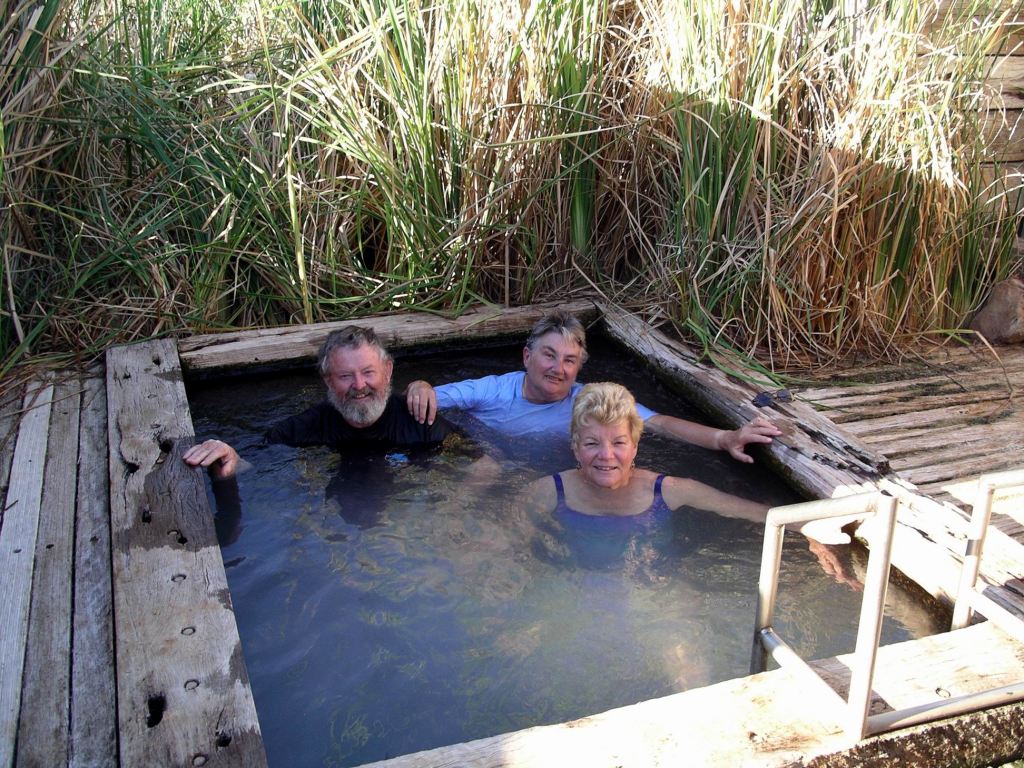
When the old bore was rectified, the owners here built a “spa” pool – the bore outflow runs through this pool and on out to the wetland.
After doing a minimal one night only set up, the three of us spent about half an hour in the warm artesian water of the pool. The water flow felt very strong and seemed very therapeutic. It felt damned cold when we got out, though!
We had a little wander about the campground. It was good that we had arrived early – had the pool to ourselves, and the campground got pretty full by the late afternoon. We’d had our pick of a number of great sites by being early.
We had a little campfire and sat by it, after tea, watching the new-ish moon and listening to the breeze rustling the trees by our site. Life felt pretty good!
We’d had some discussion yesterday, about what to do next.
M and I were interested in visiting Muloorina Station and thus accessing Lake Eyre North at Level Post Bay. We had picked up a mud map when we checked in to the caravan park, yesterday. The question was whether we went and camped out there, or just did a day trip. But we were not sure of the camp ground quality, out there, nor of the road condition. Another factor was that John tended to find outback SA with all its ruins, depressing, so he was anxious to get moving further north. Part of that might have been that the Oodnadatta Track was familiar to him. In the end, it did not seem worthwhile dragging the van all that way, if John was only prepared to stay a night there. So we decided on a day trip, only.
Galah watching proceedings…..
The unsealed road out to Muloorina was reasonable quality, but the country was incredibly dry. We could have brought the van out, no problems. There were, of course, the inevitable gates to open and close – it was a pastoral property, after all. Being in the leading vehicle, I got to be chief gate opener – and usually closer, as well…..
We checked out the campground, which was not far from the homestead. It was actually very pleasant, and would have been a great spot to stay for a couple of nights. There was a wetland area around a bore channel and Frome Creek, and plentiful bird life. There were a couple of decent toilets, a concrete table and seats, bush and informal park areas. One could swim in the waterhole – but the water was not drinkable. Charge was $2 a night! The only drawback was lots of flies!
Frome Creek at Muloorina
We chatted to a lady who was camping there, and whom we’d seen at Arkaroola. She was travelling in a Land Cruiser and had a sort of sleeping pod on the vehicle roof. It looked a bit like a blue and white Esky up there! She came from northern NSW, and was just making up her travels as she went – the best way to do it!
Muloorina wetlands
From there, we continued out to Level Post Bay on a fearsomely corrugated track.
Level Post Bay
Lake Eyre, is notable for being the largest lake in Australia – not that it fills very often. It also contains the lowest point of the Australian mainland, being some 15 metres below sea level at one place. It takes a fairly massive, prolonged rain event in SW Queensland to send water down the Warburton and Cooper Creeks, to fill water into the lake. Its base is salt, left from evaporation of previous fillings, so the water that arrives at the lake quickly becomes saline.
There are actually two parts to Lake Eyre: the northern, much larger section, and the much smaller Lake Eyre South, joined by the Goyder Channel which permits the latter to fill if the flood event is big enough.
Level Post Bay on the Madigan Gulf, was part of Lake Eyre North. The track ended here, by a small information board.
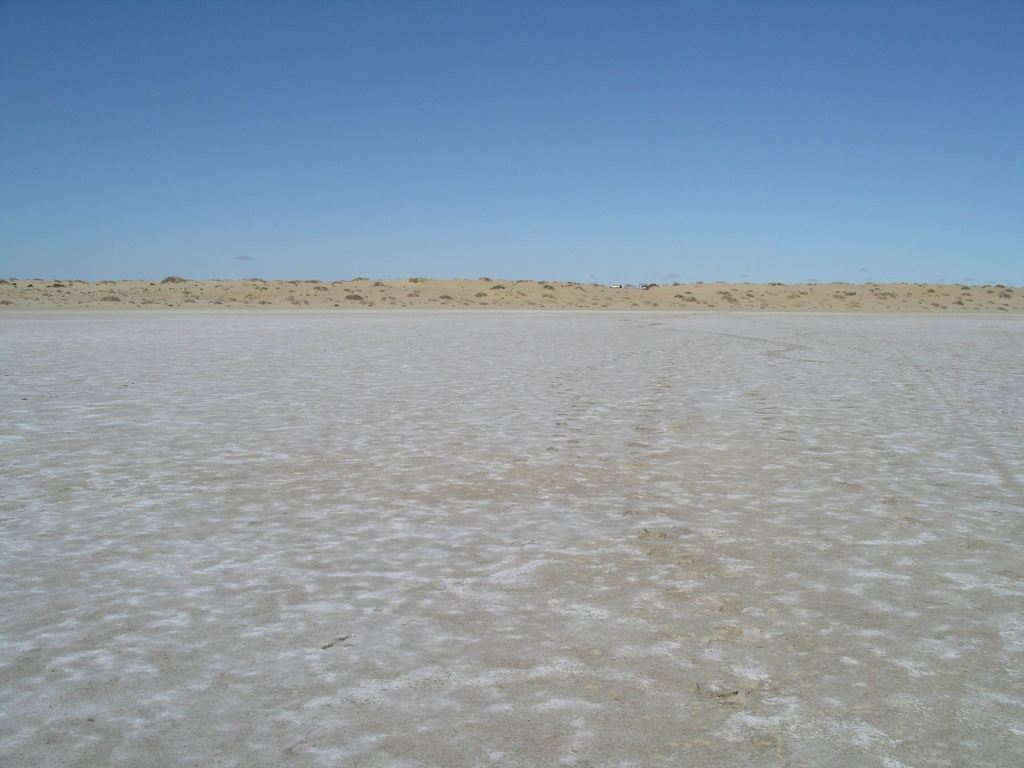
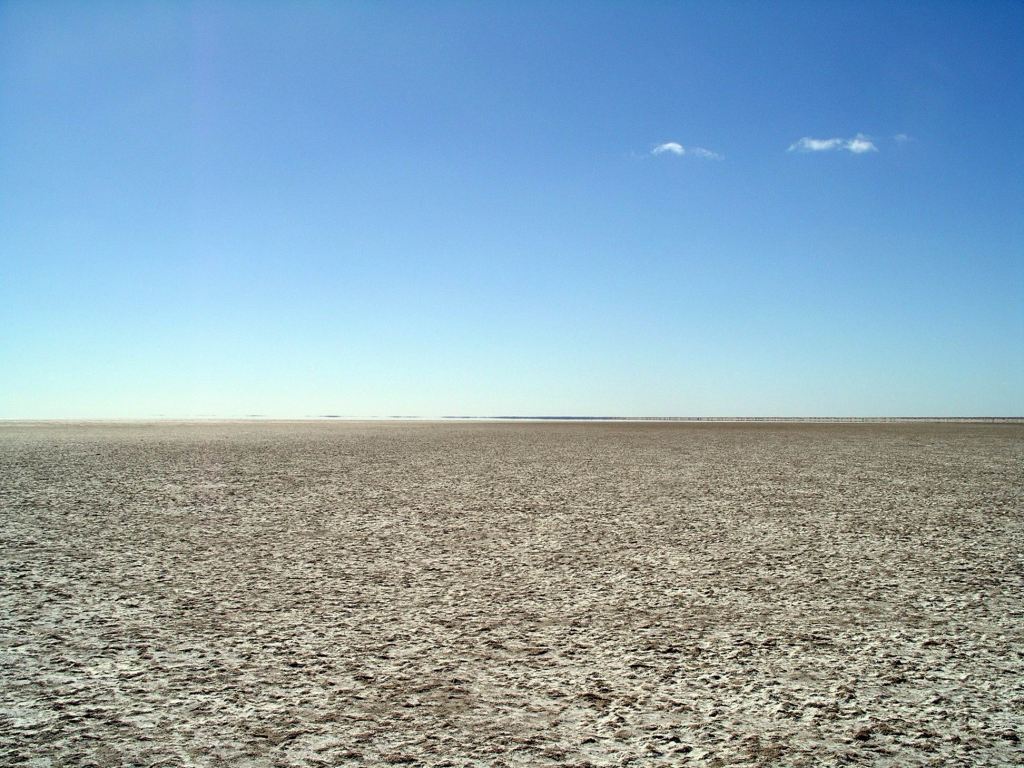
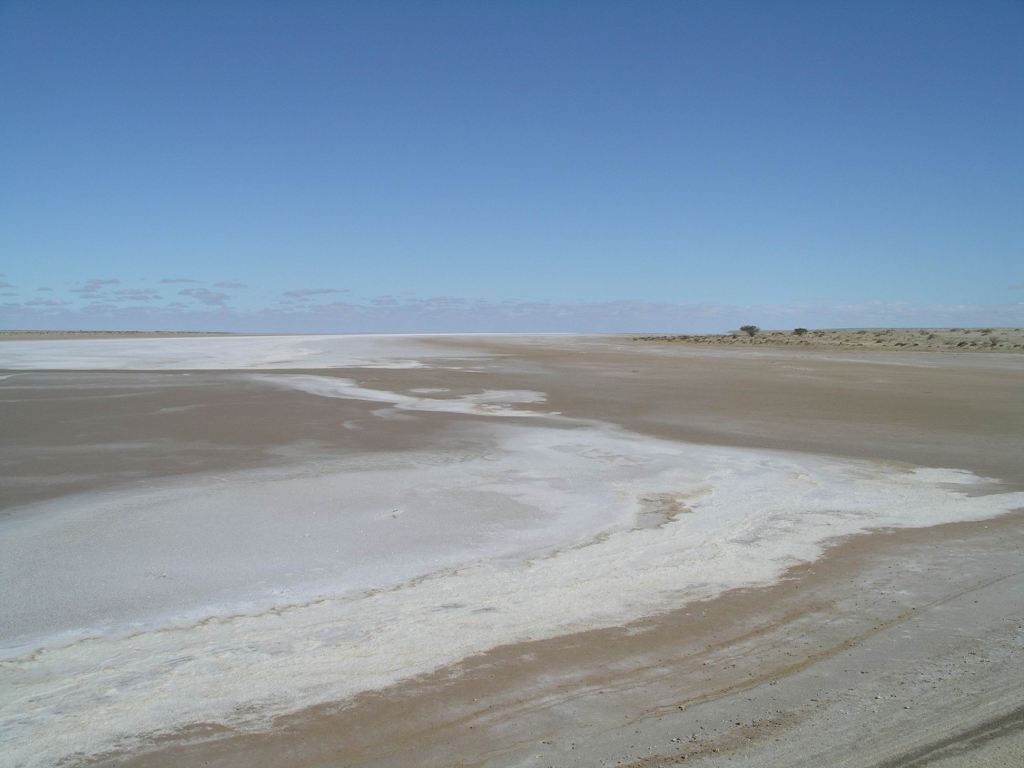
We were able to walk out on Lake Eyre North, for a few hundred metres. It was muddy, under the thick salt crust.
Out on Lake Eyre – looking back to our vehiclesThe salt surface of the lake
It was disappointing to see tracks out on the lake surface, where vehicles had been driven out from the parking area. There was always some moron who has to do what signs explicitly instruct them not to do!
Level Post Bay and Madigan Gulf
We ate lunch out there, sitting up on the bank, looking out over the lake bed.
Drove back a short way, to the Goyder Channel that links the two parts of the lake. Walked around, took photos.
Goyder Channel
There was a built up wide causeway across the channel here, not open for public vehicle access, but we were able to walk across on it. Presumably, it was used by the station people to access that part of the property and to move stock.
It would actually be quite something, to visit here when Lake Eyre was full enough for there to be water in Madigan Gulf and flowing through the Goyder Channel. I filed that in the mental wish list – but in the section that I recognized as fairly unlikely to happen!
Goyder Channel – dried salt, not water….
And so, back to Marree – with a couple of us thinking wistfully of the serenity of the Muloorina campground!
All up, we travelled 200kms. John refuelled back at Marree – $1.45cpl.
There had still been some cloud about today, but we had stopped on the way back in, to tune in to the 3pm road report on our HF radio. It had the Painted Desert road access open again, but with caution at Arkaringa Creek. Good! Maybe it would be nice and dry by the time we got up there.
Today’s jaunt had certainly been worthwhile and enjoyable – and new for all of us.
There was not far to go today, so we took it in a very leisurely way. Took our time packing up and didn’t pressure M to hurry getting her tent and all packed up.
Only a few kms north of Copley was the open cut Leigh Creek coal mine – the reason for the existence of the Leigh Creek township.
Open cut coal mine Leigh Creek
We had a bit of a browse about, at the lookout over the open cut mine. Some of the old machinery there was of interest, if only because of its sheer scale. The old digging machine dwarfed Truck and van. We took some photos to show the grandkids later, thinking they would be impressed by the size contrasts.
A tyre that was on display had set a world record for the time, racking up almost 300,000kms. And we think we’re doing well if we get a quarter of that on our Truck tyres!
The mine was a very massive hole in the ground. The coal mined here went by train to Port Augusta, to the power generation station there.
The village of Lyndhurst was the next point of note on our way north, really only because it is the southern end of the Strezelecki Track, to Innamincka. Signs indicated it was still closed.
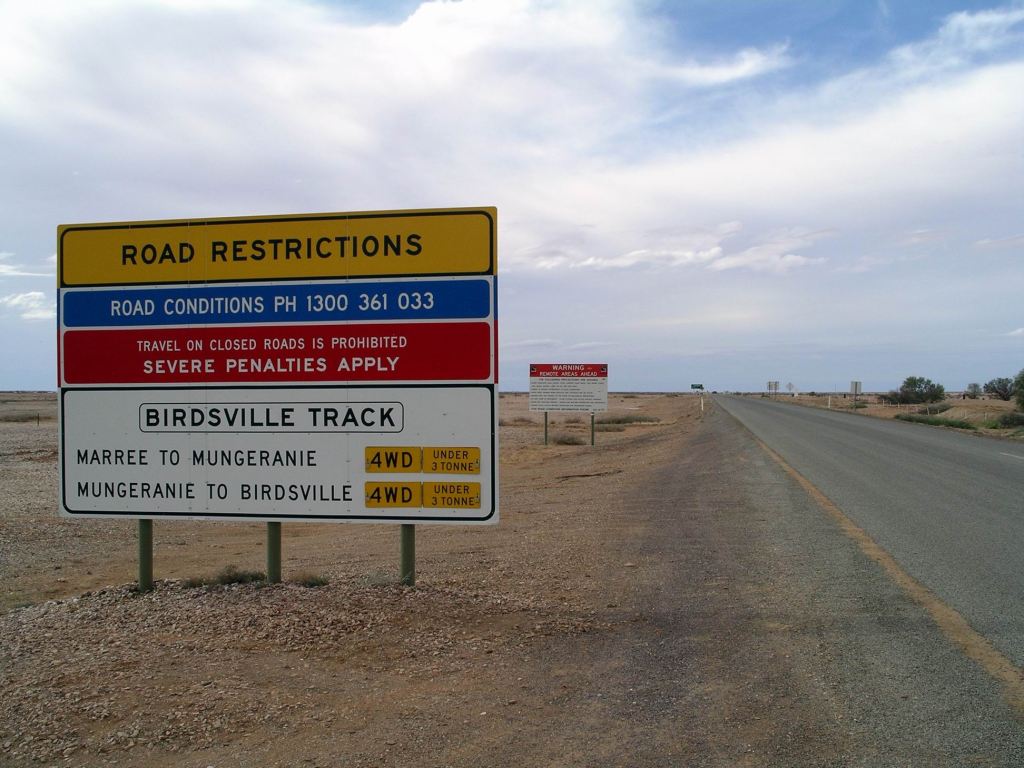
So, on to Marree, a rather desolate little township. On the outskirts, signs showed the Birdsville Track was open only to lighter 4WD vehicles, so, clearly it too had been affected by the recent rains.
We booked into the Drovers Rest Caravan Park, which had the advantage of being a good distance away from the township centre i.e. the pub and associated noise. This park was set up by the former boss drover, Eric Oldfield, who spent much of his life droving cattle on the Birdsville Track. We had stayed here before.
Marree in the background
Our powered site cost $20. We found slightly shaded sites to set up on; gravel surface of course. The amenities were still the very basic Atco donga ones, with their strange arrangement of showers of dubious privacy. There was a sort of arrangement of shower curtains, but it was best to try for a shower when no one else was in the building!
Only needed a basic camp set up here, so that did not take long. We had a quick lunch.
Walked into the centre of the township. Marree was quite sprawling – quite a lot of space between buildings and features.
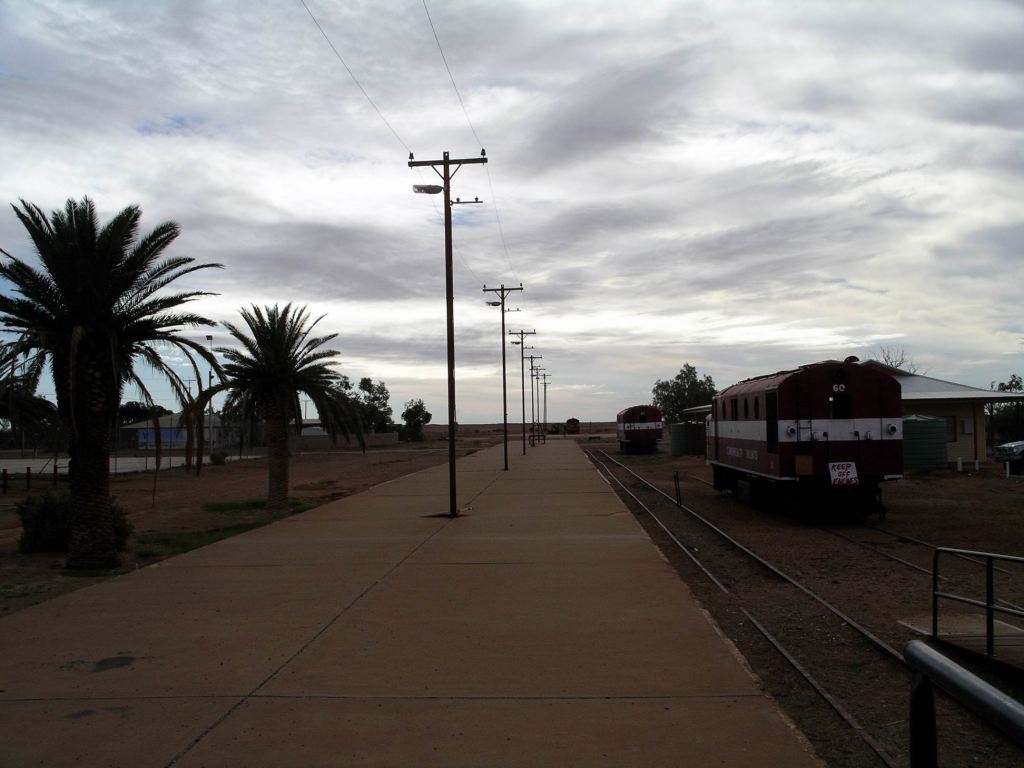
We made for the old railway station, which dated from when the original Alice Springs – Ghan – railway, passed through this town. Like Beltana, it lost out when the railway was moved west. Marree was also a railhead for the movement of cattle from the north, which were walked down the Birdsville Track. Here, they were loaded onto trains and taken to the southern markets.
There was old railway memorabilia – you couldn’t really call it “on display”. It was just there. One could but hope that sometime soon, some effort would be made to mount a proper display. It could be really interesting.
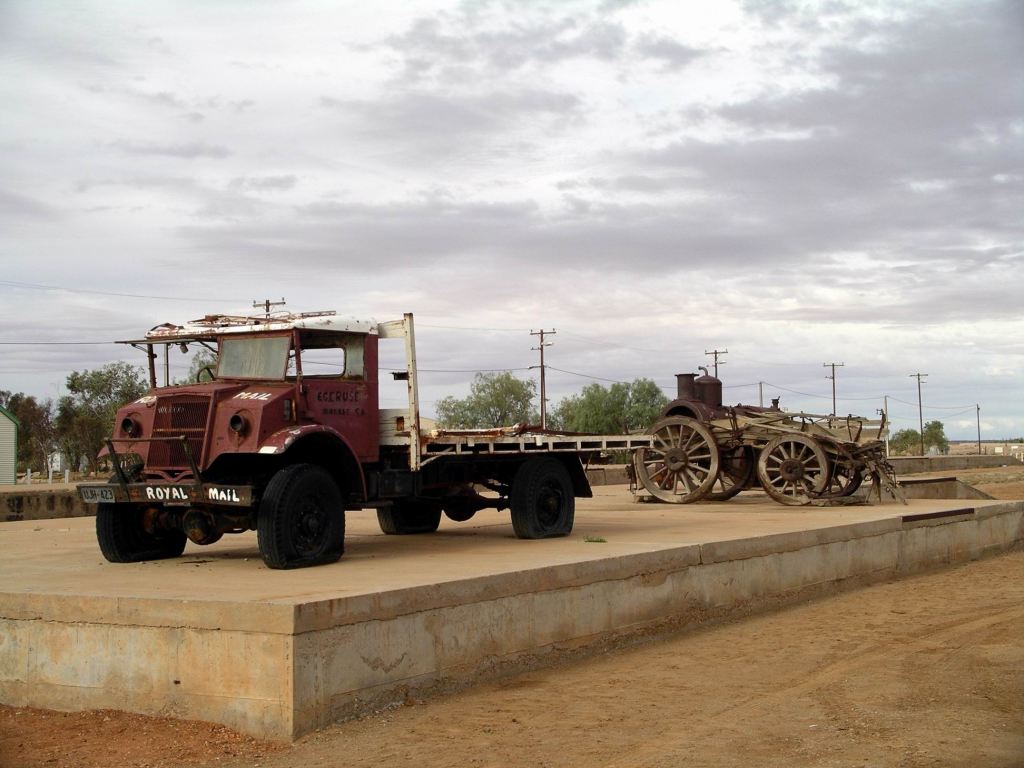
Tom Kruse, the famous Birdsville Mailman, took mail and supplies up the Birdsville Track, from the 1930’s to the mid-60’s. Each of his mail runs took two weeks, covering really challenging terrain in often difficult conditions. He was a really important person to the isolated cattle stations along the track from here to Birdsville. One of the trucks he used was on display here.
It was a pleasant walk to the township, and back.
Road reports had the Painted Desert Road – out of Oodnadatta, which we hoped to take – still closed. Could but hope that, over the next few days, it dried out and was reopened.
Drovers Rest Caravan Park, Marree
The night was really chilly. There was still some lightning to the south east. It was definitely a night for the woolly bedsocks!
I played computer mahjong until 1am – addictive game – then slept very well.
M and I both rose at a respectable hour. While John slumbered on, we each did a load of washing. The chores had been neglected for a while now. You know it is time to act when you have to start inspecting the used undies in said washing basket to find some that could be recycled!
Once John was up and breakfasted, and had pottered about for a bit, we went for a walk to explore Copley, in part because we had time to fill in before going back to Leigh Creek.
It did not take long! We bought an early lunch at the bakery, which was reputed in travel write ups as a must patronize place. John had a pastie. I had a sausage roll – which turned out to be still semi-frozen in the middle! I would not be recommending the place!
Drove to Leigh Creek to stock up on the fresh produce, which came in on Wednesday mornings. There was a much better selection of fruits and vegetables now, plus fresh bread (which the bakery didn’t have).
Took our bounty back to camp, then turned around and drove to the Heritage township of Beltana, some 35kms south of Leigh Creek.
A few of the buildings here were still occupied, but others were ruins.
Beltana
The town was a thriving little one in the late 1800’s and early 1900’s. There were copper mines to the east to supply, as well as a few local pastoral operations. The TransContinental Railway to Marree and then Alice Springs, passed through it, as did what passed for the main road.
But the copper mining declined. From the 1940’s coal was mined at Leigh Creek and a township established to service that. In 1980, the railway closed down, when the new route was established well to the west. Then the road alignment was shifted a few kms to the west – now one must detour from the main road to reach Beltana.
We wandered about Beltana for a little while, studying ruins, taking photos.
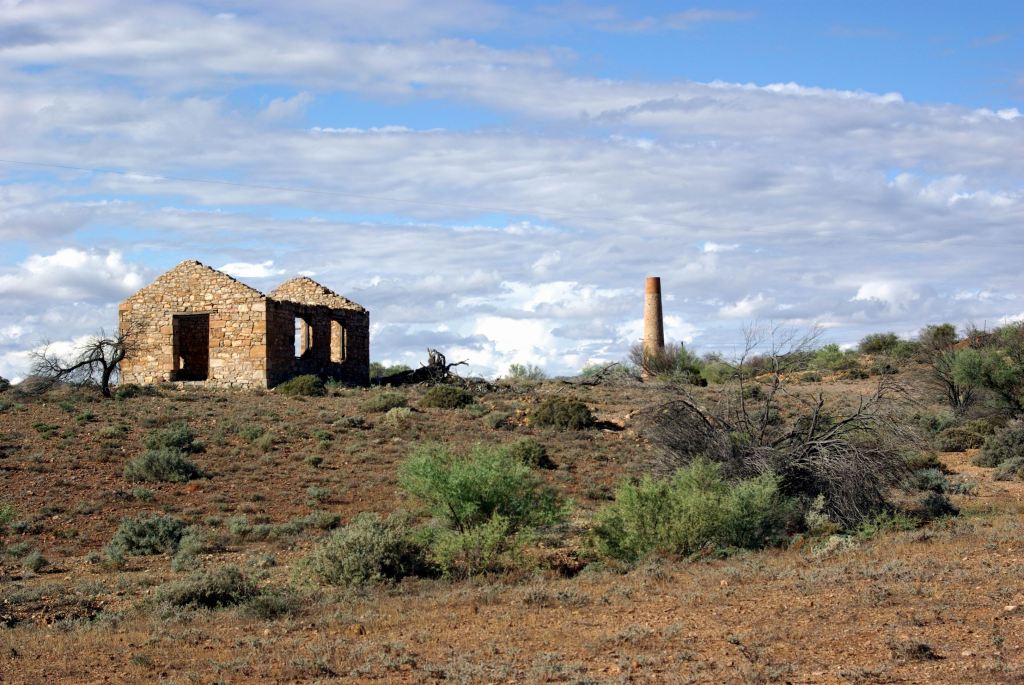
The ruins of the copper smelter and settlement at Sliding Rock, 22kms east of Beltana, was our next stop. It was a little tricky, finding our way out of Beltana to the road we wanted – tracks everywhere and little in the way of signposts. (Last time we went out there, it was kind of by accident, so I didn’t really remember the way). We crossed the dry creek bed and headed in what looked like an easterly direction. It turned out to be the Warraweena road, which was what we wanted. The gravel road out was in good condition.
The copper mine at Sliding Rock started up in 1869. The ore was so promising that a smelter was built out there, and then a second one. A little township grew up near the mine, during the 1870’s and was gazetted as Cadnia.
Unfortunately, the early optimism proved premature – copper prices fell, the smelter machinery was prone to breakdowns, transport was difficult, underground water in the mine shafts was a major problem. By the early 1900’s, the mine was closed and people were moving away to other places. The school house at Cadnia was moved to Beltana.
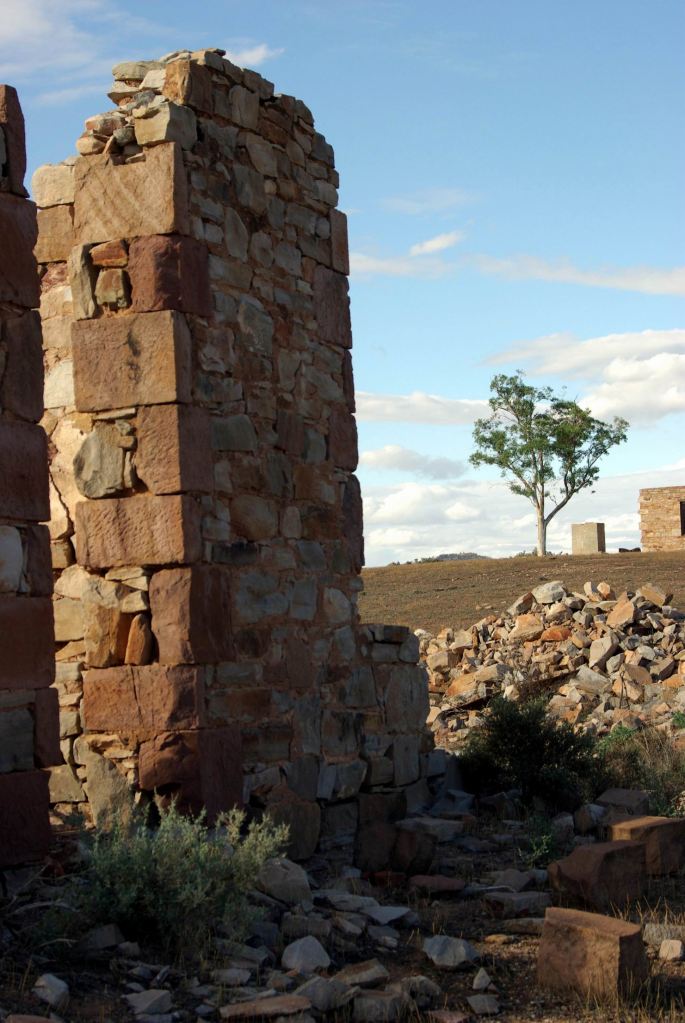
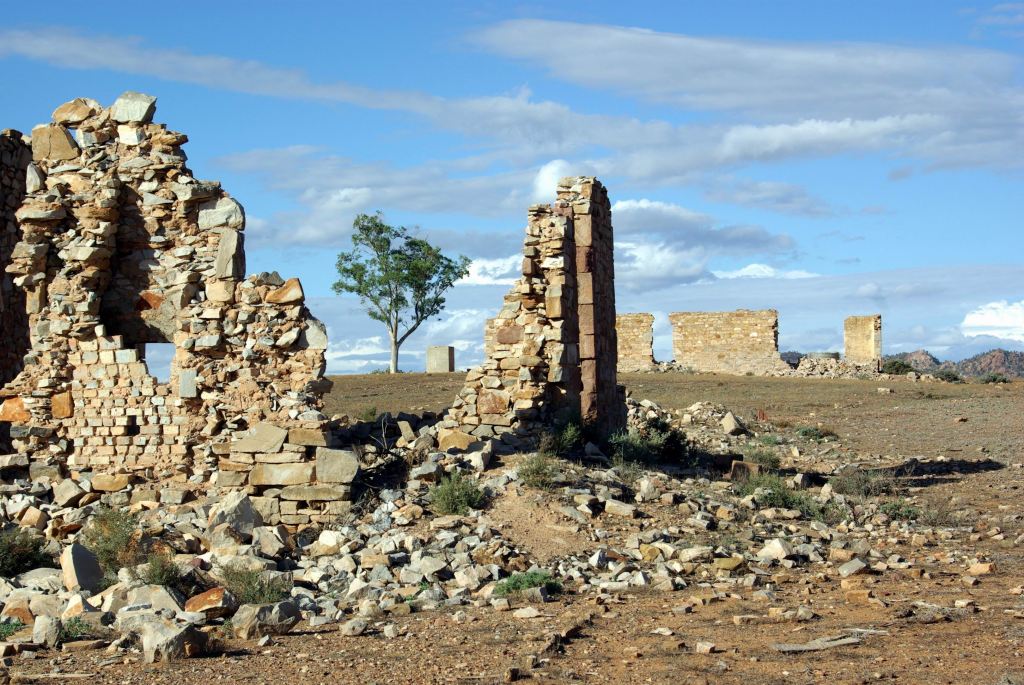
Now, it is just a collection of very picturesque ruins in a brilliant setting.
On one low hill are the remains of the smelter complex, and some distance away, on another rise, the township ruins.
We wandered around the very scenically set ruins for a couple of hours.
Sliding Rock
This place is only about 30kms in total from the main road, on good gravel roads, but it was a measure of how far off the normal tourist trail it was, that in our time out there, we saw no one else. But then, I guess the same could be said of most of the places we went at Arkaroola. But it seemed to me that travellers going through Leigh Creek and Copley are focussed on “the Tracks” – Birdsville and Oodnadatta – and do not stop to explore en route. They miss some gems.
A few kms further along the track from Sliding Rock is the Warraweena Homestead, which we had visited on a previous trip. Sliding Rock is located on the Warraweena property,. a former pastoral lease now turned conservation land. Next trip up this way, we thought we’d like to utilize their bush camping area and explore tracks further east of here.
Drove back to Beltana and, for something different, took a dirt road north that follows the old rail alignment through Puttapa Gap and so back to the main road. That was an interesting way to go.
John refuelled Truck at Copley – $1.43cpl.
We were back at camp in sufficient time for me to roast a chook for dinner – in the electric frypan, outside, as I always do my roasts when travelling and on external power.
While dinner was cooking, and M and I were getting our washing off the line, John downloaded the photos that HE had taken, to date, on the new Pentax digital SLR camera that was MY Xmas present! He was very pleased with the results, especially the ones he took out at Sliding Rock today. He named them and burnt a backup copy to a CD.
We made some phone calls. Sent emails to family and to house sitters asking for mail to be forwarded to Alice Springs.
There was an email from the construction company we had worked for, saying they were about to pay in John’s super – it had been held up for some reason, whereas mine had been fine. Almost $4000 worth – wonderful!
Through the evening, we could see much lightning flashing away in great sheets across the sky, to the east and south-east. Apparently Broken Hill, Tibooburra and Poochera all had heaps of rain – and very large hail stones. We fervently hoped that weather system did not migrate north!
After last night’s grand finale, it was time to depart Arkaroola!
With only 130kms to go, we could afford a leisurely pack up. There was quite a lot of wet stuff – our awning, but especially M’s living tent.
At the office, I handed in the Visitor Survey form that we had been asked to complete. I thought that, after eleven nights here, we could give a more accurate assessment than many campers! I was critical of the quality of the Reception staff who, a lot of the time, seemed totally disinterested in what they were doing and in us and our tourist experience there. In tourism operations, front-line staff are so important….
The Road Conditions board just outside Arkaroola indicated that the Strzelecki Track was closed. Good thing we were not planning on going to Innamincka.
The many little floodways/dips between Arkaroola and Balcanoona – some of which we hadn’t even noticed in our previous drives – had received a water flow during the night, evidenced by debris on the road. Even small rocks and bushes had been moved! Some still had a little water in. The amount of run-off there had been surprised us. Maybe it shouldn’t have, given how much run off ran through our camp!
Balcanoona Creek was still flowing – good to see. The ‘roos appeared to think so, too, judging by the numbers we saw.
After Balcanoona, the way was much drier, and the road surface was pretty good.
It was a scenic run, for much of the way.
Balcanoona-Copley road
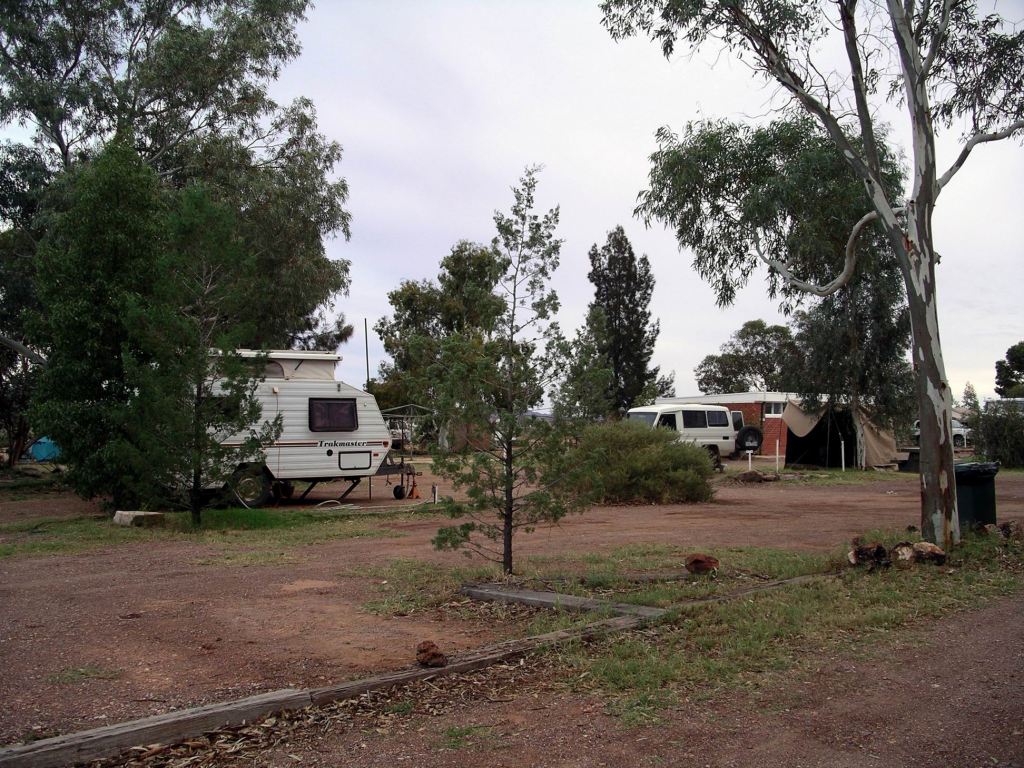
We booked into the Copley Caravan Park for two nights. Our powered site cost $22.50.
After setting up and having lunch at the van, we drove to nearby Leigh Creek, to shop for food.
Copley Caravan Park
Copley was really just a small village, with a very pleasant caravan park. There was a hotel and bakery, and a bit of a general store, but we needed to do a serious re-stock. Leigh Creek, 12kms away, was one of those soul-less purpose built mining townships, containing the supermarket we needed.
Even though the fresh produce, we found, was not due in until tomorrow, I still managed to spend $256 at the supermarket! Well, it was nearly two weeks since the last re-supply, and should be at least a week before the next. We would have to go back tomorrow for bread, fruit and vegetables.
Visited the Information Centre and picked up some brochures and maps. They were selling locally stencilled T-shirts – remainders, I thought. $5 each – can’t go too wrong at that price. They had a sort of stylized serpent on the front. I bought us one each – a nice dark green and a navy – good for not showing the dirt, which was a pre-requisite of travel clothing for us.
There was a group of indigines staying at the caravan park – led by the well-known Geoff Clarke, who came over to chat to us whilst M was setting up her camp. He was not as tall or big as he appeared in the media. He was taking a group of youths/young men from down Yambuk way to become acquainted with “outback” aboriginals. He did not really explain what this was supposed to achieve.
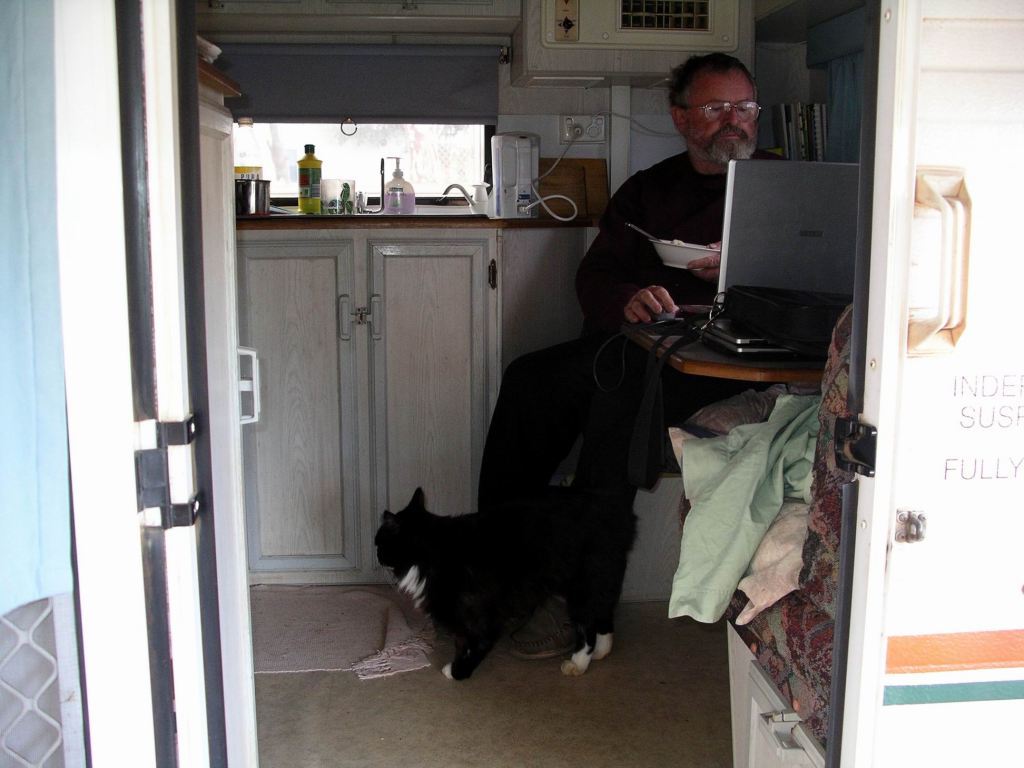
Late in the day, John was working on his laptop, in the van, with the door open. He was visited by a black cat. It just strolled in as if it was totally entitled and proceeded to make itself at home. Was this some sort of omen?
Do we want a caravan cat?
Through the evening, we could see flashes of lightning away to the south east.
Leigh Creek coal mine visible on this satellite photo




















 This Adventurous Age