It was a hot, sunny day, with just some scattered light cloud.
After breakfast, we walked up to Reception, at the main complex. Maybe the campground was a bit further away than 500 metres?
We looked at displayed information and collected walk leaflets. Booked ourselves in for tomorrow’s Ridge Top Tour.
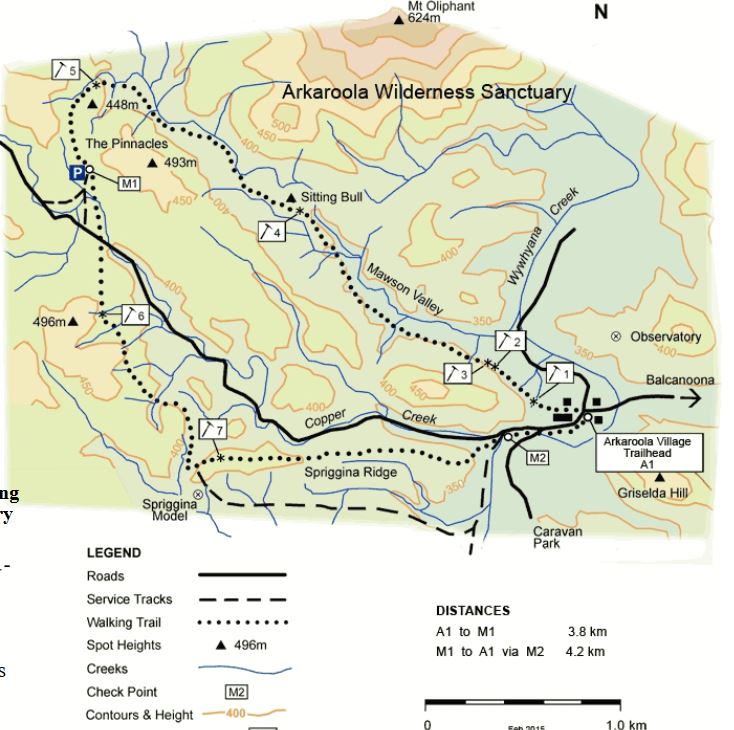
Decided to do the walk that went along the Mawson Valley to the Pinnacles, and return by the Spriggina Track. It was an 8km circuit – a reasonable stroll! After walking back to camp to get organized with things like first aid kit, drinking water, muesli bars, cameras, our proper walking boots, we then had to walk back to the village centre again, to the trail head. So that was a kilometre walked, before we’d even started!
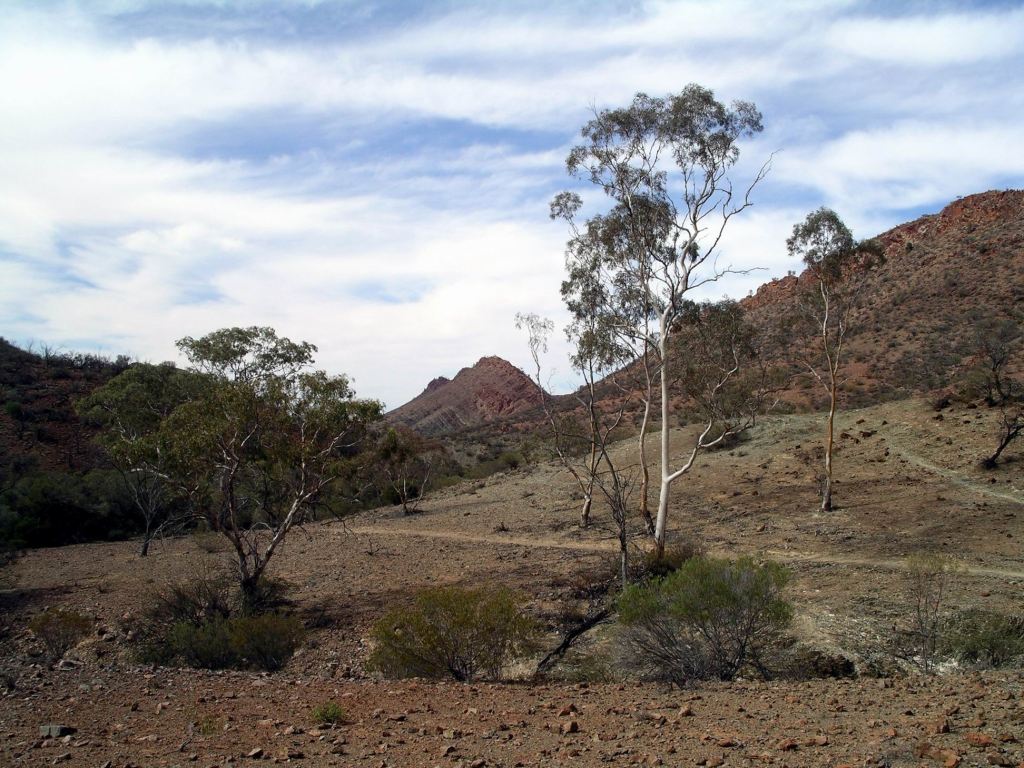
The first part of the trail paralleled a little, dry, creek. It was attractive and photogenic, with a surprising variety of vegetation – almost none of which I could name. Mt Oliphant was off to our right.
Mt Oliphant
Around half way to The Pinnacles was the granite outcrop of Sitting Bull, named by Douglas Mawson in 1945.
Sitting Bull
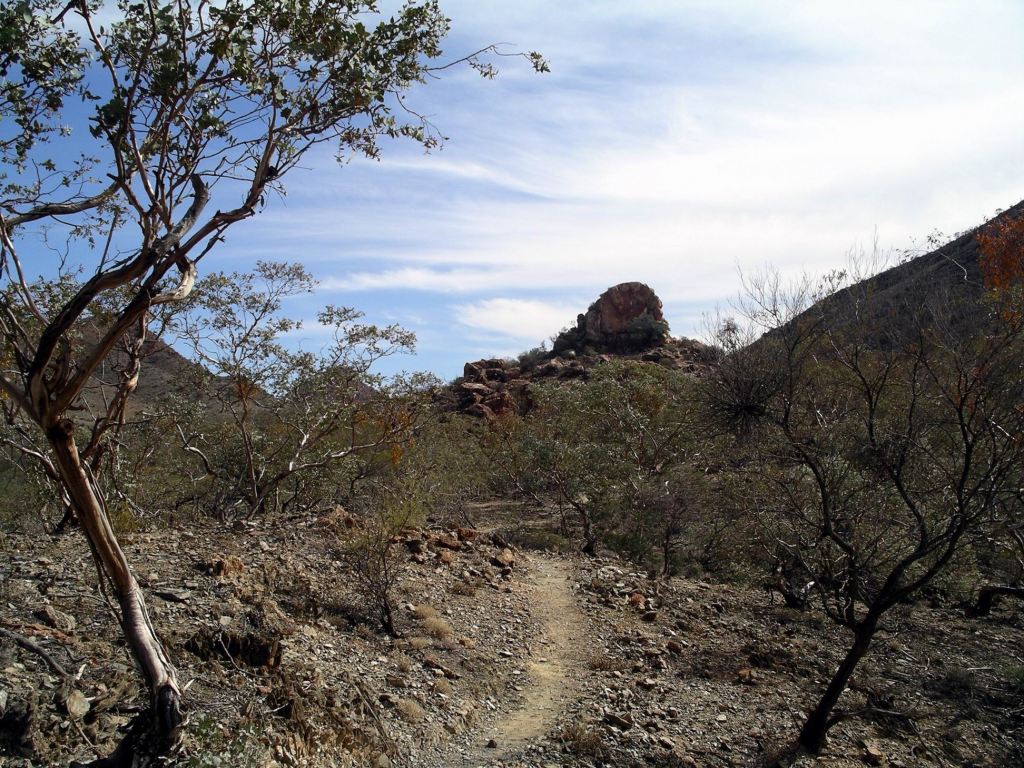
The track flanked Sitting Bull and soon we could see The Pinnacles – similarly, granite. These were all intrusions, or plugs, exposed when the softer surrounding land was worn away.
Track flanking Sitting Bull on the way to the PinnaclesPinnacles
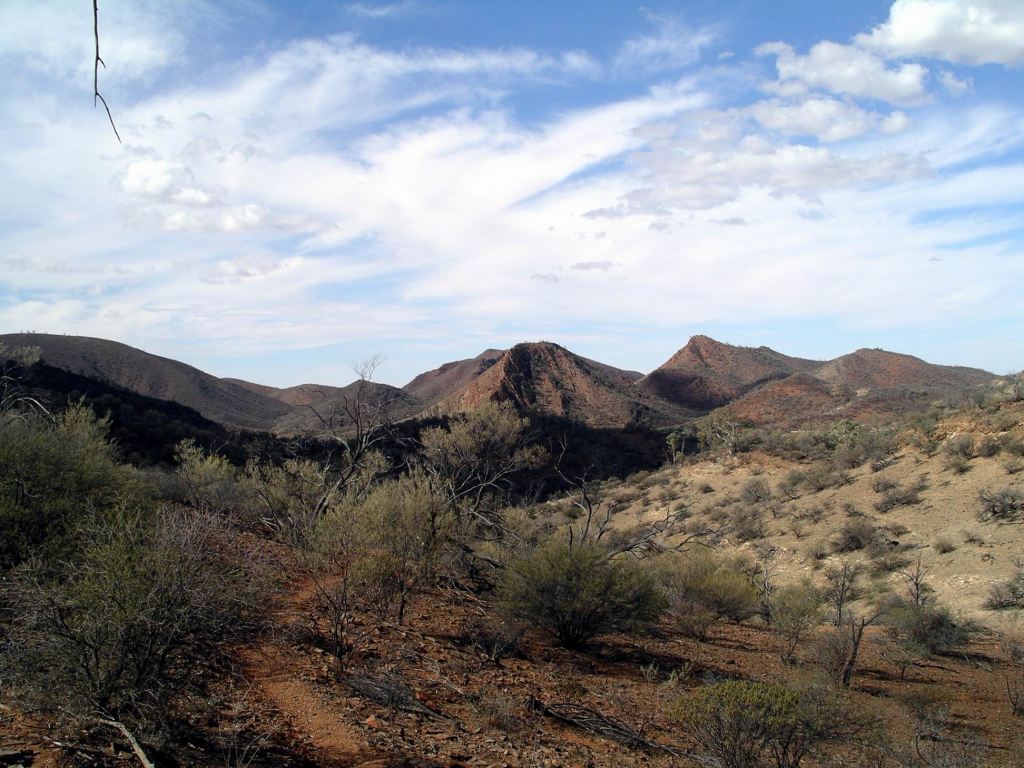
From The Pinnacles, we followed a track back to the Bolla Bollana road, crossed that, taking a trail towards the Spriggina fossil replica, then followed low ridges back to the campground. Taking this trail meant that we avoided walking back on the road, but it was more open, hot and less attractive than the first part of the walk had been.
On a flat area below the trail, so walkers could look down on it, Reg Sprigg had built a much enlarged replica of the Spriggina, an ancient fossil that he discovered in 1946, west of Beltana. It was like a worm and was the first animal fossil discovered to have a definite head. It was one of a most significant group of fossils found around the Flinders Ranges area, called the Ediacara Fossils – for the geological age when they crawled around on the sea floor. They were the first multi-celled animals to appear on Earth, some 600 million years ago.
The Spriggina replica (Zoom)
From the last part of the trail, as we came along the ridge, there was a really attractive view of the campground, with Griselda Hill behind it.
The campground and Griselda Hill
John found the latter part of the walk hard. Neither of us was very fit, after the ailments of the past few months. The shingles that John contracted, back in February in the Pilbara, really knocked him about. I was hoping that a recent cortisone injection had finally fixed the troublesome Achilles tendon that plagued me all last year. I was pleased with how it stood up to this walk – a positive sign. M, of course, the former PE teacher, was totally fit and agile!
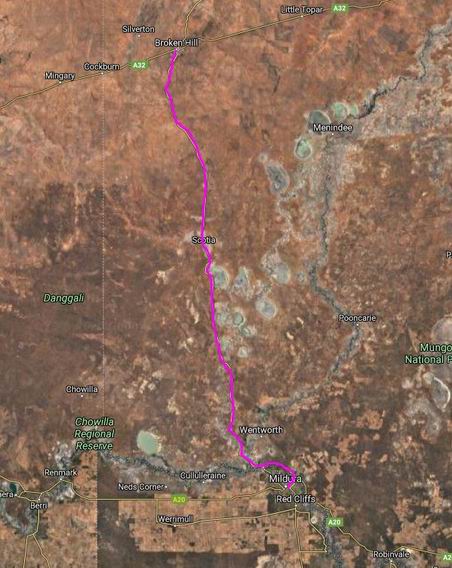
The route of our walk
We had a late lunch back at camp and relaxed in shade there for the rest of the afternoon.
M drove up to the mechanic’s to collect her repaired tyre. They had found there was a hole in the inner tube, caused because some drongo at the tyre service place, back home, had left a valve cap inside the wheel when her new tyres were put on, last week! Why is it so hard to get competent workers?
There were notices up, that the Gammon Ranges National Park, to the south, would be closed for feral and weed control work, in a week’s time, so we would have to do all that we wanted to, there, before then.
As we pored over maps and brochures, I was already suspecting that a week would not be long enough, here.
Tonight, sitting outside, we faced the other way and watched the moon rise over the hills. The moon always seems larger, here. The stars are certainly brighter.
Today was my son’s 33rd birthday. We’d acknowledged that before we left home.
We packed up and hitched up as efficiently as we could, with a big trip ahead of us today.
It was a long day of driving – on the Barrier Highway to Yunta, then on dirt roads north past Frome Downs Homestead and Balcanoona, and on to Arkaroola. The roads were firm gravel and, for the most part, pretty good to drive on. Some of the sign-posting, or lack thereof, left a bit to be desired.
Topped up the fuel again at Yunta – now, in SA it was $1.29 cpl.
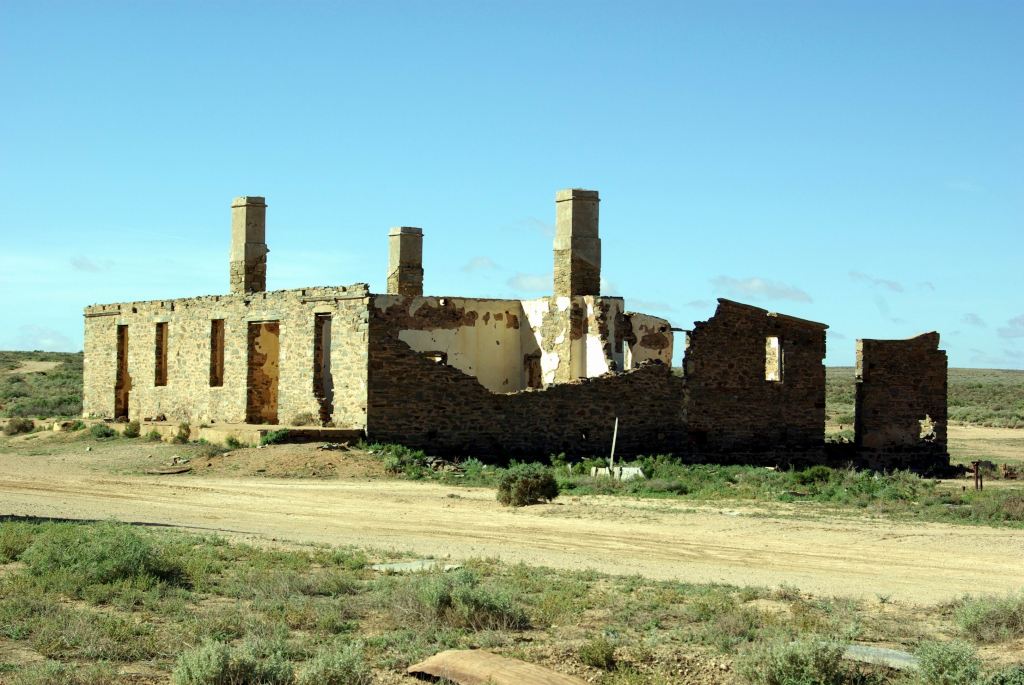
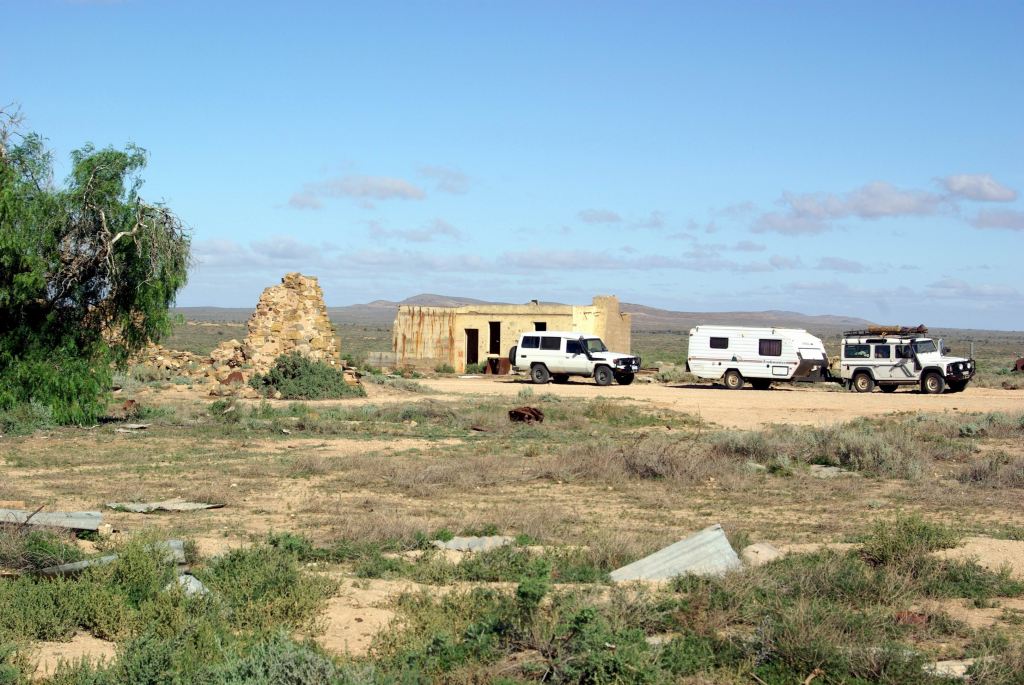
Some 34kms north of Yunta were the Waukaringa ruins. We spent about an hour browsing around these.
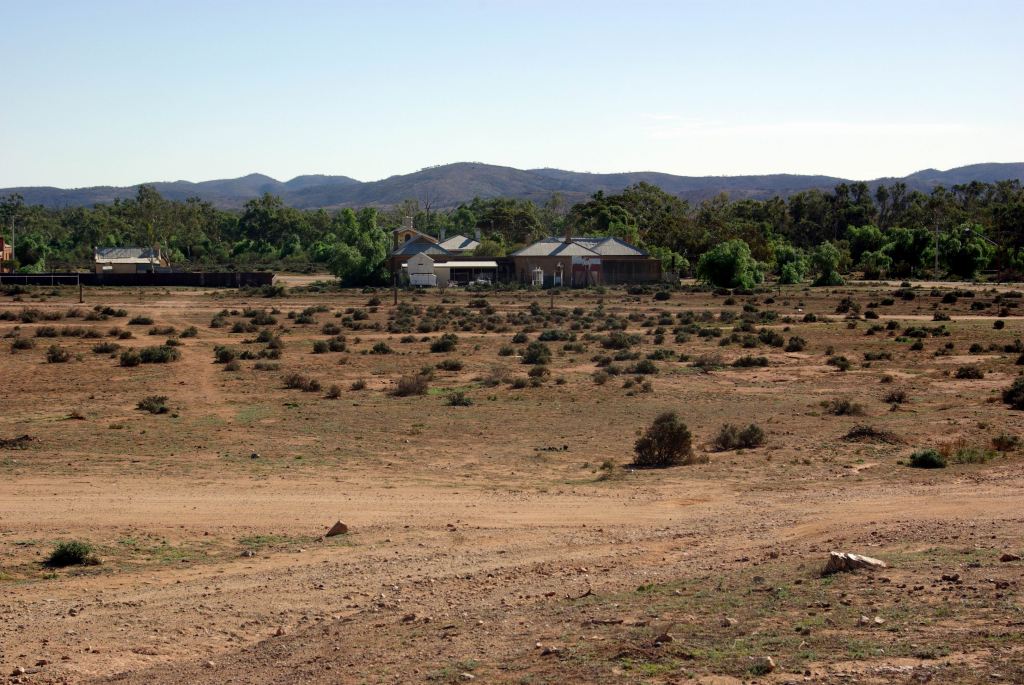
Hotel ruins Waukaringa
In the 1880’s, a gold mine was established here and a township grew up rapidly, as tended to happen when there was a promising find. By 1890, it had a population around 500 people. As the gold petered out, the population dwindled. The hotel licence, however, was not surrendered until 1964.
The skeleton of the old hotel was the most obvious ruin, but there were others, plus mining relics, scattered around and up on the low ridge where the actual mines were.
It was evident that the area around the hotel ruins was sometimes used by campers.
Further on, we stopped to eat lunch, near the dry Wilpena Creek ford, just beyond Frome Downs.
Of course, after we started off again, there was a spot that would have been better, with a few trees by another dry creek.
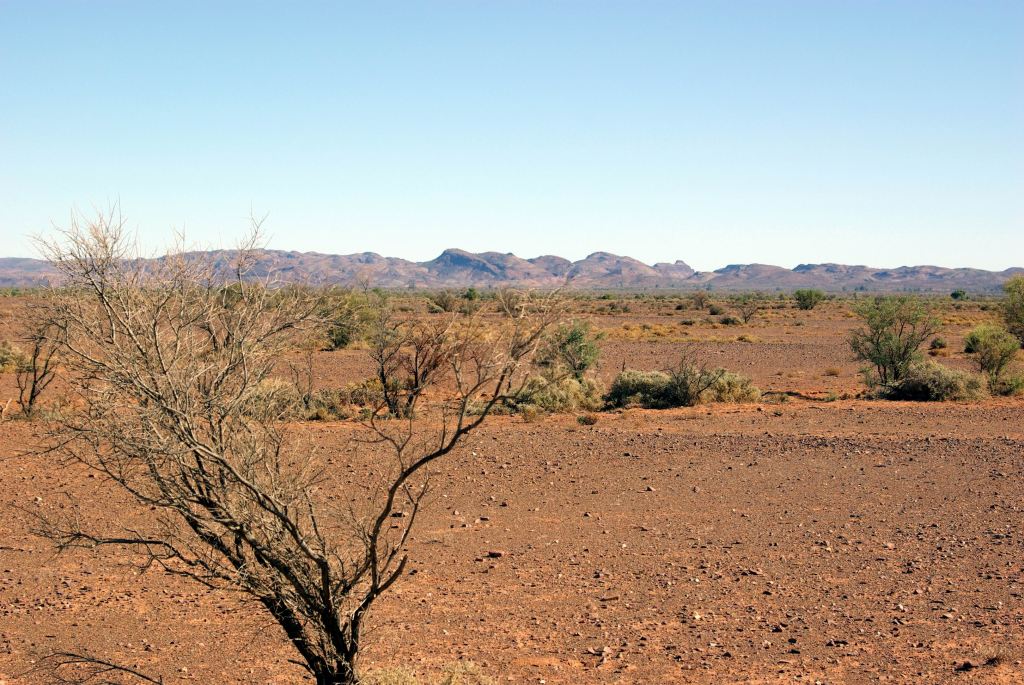
Although we were traversing flat, stony country, in the distance to the west, was the line of the Flinders Ranges.
Flinders Ranges – well to the west of our road.
The road crossed a gas pipeline, from the Moomba gas fields near Innamincka. Here was a bit confusing. A road runs alongside the pipeline and it looked like we should go right, but the correct way was straight ahead. For once, I got it right!
As we progressed north, the flat, barren, stony plains were replaced by more rugged country, with more ranges apparent. This really was an interesting drive. We crossed a number of dry creek beds, many with low trees and scrub growing along them, and then red gums. Essentially, we were skirting the western edge of the dry salt Lake Frome, but at a distance sufficient that we could not see it.
Balcanoona, once a sheep station, is now the base for the Rangers of the Gammon Ranges National Park, which takes in country mostly to its north and west. Arkaroola, where we were heading, is about 30kms north of Balcanoona, and just on the eastern edge of the National Park.
I had hoped to stop at the Ranger Base, to see if I could get any information about the National Park that I didn’t already have, but John wanted to push on. He could see the end to the day’s driving almost in sight!
We got into Arkaroola mid-afternoon, so we had made good time. We parked near the Reception area of the outback resort that is Arkaroola and booked ourselves into their campground. As well as this, they had motel style units and some cabins – so a range of accommodation. The campground was about 500 metres distant from the Village hub.
Our powered site cost $20 a night and, because we booked in for a week, the 7th night was free. M was only charged $15 a night, because she was travelling solo – so many places will not make that concession, even though it seems fair. John and I had visited Arkaroola a few times previously – it was a place we loved – but this was a first for M. Hence the longer stay.
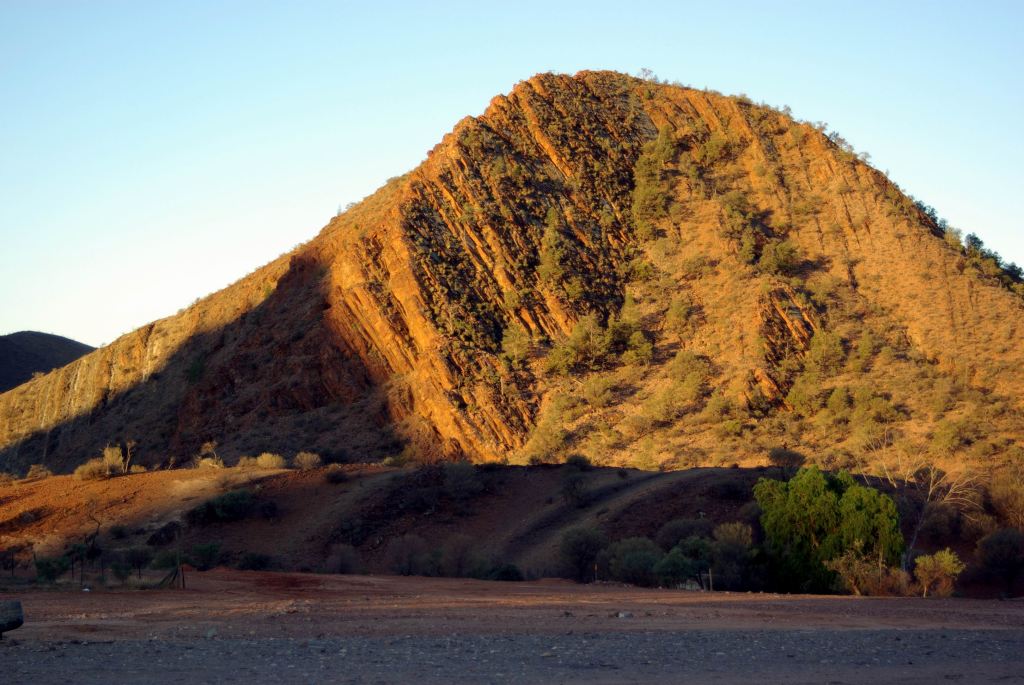
We had a pleasant area, designed to take two outfits, on the top level of the tiered campground, with a great view across the very scenic area to Griselda Hill and the surrounding ranges. The camp ground felt very much as if it was in a pocket, surrounded by stark and rugged hills.
Griselda Hill, from our camp
The campground was gravel surfaced, as one would expect in such an arid area.
Our site had a fire pit and BBQ plate and there was a bore water tap. We did not hook up to the latter, as we preferred the better quality of our own tank water, but filled containers from it for washing up. The nearby amenities were dated and basic, but spacious and clean. Let’s face it – really, all one needs are a clean and functional toilet and shower. Frills are able to be dispensed with.
We set up for our extended stay. The afternoon wind made putting up M’s living tent a bit tricky. We needed the 4 inch masonry nails that John carries, to anchor the tent ropes in the rock hard ground. From memory, it was actually one of our earlier tent based camping trips to Arkaroola, that got him into the habit of carrying the masonry nails – for places like this where tent pegs just did not have a hope!
Whilst M slept in the Troopy, it was not set up inside as a camper. For overnight stops she made do with her camp stove on a small folding table, but when staying longer, set up a tent for cooking and living in. This system had evolved over the previous couple of years of travel, but she was yet to get the right mix of convenience and comfort. A work in progress.
The van had travelled well. With the pressure scoop hatch open, and cardboard taped across the vent in the lower door, very little dust had gotten inside, though we’d done about 300kms on dry and dusty surfaces.
Almost immediately upon arrival at our site, M’s front tyre went flat. After setting up, we changed it and she took it up to the resort complex to the mechanic facility there, for repair.
We sat outside together, to eat tea, and stayed there for a while, after. We hadn’t thought to gather firewood on the latter part of the drive here, but would rectify that sometime soon.
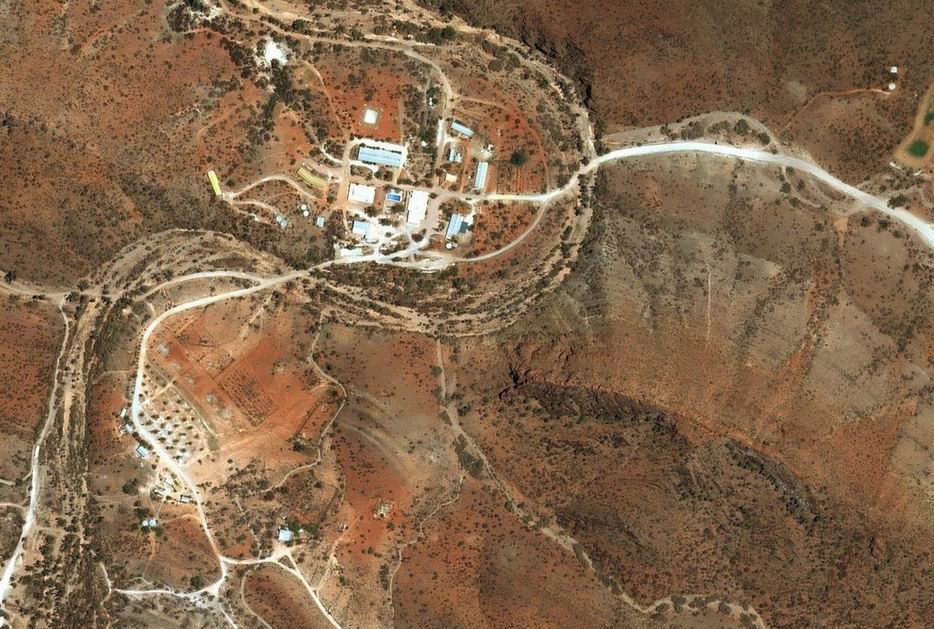
Arkaroola Resort complex at top, campground lower left, showing formal sites, with large unstructured camp area beyond it. (Zoom)
Unseen by us, the full moon rose behind us, but we were busy admiring the myriad of stars spread out above us. The skies here were so clear that Arkaroola has two proper astronomical observatories.
We finally felt like we were getting away from the rat race again!
Arkaroola has an interesting history. It sits in the midst of a really ancient landscape, buckled and tortured over time. Some of the geological structures here are 1.6 billion years old, pre-dating animal life on Earth. Europeans moved into the area in the 1860’s, chasing copper, as happened in other parts of SA too. As was common, the mines did not last long, but their relics are dotted about the area now.
From the early 1900’s, it was a sheep run, in very marginal country.
The ancient rocks of Arkaroola contain unusually formed radioactive deposits and “hot rocks”. Uranium was found and briefly mined from 1910 – with great difficulty given the terrain. The events of WW2 led to a revival of uranium exploration and mining on Arkaroola.
In 1968, the Arkaroola Pastoral Lease was bought by the Sprigg family, with the aim of setting up a Wilderness Sanctuary. The very interesting and talented geologist, Reg Sprigg had visited the area with mineral survey parties and with (Sir) Douglas Mawson of Antarctica fame. He became convinced of the unique nature of the area and the need to act to conserve it. Back then, such private sanctuaries were unusual, but the government of SA was not prepared to buy the property. A huge effort was then made to get rid of the feral animals that infested the place and threatened both its fauna and flora. The development of the tourism aspect of Arkaroola was a means of partly funding the place, but also showing visitors its special qualities. The Sprigg family still runs Arkaroola.
In this region, of course, the Flinders Ranges and Wilpena Pound are the best known tourist destination. The more rugged and arid Arkaroola and Gammon Ranges are much less visited – in part, because of the unsealed access roads, in part perhaps because visitors assume they have “done” the Flinders Ranges and hence there is no need to look further. They don’t know what a superb area they are missing!
Today we drove out to Silverton, 25kms to the NW. We had been here before, but it was new territory for M. Much of this trip was going to be about introducing her to new places.
Silverton began, as the name suggests, with a silver mining rush in the late 1800’s. However, it was soon eclipsed by the richer finds in Broken Hill. Most of the population left – often moving their houses to Broken Hill, too. But Silverton refused to totally become a ghost town, and in recent times has been rejuvenated by becoming a base for some notable artists, and the setting for films.
Looking to central Silverton! Hotel to left.
Today, there’s a handful of permanent residents, one hotel, and it is one of the go-to destinations of the region. It has also been used as a film location – the hotel is associated forever with Mad Max! We came here first – separately – in the late 1960’s. It remains a quirky, favourite place.
Apart from some old buildings – in various stages of repair – there is superb arid country scenery around the area.
When here last, in 2005, I took a heap of photos of the old Broken Hill-Silverton railway alignment and siding “station”. The place is a photographer’s dream.
We visited the usual – for us – galleries: Peter Browne’s and the Horizon Gallery, which was my absolute favourite of all the ones on offer in Broken Hill and Silverton.
Sculpture on the wall of the Coin Carvery
John was attracted to the coin-carver’s unusual gallery. Essentially, the “background” sections of older coins were cut out, leaving the rim (frame) and the featured centrepiece. This was then gold or silver dipped. The man needed a special permit to destroy currency!
John bought his daughter a birthday present – a coin that had been cut out and gold plated. It was really nice.
Silverton was a very “arty”, quirky place. Maybe the aridity and vast vistas of this area somehow feed the creativity of the people who live here?
Up on the hill, at the Browne Gallery, we ran the gauntlet of some strange critters.
Bought some cute postcards to send to the grandchildren, and a tin VW with an emu painted on it, for the coming first birthday of grandson. It could maybe be a collectors piece for him, rather than a toy?
I was very tempted to buy a wire “sculpture” of a chook, and a wire and metal cat sculpture – but resisted. It took a great effort, I might add!
John bought a set of large, old, door keys, that he thought he could mount on some turned wood and turn into an unusual decoration for an outside wall.
The Browne Gallery was in a rather lovely old house, up on a rise, overlooking the township. It was worth the trek up there just for the outlook alone.
We then proceeded to spend too long at the Horizon Gallery. Here, I could not be strong, and bought a framed Bronwyn Stanley Woodroffe print. It was of the Pinnacles peaks, near Broken Hill, with an eagle soaring in the foreground. It would be shipped to us in October, when we were home to receive it. That would make two of her works we now had, and two of her husband’s. Magic works, they all are.
The gallery still had several other works that I could easily buy! I purchased eight picture cards, with the idea that these could be framed – singly or as sets – for us, or for gifts. Or else, I could just use them to write notes to people.
While browsing and making decisions, we got talking travel with Bronwyn and the subject of house sitters came up. I ended up telling her we would consider house sitting for her, up here, for short spells, in the future. We could enjoy some time spent in this region.
Drove out to the north of Silverton for about 10kms, and ate lunch at the Umberumberka Reservoir, built in the early 1900’s to supply water to Broken Hill. It had water in it – an unusual sight in this dry country.
Stopped at the Lookout over the Mundi Mundi Plain where the vast plains stretched in all directions. Perhaps for someone new to outback travel, this outlook would be impressive, but we had seen a lot of vast country in our travels.
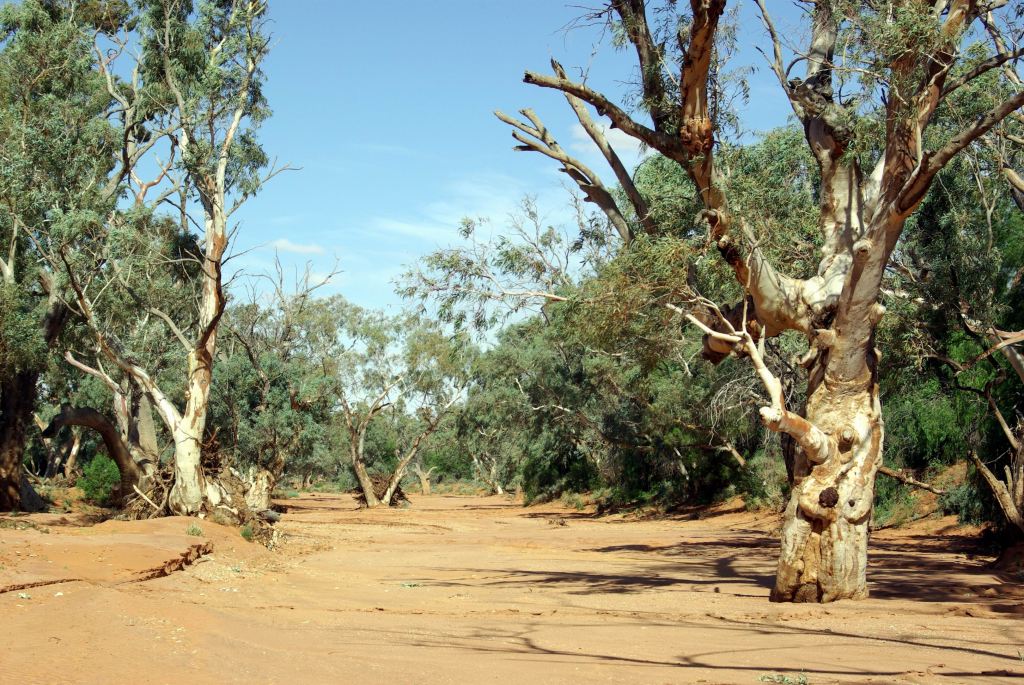
Back in Silverton, we went walking along the dry Umberumberka Creek bed, which was lined with majestic old river red gums.
Debris piled up behind trees shows that the creek does sometimes flood
There were lots of hollows in these ancient trees, to be homes to birds and critters.
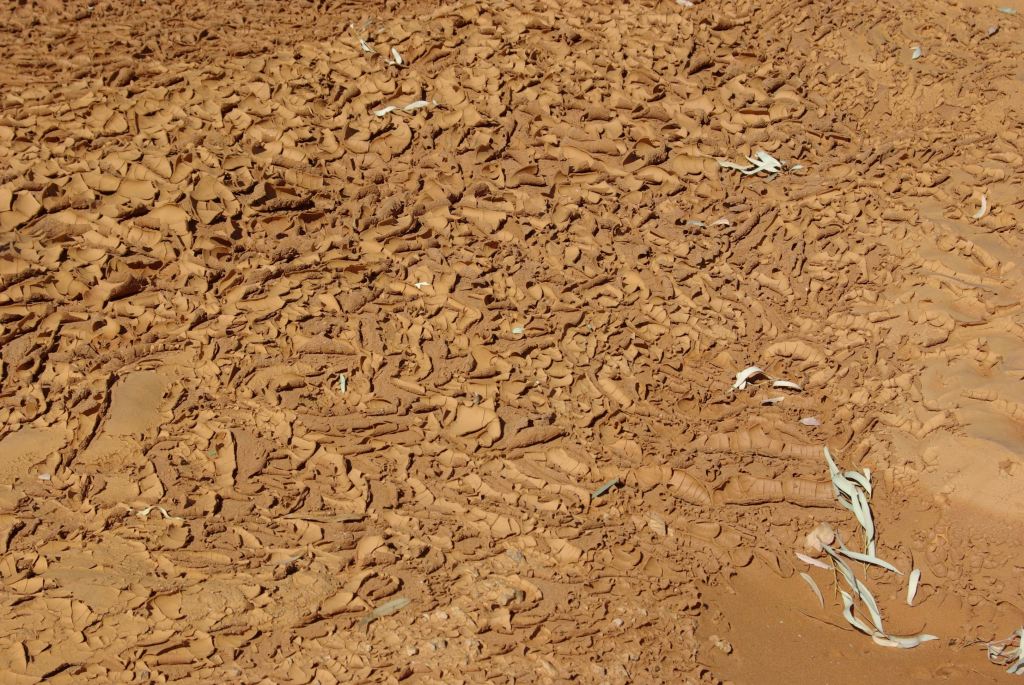
In a part of the creek that had been the most recent to dry up, there was a large patch of red mud curls – very artistic looking. From a distance, they resembled leaf litter.
Back in Broken Hill, we went to the Post Office and sent off the birthday presents bought today, and postcards to the grandchildren. Checked at the mail centre there – the package with the fridge thermostat had not arrived yet. Since the fridge now appeared to be working perfectly after its regassing, I did a redirection notice to have it sent on to home.
We shopped for food supplies, to last for some time. We had a bit of a dilemma. In theory, we should not take fresh produce into SA. But we were planning to turn off the highway at Yunta, and head north to Arkaroola. There were no shops along that way. We would be taking the purchased fruit and veg a long way distant from the crucial agricultural areas of SA.
Refuelled Truck – $1.30cpl.
John discovered that the other side back indicator on Truck had no globe in it, either! I was not sure how I had missed its non-functioning, in our checks – my reputation was tarnished, somewhat. He was incensed enough to phone the dealer’s service centre to complain. They were very apologetic and gave him the usual spiel about apprentices ! Hey – isn’t the work of these supposed to be supervised?
Yet again, we wondered what else had been missed, or done sub-standard.
We had been able to remain hitched up last night – big tick to the caravan park – so there was not much to do to get on the road again.
But before we left, once it was past 8am, John consulted the local phone book and started phoning refrigeration places, to find one that could deal with our kind of fridge. Past experience suggested that it was either gas or thermostat. After some initial phone calls, we were able to drive straight to a place that would check it all out, parking in the laneway at the back of the business. The unit was found to need re-gassing, which was efficiently done. It did not take long – all remarkably hassle free. Maybe things were going our way now?
I wondered if all the extreme heat that the van had been in, last year, had caused a loss of refrigerant, somehow?
Crossed the mighty Murray, into NSW. Refuelled at Buronga – still $1.30cpl.
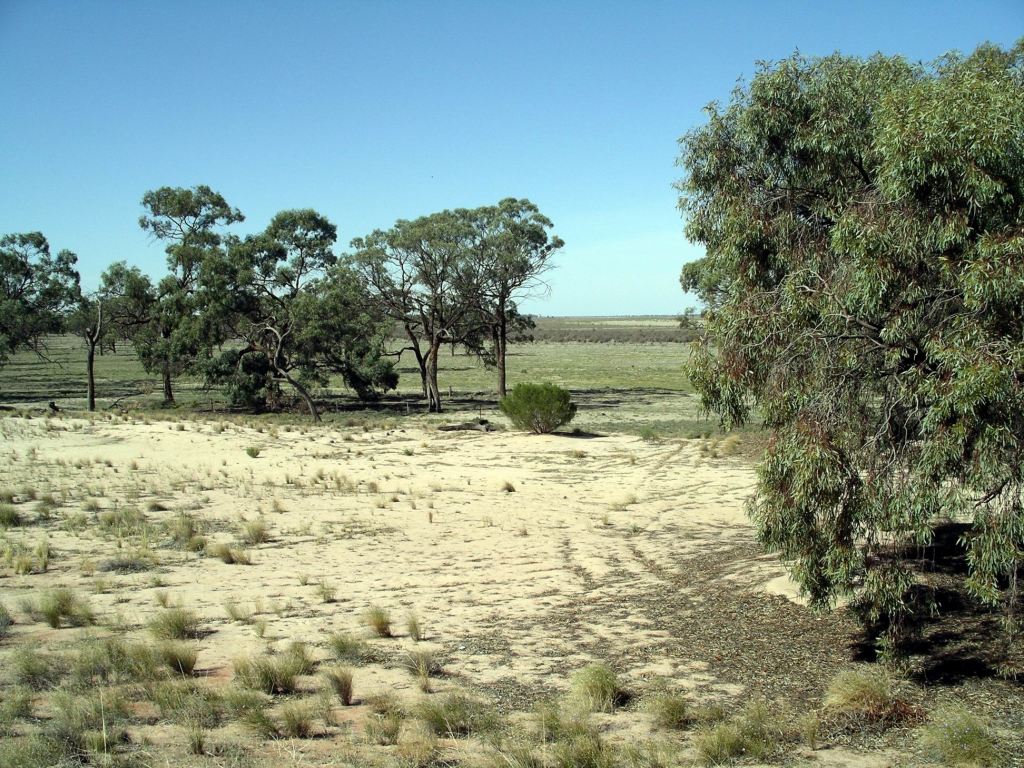
The very good Silver City Highway carried us north, with no dramas. Once away from the influence of the Darling River and the availability of irrigation water, the country quickly became flat, dry grasslands, with patches of red sandy soil showing through. There were enough patches of scrub and stunted trees to keep it vaguely interesting.
We stopped at the rest area at Lake Popiltah, about the half way mark, to eat the sandwiches I’d made this morning. M usually only had a piece of fruit for lunch – she believes in simplified travel!
Lake Popiltah was dry, and from the look of the grass growing in its base, had been that way for some time. It is one of a series of shallow depressions, sometimes filled from high water in an anabranch of the Darling River, to the east. Since the flow of the Darling was heavily controlled by irrigation schemes and diversions, even in good years, the lake was more often dry than not.
The dry bed of Lake Popiltah
The large rest area would probably be fine for an overnight camp, with plentiful shade trees, including some of the cypress pines that I love, and a view out over the dry lake area. There was plenty of room to spread out. There were long drop toilets – rather “on the nose”. The rest stop was close to the road, though, and traffic noise might be obvious at night. However, it was great for a lunch break.
Lunch stop Lake Popiltah Rest Area
I can’t say that the southern approach to Broken Hill is all that attractive, skirting as it does the first of the large mining operations. I navigated us through to the Broken Hill City Caravan park, on the Adelaide road.
After discount, our site cost $22.50 a night. The sites were fairly small, the surface was wood chips – a good idea in this arid environment, where grass is not feasible. Wood chips do not get tracked into the van like small gravel does. Gets my tick of approval.
Since it was only mid afternoon by the time we had set up, (Broken Hill operates on SA time, so we’d gained time) we decided to check out some galleries. Drove to the Boris Hlavica photography gallery where I had, on our last visit, bought a superb photo of Lake Eyre at dusk. I wanted to see what might be new there, and show the works to M. Although she had been through Broken Hill before, she had not been here. I managed to be quite disciplined, and bought only a card to send off for step daughter’s birthday.
We then tried to find a couple of advertised galleries that sold aboriginal art works. One was closed, and the other had moved. By this time, we couldn’t be bothered trying to track it down, so went back to camp, for the usual leisurely end to the day.
Grandson got to do his routine of waking up grandma – early! We had the expected cuddle in bed, before he had to go in for breakfast, and we got organized. It always surprises me, the simple things that give little kids so much joy.
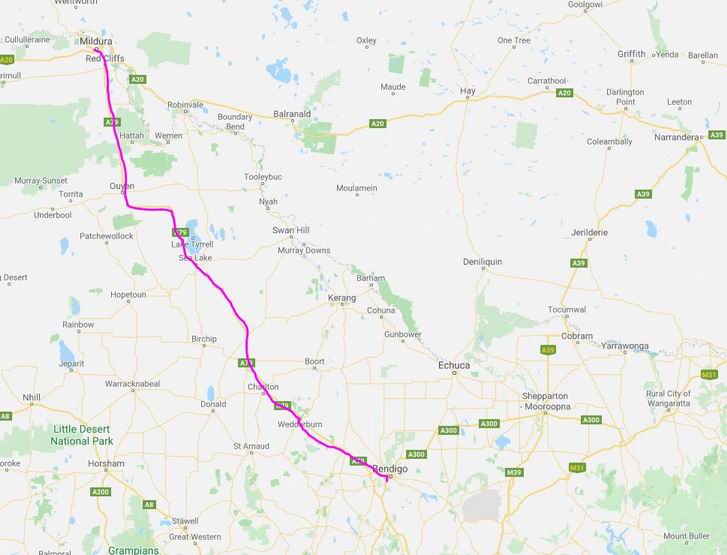
We pulled out of the Bendigo driveway about 8.30am. Although coming across town yesterday, in what was after-school traffic, had been somewhat tense, the bonus for today was that we were on the “right” side of town, only a few blocks from the highway to the north west.
It was very foggy for the first hour or so, as we drove up the Calder Highway.
Stopped at Wedderburn to refuel – $1.30cpl.
Stopped at Ouyen, eating the sandwiches that I’d made this morning, and making coffee with hot water from the thermos carried in a basket in Truck. This always contained items that could be needed for a roadside break – plates, mugs, a knife, wipes and so on. It saved having to open up the van for such stops.
Ouyen has a very pleasant rest stop, centred around a feature made from a huge Mallee root. Looking at this, one could see why clearing this Mallee scrub country was such a challenge for the early settlers – and why the stump jump plough was invented. This machine, invented in the late 1800’s, as the more arid Mallee lands were being opened up, simply lifted up the plough blades when they hit a stump, and dropped them down again when the plough was over the obstacle.
Our overnight destination in Mildura was the Desert City Caravan Park. After discount, the powered site cost $20.70. This park was conveniently located within easy walking distance of a major shopping centre. Having been very good and not carried vegetables or fruit into the exclusion zone, we needed to stock up a little, here, on fruit and greens, so we made a brief foray over to the supermarket.
Sat outside in pleasant late afternoon sun, just chatting.
On Sunday, I’d cooked three chicken maryland pieces. These were rather a traditional first meal on the road for us. Marinated in lemon juice, sherry, soy sauce and garlic, then baked, they were really tasty – and kept well in the fridge. With some coleslaw – also made on Sunday, they were an excellent meal. I would not be catering, most of the time, for M, but some times when we were just overnighting in a place, it saved her having to unpack her cooking stuff from the Troopy.
After the usual flurry of last minute organizing and packing, we managed to leave home about 12.20pm. I might add that the usual last-minute flurry was not mine!
Our house sitters considerately kept out of our way while the last bursts of packing were done. We had done the “handover” yesterday, after their arrival. I had every confidence in this couple, T and A, who had been full time housesitters for several years, and who were solidly booked up a couple of years in advance.
It was really convenient to have sufficient rooms in the house for them to have their own area, whilst here. However, we did have to evict M for last night, as they would be occupying “her” bedroom, with its double bed. She slept in her Troopy, parked up on the lawn area in front of the house – getting into practice again, she said.
I’d thought, over the last couple of days, as I was packing the van, that the fridge was not working properly, that it was running too much. Perhaps the thermostat needed replacing again? John found and phoned someone who could supply a thermostat; it would be mailed to us c/o Broken Hill Post Office.
Part of the setting out ritual, every day that we were towing the van, was to check that all the exterior lights were working. This could really only be done after Truck and van were connected up and manoeuvred out onto the flat ground of the road in front. This time, they weren’t! Naturally. We did not have too many trips where there was not some setting-out drama.
John’s investigation showed that there was no globe where there should have been one, in the tail light of the Truck. And this after last week’s service by a proper Land Rover dealer! It really filled us with confidence that the vehicle had been properly prepared for the remote areas to come – NOT! In theory, having Truck serviced by accredited Land Rover dealers should provide us with confidence that tradesmen who know what they are doing, work on our vehicle. Over the years, we had received some great service from various interstate service centres, but the ones in Melbourne had proved distinctly lacking, unfortunately. And we had tried most of them, at some stage.
John was able to put in a globe, from the stock of spare fuses and globes he carried, so we were not too delayed. Even that did not work at first, but he applied RP40, liberally to the area, and that fixed it.
Through all this mini drama, M waited patiently with her Troopy, parked a bit further up the street.
We stopped for lunch at Yarra Glen, parking up a side road from the main street, and walking to an excellent bakery.
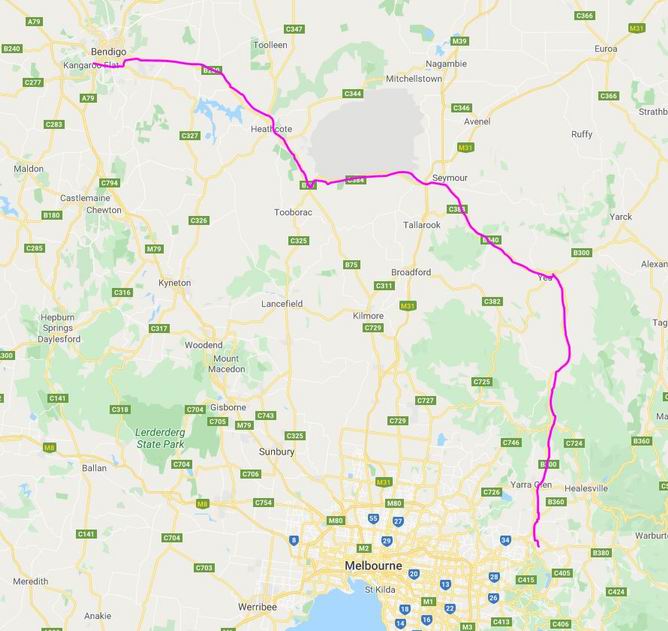
After that, it was the usual run to Bendigo. Up and over the Range and down to Yea, then the picturesque but winding stretch to Seymour – where we inevitably finished up with a tailback of several vehicles behind us, but with nowhere to pull over and let them past. Minor road to Tooborac and then good highway for the last stretch, through Heathcote to Bendigo.
The roadside gum trees were looking really stressed, much more sparsely foliaged than normal. The effects of the last few drought years were really showing up.
I navigated us across town, to daughter’s. Over the years of visiting here, I’d come to know a route that avoided the centre of the city, with its heavier traffic, trams and traffic lights. But it was a route one needed to know, rather than a signposted one, so I just hoped that M was able to keep us in sight. Back in the gold rush years of the later 1800’s, Bendigo had developed in a somewhat ad hoc manner, dictated by the locations of reefs and mines, which now meant roads at strange angles and an illogical layout.
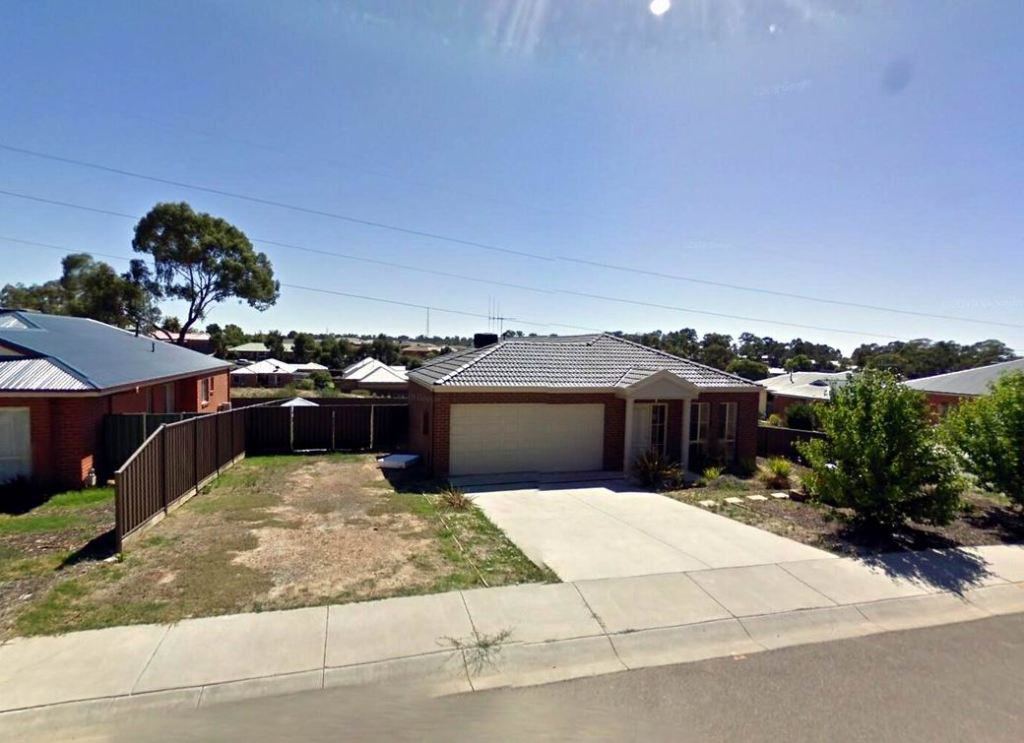
We set up in daughter’s driveway. Backed Truck and van down the slope, as close to the back yard fence and gates as we could get – and heavily chocked behind the van wheels! M was then able – just – to fit the Troopy in front of us. Staying hitched up meant that we had to put up with sleeping in a van that was distinctly higher in front than at the back – and we had a crossways bed! At least M had her head pointing uphill.
This driveway is a lot steeper than it apppears in the photo!
We enjoyed a pleasant evening with the family – dinner and lots of chat. I collected early Mothers Day gifts. Grandson was, of course, pleased to see us again, even though it was less than two weeks since we’d hosted a family get together for daughter’s 35th birthday. We talked with him about the trip we were doing, explained why we wouldn’t be seeing him for five months, and promised him lots of postcards from interesting places. He had – with some discreet help – kept a collection of every postcard we had sent him, to date. He went through it, very proudly, with us.
It was a chilly night – got down to about 7 degrees. Well, this was what I’d longed for, a few months ago!
In my occasional wakeful periods through the night, decided the fridge was definitely running too much, given the chill of the environment. What a pest.
Unpacked, washed, tidied away our stuff. Reckoned the only use I would have for my boots now, would be gardening!
The place seemed strange without a resident cat. We were missing Spook cat. M had to have him euthanized while we were away this time. We had been expecting that. He lived to a very old age, for a cat. She had buried him by the climbing roses, beside the pool.
It was a great relief to be home. John could sleep and rest, and try not to have the shingles get any worse. He had a bad dose of it.
The three of us started throwing around ideas for this year’s extended trip. I’d long had house sitters booked for five months – May to September….. M had not yet been to the Kimberley, so that seemed an obvious destination – more of WA!
PILBARA POSTSCRIPT
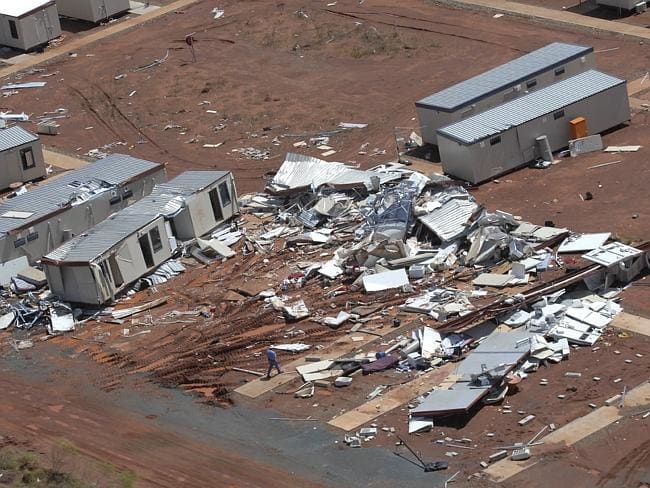
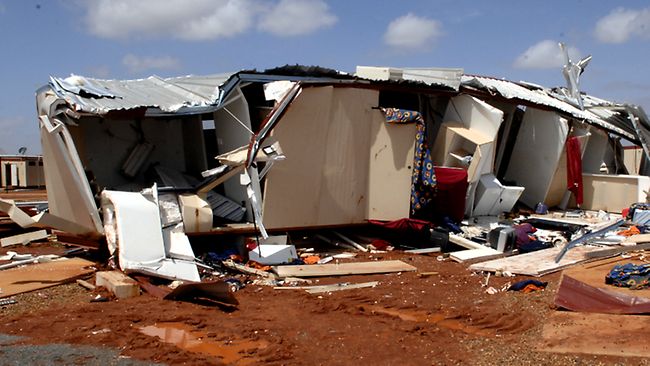
A month later, on March 8, Category 4 Cyclone George caused major damage and destruction at RV1, two people died and a number of others were severely injured. One of the people killed was sheltering in the same donga we’d slept in, the previous month. Our manager friend was injured, but survived.
Cyclone destruction (from media)
The winds were so strong that there was even some damage at RV 2, so much further south.
The resultant enquiries, inquests, law suits went on until 2015. They basically took two lines – why the damage was so severe, and why the camp had not been evacuated before the cyclone hit. (For anyone interested, assorted reports can be found via internet)
RV1 was rebuilt for the duration of the rail building project – but not by the company we’d worked for.
In mid-2007, we received a phone call from WorkSafe WA, about interviewing us as part of their enquiry into the disaster. We were travelling at the time, in the Kimberley, and said we would be back home in Melbourne, later in the year. We heard no more from them.
I could not help but think that this ancient and superb country had taken some revenge for its destruction by mining.
ANOTHER PILBARA POSTSCRIPT
Late last year, at RV1, when Fortescue shares on the Stock Exchange were only a few dollars, John wanted me to buy some of those shares. I did not take the opportunity, because I felt that so much money was being expended, in a way that seemed quite reckless. The image stuck had stuck in my mind of one day at RV1, when a plane was doing repeated low passes over the site. R said it was “just” Twiggy Forrest having a look at progress. I’d wondered what it had cost for him to do it that way?
So, I couldn’t have faith then in the iron ore mining venture actually making money. What did I know? It wasn’t long before those shares hit $80.
After a very early breakfast, it was back into the bus and off to Hedland airport, where we were booked on the 9am flight to Perth.
This time we really were leaving the Rail Villages for good! I’d had enough of the heat, and poor John really needed to get home and rest.
We left the bus keys on top of the wheel, as usual.
Checked our bags in, hoping they would be properly transferred in Perth and make it back to Melbourne. We each were carrying a laptop and small day pack. We had to take off our steel capped boots, which we were wearing because we had only taken fairly small cases with us, and there wasn’t room to pack them. Bad planning initially! John was told to take off his belt to go through the metal detector, so at the other side he was clutching daypack, laptop, boots – and his pants fell down around his ankles! The man has no hips at all. He had the same problem in Perth.
Our flights were uneventful. Had to spend a couple of hours hanging about Perth Airport, waiting for the connecting flight.
We got into Melbourne at 7pm, their time. It was a very long day – but we were being paid for ten hours of travel, so that was some recompense. Son picked us up and drove us home.
Melbourne in summer seemed cold by comparison with where we had been.
It was only in the mid-40’s today! Positively cool…..
The three company men still here were working on the verandas on the new dongas.
I finished as much of the office pack up as I could do – leaving just the bare essentials for the office for the bit of time left. Sent a list of what was packed, to HO, for their information. The packed boxes would be going to Leonora.
I left written instructions for A, about recording Variation Order work, petty cash recording, ditto tip trips, signing of handovers of the new buildings, doing the Daily Reports for HO. That was the best I could do – it was up to them now. I did not hold out great hopes……
RV2 in more recent times, with one Pod mostly removed (Zoom)
We had packed up our rooms, mostly, yesterday. Finished doing that and left for RV1 in the bongo bus, getting there in time for tea.
We had two rooms allocated to us, near my favourite manager’s room. John always occupied “his” room when there – now I had one too. We sat outside with a beer or two and chatted with our mate R.
It seemed rather apt that our last night in the Pilbara was back here, where the saga had started, some five months ago.
The unrelenting heat – high 40’s – just went on and on.
The shingles rash had spread around half of John’s torso – which was, apparently, typical. He did not feel too good. He took the bus to Hedland to do some purchasing and send off the documents, files stored on thumb drives and other essential records, to HO. Then he met the midday plane and took some subbies to RV1 to work on the new dongas there. Then he came back here.
Two of our men set off AGAIN in the morning to install the Telstra hut at Hope Downs. This time they hoped to actually get there – but still without a spare tyre. This time, the venture went as planned.
K had intended to leave some time in the morning, to drive to Broome, to overnight there and catch his plane in the morning. But he could not leave until the Landcruiser got back from Hope Downs. By the time that happened, it would be too late when he got to Hedland, to get his spare tyres fixed. Of course, it had not occurred to him to send them in with John – either today or last week. Typical. So he would be driving to Broome with no spare, and mostly in the dark. Would serve him right if he got a flat!












 This Adventurous Age