FRIDAY 8 MAY TORQUAY TO LAKE MCKENZIE
The alarm sounded at 7am.
There was last-minute packing – of things that would not fit in the van until we had moved out! That included the folded up awning, and the bikes and rack. I have a pang or two about leaving the van like this – we haven’t done so before. Hope all will be well.
We had to drive about 23 kms to River Heads and be there by 10am for the 10.15 barge. The departure point was paved, with big car parks, a toilet block, and well signposted. There were a lot of young back packer types waiting for the barge – some in hired 4WD’s, some with commercial tour companies. About fifty of them. We wondered if we are going to end up spending days in the midst of backpacker parties, having heard they can sometimes be somewhat out of control on the island! There was certainly a real sense of anticipation about the place.
On the barge, we Australians are severely outnumbered by Germans, Brits and Yanks.
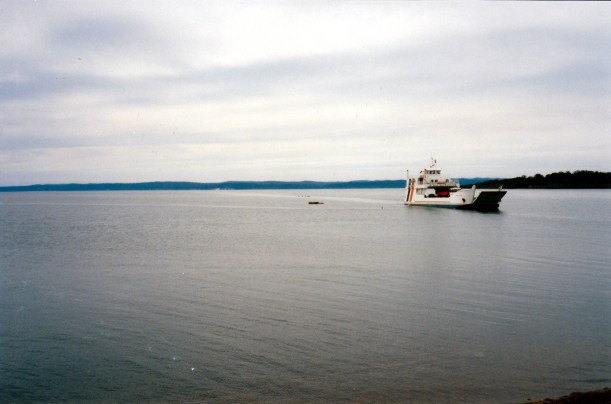
Our barge approaching River Heads to load us for the trip to Fraser Island
John had to back Truck onto the barge – no worries. We had to pay for all costs and permits on board the barge – $65 for the return barge ticket, $30 for the permit to drive on the island, $21 for a camping permit for three nights in National Parks campgrounds. So this is not a cheap excursion! And we had to pay in cash, despite the assurances of the caravan park lady that Visa would be ok! That did not leave us with much cash, though, hopefully, we will not need to spend much more.
So saying, John promptly treated himself to a pie on the barge – his first for quite some time. I bought a Coke – long time since I’ve had one of those.
The trip across the Great Sandy Strait took half an hour and at the Wanggoolba Creek end, we drove off frontwards, onto a sort of boarded and asphalted pathway up the beach sand, and on to a sandy “road”. There were two dingoes sitting and watching us come off the barge – the welcoming committee? Certainly, some local atmosphere right from the start.
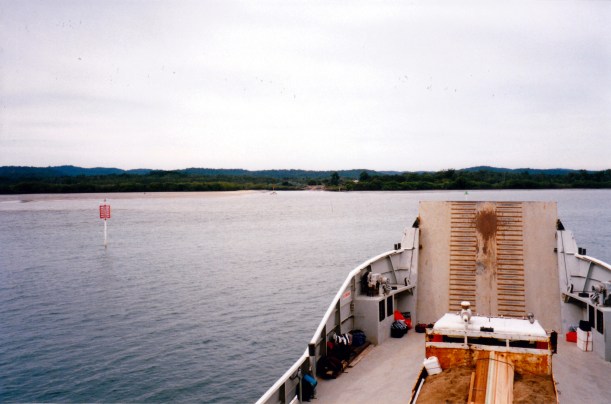
Approaching the Wanggoolba Creek Landing. A truck with building supplies will be first off the barge.
We had to engage 4WD before driving off the barge – those are the rules. Only 4WD vehicles are allowed on the island, as it is a sand island.
I will comment here on our driving experiences, overall, on the island. One travels on the few inland “roads” that cross the island from east to west and, in a few places, join features of importance down the spine of the island. Or else one drives on the beach on the eastern side. The east coast is where the several small, older resort settlements are, and some of the main tourist attractions, though there is a newer resort – Kingfisher – on the western side. The east coast beach is certainly the main thoroughfare of the island. Apart from the usual vehicles and 4WD tourist buses that we saw, there was other traffic too, obviously doing commercial business like taking supplies to the settlements, a big rubbish dumpster truck – and a plane that used it as a runway!
The inland roads are very sandy with varying degrees of being churned up, and depths. One has to watch for big tree roots as well as deep sand patches and former bog holes. There are a couple of one way sections on the major routes, but for the rest, the tracks are single lane, so one also has to watch for oncoming vehicles – and many of the tracks are very bendy. The rule is that the smaller vehicle should back up until it can pull over to let the bigger one through. When you are equal size, it becomes a game of bluff, though we found that most drivers would let the one going uphill – who needed to maintain traction in the softer stuff – have right of way if there was a possible pull over point. We hear that there are many head-on bingles on the island, though we took it carefully and with much concentration, and had no close shaves.
There is an official speed limit of 35kmh on the inland tracks, which seems impossibly high for the conditions we found. On the east beach, the speed limit is 80kmh! The sand there is mostly firm, although closer to high tide one must drive on softer sand, which can be a hazard if hit at speed coming off the firmer stuff.
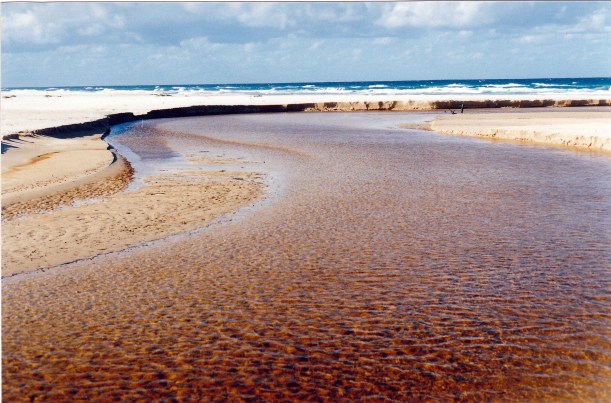
The biggest hazard on the beach route is the many creeks that cross the sand. They can build up little sand cliffs and some have quite deep channels that you can drop into, if not careful. Apparently these cause many roll overs! It is very hard to tell, coming up to a creek, what the crossing will be like. In theory, one should walk each one first, but there are just too many. There is no real logic, either – the biggest creeks are not necessarily the ones with the deepest channels. We slowed down at each, followed the tyre tracks of those who had gone before, and hoped! We did not have any bad creek hits.
In places, there are rocky outcrops across the beach and one must deviate on inland bypasses. Where these leave and enter the beach, the sand can be very soft and churned up. The one at Indian Head gave us problems and nearly bogged us – we were thankful for the diff lock on Truck. We churned past three bogged vehicles there.
From the Wanggoolba Creek barge landing, we chugged the 9kms to Central Station, which is as its name suggest, in the middle of the island, behind a big 4WD 6-wheeled truck that was carrying building supplies from the mainland, to Eurong, on the east coast.
Central Station had information boards, a Ranger Station and a campground. It was a fairly open area, amongst tall trees. It was the site of the main forestry camp from the days when Fraser Island timber was exploited. There was logging here from the 1860’s until 1991.

One of the Information Boards at Central Station
We stopped and read the information boards and camping bulletins – which warned about dingoes, and also fireweed, a stinging organism in the sea currently causing allergy problems for people at the east coast beaches. Well – I wasn’t intending to swim in the sea, anyway.
We drove on, at a slightly better pace this time, another 9kms to Lake McKenzie campground, hoping to find a place to camp in this most popular area, rather than have to return to Central Station.
There were several places empty in this rather typical National Parks camp area – about 20 sites defined in the bush by treated pine railings, some smaller, some larger. We found one where we could put up the big tent and still have room to park Truck beside it, off the access track. It does seem that most of the campers here are in groups and so are gathered where there are sites close together, so we got lucky with a reasonable one that was more on its own.
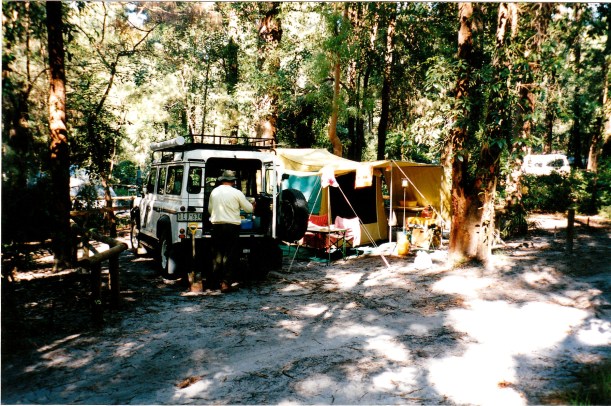
Our camp set up at Lake McKenzie.
Our site was some distance from the amenity block, which we thought was basic, but ok. There were a couple of toilets for each gender, and a cold water shower. There was also a tap supplying drinking water. All that one needs – almost luxurious!
There were also big, heavy-lidded hoppers for rubbish – very dingo proof, and a firewood supply because most campers seem to see it as mandatory to have a bonfire in the bush! We were good little greenies in this environment and used our gas appliances – no fires.
After all the warnings about dingoes, we made sure all our foodstuffs were kept in the Truck. Made sure the lid of the camp fridge, which was outside the tent (as it runs on gas) was heavily weighted down, when we weren’t in camp. We even kept our bedding and clothes in Truck, as we had been warned that people scents could attract dingoes into the tent – and we did not want it to get chewed or torn into by a curious dog!
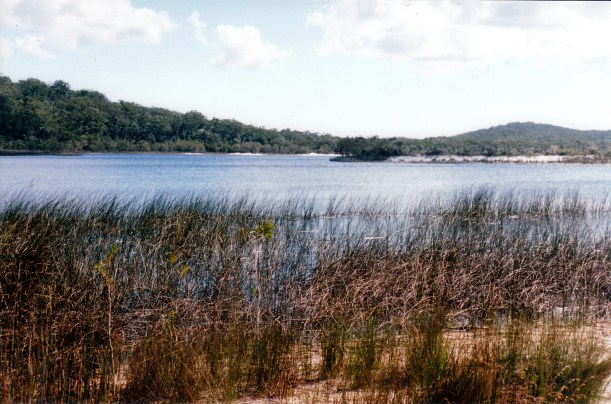
The camping area was about 200 metres from Lake McKenzie, which is one of the most fascinating features on Fraser Island. It is one of the many freshwater perched lakes (above the water table and fed by rainwater). It seems such an unusual feature to find on a sand island.
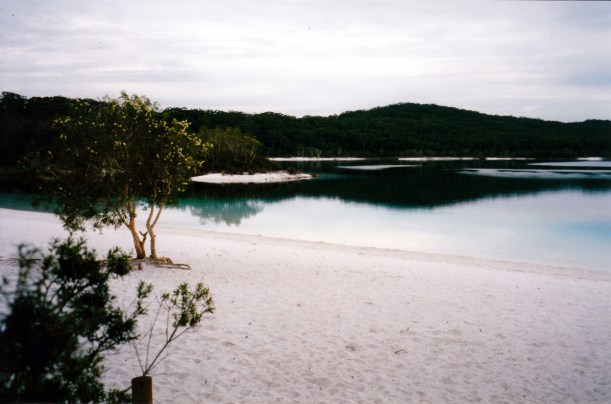
Our first sight of Lake McKenzie
Fraser Island is the largest sand island in the world and has had World Heritage status since the early 1990’s – not long at all. I remember the controversy, back in the 70’s, over mineral sands mining on the island and proposals to expand same. The growing conservation movement in Australia lost the campaign to save the original Lake Pedder in Tasmania, from being drowned, but won the campaign to shut down sand mining on Fraser Island. Seeing the place now, I am so thankful for that.
The island actually was once called Great Sandy Island, until a shipwreck in the 1830’s stranded a lady called Eliza Fraser here, for some weeks.
We found that Lake McKenzie is constantly changing its appearance, depending on the time of day and the weather conditions. It is never the same for more than a few hours at a time. It is absolutely beautiful, and even on our first day here, I was wishing that we would have longer camped by it! We are privileged to be able to observe its constant changing, and feel that the day trippers who are only briefly here are missing out on a wonderful experience.
One morning, I saw mist rising off it; later in the day, in bright sunshine, it was a brilliant aqua colour; at sunset that same night is was a dark purple colour. In the afternoons, campfire smoke drifted across the lake, sometimes making interesting patterns. One afternoon, there was a rainbow coming out of it, before we got the only little bit of rain of our stay on the island. Another afternoon, it was aqua at its shallow fringes and deep ink blue where it quickly gets deeper. We went for a swim and it actually seemed blue to swim in – like moving through dark ink – like nothing I have ever before experienced! Such a magic place.
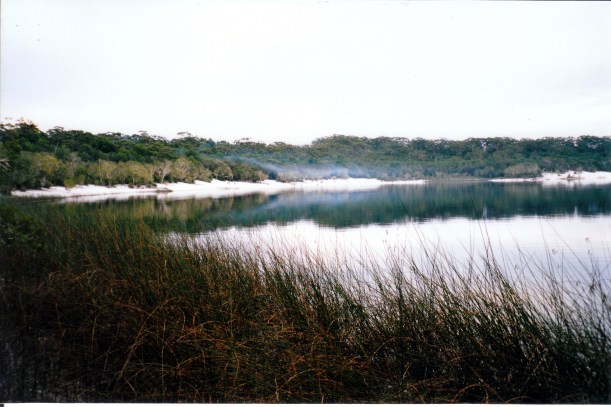
Late afternoon campfire smoke hanging over Lake McKenzie
There were lots of tortoises living in the lake – we could see them stick their heads out of the water to look around, and also see them swimming in the shallow edge water. We even saw some baby ones swimming around, about the size of a 50 cent piece.
We were pleased to find that the Lake McKenzie camp ground is regulated and controlled, as the 1992 guide book that I have says this is one area that has suffered from over use and is very degraded. Clearly National Parks has undertaken significant management and rehabilitation programs, that have worked, since that was written. However, all is not perfect. One tends to assume that people who make the effort and pay the costs to come to a place like this do so because they are “into” the natural environment. Yet they leave rubbish around in camp areas – beer bottle tops and cans, in particular. There is much toilet paper scattered in the bush beside the campground tracks, despite the toilet block nearby! There was a big pile of person poo beside the track when we first walked down to the lake – inexcusable!
After setting up camp, we walked the little way to the lake edge and small beach, along a well used track through the bush. Walked part of the way round the lake, which is big enough to take about half a day to walk right round it. We spied some “new” birds: mistletoe birds, a male scarlet honeyeater, a Lewins honeyeater, a white throated honeyeater.
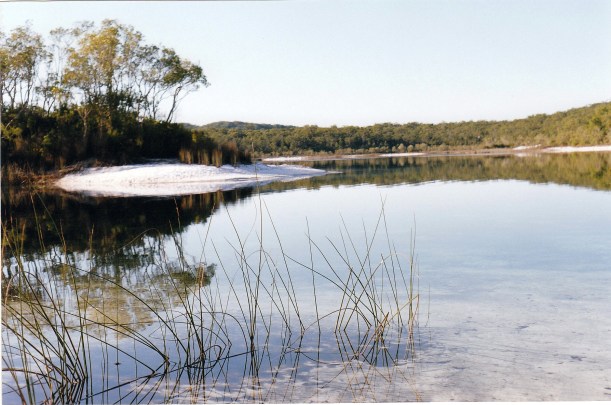
Reflections in the clear water of Lake McKenzie
On the way back, followed a little track near our camp and found a rubbish dump – with a difference. It was a dingo’s storage place. There were a couple of cans of meat which it had been unable to open, with plenty of tooth dents. The remains of milk cartons and bread wrappers showed where it had been more successful. It also had a pair of shorts and a leather shoe – both chewed. We had been told that, apart from tearing tents to get at food, they have also been known to carry off sleeping bags – maybe some of the backpacker ones get a bit ripe?
In our time at this camp ground, we saw the occasional dingo padding up the camp area roads, or going behind the tent, but they never lingered in our area, or made us feel uneasy in camp. In the mornings, there were always several sunning themselves by the rubbish hoppers. At night, there were choruses of dingo howls, near and distant, a beautifully eerie bush sound. We were there at full moon time, which probably made them more noisy at night. In the mornings, there were dingo tracks on the white sand beaches of the lake.
I cooked chilli con carne for tea. Quick and easy to do and only needed two stove burners – one for the chilli and one to cook some accompanying pasta spirals on.
As that first evening wore on, there was quite a bit of noise from the camp sites where the back packer groups had settled. There were several lots of 8 to 10, each sharing a Toyota Troopy. However, they did go quiet about 9.30pm, in line with the camp ground etiquette. It is known that the Rangers are being quite tough on noise disturbance and have sent people off the island. It seems to have had the desired effect!
It is pleasant to be in the tent again, for the first time since John’s hip was done. But this new lilo, that we bought last year, is akin to a water bed that wobbles about and is quite difficult to sleep on. We had discovered, as it grew dark, that we had no mantles for the gas lantern that screws onto the top of a wand that sits on the gas bottle – don’t know where those got to. Miraculously, the existing mantle, despite all the travel, is still intact. It must have been there for years! We tried to use the new Coleman lantern that K had given us for Xmas, but upon reading the instructions (why do we never do this in advance of trying to use something?) that we needed meths to light it. We had brought a bottle of its kerosene main fuel, but had not thought of the primer. It was nearly a very dark night!















 This Adventurous Age