This Adventurous Age

Adventures travelling and working around Australia.


Leave a comment

2000 Travels February 29

TUESDAY 29 FEBRUARY     QUEENSTOWN

Yes, a Leap Year!

We woke early, to the alarm. Left camp at 7.45am to drive to Strahan, getting there at 8.30.

Stopped at the bakery, so I could buy us focaccia rolls for lunch, as we had decided not to pay the extra fee for the lunch provided on the cruise, thinking it would probably be fairly ordinary.

We were able to get a window seat on the cruise boat, opposite a couple from NSW. The seats were each side of tables, so some people faced forwards, some back. The Wanderer III was a big boat which took over a hundred people at a time. We found it quite comfortable. There were some tour groups on the boat, mostly older people.

Departure was as scheduled, at 9am. We cruised down Macquarie Harbour, then around to Macquarie Heads and the narrow Harbour entrance – Hells Gates. This name came from the convicts when Macquarie Harbour had a penal settlement, 1822-33. To them, it was the entrance to Hell.
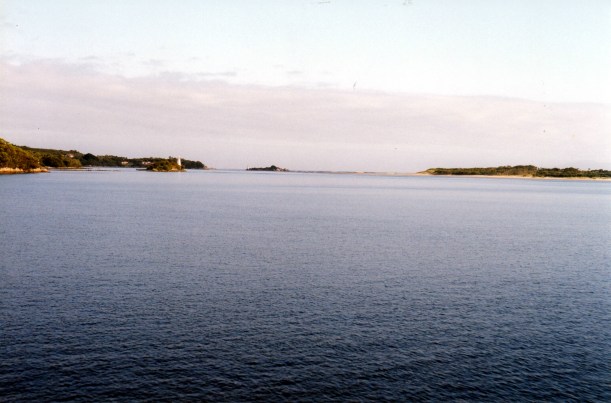
02-29-2000 01 Hells Gates from inside Macquarie Harbour.jpg

Approaching Hells Gates: Bonnet Island and Entrance Island

The boat proceeded past the small light houses on Bonnet and Entrance Islands the guide through the channel – narrow and treacherous – and on out into the open sea. We could see the convict-constructed rock wall along the channel near the entrance. The commentary explained the scouring effect of the channelling, to keep the entrance clear, and pointed out the Cape Sorell Lighthouse.
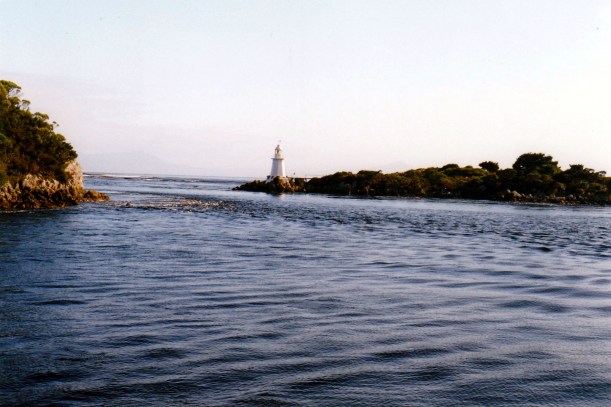
02-29-2000 02 hells gates.jpg

The narrow, treacherous channel at Hells Gates

We could just see lots of wild, western mountains in the misty distance – a lovely outlook.
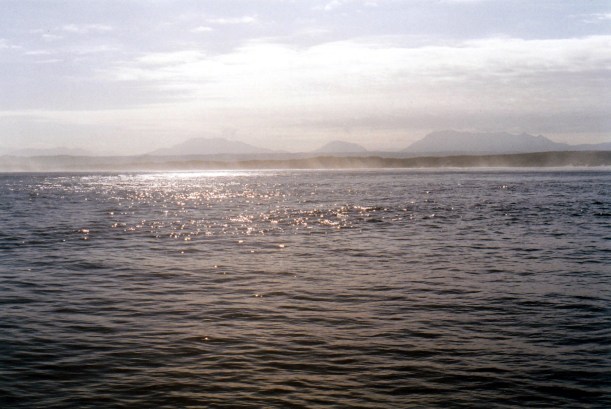
02-29-2000 04 west coast mts

The mountains of the west coast, from outside Macquarie Harbour

We were followed through Hells Gates by another, similar, cruise boat.

After our little look about out there, we motored back into the Harbour. The Hells Gates entrance was, thankfully, very docile today. I guess there are plenty of times when the cruise can’t go outside, as we did.

02-29-2000 05 outside hells gates

Outside Hells Gates, Entrance Island, other boat

Our next destination was Sarah Island, down the Harbour, about 25kms from the entrance, passing some Atlantic salmon fish farms in their circular cages, on the way. This was the site of the penal settlement. There, we went ashore for a guided tour. This was done by actors based at the Visitors Centre, in Strahan, and was excellent, interesting and informative. Despite the large group, it was all audible. At one stage, an actor went into the water (in a wet suit) to explain and show the existence of the old slipway timbers and jetties.

02-29-2000 06 Sarah Island ruins

Sarah Island building ruin

Much research seems to have been done about Sarah Island. Conventional wisdom has long had it that Macquarie Harbour was a dreadful place of punishment and that the penal settlement here was eventually abandoned in favour of Port Arthur because of the difficulty of supplying the place from Hobart (by ship). However, on the tour it was suggested that it was actually a very successful, calm and hard working establishment, where there was little trouble and the convict population took pride in the ship building and support works. Not all of the convicts were those being punished for further crimes committed while under sentence elsewhere; some were those who had opted to go there in return for a remittance  of their sentence. Thus, the tour suggested, it was abandoned because it was not punishment enough!

02-29-2000 08 new penitentiary sarah is.jpg

The New Penitentiary on Sarah Island

The hour of the presentation flew by. I would have liked some time to browse on the island independently, which we did not get. I think that only having supervised groups may be part of the preservation tactics.
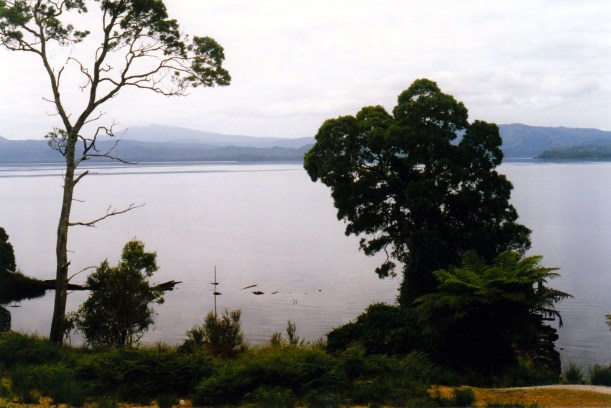
02-29-2000 07 sarah is view

Macquarie Harbour from Sarah Island

Back  aboard, the boat headed further down the Harbour, to the entrance to the Gordon River.

Lunch was served on the boat at this time. I think we were the only ones who had brought our own! The boat meal looked excellent – cold meats, stacks of smoked salmon, salads. I think we made a major misjudgement there! Still, our focaccia was nice.

We progressed slowly up the Gordon River – there is a low speed limit, to protect the river banks from wash from the tour boats.
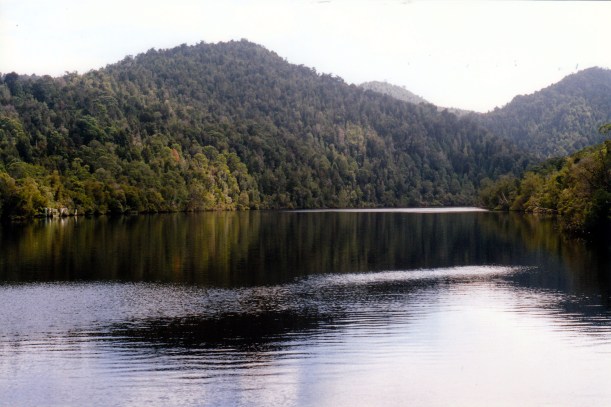
02-29-2000 10 on the Gordon R.jpg

Going up the Gordon River

Thick forest came right to the water’s edge. There were brilliant reflections in the dark river water. The river was wide and tranquil.

We passed a yacht tied up at Fishermans Landing.

02-29-2000 09 Gordon R Fishermans Landing

The Gordon River at Fishermans Landing

The commentary on the boat told of the protest blockades of the early 80’s, over the proposal to dam this river, downstream of the junction with the Franklin River, that would have impacted hugely on both rivers. It described all the arrests that were made – including of Bob Brown, a leader of the Save the Franklin movement, who went on to become an Australian Senator and Greens Party founder and leader.

The rivers were saved, after the intervention of the newly elected Hawke ALP government, and High Court decisions about federal powers and World Heritage Area rights. All history now!

02-29-2000 12  gordon r.jpg

Reflections in the tannin brown Gordon River

We went ashore at Heritage Landing for a 15 minute rainforest walk, with commentary. The forest here, ironically, was nowhere near as good as that we’ve seen in other part of Tasmania. There was one huge Huon pine tree – falling down – and we took photos of that.

Back on the boat and back down the river and across the Harbour, to Strahan. One does not really realize how big Macquarie Harbour is, until you do something like this.

We spent some of the time on deck and some inside, watching a scenery video they showed – brilliant. Many of the older, tour bus people slept.

It was a pleasant trip back down the river and up the Harbour, but blowy when the boat went fast.

02-29-2000 13 macquarie harbour

Speeding back to Strahan across Macquarie Harbour

We docked at 3.45pm. The trip, at $44 each, was excellent value.

We then went to the pine mill here – Morrisons – and John talked to the owner, who seemed to remember him. This is where John bought the Huon pine he used to make our bedroom furniture, in early 1993. He did the timber buying whilst I was laid up in Queenstown Hospital with a ruptured disc in my lower back; he enjoyed that time much more than I did! The pine was shipped across for us.

There were lots of round pine turning blanks, some sassafras ones too. The prices seemed good and John got a price list. He was given the advice to keep such pieces in plastic, to season it and prevent cracking.

At the bakery I bought two more focaccia rolls, for tomorrow’s lunch.

The drive back to our Queenstown base, in the late afternoon sunshine, was enjoyable. We were in time to collect the papers for the last two days.

Tea was potato salad and coleslaw and a tin of pink, smoke flavoured salmon. Seemed fitting and was nice.

This was the last day of summer – and an excellent way to spend it. I was so pleased that the weather forecast had remained accurate, and that we had a clear, sunny day for this trip.

We decided to extend the stay here until after the weekend, as there are still things we want to do.


Leave a comment

2000 Travels February 28

MONDAY 28 FEBRUARY     QUEENSTOWN

This morning seemed to herald a more promising weather day.

After breakfast, and making some lunch, we went to the National Parks headquarters again, and got the key for the Mt McCall Track. Washed the underneath of Truck at a servo.
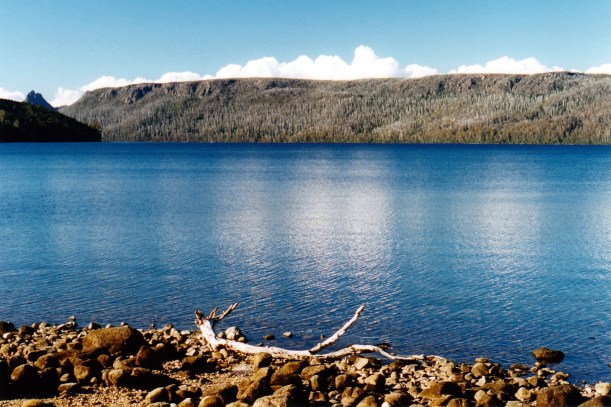
We took the Mt Jukes Road, south, out of town. This paralleled the brown coloured Queen River for a while, to where it ended at its junction with the King. Then the road trended south east, roughly, until we eventually came to the southern part of Lake Burbury, which we followed south.
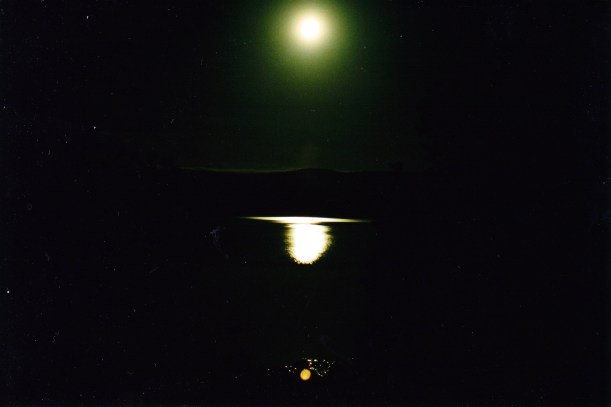
We saw a spotted quoll walking across the road near Mt Jukes – have never seen one of these in the wild, before. A quoll is a carnivorous marsupial. This one looked a bit like a large, spotted cat, but with a different shaped face.

It was still quite misty, out to Lake Burbury; we had assumed this would lift as the day went on – and it did.

The track  continued, generally south, until, about 37kms from Queenstown, we came to the junction with the Kelly Basin/Bird River Road. Our Mt Mc Call track trended to the south east again.

We soon came to the locked gate and locked it again behind us.

02-28-2000 09 mc call tk gate.jpg

Key is needed to go any further

The road had been really good until the Kelly Basin Road, then it quickly became rougher and steeper. In places, the track was quite rocky and there were some steep hill climbs and descents, but it was all quite manageable.

02-28-2000 02  Mt McCall Tk getting rugged.jpg

Somewhat steep and rough!

I used my Franklin topo map and the GPS to try to keep track of where we were on the track. I was mindful of the warning in the rough track notes we had, that, at the end, the track stops abruptly and without warning, at a 300 metre log haulage way drop down to the Franklin River below!

02-28-2000 06  mc call tk vista.jpg

Sections of the track felt like the top of the world!

The drive was extremely scenic and different, especially as the mist lifted. We saw some most incredible vistas from the track.

02-28-2000 01 mccall tk

White quartz outcropped along parts of the track

Near the end of the track, some 22kms from the gate, it went very steeply uphill, then very abruptly down. I chose to walk this last section, as really steep downhills give me the heebies. At the end was a fair sized clearing in which to turn around – despite what we had been told, there was certainly room for more than one vehicle.

We parked in the turnaround, ate lunch, watched birds. We inspected the haulway remnants, where logs harvested from the surrounding forests were “dropped” down into the Franklin River and would eventually be floated down this to the Gordon and thence to Macquarie Harbour.

02-28-2000 04 haulway.jpg

Old logging haulway – logs dropped 300m down this to the Franklin River below

At one stage, we thought we could hear voices from below, faintly – maybe rafters on the Franklin?

It certainly was wild and lovely country and we felt privileged to have been able to do this drive – and so happy that we’d made the effort.

02-28-2000 08 view to Mt Owen from Mt McCall Tk.jpg

View to Mt Owen from the Mt McCall Track

The drive back out was even more breath taking as we could see vistas that had been invisible in the morning mist. Much of the way was through quartz capped hills and ranges, like Frenchmans Cap, which was as the crow flies, not that far away. There were vistas into deep, thickly forested valleys.

02-28-2000 07 from Mt McCall Tk

Really rugged country

In places, we could see the track winding away over the top of the ridges.

02-28-2000 05 mc call tk view

The Mt McCall Track winding away over the ridges

We stopped at the Lake Burbury lookouts to see the views over this and to the back end of Frenchmans Cap in the distance.

02-28-2000 10 lk burberry frenchmans cap

Looking over Lake Burbury towards Frenchmans Cap

On the way out of town, this morning, we had passed a big Huon pine sawmill. There were great heaps of the timber stacked about. John was amazed at the quantity. We called in on the way back – it was Bradshaws Mill. Although it was 4.30pm, the owner and his son allowed us in to browse around. John was really taken with the pallets of offcuts they sell – he thought they were great value. They had some great slabs and carving pieces too. They have recently amalgamated with the mill at Strahan, we were told.

Huon pine is a really unique timber because its natural oils make it repellent to insects, and it does not rot away. It is also very slow growing and can grow to many hundreds of years old. Thus, the rings in the timber are really close together. The early colonists realized that Huon pine was a perfect timber for boat building, and the logging of it became an industry, supposedly the reason that the Macquarie Harbour penal settlement was established. It is no longer legal to cut down Huon pine trees, but when areas were going to be drowned by hydro dams, the Huon pines there were cut and preserved for the future. Now, three companies have the right to retrieve and mill this Huon pine, Bradshaws being one of them.

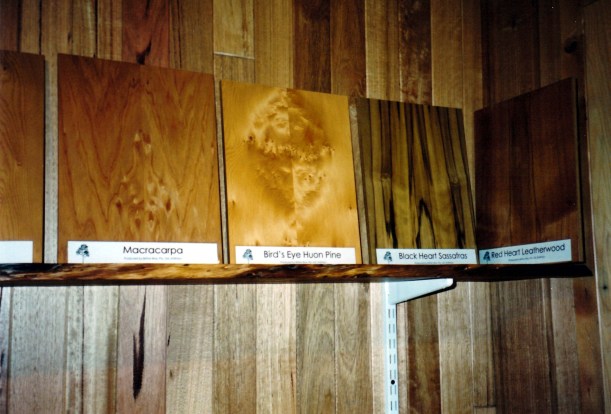
When Huon pine is first milled, it is quite pale in colour, but ages to a golden caramel colour. I love the smell of it – quite distinctive. There can be beautiful speckly patterns in the timber – called birds eye – and this is the most valued form for woodworkers.

03-13-2000 brittens smithton.jpg

Birds Eye Huon Pine

We did not stay too long, given the time, but John indicated to them that we would be back.

We returned the gate key to National Parks, and filled our large water container from the standpipe near the Parks Office, there for this purpose. The locals drink it so I guessed we could too. Presumably it is piped from somewhere up in the mountains that is distant from the pollution of the area closer to town.

We were too late to pick up the paper.

Tea was pasta with bacon and mushroom creamy sauce.

This had been yet another truly  memorable day in Tasmania. We drove 138kms.


Leave a comment

2000 Travels February 27

SUNDAY 27 FEBRUARY     QUEENSTOWN

It was a bit misty this morning, and we were late getting up.

After breakfast, set out for Strahan.

We drove past the caravan park and had a look. It does appear to be in better condition than in ’93, but not by much. There are now some permanent amenity blocks at least. We are definitely better off in Queenstown.

02-27-2000 Strahan shacks.jpg

Strahan houses – colourful!

We spent some time in central Strahan. Booked ourselves onto a Gordon River cruise for Tuesday, as the weather forecast for that day looked ok. Bought a topo map – the Franklin sheet – that covers the Mt McCall area.

I put four rolls of film in for processing at the Kodak shop, after they assured me that their work would be good. I hoped I was not being gullible.

We drove out the King River Forest Drive – out along the Lowanna road beside Macquarie Harbour, then the dirt road alongside the King River. This took us to the old Iron Bridge, part of the former ABT railway, near the Teepookana locality. The road track followed the old rail alignment and was very narrow in parts, and with the King River right below.

02-27-2000 king river nr teepookana.jpg

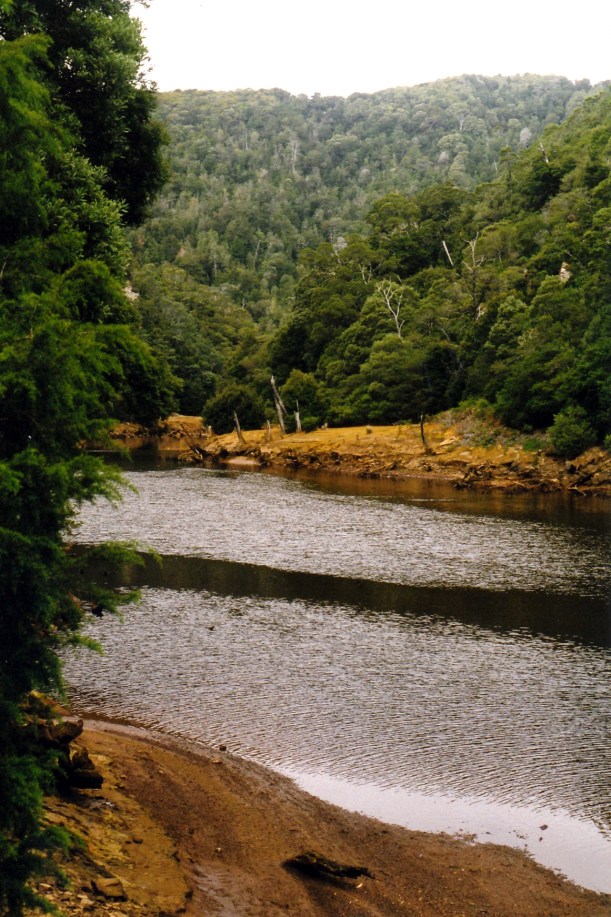
The King River from the Drive

The King River still had the polluted sludge banks evident in piles alongside its channel – from the days when the Mt Lyell Mine and smelter in Queenstown used the Queen River water in their processes, and then discharged the untreated waste straight into the river. The Queen is a tributary of the King. Even though the mining practices have changed in recent times, these rivers are probably the most polluted ones in Australia. The sulphuric acid residues remain a major problem.

02-27-2000 King R Teepookana and mine sludge

The King River near Teepookana – and polluted mine sludge residue

Gold and copper mining began in the Queenstown area in the late nineteenth century, with smelting of copper commencing in 1895. Back then, there were no roads into the region and so, in 1897, a railway opened between Queenstown and Teepookana, near the mouth of the King River. This was to bring the mine products to a port there, for export.

The building of the 3’6″ gauge railway had to overcome major problems. The terrain was mountainous and heavily forested. There were many streams. Cuttings were dug by hand, some up to twenty metres deep. The original 35km long railway had 48 bridges, the longest of which was the “quarter mile” bridge – approximately 250 metres long. They had difficulty finding a firm foundation for this, having to dig down a great distance into the river silt. Even so, trains could only go at walking pace across this bridge, as any greater speed would cause it to sway too much and collapse! It was high up above the river.

The problem of the steep gradient from Queenstown up to Rinadeena siding – 1 in 16 – was solved by using the Swiss ABT rack and pinion system, for some 7kms. The train engine could engage with this central “rail” and pull itself up.

In 1899 the railway was extended from Teepookana to Regatta Point, near Strahan, where the bay was deeper. This necessitated the building of the Iron Bridge over the King River at Teepookana. Later, the railway extended right into Strahan. What had been a busy little port town quickly declined.

02-27-2000 iron bridge teepookana.jpg

The Iron Bridge, near Teepookana

The first road to connect Queenstown to the outside region was the Lyell Highway, in 1932. In the 1950’s, a road was built between Queenstown and Strahan, and this spelled the end for the railway, as the many wooden trestle bridges were too costly to upkeep, and there were increasing concerns about the Quarter Mile Bridge.

The last train ran in 1962. I was fortunate enough to do the return trip on the railway in May, 1962, and remember the Quarter Mile Bridge swaying quite noticeably as the train crawled over it. The bridge was virtually only the width of the rails, so one looked straight down from the open train windows – and the river was a long way below!

In 1964, with three friends, I walked the disused railway track, camping a night at Dubbil Barrel siding and even riding hand operated trolleys some of the way. These had just been left at sidings when the railway closed! Crossing the Quarter Mile Bridge on foot, high above the river, with no side rails, was very scary!

This bridge was, by 1972, partly washed away by floods and by the 1990’s most of the old track, bridges, sidings and station buildings had fallen down, been burnt in bushfires and overgrown by the lush vegetation of these parts.

Now, the decision had been made to rebuild the ABT Railway as a tourist railway and work was obviously  happening at both ends.

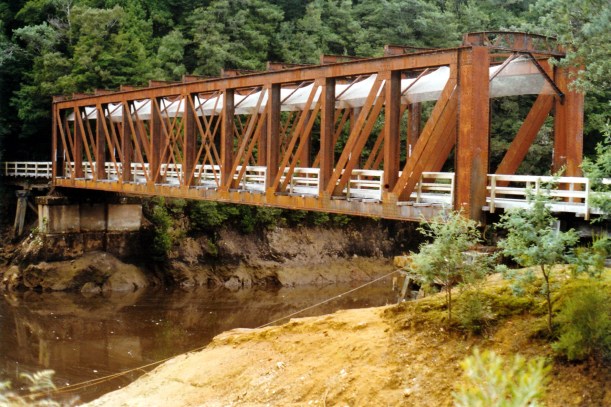
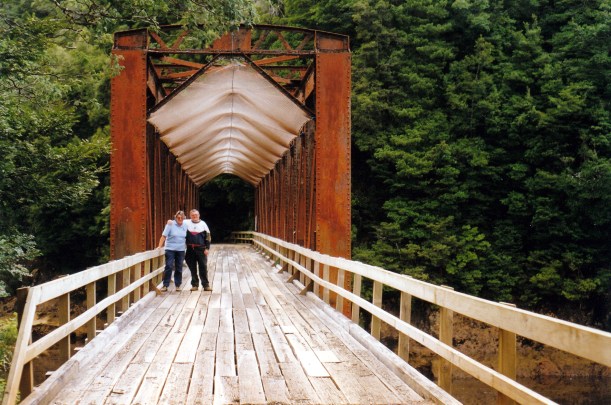
Because of this, the Drive was blocked at the Iron Bridge. It used to allow one to drive as far as the former Teepookana town site. We walked around the fence and across the bridge, with another Victorian couple who had fetched up there at the same time as us. They took a photo for us, on the bridge. When the former rail alignment here was set up as a tourist drive, wooden planking and side rails were added to the bridge, and mesh was slung between the top girders to stop flakes of rusty metal falling on cars and walkers.

02-27-2000 iron bridge mesh

The Iron Bridge altered for road traffic

It was a pity that we could not access the walk to the old Quarter Mile Bridge. Apparently, a tour operator can take customers up to the Teepookana Plateau, for $30 a head. John is not inclined to do that, at this stage.

John found a healthy looking Huon pine tree growing by the King River, and wanted a photograph with it.

02-27-2000 huon pine king r.jpg

John with Huon Pine at the King River

On the drive back to Strahan, we looked at the ABT Railway terminus at Regatta Point, which is being restored. This is where the new tourist railway will terminate.

02-27-2000 regatta pt abt terminus

Regatta Point Railway Station being restored

In Strahan, we went to the huon pine sawmill, and looked at the mill and associated gallery of timber pieces. They had some great products, bowls especially, and some very evocative wax painting by a local artist.

We collected my photos. They were beautifully done. It was not cheap, but he gives a replacement film “free”. For $1 a roll extra, I could upgrade from a 24 exposure to a 36, so I got 4 rolls of 400 speed for, effectively, $4. That shop also had huon pine wood products for sale. I liked the wooden cribbage boards – an idea for John to make sometime for Xmas presents: wooden board, Tasmanian illustrated playing cards, printed game rules, in a box. I also liked the shaped garlic bread dishes, with a natural edged top, about 1cm thick, and naturally curved, hand carved, I think.

At the Strahan bakery, I bought a loaf of damper bread and some rich, indulgent fudge.

After a full day, we drove back to Queenstown. The highway between the towns is 41kms, so it is not that far, but overall we managed 156kms for the day.

Tea was cold roast chook, the damper bread which was very nice, and the fudge which was yummy!


Leave a comment

2000 Travels February 26

SATURDAY 26 FEBRUARY     QUEENSTOWN

There was quite heavy rain during the night, which was pleasant to hear on the van roof. As this very wet west coast area gets almost 100 inches of rain a year, this was no surprise. In the morning there was low, misty, cloud and still some rain. Visibility was poor. The weather did clear, a little, late in the day.

We decided to defer the planned drive until the weather was better, for seeing the scenery – which is the purpose of the exercise, for us.

John went back to bed.

It turned into a van based day. I did some computer letter writing, but did not yet print same. It was good to get a chance to do letters.

03-03-2000 wet day queenstown camp.jpg

Wet and misty day at our Queenstown camp

We drove to the National Parks Office and returned the track key. Collected the papers that I’d ordered yesterday from the newsagent.

Tea was roast chook and veggies. An “in” day gives me time to do such meals.

John phoned K and left a message to send mail here. He also talked to sister H, and R again.


Leave a comment

2000 Travels February 25

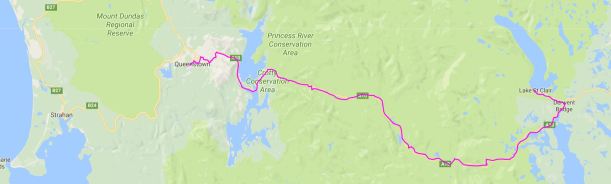
FRIDAY 25 FEBRUARY   CYNTHIA BAY TO QUEENSTOWN   98kms

I got up about 8am. There was some mist and cloud just rising off the lake and I took my mug of coffee down to sit and watch it. It really is a beautiful place here, despite the deficiencies of the campground.

We were slow packing up and getting away – John adjusted both van brakes before we left and that involved some fiddling about. It was 11am when we left the campground.

Out on the highway, John thought the van brakes were working better.

The run to Queenstown was straightforward enough, quite winding for much of the way.  We had seen almost all of it yesterday.

Since we were last in these parts, the HEC had dammed the upper King River and created the very large Lake Burbury. The highway follows the shores of this in parts, and one gets interesting glimpses of water through the trees. A long bridge takes the highway across the lake and gives very scenic views both ways of the lake and surrounding mountains.

The final 6km downhill section was not as difficult as I had feared. It was a steady downhill run, but not as steep as the road down into Tarraleah had been. But it was quite winding. We did not end up with smoking brakes this time, though they smelled a bit warm!

That Gormanston Hill descent has some vertiginous drop-offs and being a passenger going down is not much fun.

I was amazed at how much the vegetation has grown back on the once bare hills surrounding Queenstown since the copper smelter closed down in 1969. The early miners cut down the timber on the surrounding hills, for quite a distance. Then the fumes from the sulphuric acid treatment in the smelter poisoned off any remaining vegetation. I first came to Queenstown in 1962 and it was like I envisioned the moon would look – bare and crater like.

On the way through town, to the caravan park, we saw where the new ABT railway station was being built, as part of the project to restore the railway. This was of real interest to me, because the reason I came here in 1962, was to ride on the original train to Strahan, and back, on one of its last journeys.

We had decided to have a look at the Queenstown Cabin and Tourist Park and, if it was reasonable, to use this as our base in this area. Back in 1993, we’d camped at the caravan park in Strahan and it was not a pleasant memory. We really did not want to go there unless there was no alternative.

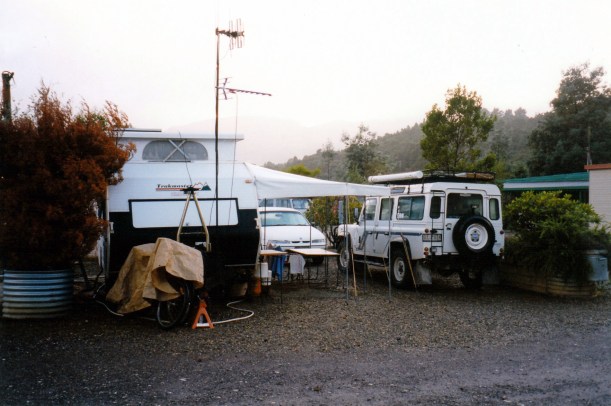
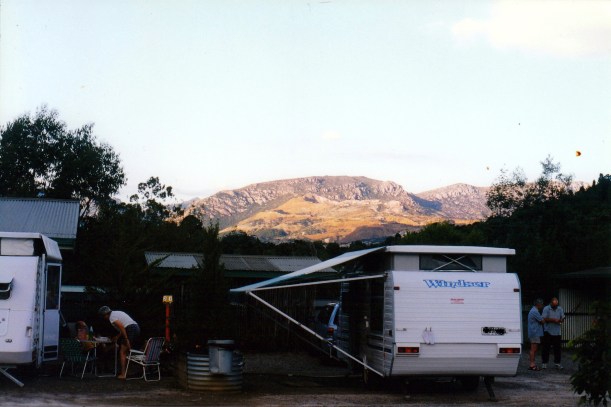
As it turned out, the park was pleasant enough. The surface of the sites was gravel, but one would expect that here, where even the football oval is gravel! With the high rainfall levels of these parts, even if grass would grow, it would get horribly soggy! There has been an effort to grow shrubs in tubs to screen sites, and the amenities are clean and adequate. $15 a night, with the seventh night free.

02-26-2000 from the cp queenstown.jpg

Outlook from our site at the Queenstown Caravan Park

It had become quite a warm day in Queenstown. We were sweating, doing the camp set up.

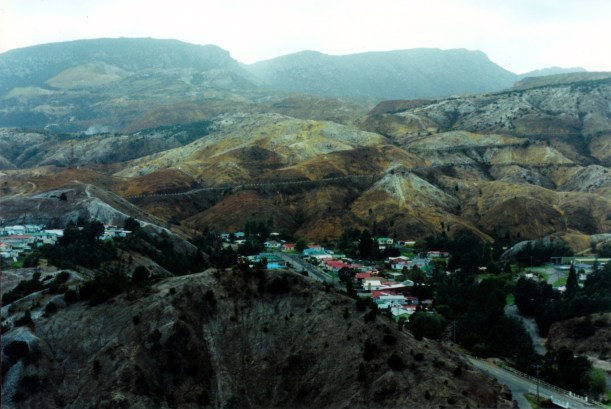
After setting up and having lunch, we drove to the central shopping area. The town is in the valley of the Queen River, so is long and narrow, following the valley.

03-04-2000 Gormanstown road from Rotary LO.jpg

Queenstown, built along the river valley. Lyell Highway on Gormanston Hill behind.

At the town centre, we encountered the 4WD Radio Network lady again. She is staying in Queenstown too, having investigated and found Strahan too awful. She and friends are driving the Mt McCall Track tomorrow. John decided we should join them and, after unloading the shopping and me back at camp, went off to get the required key and permit from the National Parks Office, and to wash the underside of Truck – also required – to prevent the spread of root rot. He refuelled Truck – 94cpl.

While John was gone, I did two loads of washing. Put the socks and jocks through the dryer. Hung T shirts and the like outside the van, on lines under the awning. Thought I might need to put them through the dryer tomorrow, to finish them off. It was good to have the dirty wash bucket somewhat reduced.

We found that the mobile phone worked here. There were two messages – one from the bookshop about the ordered book. One from K, whose job at the hotel has changed; in the flurry of his new sales role he’d forgotten to send the mail. For once this was good, because we’d earlier asked him to send it to Strahan.  His message said he’d send it Monday if we let him know where to.

TV reception, apart from SBS, was excellent here, which rather surprised me, with the hills all round.

The water is not drinkable. The park has a rainwater tank.

Tea was bought fish and chips. They were rather greasy, but huge servings.

After tea, John phoned daughter R, as it was her birthday.

A big huntsman spider came into the van, through the partly open pressure hatch, where John had brought the TV aerial cable through. The spider sat on the ceiling of the van – John had to capture and remove it to the outside garden. It was a surprising visitor for this area – I wondered if it had been tucked away somewhere under the poptop roof, since the treed camps of Cynthia Bay or Mt Field. If so, would certainly be out of its comfort zone here!

02-25-2000 to qtown.JPG


Leave a comment

2000 Travels February 24

THURSDAY 24 FEBRUARY     CYNTHIA BAY

Today was a beautiful, sunny, clear blue sky day. It would have been a great day to tackle the Mt Rufus walk, had we waited for better conditions.

This was a driving day. We had decided to drive down the highway towards Queenstown, visiting the various suggested tourist stops in the Franklin Gordon Wilderness Area, along there. It was a lot easier to do this without the van on, trying to fit into small car parks and without the pressure of having to get to a new camp destination at the end.

The road west from Derwent Bridge was initially through heathland and buttongrass country, but we soon got into the forested western country, with the road becoming more winding as we got amongst the mountains.

First stop was to do the Franklin River Nature Walk circuit. This was superb, through the rainforest, and by the Franklin River for some of the way. John tried to take a few photos in the dim, green forest, on a very low speed. The circuit was only about a km, but we did dawdle, enjoying the forest.

02-24-2000 franklin r rainforest.jpg

On the Franklin River Nature Circuit

One could see why this sort of country, across the western part of the island, was so hard for the early explorers and settlers to penetrate.

Next stop was at the car park area at the start of the Frenchmans Cap walk. Frenchmans Cap is a pointed, white quartzite mountain, that one can see in the distance from several places in the west. The walk is a pretty tough, multi-day one, three days at a bare minimum. It is not a walk I have done, although at one stage it was on the to-do list.

From the car park, we walked the first few hundred metres of the track, as far as the Franklin River crossing. The old flying fox that used to be the means of crossing the river has now been replaced by a little suspension/swing bridge.

02-24-2000 franklin r crossing f cap tk

Hikers’ bridge over the Franklin River, on Frenchmans Cap Track

There were some photos, at the walker registration booth, of hikers battling through the nearly waist deep mud on the “sodden Loddon” Plains – buttongrass swamp country. I told John that I remembered parts of the Overland Track being like that, when I first walked it – especially the Pelion Plains. The biggest problem walking in that sort of stuff is that you cannot tell, until foot is planted in it, whether the patch of mud you are entering is a few inches deep, or a couple of foot deep. The boardwalks of the Overland Track are a great improvement!

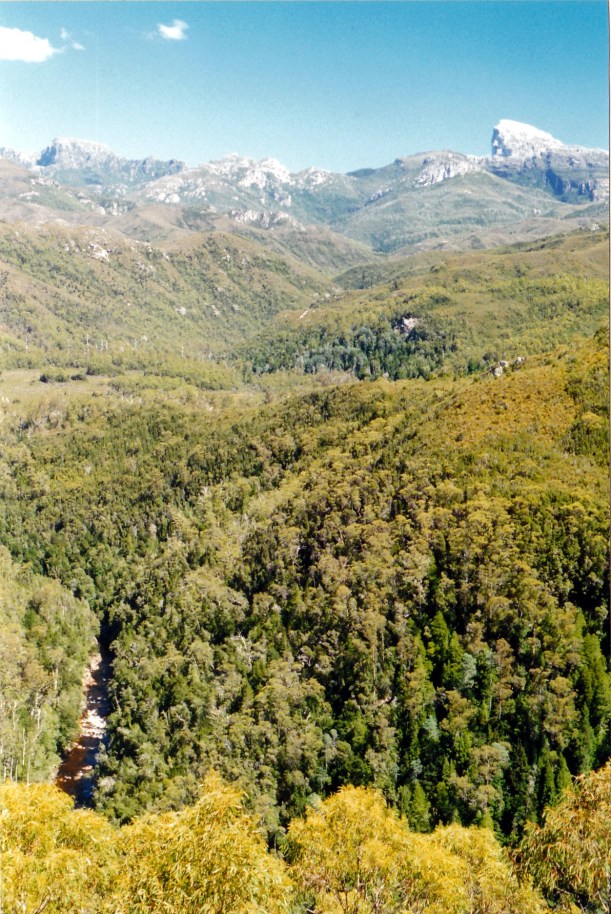
Back to the highway for a short while, then another car park and the short walk to Donaghys Lookout, from where there were superb views of the Franklin and Surprise Rivers and Frenchmans Cap. We were lucky to strike such a good day – the top of the Cap is often shrouded in cloud and invisible. But for us today, the summit stood out, brilliant white.

02-24-2000 frenchmans cap from donaghys lo.jpg

Frenchmans Cap from Donaghys Lookout

We stopped on the walk track to look for some birds we could hear. While John was standing still, a big tiger snake crossed the path, quite close to him. It wasn’t in any hurry – unlike John – and I was just able to photo its rear end moving off the path.

02-24-2000 another tiger snake departing.jpg

Tiger snake disappearing – John gone!

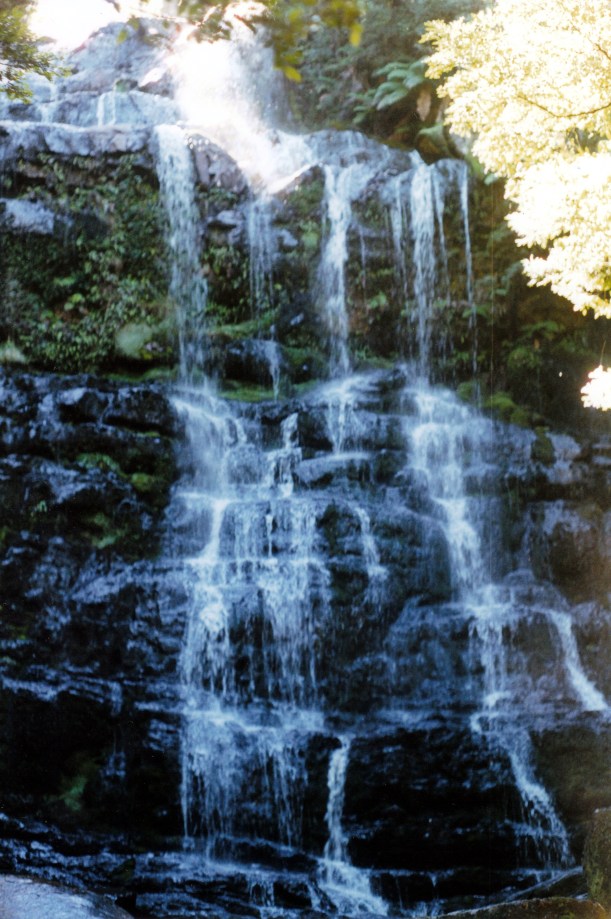
The furthest point west we went was to Nelson Falls – again, a short walk from the parking area. The Falls were excellent, amongst the best we’d seen, till then, in Tasmania. However, they are on the tour bus route and we did not get much time to ourselves, in there, between bus groups. It was impossible to get enough distance from them to take a photograph that did them justice.

02-24-2000 Nelson Falls too

Nelson Falls

At that point, we were not really all that far from Queenstown.

On the way back, we stopped at the Collingwood River crossing of the highway, which Franklin River rafting parties often use as a setting off point, as the Collingwood runs into the Franklin. The river seemed rather low there now, though. Even this part of Tasmania seemed unusually dry.

We drove 135kms today. It was definitely much easier than trying to visit those places with the van. Some of the parking areas were pretty small.

Tea was sausages. John also had leftover fried rice, and bread with peanut butter! His choice! I has some salad with my sausages.


Leave a comment

2000 Travels February 23

WEDNESDAY 23 FEBRUARY     CYNTHIA BAY

During the night, the wind dropped and rain set in. It eased off towards the morning, but visibility outside was low.

We decided to have a “wait out the weather” day. This assumed, of course, that the bad weather would only last a day! Up in this country, there are no guarantees of that, even in summer. There are a couple of huts on the Overland Track that I’ve been blizzarded into, for days at a time! In summer.

Through the morning, we read the paper and lazed about.

02-24-2000 crow vs wallaby.jpg

Crow investigating what wallaby eating, by our van

After lunch, as the weather was clearing, after all, we went for a walk.

Took the Overland Track to Watersmeet, then a loop that went to Platypus Bay, on Lake St Clair. We returned along the Woodlands Track, to make a circuit of about 5kms. We were out for about two hours, but it was a leisurely walk.

Watersmeet, where the Hugel and Cuvier Rivers join, was really beautiful. The waters of both were rushing over smooth boulder beds, amongst the green of the surrounding myrtle rainforest. Much of the Woodlands Track was also through myrtle dominated rainforest and was rather lovely.

It was good exercise, to walk today, and ease out any stiffness from yesterday.

John took his little portable radio with him, and tried to listen to the Australia Vs NZ One Day cricket, at points on the walk – not very successfully. I was surprised there was any radio signal at all, up here.

Back at camp, we had early showers – to catch the amenities when they were – briefly – clean.

A lady walking past our camp stopped when she saw the 4WD radio network sticker on Truck. She told us her Victor call sign. All members have a call sign with a number; the first part identifies the State one comes from – Victorians are Victor……She travels solo in an ex-Britz hire Troopy, with a pop top. She told us that she sometimes fills in doing relief spells at the radio bases, so it is quite possible we will encounter her sometime, on the radio network. Her Troopy has two spare wheels, on fold out Kaymar frames, on the back. Good way of setting up to carry the extra spare.

Tea was fried rice.

02-21-2000 04 dusk lk st clair.jpg

Lake St Clair dusk

John phoned daughter R, who is still having job interviews. Then he read my share book for a while and played his computer games. I am trying to ration out John’s “Solomon’s Song” to make it last the rest of the trip, so read this week’s quota then went to bed at 10pm.


Leave a comment

2000 Travels February 22

TUESDAY 22 FEBRUARY    CYNTHIA BAY

I got up at 8am, to a cloudy day. Took my morning coffee down to the lake side and sat, watching the water. It was rather windy.

We set off, walking, about 10.30am, to tackle the track to the summit of Mt Rufus. This peak – some 1400m high – is at the “back” of Cynthia Bay. The walk is one I did many years ago, when staying here after an Overland Track walk. It is a circuit of about 20kms – up Mt Rufus, from Cynthia Bay, then back via Richea Valley and Shadow Lake.

We were later leaving than we should have been – story of our lives! The cloud overhead was fast moving, and it did not look to be a promising day for going up high, in these parts. I suggested we walk to Forgotten Lake first, then see what the Mt Rufus summit area looked like from there – in effect, starting the circuit the reverse way. However, John was determined to tackle Rufus today, regardless.

We did not have far to walk, maybe 500 metres, from the campground, along the start of the Overland Track, before coming to the Mt Rufus track, which veered off to the left. Then, it was a steady climb.

There were some really pretty parts, in myrtle forest and the like, with lots of lichen and mossy growths on the trees, which was enchanted forest-like! There was a desolate area, higher up, where bushfire had killed the snow gums, which were just bare, silver trunks. There was one beautiful old, low, tree, half dead but battling on with its other half, really gnarled, with moss and lichen hanging off it. I stopped, admired it, touched it – as a sign of encouragement, I think. I don’t normally do that sort of thing.

02-21-2000 lichen Lake St Clair.jpg

Lichens festooning a bush

As we climbed higher, we came out of the tree line onto rocky, alpine scrub and marsh areas. The wind was noticeably stronger and it was quite cold. The clouds were really racing over.

We climbed up onto the ridge that leads, for over a kilometre, to the summit. Here, the wind was strong enough to make one stagger and lose their footing. It was really hard to walk.

We encountered the couple that we’d met and talked with at the Lake Dobson car park, after we’d finished the Tarn Shelf walk. They were on their way down from the summit of Mt Rufus, and said that it was even windier, higher up.

We went to the top of the first ridge, and could see the main summit, probably about twenty minutes walk away. The wind was horrendous, and the clouds coming in looked really threatening. This was no place to be caught in really rough weather, as can happen quickly in the Tasmanian alpine country, so we decided to turn back.

02-22-2000 mt rufus windy.jpg

Strong wind blowing John’s coat off near summit of Mt Rufus

It was disappointing not to reach the top and see all the fantastic mountain and wilderness views that I remembered – but even had we reached the summit, cloud would have prevented much of a view. It was never the right sort of day, weather-wise, to tackle this walk. It was probably surprising that we got as far as we did.

It was a long, downhill trudge, back the way we came. It was also disappointing not to be doing the circuit walk.

We were out for about five hours and walked about 14kms.

As we were walking through the timbered lower section, heard a tree fall, somewhere behind us.

Back at the lake level, the wind had really picked up, too. It was very gusty. A tree had come down over the road, near the van.

02-22-2000 windy day at Lake St Clair.jpg

Tree down over the road – our van visible through the trees

John decided that, from now on, he wanted me to take a photo of the van at every place we stayed. His memory is such that he already can’t remember many of the places from the last couple of years, so he wants photos as a memory aide.

Tea was pork and veggie stir fry, and rice. We had it quite early, being hungry after the day’s efforts.

After tea, I tried doing some sewing, but the light was too poor. John read and played on the computer. I went early to bed, with sore feet after the day’s walking, and with the van rocking about in the wind. We just hoped no more trees fell!


Leave a comment

2000 Travels February 21

MONDAY 21 FEBRUARY     CYNTHIA BAY

It seemed very dim and still when I woke up. Upon going out to investigate, I found a really thick mist over the lake – quite eerie and beautiful. It later lifted, with the sun, of course.

02-21-2000 morning mist Lake St Clair.jpg

Morning mist – right on the water’s edge!

Just as we finished breakfast, a good site became vacant when the occupiers moved out, so we very quickly shifted some of our gear over onto it and then moved the van over. It was worth the extra hassle of hitching up. Our new site was more defined  and had views straight down to the lake. We had room to put the awning on.

After getting the new set up all done, we left about 11am, to drive around to the Great Lake via Bronte and Miena. We were high enough up, now, on the Central Plateau, for the country to be a mix of snow gum scrub with more open heathlands.

Stopped at Bronte where I was able to buy a Melbourne Sun newspaper, and some salami, before continuing on to the Great Lake.

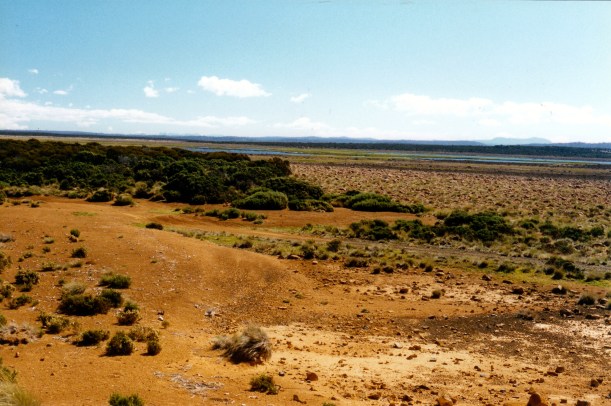
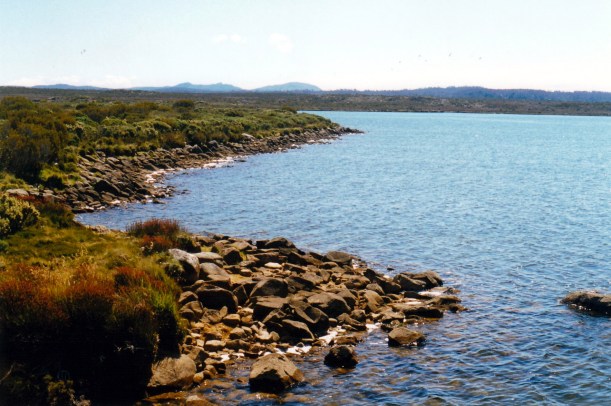
We sat in Truck, down a little side track that took us to the edge of the Great Lake, and had our lunch.  It was the usual bleak outlook over the lake, although the water was blue – I think it was the first time I had seen it anything other than a dirty grey! I have always found the Great Lake a bleak and desolate place.

We then drove up to Liaweenie, where a canal takes water from Lake Augusta, via the Ouse River, to the Great Lake. All part of the interlocking network of hydro electric infrastructure up here.

We drove the track that follows the Liaweenie Canal, to Lake Augusta. This is another place I have long wanted to come, after hearing my cousin and his mate, in the 60’s, talk of fishing and walking expeditions, where they walked from Lake Augusta, via a whole chain of glacial lakes on the plateau, over several days, eventually travelling through the Walls of Jerusalem and down Howells Bluff, to a rendezvous point on the Fish River. Always wanted, in vain, to do that trip – not for the fishing, which they could have to themselves, but for the walking and to see such superbly named places.

Lake Augusta was really low – almost non-existent. Ironically, there was a warning sign that the lake could spill over any time, without warning.

02-21-2000 01  lk augusta tk.jpg

Not hard to see why we were not worried!


02-21-2000 03 Lake Augusta in dry.jpg

Almost dry Lake Augusta

The Liaweenie Canal was not flowing. Many years ago, I saw it at the Great Lake end, totally packed with churning trout, trying to get upstream to breed.

From Lake Augusta we followed a rough track to Lake Ada and Ada Lagoon. We could see the DuCane Range, Mt Pelion and Mt Ossa in the distance – in the Cradle Mountain Lake St Clair  National Park, and Mt Jerusalem closer.

02-21-2000 02 lk ada and walls jerusalem behind

Lake Ada, with the Walls of Jerusalem in the distance

There were people fishing in the lakes up there, including fly fishermen standing thigh deep in the water.

On the return journey, we visited the National Park information centre at Liaweenie – it had an interesting display. We also stopped again at Bronte and bought the Hobart Mercury and an icecream each. There was nothing that related to John’s letter in the Mercury, but there was an interesting editorial on the problems of over-use of the Overland Track. They are so right about that!

We drove 209kms today.

The camp area was over-full – very busy.

Some cloud and mist in the sky made for a very pretty sunset of pinks and reds.

02-20-2000 sunset lk st clair.jpg

Sunset at Cynthia Bay

Tea was pork chops, potato, onion gravy.

After dark, the moon was surrounded by a haze – I was not sure what that meant for tomorrow’s weather. The night was warmer.


Leave a comment

2000 Travels February 20

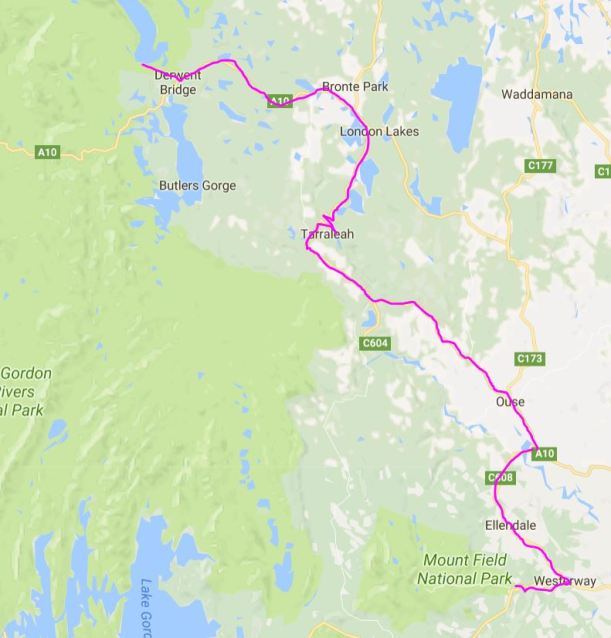
SUNDAY 20 FEBRUARY   NATIONAL PARK TO LAKE ST CLAIR   137kms

When we got up in the morning, there was the lovely smell of rained-on bush.

I phoned the Visitor Centre at Lake St Clair to book us a powered site. Knowing we had a place for tonight, we had a leisurely pack up and departure.

We stopped at Westerway for fuel – 88cpl.

Took the minor road through Ellendale, to the Lyell Highway. There were some very steep hills. We stopped at the bottom of a particularly long downhill section, so that John could check that the repaired van brake was not too hot. It was fine, but there was smoke coming from the front passenger side of Truck, which caused us some consternation. John checked the obvious engine things – water, oil, etc. All were ok. We concluded that maybe the wheel or brake drum was hot and had gotten some water or mud on it when we pulled off the road.

So we continued on.

The country around Tarraleah was hilly again. There was a really long, sustained, steep downhill, winding road going down into the Nive Gorge, to Tarraleah. It went on for kms. We pulled over again at the parking area by the Tarraleah power station. Smoke came out of Truck’s brakes! They had obviously been working too hard, although the wheels themselves did not feel too hot.

With superbly bad timing, there were some tour buses parked there too, as audience to our entry. One self-important old twat came rushing over to tell John that he really should use the gears coming downhill! Duh! The only gear John hadn’t used on that downhill run was reverse!

Actually it occurred to me that it would help, on such gradients in the future, to have Truck in low range. That might make the engine into more of a brake. I decided I would suggest that, at an opportune time. This wasn’t it!

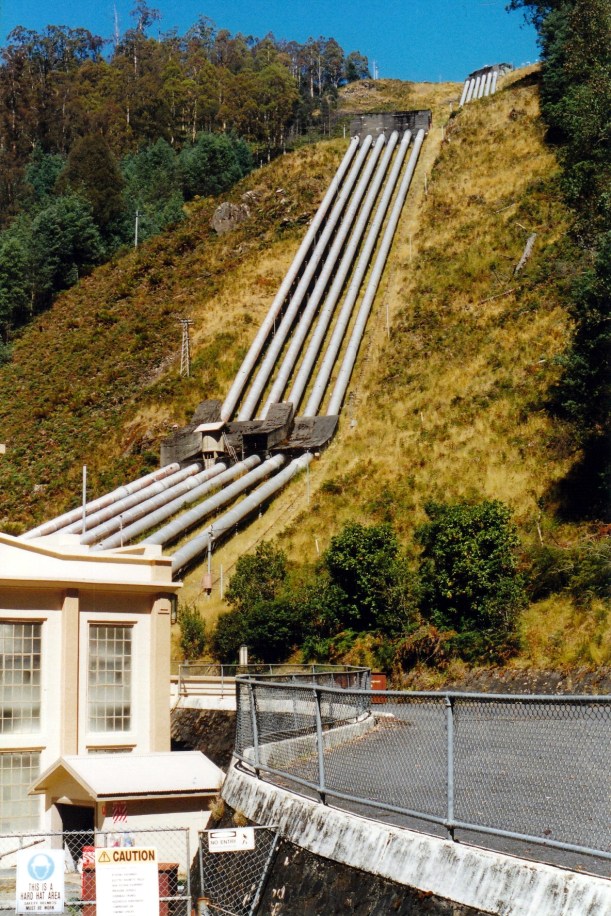
We wandered about, and had a look at the power station and the penstocks that come down the hill to it, bringing water from the storages up top, like Tungatinah Lagoon. We had an interesting discussion about what the results of a broken penstock might be!

02-20-2000 02 penstocks tarraleah.jpg

Tarraleah – penstocks bringing water to the power station

When John thought the brakes were cool enough, we continued on, up the long, steep climb from the Nive Gorge, and amidst the tourist bus traffic.

It had turned into a pleasant, sunny day.

We reached Lake St Clair about 1pm, turning off the Lyell Highway at Derwent Bridge (which is basically just a hotel) for the 5km or so to get to Cynthia Bay, where the settlement is. Derwent Bridge is, as the name suggests, where the highway crosses the upper reaches of the Derwent River, which originates  from Lake St Clair.

Lake St Clair is another glacier formed lake – long, narrow and the deepest lake in Australia. It is in a beautiful setting, with mountain backdrops. It is at the southern end of the Overland Track – the walk track from Cradle Mountain, some 80kms to the north. The track emerges at the northern end of the lake and most hikers choose to avoid the extra day’s walk, and night in a tent, by catching the boat service down the lake to Cynthia Bay. This is what I have done, the times I’ve walked the Track!

So the settlement at Cynthia Bay – Rangers Station, visitor information centre and shop, campground and accommodation huts – caters both for hikers and tourists like us, this time, who come in by road.

We went to the slick new Visitors Centre and paid our camp fees of $12 a night, for five nights. We were told that ours would be the only empty site in their small powered camp area. They do not bother to allocate numbers or really demarcate sites! There were 9 power points, in pairs, on the trees around the roughly circular area. That’s it!

The only seemingly empty place for us was a small spot between trees and very close to a Kombi van there. We occupied  it. Were pretty dissatisfied as there was no room to put the awning out to the side! The people in the Kombi were rather strange. It turned out that they had decided to stay on an extra night, but had no bothered to tell the office, hence the squash.

After dark, a motorhome came in; the people hunted around for a power outlet but of course there was none. We did not know whether they had been misinformed at the office, or had simply decided to try their luck without checking in.

When we booked in, the cafe/shop was doing a roaring trade, with two big coaches pulled in, plus walkers in off the Overland Track. Lakeside St Clair is now a slick operation geared to extracting maximum cash from tourists and walkers – but not overly concerned to give value for money. That was my impression anyway.

After our very basic set up, which didn’t take long  – there was no room to put out table, chairs and the like – we walked up to the National Park Information Centre, which was of excellent quality. We studied the information there for over an hour, which is a measure of its quality, considering our previous visits to Cynthia Bay and thus already knowing a lot about the area. In the 60’s I had camped there with friends for a few days at a time, after walking the Overland Track. When John, my son and I finished the track in 1992, we didn’t stay because there was a bus conveniently leaving for Devonport, and we were on a fairly tight schedule.

Then went to the shop, where I bought magnets, postcards and a Sunday paper.

The amenities block for this campground is abysmal. It also services a backpacker bunkhouse. There are two toilets and three showers in the Ladies, which is not enough. One of the toilets has a leak – only fresh water, one hopes! The floor is thus awash most of the time. The showers cost 50 cents in the slot – but the water does then run for a good seven minutes. However, there is no temperature control – you take it as it comes, which was a bit hot for me. The shower design has the water washing over the floor into the next cubicle, so the end one gets the wash from both the others. Most unhygienic. The whole pace was grotty and dirty. There was much backpacker washing of dishes in the handbasins, too, which always creates more mess.

We took beers down to the lake shore, downhill from our van site and sat, watching fish jump. It was very beautiful, with Mt Ida and the Traveller Range opposite, and big cumulus clouds building along the top of the Range.

02-21-2000 lk st clair and traveller range

The Traveller Range, across Lake St Clair

Tea was fettucine with olives, capers, tuna, tomato. John really likes this recipe, and I like it because it is quick and easy to make.

There was a really pretty sunset over the lake. Then, later, the full moon shone on the lake, making a reflected beam. We took some photos of this, using the camera tripod. Later, as the moon got higher, little light speckles appeared on the water, like a few fish wearing tiny lights. These grew into a big shimmering patch. There must have been some ripples on the surface, catching the moonlight. It was most unusual, and lovely.

02-20-2000 moon on Lake St Clair.jpg

Moon over Lake St Clair, with multiple reflections

It was also a cold night. I needed my woolly bedsocks.

John phoned his sister and had a chat, then K to leave a message for him to send mail to Strahan.

We booked in here for five nights, intending to do some sightseeing in the broader area, and walking. Had we inspected the site first, might not have done so!

Seeing the walkers coming in off the Overland Track today was real nostalgia stuff, for me. Forty six years ago that was me, the first time!

02-20-2000 to lake st c.JPG