This Adventurous Age

Adventures travelling and working around Australia.


Leave a comment

2000 Travels March 4

SATURDAY 4 MARCH     QUEENSTOWN

After breakfast, we drove up Spion Kopf Hill, behind the town. From here, there were good views over the railway station building works, and up the “Gormy” hill. Could see a newly painted and refurbished train turntable at the terminus works – very flash.

03-04-2000 Queenstown view from Spion Kopje.jpg

From Spion Kopf. New railway building in centre.

Then we drove to Strahan, yet again. I put a couple of rolls of film in for processing at the good shop there. At the bakery, bought scrolls for lunch, and for dessert tonight.

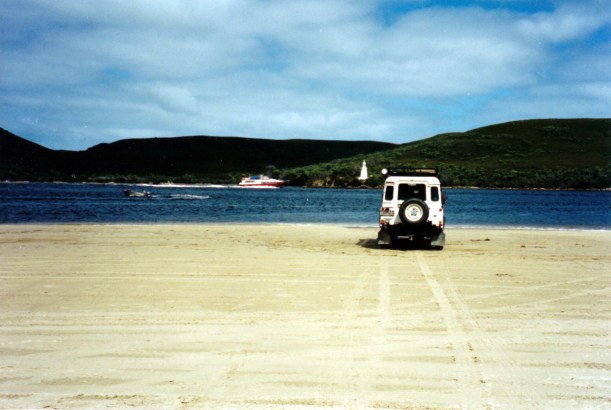
We drove out to Macquarie Heads and ate lunch, sitting in Truck, parked on the beach there. Watched the cruise boats go out through Hells Gates.

03-04-2000 Ocean Beach by Hells Gates

On the beach at Macquarie Heads, with tour boat passing Bonnet Island

Then drove around to Ocean Beach which, as the name suggests, fronts on to the Southern Ocean. John said he was sure he had been here before, but I did not remember it. We concluded that he might have visited it alone, while I was in hospital in 1993.

We went for a very pleasant walk along Ocean Beach, for a couple of hours. Then drove back to Strahan where I collected my photos. Refuelled Truck – 96cpl.

Went to Tuttles Whittling Display, which was quite whimsical and something different.

I drove us back to Queenstown, so John could have a good look at the scenery on the way, for a change. The road certainly required one to concentrate!

Tea was leftover chow mein for John; I had some salad and a tin of fish.


Leave a comment

2000 Travels February 29

TUESDAY 29 FEBRUARY     QUEENSTOWN

Yes, a Leap Year!

We woke early, to the alarm. Left camp at 7.45am to drive to Strahan, getting there at 8.30.

Stopped at the bakery, so I could buy us focaccia rolls for lunch, as we had decided not to pay the extra fee for the lunch provided on the cruise, thinking it would probably be fairly ordinary.

We were able to get a window seat on the cruise boat, opposite a couple from NSW. The seats were each side of tables, so some people faced forwards, some back. The Wanderer III was a big boat which took over a hundred people at a time. We found it quite comfortable. There were some tour groups on the boat, mostly older people.

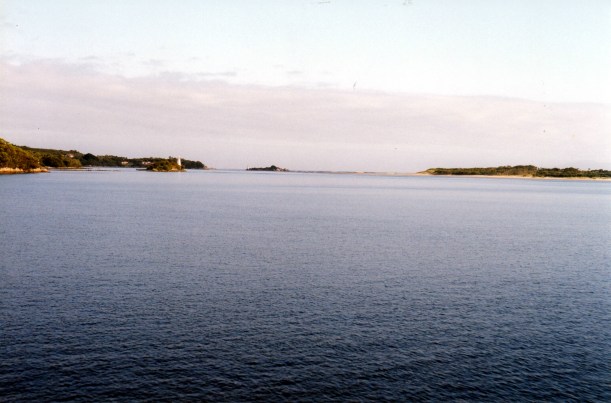
Departure was as scheduled, at 9am. We cruised down Macquarie Harbour, then around to Macquarie Heads and the narrow Harbour entrance – Hells Gates. This name came from the convicts when Macquarie Harbour had a penal settlement, 1822-33. To them, it was the entrance to Hell.

02-29-2000 01 Hells Gates from inside Macquarie Harbour.jpg

Approaching Hells Gates: Bonnet Island and Entrance Island

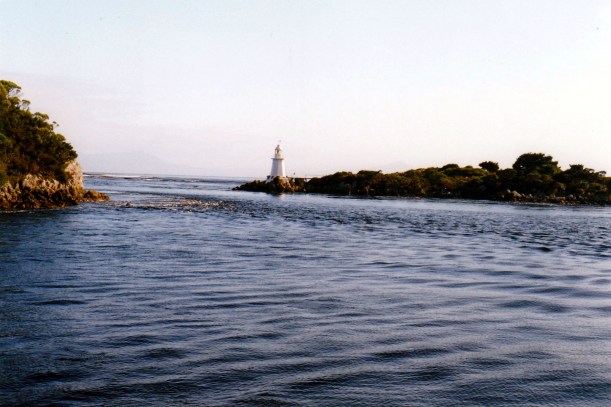
The boat proceeded past the small light houses on Bonnet and Entrance Islands the guide through the channel – narrow and treacherous – and on out into the open sea. We could see the convict-constructed rock wall along the channel near the entrance. The commentary explained the scouring effect of the channelling, to keep the entrance clear, and pointed out the Cape Sorell Lighthouse.

02-29-2000 02 hells gates.jpg

The narrow, treacherous channel at Hells Gates

We could just see lots of wild, western mountains in the misty distance – a lovely outlook.
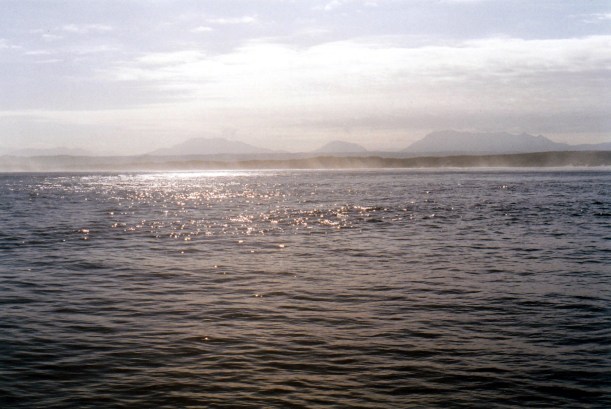
02-29-2000 04 west coast mts

The mountains of the west coast, from outside Macquarie Harbour

We were followed through Hells Gates by another, similar, cruise boat.

After our little look about out there, we motored back into the Harbour. The Hells Gates entrance was, thankfully, very docile today. I guess there are plenty of times when the cruise can’t go outside, as we did.

02-29-2000 05 outside hells gates

Outside Hells Gates, Entrance Island, other boat

Our next destination was Sarah Island, down the Harbour, about 25kms from the entrance, passing some Atlantic salmon fish farms in their circular cages, on the way. This was the site of the penal settlement. There, we went ashore for a guided tour. This was done by actors based at the Visitors Centre, in Strahan, and was excellent, interesting and informative. Despite the large group, it was all audible. At one stage, an actor went into the water (in a wet suit) to explain and show the existence of the old slipway timbers and jetties.

02-29-2000 06 Sarah Island ruins

Sarah Island building ruin

Much research seems to have been done about Sarah Island. Conventional wisdom has long had it that Macquarie Harbour was a dreadful place of punishment and that the penal settlement here was eventually abandoned in favour of Port Arthur because of the difficulty of supplying the place from Hobart (by ship). However, on the tour it was suggested that it was actually a very successful, calm and hard working establishment, where there was little trouble and the convict population took pride in the ship building and support works. Not all of the convicts were those being punished for further crimes committed while under sentence elsewhere; some were those who had opted to go there in return for a remittance  of their sentence. Thus, the tour suggested, it was abandoned because it was not punishment enough!

02-29-2000 08 new penitentiary sarah is.jpg

The New Penitentiary on Sarah Island

The hour of the presentation flew by. I would have liked some time to browse on the island independently, which we did not get. I think that only having supervised groups may be part of the preservation tactics.
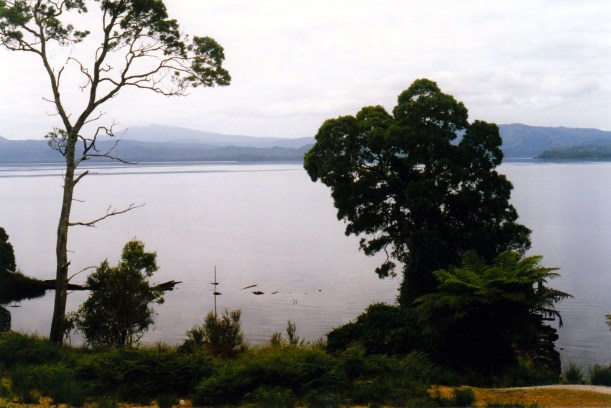
02-29-2000 07 sarah is view

Macquarie Harbour from Sarah Island

Back  aboard, the boat headed further down the Harbour, to the entrance to the Gordon River.

Lunch was served on the boat at this time. I think we were the only ones who had brought our own! The boat meal looked excellent – cold meats, stacks of smoked salmon, salads. I think we made a major misjudgement there! Still, our focaccia was nice.

We progressed slowly up the Gordon River – there is a low speed limit, to protect the river banks from wash from the tour boats.

02-29-2000 10 on the Gordon R.jpg

Going up the Gordon River

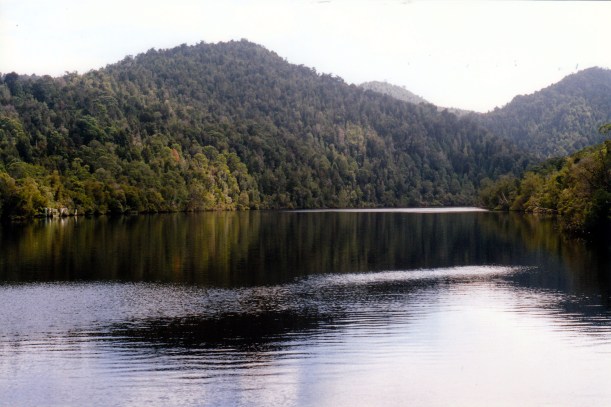
Thick forest came right to the water’s edge. There were brilliant reflections in the dark river water. The river was wide and tranquil.

We passed a yacht tied up at Fishermans Landing.

02-29-2000 09 Gordon R Fishermans Landing

The Gordon River at Fishermans Landing

The commentary on the boat told of the protest blockades of the early 80’s, over the proposal to dam this river, downstream of the junction with the Franklin River, that would have impacted hugely on both rivers. It described all the arrests that were made – including of Bob Brown, a leader of the Save the Franklin movement, who went on to become an Australian Senator and Greens Party founder and leader.

The rivers were saved, after the intervention of the newly elected Hawke ALP government, and High Court decisions about federal powers and World Heritage Area rights. All history now!

02-29-2000 12  gordon r.jpg

Reflections in the tannin brown Gordon River

We went ashore at Heritage Landing for a 15 minute rainforest walk, with commentary. The forest here, ironically, was nowhere near as good as that we’ve seen in other part of Tasmania. There was one huge Huon pine tree – falling down – and we took photos of that.

Back on the boat and back down the river and across the Harbour, to Strahan. One does not really realize how big Macquarie Harbour is, until you do something like this.

We spent some of the time on deck and some inside, watching a scenery video they showed – brilliant. Many of the older, tour bus people slept.

It was a pleasant trip back down the river and up the Harbour, but blowy when the boat went fast.

02-29-2000 13 macquarie harbour

Speeding back to Strahan across Macquarie Harbour

We docked at 3.45pm. The trip, at $44 each, was excellent value.

We then went to the pine mill here – Morrisons – and John talked to the owner, who seemed to remember him. This is where John bought the Huon pine he used to make our bedroom furniture, in early 1993. He did the timber buying whilst I was laid up in Queenstown Hospital with a ruptured disc in my lower back; he enjoyed that time much more than I did! The pine was shipped across for us.

There were lots of round pine turning blanks, some sassafras ones too. The prices seemed good and John got a price list. He was given the advice to keep such pieces in plastic, to season it and prevent cracking.

At the bakery I bought two more focaccia rolls, for tomorrow’s lunch.

The drive back to our Queenstown base, in the late afternoon sunshine, was enjoyable. We were in time to collect the papers for the last two days.

Tea was potato salad and coleslaw and a tin of pink, smoke flavoured salmon. Seemed fitting and was nice.

This was the last day of summer – and an excellent way to spend it. I was so pleased that the weather forecast had remained accurate, and that we had a clear, sunny day for this trip.

We decided to extend the stay here until after the weekend, as there are still things we want to do.


Leave a comment

2000 Travels February 27

SUNDAY 27 FEBRUARY     QUEENSTOWN

It was a bit misty this morning, and we were late getting up.

After breakfast, set out for Strahan.

We drove past the caravan park and had a look. It does appear to be in better condition than in ’93, but not by much. There are now some permanent amenity blocks at least. We are definitely better off in Queenstown.

02-27-2000 Strahan shacks.jpg

Strahan houses – colourful!

We spent some time in central Strahan. Booked ourselves onto a Gordon River cruise for Tuesday, as the weather forecast for that day looked ok. Bought a topo map – the Franklin sheet – that covers the Mt McCall area.

I put four rolls of film in for processing at the Kodak shop, after they assured me that their work would be good. I hoped I was not being gullible.

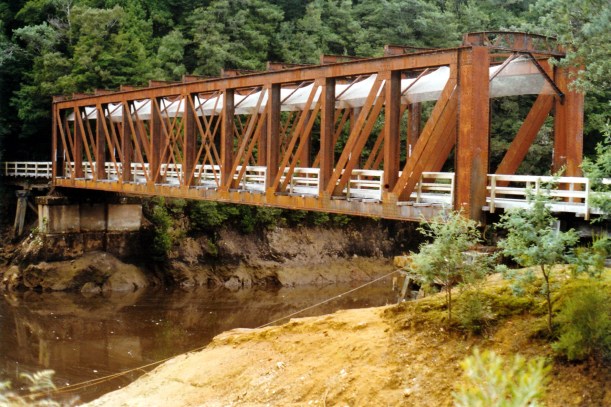
We drove out the King River Forest Drive – out along the Lowanna road beside Macquarie Harbour, then the dirt road alongside the King River. This took us to the old Iron Bridge, part of the former ABT railway, near the Teepookana locality. The road track followed the old rail alignment and was very narrow in parts, and with the King River right below.

02-27-2000 king river nr teepookana.jpg

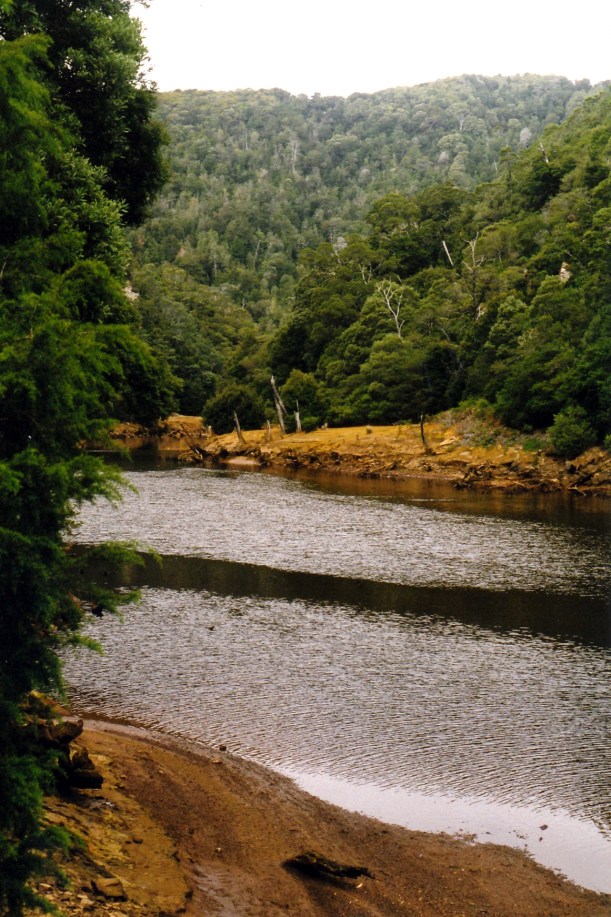
The King River from the Drive

The King River still had the polluted sludge banks evident in piles alongside its channel – from the days when the Mt Lyell Mine and smelter in Queenstown used the Queen River water in their processes, and then discharged the untreated waste straight into the river. The Queen is a tributary of the King. Even though the mining practices have changed in recent times, these rivers are probably the most polluted ones in Australia. The sulphuric acid residues remain a major problem.

02-27-2000 King R Teepookana and mine sludge

The King River near Teepookana – and polluted mine sludge residue

Gold and copper mining began in the Queenstown area in the late nineteenth century, with smelting of copper commencing in 1895. Back then, there were no roads into the region and so, in 1897, a railway opened between Queenstown and Teepookana, near the mouth of the King River. This was to bring the mine products to a port there, for export.

The building of the 3’6″ gauge railway had to overcome major problems. The terrain was mountainous and heavily forested. There were many streams. Cuttings were dug by hand, some up to twenty metres deep. The original 35km long railway had 48 bridges, the longest of which was the “quarter mile” bridge – approximately 250 metres long. They had difficulty finding a firm foundation for this, having to dig down a great distance into the river silt. Even so, trains could only go at walking pace across this bridge, as any greater speed would cause it to sway too much and collapse! It was high up above the river.

The problem of the steep gradient from Queenstown up to Rinadeena siding – 1 in 16 – was solved by using the Swiss ABT rack and pinion system, for some 7kms. The train engine could engage with this central “rail” and pull itself up.

In 1899 the railway was extended from Teepookana to Regatta Point, near Strahan, where the bay was deeper. This necessitated the building of the Iron Bridge over the King River at Teepookana. Later, the railway extended right into Strahan. What had been a busy little port town quickly declined.

02-27-2000 iron bridge teepookana.jpg

The Iron Bridge, near Teepookana

The first road to connect Queenstown to the outside region was the Lyell Highway, in 1932. In the 1950’s, a road was built between Queenstown and Strahan, and this spelled the end for the railway, as the many wooden trestle bridges were too costly to upkeep, and there were increasing concerns about the Quarter Mile Bridge.

The last train ran in 1962. I was fortunate enough to do the return trip on the railway in May, 1962, and remember the Quarter Mile Bridge swaying quite noticeably as the train crawled over it. The bridge was virtually only the width of the rails, so one looked straight down from the open train windows – and the river was a long way below!

In 1964, with three friends, I walked the disused railway track, camping a night at Dubbil Barrel siding and even riding hand operated trolleys some of the way. These had just been left at sidings when the railway closed! Crossing the Quarter Mile Bridge on foot, high above the river, with no side rails, was very scary!

This bridge was, by 1972, partly washed away by floods and by the 1990’s most of the old track, bridges, sidings and station buildings had fallen down, been burnt in bushfires and overgrown by the lush vegetation of these parts.

Now, the decision had been made to rebuild the ABT Railway as a tourist railway and work was obviously  happening at both ends.

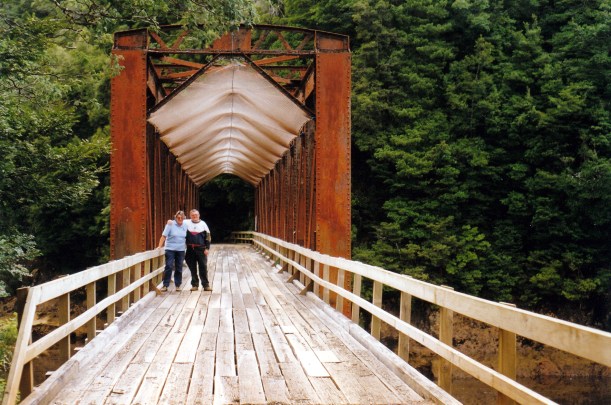
Because of this, the Drive was blocked at the Iron Bridge. It used to allow one to drive as far as the former Teepookana town site. We walked around the fence and across the bridge, with another Victorian couple who had fetched up there at the same time as us. They took a photo for us, on the bridge. When the former rail alignment here was set up as a tourist drive, wooden planking and side rails were added to the bridge, and mesh was slung between the top girders to stop flakes of rusty metal falling on cars and walkers.

02-27-2000 iron bridge mesh

The Iron Bridge altered for road traffic

It was a pity that we could not access the walk to the old Quarter Mile Bridge. Apparently, a tour operator can take customers up to the Teepookana Plateau, for $30 a head. John is not inclined to do that, at this stage.

John found a healthy looking Huon pine tree growing by the King River, and wanted a photograph with it.

02-27-2000 huon pine king r.jpg

John with Huon Pine at the King River

On the drive back to Strahan, we looked at the ABT Railway terminus at Regatta Point, which is being restored. This is where the new tourist railway will terminate.

02-27-2000 regatta pt abt terminus

Regatta Point Railway Station being restored

In Strahan, we went to the huon pine sawmill, and looked at the mill and associated gallery of timber pieces. They had some great products, bowls especially, and some very evocative wax painting by a local artist.

We collected my photos. They were beautifully done. It was not cheap, but he gives a replacement film “free”. For $1 a roll extra, I could upgrade from a 24 exposure to a 36, so I got 4 rolls of 400 speed for, effectively, $4. That shop also had huon pine wood products for sale. I liked the wooden cribbage boards – an idea for John to make sometime for Xmas presents: wooden board, Tasmanian illustrated playing cards, printed game rules, in a box. I also liked the shaped garlic bread dishes, with a natural edged top, about 1cm thick, and naturally curved, hand carved, I think.

At the Strahan bakery, I bought a loaf of damper bread and some rich, indulgent fudge.

After a full day, we drove back to Queenstown. The highway between the towns is 41kms, so it is not that far, but overall we managed 156kms for the day.

Tea was cold roast chook, the damper bread which was very nice, and the fudge which was yummy!