
The 1993 long service leave trip crystallized our desire to travel full time, sooner rather than later. John would be able to take early retirement, with superannuation income, once he turned 57 – in September, 1997. This would also be the year that his younger daughter completed her final year of university, thus ending a major financial outgoing for us. So our thoughts turned to retirement at the end of that year.
We had plenty of time to research and make important decisions. What vehicle would we use? What would we use for accommodation? And – after the late-1996 death of my father, who lived at our place, what would we do about our house, dog and two cats?
Accommodation:
This was the issue that caused us most deliberation. For the four months of our LSL trip, we’d tented it, carrying all the needed camping gear in our Hilux. We put up a hike tent for short stays and a larger one when staying longer in one place. The process of setting up camp was time consuming, though, and more than once we were affected by wet and windy weather.
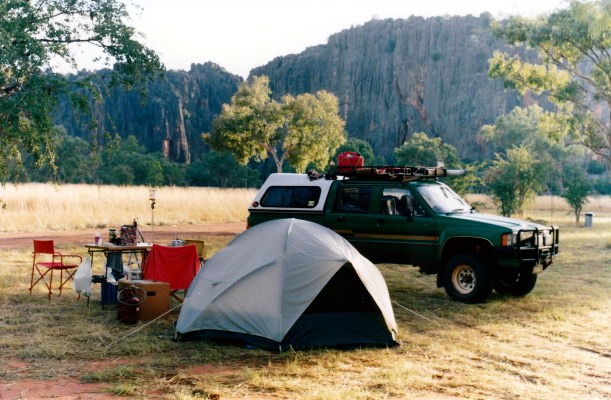
A typical camp with our hike tent
Although tenting seemed to offer the greatest flexibility about where we could go, it really did not seem a desirable option for extended travel.
At the same time, we really did not want to tow anything!
And there the issue sat, for a couple of years, during which time we bought a very sturdy and expensive, locally made, large tent, to replace the old one that had disintegrated in a Mallacoota storm, in 1994. The new tent was much quicker and easier to put up, and much more weatherproof – and after a few school holiday trips with it, we thought this might do for our future travel.
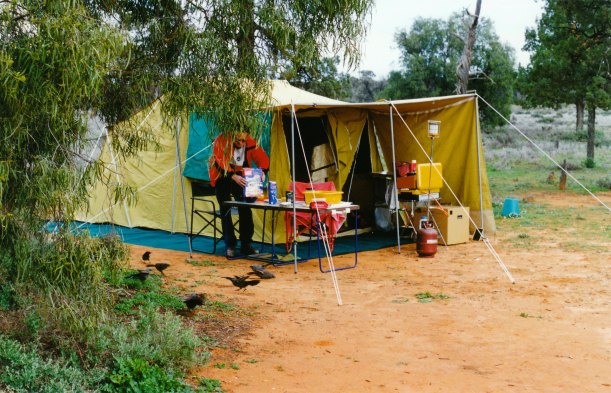
The new, easy to put up, tent – in 1995
By the end of 1996, it was becoming obvious that John was going to need hip replacement surgery, before much longer. It would be best to have this done before we set off travelling.
Our tent based camping involved much packing and unpacking of the Hilux, lifting the heavy camp fridge, and the like. This was not going to be very workable with a newly replaced hip, so it was time to seriously consider other options.
We still wanted to be able to access places “off the beaten track”, and certainly off the bitumen, so wanted to retain 4WD capability. Camper trailers fitted this requirement, but the ones we’d seen in our travels to date seemed as time consuming as our tent to put up, and we would still have to carry a lot of the gear in the vehicle, with attendant lifting and packing for John. I hated the idea of maybe having to drop wet canvas sides onto the bed, as we’d seen others having to do.
So, with considerable reluctance, the thoughts turned to caravans. On a holiday trip the previous year, camped at Mootwingee, we’d seen an unusual caravan – a small Supreme Getaway. Until then, we’d had no idea that there was such a thing as an off road caravan! Out of curiosity, back home, we arranged to go to the factory and have a close-up look at one of these units.
Just about convinced that one of these would suit us, we went off to the Melbourne Caravan and Camping Show, in early 1997, intending to have a really good final inspection of the Supreme, and order one. However, at the Show, there was another offroad caravan display – that of Trakmaster, a fairly new entrant to the realm of such vans. We spent several hours going back and forth between the two displays, and ended up putting a deposit on an order for a Trakmaster Kimberley, to be built in late 1997. Apart from the merits of the van itself, the factory was only a few kms away from home, and it turned out that, through work, I had links to the owners. Everything aligned.
John’s hip was replaced in August, but resulting health dramas kept him hospitalized for over a month, and convalescent for some time after that.
It came time to finalize the details of our van build; Craig from Trakmaster very obligingly came to us, as John was not mobile. What we wanted was the minimum required for comfort and utility, in our 14 foot pop top.
Storage had to be maximized, as we would be living full time in the van. Two 9kg gas bottles and 120L of fresh water storage gave us considerable capacity to be away from services. A gas cook top and oven was chosen – no microwave, thinking that corrugated roads would not be good for same. We minimized electricity use by not having a hot water service, or electric water pump – no bathroom, either. We did buy a porta potty – but ended up never using it, though the shovel we carried on the roof rack got a good workout in some places!
I had read about a marine 12v compressor driven fridge that was used in boats and worked in the roughest of seas – a Vitrifrigo – sounded like it might endure rough roads, too. Compressor driven would work better in the tropics than the conventional 3-way fridges. Craig agreed to install the Vitrifrigo for us. The van would be built with provision for solar panels to be installed later – we didn’t think we’d need same for the first year or so, and wanted to wait for the emerging technology to develop further. The fridge, lights and range hood fan would be powered from the 12V battery, which would be charged from 240v hook ups in caravan parks, until we eventually put in solar power.
On camping trips, we had been taking our two mountain bikes on a sturdy carry frame on the tow ball of the 4WD. Craig worked out that he could extend the A frame of our van and build a cross member on it that would hold a tow ball and thus enable the bikes and carrier to go at the front of the van. Then, we would have the flexibility of still being able to use the bike carrier on the back of the 4WD, on day trips.
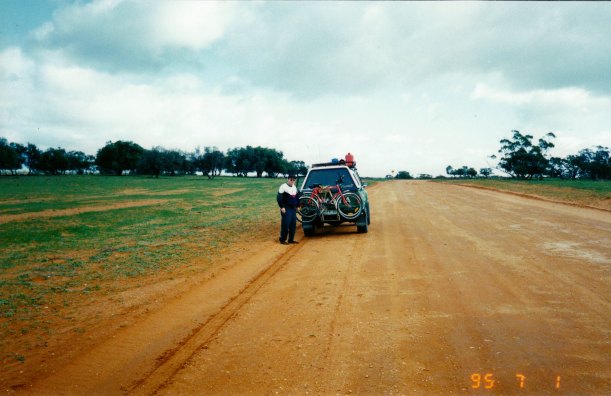
Our bikes on the rack we wanted to also use on the caravan
We opted for an awning that fitted into a sail track channel – more work in setting up, but we did not want an attached one that could pull the pop top askew, or be scraped off by trees on narrow tracks. There would be two jerry can carriers on the back bumper frame of the van. One of my farewell presents from work colleagues was three metal jerry cans! The three wheels would be the same as on our 4WD, thus making spares interchangeable.
Trakmaster vans featured sturdy off road independent trailing arm suspension and Treg poly block hitches, that enabled a considerable variation in angle between van and tow vehicle, such as one might get on rough tracks.
Through October and November, 1997, John had to go to Knox Hospital once a week for blood tests. His “reward” after each procedure, was to call in at the caravan factory at Bayswater and see how our build was progressing. So we closely followed the van’s construction, from the time of the chassis delivery, on. At times we had wondered about the wisdom of going with such a new caravan manufacturer, but were reassured by the quality of the construction we saw.
In late November, we took delivery of our Kimberley – the 36th caravan built by Trakmaster! Trakmaster staff attached the van to the receiver on our vehicle, and we towed it the 10kms home. Neither of us liked the feel of driving with the van on – a distinct forward and back pitching sensation. We could only hope that the loaded van would feel different!
John had contacted Hayman Reece, about setting up a weight distribution system on the rig. We were lucky, in that they had just developed a hitch that was compatible with the Treg coupling – in fact, they were looking for customers for this to give them feedback. John took the rig to have this fitted – and a great, cumbersome thing it was, too. But he reported that the pitching sensation was less.
As our travel plans began to become clearer, it was decided that we would carry, in the 4WD, both the large tent and a hike tent, as well as some camping gear. If John’s hip permitted, we had some plans to visit places where we wouldn’t want to tow, but would store the van and take to the tents.
The vehicle:
Since 1992, our travel vehicle had been a Toyota Hilux. This had served us well, most of the time, but it was not a very comfortable ride. It had a very low tow rating, and would not be suitable to tow much at all.
I started buying 4WD magazines and reading reviews. We needed a capable off-road vehicle, capable of towing a caravan. This research threw up one we’d never even heard of before – the Landrover Defender! They received great reviews for off road ability, and were rated to tow 3.5 tonnes.
It was not that easy to find a Defender to look at! There were not many Landrover dealers in Melbourne and most did not have a Defender to display – not exactly being an urban car. In early 1997, John located a demo model of a 110 Tdi wagon at the Frankston dealership, went and had a look at it, liked the deal they offered, took me there the next day to inspect – and we bought it! 5000kms already done – for a diesel engine, hardly run in! Being a demo version it had some valuable extras – side steps, bull bar, cargo protector, roof rack and a back ladder to access same. It also had a very “rural” appearance – brick-like! Although I initially found it rather claustrophobic inside, after the space of the Hilux, this was easy to adjust to – and the seats were much more comfortable.

The arrival of the new Truck at home
I had only one real reservation about the new Truck – the whole unit was one integrated piece. I still had vivid memories of the time we loaded firewood into the back of the Hilux, along with a colony of huntsmen! I resolved that no wood would ever go in the new Truck.
Through 1997, we had the vehicle fitted out for the travel we planned. Winch fitted to the front. Both a CB and HF radio fitted; they went on a shelf above the front window; the main part of the HF radio went under the rear passenger seat. A snorkel was installed. So was a second cranking battery – there was space under my seat for this. An inbuilt air compressor fitted under the back seat, with the storage tank under the Truck body. We put in a cargo barrier. We found that the already fitted side steps precluded putting in a second fuel tank, and decided the steps were of more value.
Hayman Reece took care of towbar installation. A brake controller for the van brakes was fitted.
We trialled the new Truck on a couple of school holiday trips. What did surprise us was how much gear could be fitted into the back – very capacious.
The house and pets:
My son K, and his partner, P, agreed to move from their rented house into our home and mind it and our pets, for the duration. As well as solving the pet care issue, this would enable them to save more towards ultimately buying their own first home.
We debated and agonized over whether to take dog Butch with us on our travels, or leave her at home. She had travelled with us on some of our school holiday trips and managed the travel well. But we knew having her with us would preclude the National Parks visits we hoped to do, and I was dubious about taking her into parts where there were things like crocodiles, 1080 baits, and wild dogs. She had initially been son’s dog, so in the end we left her home.
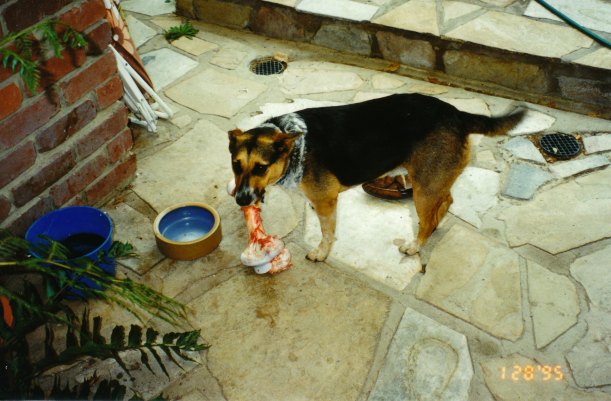
We thought long and hard about taking Butch with us
Through 1997, we did some downsizing of our possessions, with the aim of being able to pack away all our furniture and belongings into our bedroom, John’s study, and his shed – which would also store my small Barina car, with its battery removed. Between us, we’d accumulated over a thousand books that had to go – a very eclectic lot, that sold to a booklover who had lost her collection in a fire.
The budget:
We will have to be fairly careful with money, as we still have the fixed costs associated with our home to cover, like rates and insurance. Can only do a rough travel budget estimation, until we see what the realities of travel are. That estimate is $100 a week for caravan park/camping fees; $100 a week for diesel; and $200 a week for food and all else. Some weeks we will exceed these amounts, but other weeks will be under – and hopefully the average will be about right.
We aim to keep enough in savings for things like vehicle servicing, tyres and unforeseen events.
The initial plan:
The starting point was a broad plan to be “up north” in the Dry season, and somewhere more comfortable once the rains and humidity set in, up there.
We focussed on Queensland, because John had never been there, and I had only holidayed briefly around the south east corner. After our successful foray into the wilds of the Kimberley, a few years before, Cape York seemed to beckon as a key destination for the first year of travel.

Our plan for several years of travel
We would have to be back in Melbourne for a few weeks in March of 1999, for K and P’s wedding, and to “mind” our own home while they honeymooned overseas. My daughter, V, and John’s elder daughter, S, both rather conveniently had their weddings during 1997!
John was determined to come off the Warfarin medication that he’d been on since September, with its attendant blood tests and uncertainties about dosages, that could really impact on our travels. The physician was dubious, but under pressure decided John should have tests to see if he had a clotting disorder. The complication was that he would have to wean gradually off the Warfarin, then go to Royal Melbourne Hospital for these special tests, which could not be done until February. By this time, it was December. Son and partner had already moved into our place, when their lease expired in November, and were expecting us to depart just after New Year!
We decided to stick to planned departure date, and do a six week shakedown trip through the Western District, returning close enough to Melbourne for John to have the tests, before then heading north. As it worked out, this was really of benefit, because it enabled us to assess what we had and had not packed, and adjust things before we finally set off. Remember that we had not even done an overnight trip in the van, at this stage!
It also meant that there was no pressure on John to do great distances – we could take it easy and let his leg adjust and get stronger.
December was a whirlwind – all the usual end of school year work for me, complicated by having to sort/pack/discard the accumulation of sixteen years at the place; farewell functions for me; hosting the family Xmas; having P and K living with us; organizing what we would take away; packing all else into two rooms. John’s ability to lift or carry anything heavy or bulky was limited, so much of the packing fell to me. There seemed no end to the last minute things, but eventually it was 1998 and we were ready to go………adventuring, we hoped.
It was a good thing that we had focussed on the Western District for our short, initial trip, as just about all the other parts of Victoria had significant bushfires going by the time we were ready to leave.
 This Adventurous Age