This Adventurous Age

Adventures travelling and working around Australia.


1 Comment

2015 Travels August 17

THINGS ONE SEES IN A CARAVAN PARK     AUGUST 17

Across both of our stays at Lightning Ridge, this year, I had been amazed at the number of different “breeds” of caravan there are, these days. They just seem to have suddenly proliferated. There were so many brands I had never heard of, or seen before. Guess if I bought magazines or went to shows, I would know more. But I had wondered, as dog and I walked around the park, and gazed at yet another new name, how many of these brands will still be being manufactured in, say, five years? It is, I suppose, evidence of the market growth as the baby boomers hit retirement age and invest in rigs to go travelling.

In the morning, before the day’s influx of new rigs

The modern trend was, obviously, away from the sterile white van cladding towards silver, black, with lots of multi-coloured decals and general bling. One can only hope that the quality of the build and finish on a lot of these matches the external hype.

I wondered what it was like inside the mainly black vans, on a hot day?
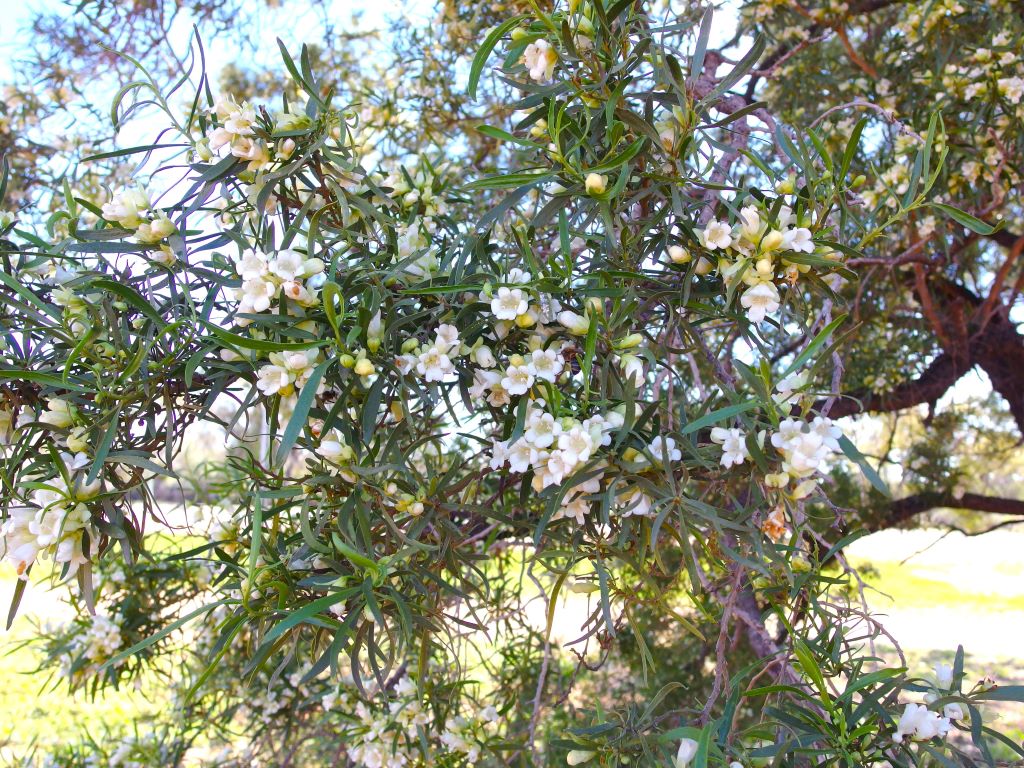
I’d like to know what this shrub is

Another evident trend  is towards increasingly larger vans. They need to be, of course, to contain the multiple lounges, large two door refrigerators, washing machines, on-board bathroom and separate toilet room, that seem to be the keeping-up-with-the-Jones’ items of now. I heard one van owner boasting of his dishwasher!
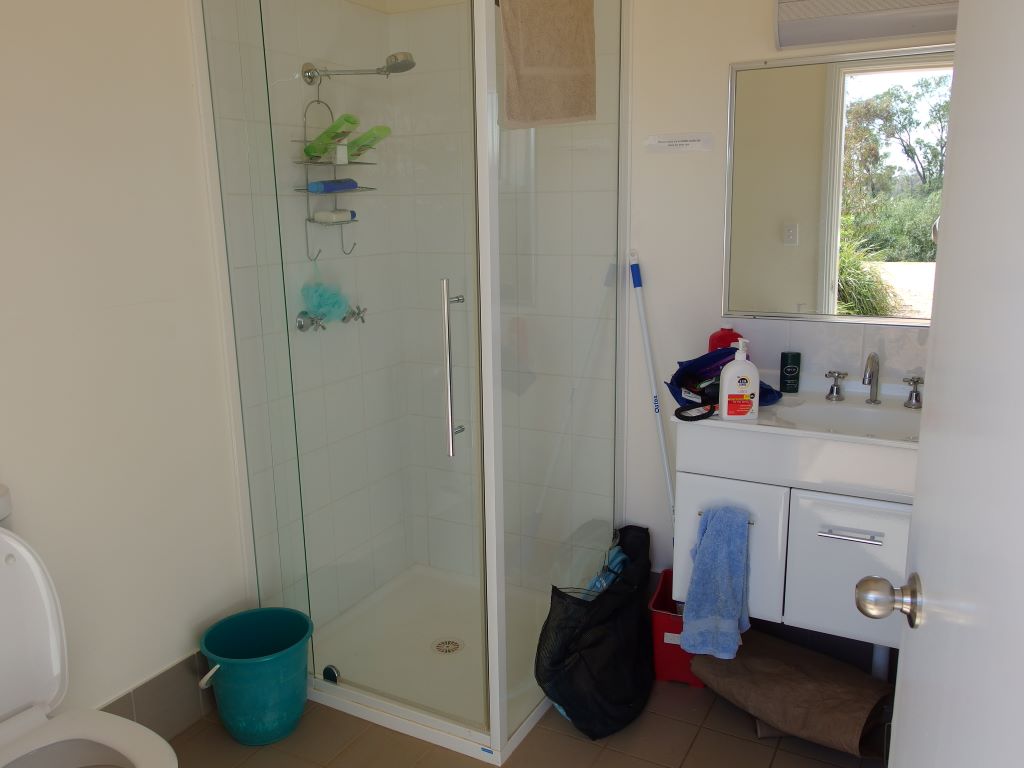
With a bathroom like this, who needs to tow one?

It is just a pity that some of these large van owners are not all that adept at towing same. At the Opal, all the sites are drive through. You would think that getting a van onto such a site would be an easy undertaking, but it was surprising how many drivers managed to mess it up. Some swung out too wide and ended up well over into the next site – time for a go-round. Or they forgot to allow room for their awning to go out – oops, time for a go-round.

One guy pulled into a site over from us, went through all the unhitching rigmarole, then thought to check the back of his van, which was almost two metres still out in the roadway. But he had plenty of room to park his 4WD in front of his van, instead of the usual at the side!

The en-suite sites had the additional complication of the little building to the side of the site. We saw one driver try to remove his awning by driving too close to the overhang.

Not exactly difficult to park on…

Some of these people must have enormous issues when they have to actually back onto a site.

It was not just caravans that have succumbed to the “big” syndrome. I saw some very large motorhome buses come in, usually towing a large enclosed trailer with car, trail bikes, sometimes with a boat on a frame on the trailer top. All eventualities catered for! The drive-through sites of the Opal cater for these behemoths, even though occasional ones needed two sites to put all their additional gear on, but a lot of parks don’t.

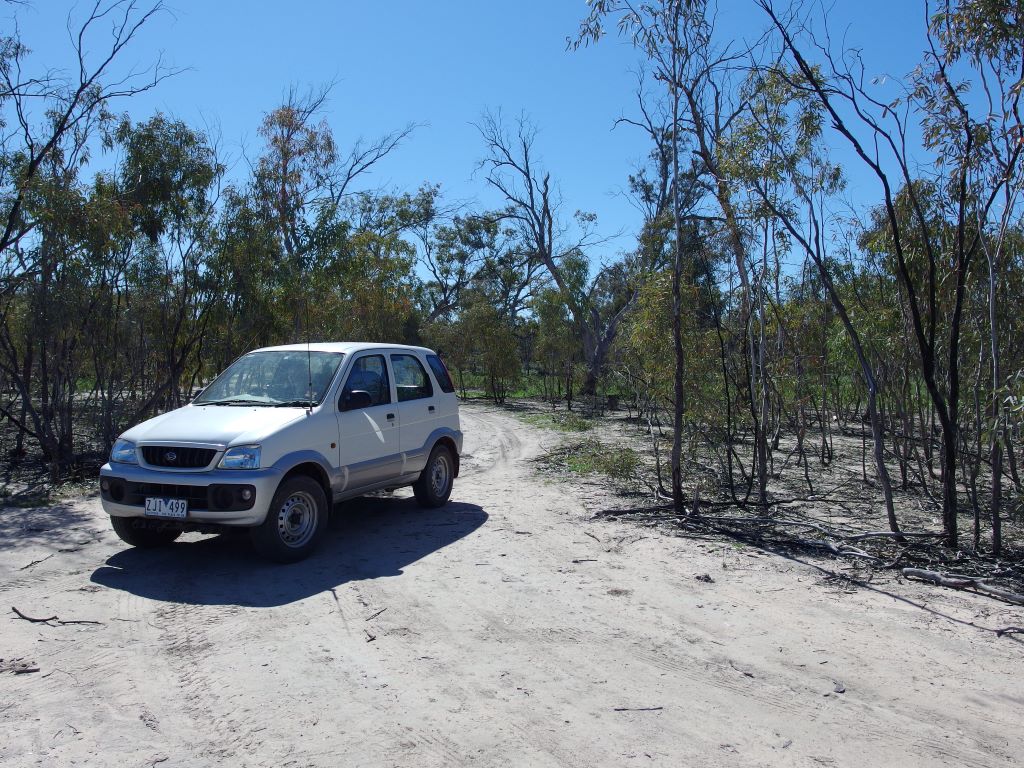
The Coaster feels like the poor cousin of such rigs. But I bet we use a hell of a lot less fuel. In the same way, our previous Trakmaster caravan was tiny, compared to the king sized fancy vans, but I bet we got that van into places they never even dream of.

The poor cousin…

One day I did lose my cool with the inept driver of one rig, and he didn’t even have an excessively large van.

The Opal has a designated check in lane for new arrivals, with enough roadway beside this to cater for residents driving in and out. It is well done. One enters the park across a cement culvert over a big drain. The culvert is easily wide enough for two vehicles to pass side by side.

On this day, I was coming back from a hunting and gathering expedition to the IGA, about lunch time. There was a queue of new arrivals, such that the check in lane was full with three or four rigs, and there were another three or four parked at the side of the road, waiting to enter. One side of the culvert top was occupied by a 4WD and camper trailer, waiting to check in. And there was a rig whose driver hadn’t booked ahead, and thus had to go try find somewhere else with a powered site to stay. He had driven into the park from the check in lane and turned around, as they do, but faced with the rig on the culvert, decided there wasn’t room for him to pass it. So he stopped, right at the entrance – no room for anyone to come past him from behind. And behind him were half a dozen residents’ cars, waiting to drive out. And out in the roadway, with my right turn indicator going was me, stopped, blocking my lane of the road, waiting… and waiting… and waiting. Whilst about four lots of new arrivals were checked in and moved off. The clown had no spatial judgement whatsoever. There was plenty of room for him to pass the parked trailer, and then some. In fact, it took me a while to realize that the reason he was stopped was because he thought there wasn’t space. I thought he must have broken down, at first. After a good ten minutes of this stalemate, the rig parked next to him moved forward and a Terios sized space was created between him and the next parked rig, through which I could weave. Not exactly legal, but…. As I got level with him, I did ask what the hell he thought he was doing, creating such a snarl up – or words to that effect. When he replied there wasn’t room, I said one could drive the Queen Elizabeth through that opening! Well, it was hot and I had melty things in my groceries….so I was cross. After that, he did indeed inch his painful way very slowly out to the road – with a good metre of space on either side to spare. Wonder where he got his licence?

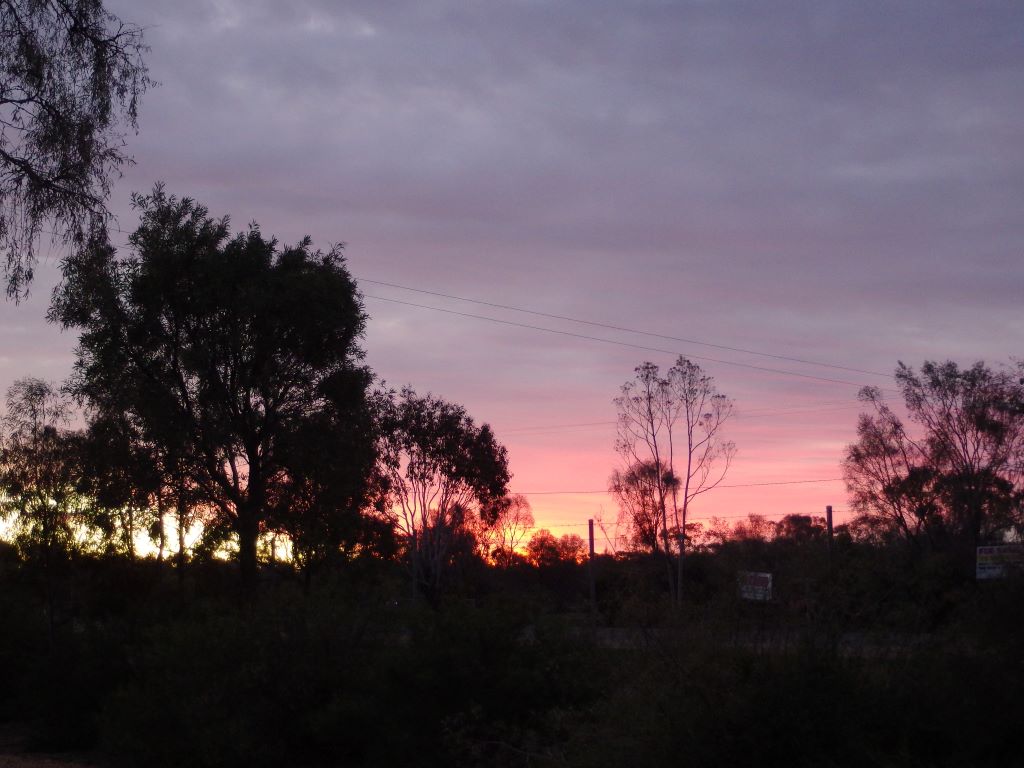
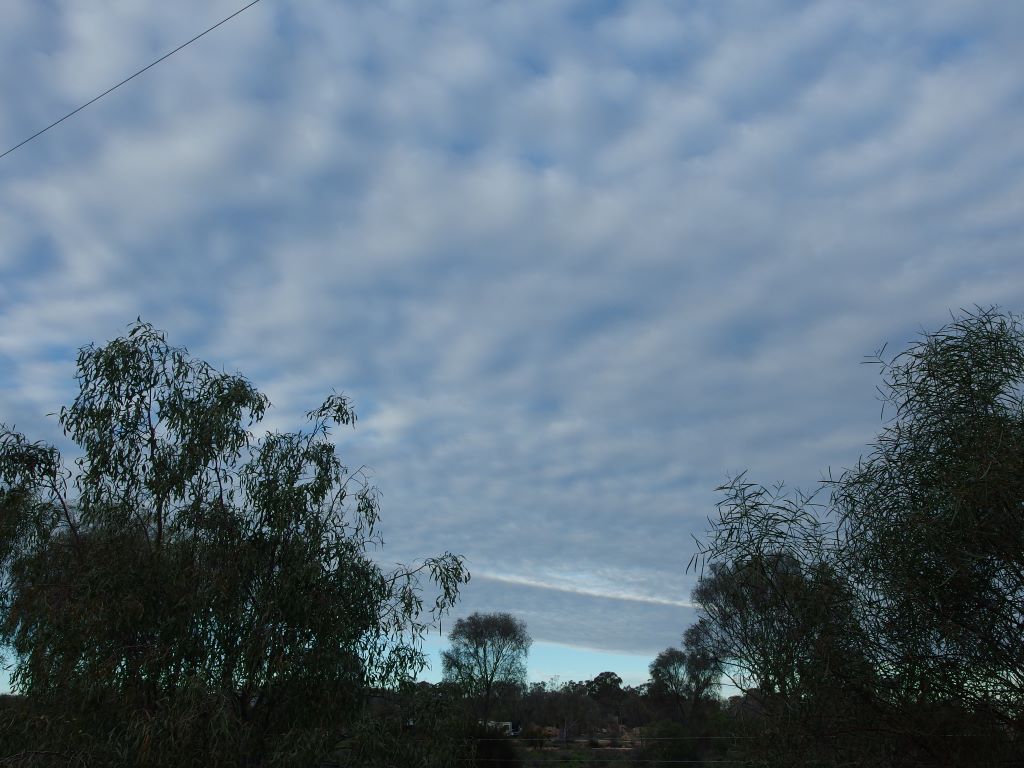
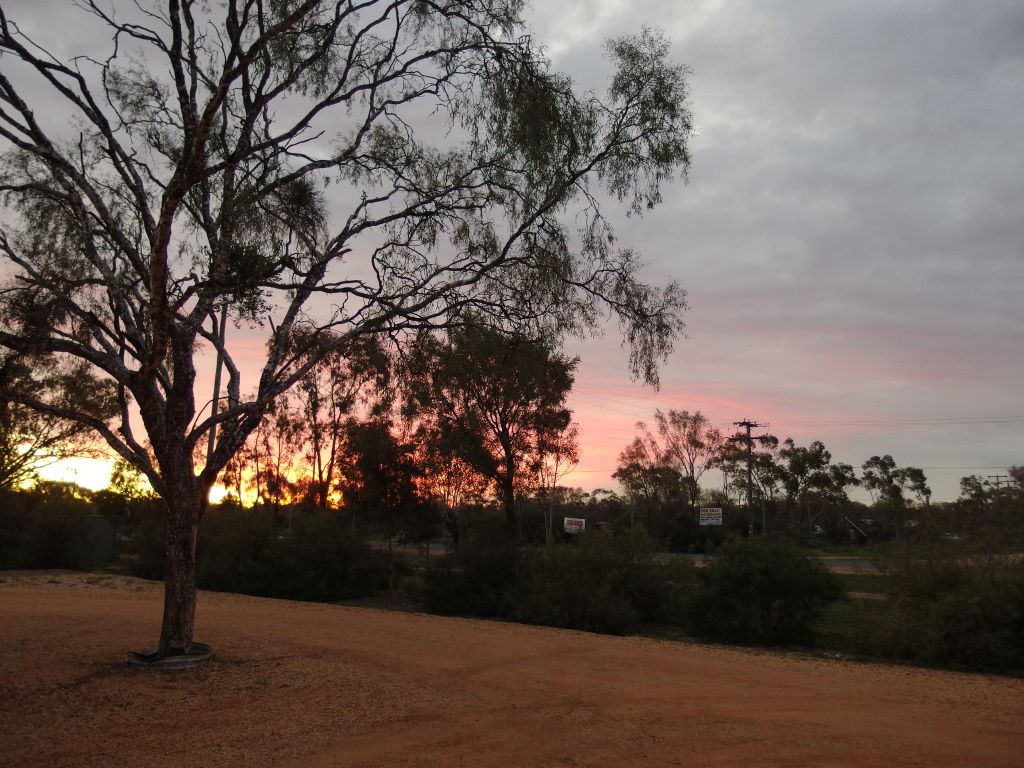
Lightning Ridge sky


Leave a comment

2015 Travels August 12

OUT TO LUNCH     AUGUST 12

During the time we were at Lightning Ridge, John played bowls a couple of times. He won the first prize on one of these occasions: $20 worth of vouchers that could be redeemed at a selection of local businesses, including the Bowls Club itself, for drinks and food.

Seen on my morning walk

Having a meal out was a rare occurrence for us, both at home and when we travel. This was partly because there were only a few decent eateries close to home. But mainly it was my own damn fault because John says I cook better meals than he can get elsewhere.

We do have an excellent local café, at a nearby native plant nursery. It does lunches only, so I tended to meet friends there for lunch, on occasion.

This is a very dog friendly park

When we are having travelling days, John likes to buy lunches of the not-good-for-him variety: pies, pasties, sausage rolls. I don’t eat such things, but am happy to go for a good cheese and salad roll, or a subway with roasted vegetables.

During our time at Lightning Ridge, we bought pizza for tea one night. The smells coming from the wood-fired pizza van at Opal Fest had been reminiscent of our pizza oven at home, and oh-so-tempting. But the wait was too great on the day in question.

About a week later, John suggested pizza for tea. He was even prepared to drive and pick them up. So he ordered his usual hot and spicy choice and I requested a vegetarian one. I expected that the mushroom, zucchini, eggplant etc mentioned in the menu as topping for this, would have been chargrilled first. But, no, they had been put raw on top, before the pizza was cooked. While the result was much more al dente than I’d anticipated, it was strangely nice. John had bad indigestion all through the night.

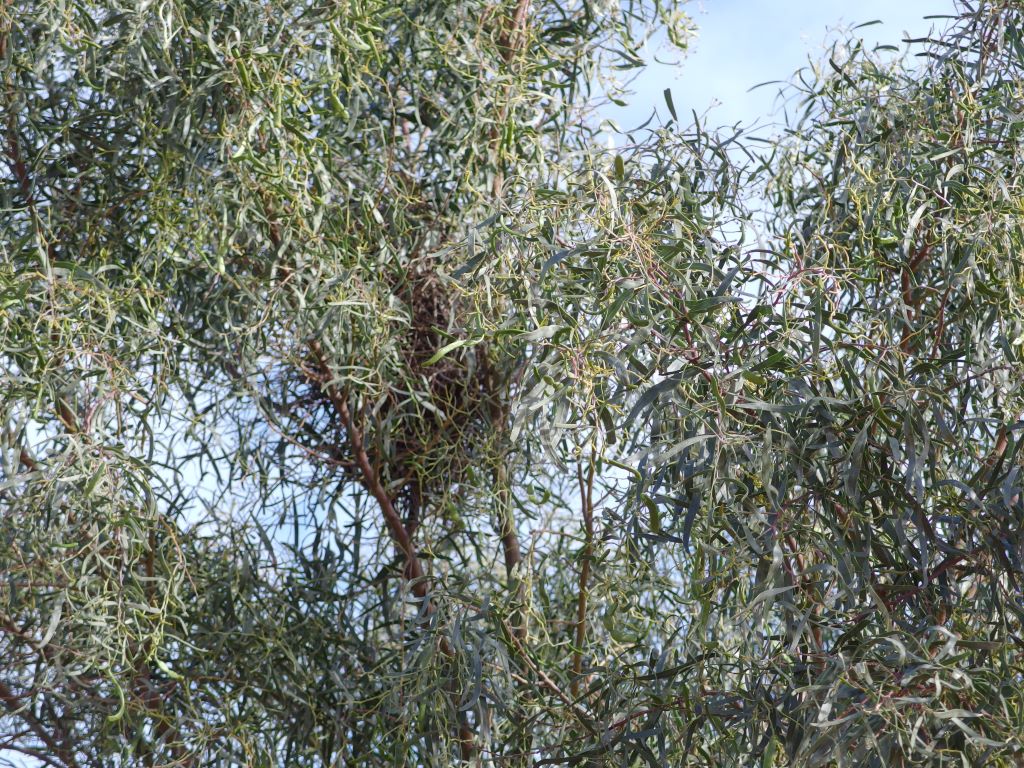
Babblers’ nest

In a week when we were not doing much except relaxing at camp, John suggested we lunch at the Bowls Club, to use up his prize vouchers. The Club is the main venue in town for eating out, the other being the place that makes the pizzas. There is not a hell of a lot of choice.

Given its status as the main foodie place in town, and that it had been the venue for the big, important Opal Fest Dinner, I was anticipating a very nice lunch. The atmosphere in the dining room was similar to that of a pub bistro, at home. The menu matched!

The service was abysmal. We stood at the counter for about five minutes before one young woman interrupted her conversation with the other staff, about her social life and friends, in order to slouch over and take our orders.

I had salt and pepper squid. Adequate, but I suspected it had come pre-coated and frozen from a catering pack. John had beer battered flathead, which looked identical to what I had served him, a couple of weeks, previous, from a frozen packet bought at the IGA. He said it tasted similarly of sawdust. The chips were nice. Before you think that it is hard to mess up pre-prepared frozen chips, a cautionary tale. I once left daughter and son, then aged 18 and 16, to fend for themselves whilst I attended a conference. My father kept an overall eye on them from his flat in our backyard. Son complained about the first meal daughter attempted – sausages and chips. Turned out that no-one (meaning me) had ever told her you were supposed to heat the cooking oil before putting in the chips! Never assume…

Part of our morning perimeter walk

At least the eating out gesture had been made. The vouchers had been used. The sadly pedestrian meals had not cost us much.

We would repeat the pizza meal another time, although John might choose a less fiery option, but I couldn’t see us going back to the Club to dine – ever.


Leave a comment

2015 Travels August 10

A DAY OUT TO HEBEL     AUGUST 10

Hebel is a very small village, some 70kms from Lightning Ridge. It is in Qld, just across the border. One activity promoted by the tourism brochures at Lightning Ridge is to go for a day trip to Hebel and have lunch there at the General Store.

We had passed through Hebel, on our 2009 trip north, but decided today to go for a drive up there and have a look at a couple of other places on the way.

Hebel began as a Cobb and Co staging point in the latter part of the 1800’s. Like many other villages along the border, it also became a customs duty collecting point, back in the days before Federation, when each State ran its own Customs and Excise laws. That function disappeared after 1901, when the new Australian Government took it over and ensured uniformity of these levies across the nation.

Since then, Hebel continued its existence as a small service centre for surrounding pastoral properties. The sealing of the Castlereagh Highway north to Hebel in the 1970’s laid the basis for it to become a tourist route.

Local lore has it that some members of the bushranging Kelly Gang lived in the area under assumed names – and Hebel’s original name was Kelly’s Point.

We first heard of the village in 2005, when we worked with a man who had, for a time, owned the General Store.

We took advantage of a pleasant, fairly sunny day for our trip.

Not long after turning north on the highway, I noticed what looked like a well trafficked gravel road, angling off to the NW, named Lone Pine Road. I wondered if it was the way to the Coocoran diggings, which we had never visited. Then the Nine Mile and Ten Mile diggings of the original Lightning Ridge diggings were on the right of the highway. We could see the Nettletons First Shaft area, up on a low ridge.

Maps show the large Lake Coocoran to the west of the highway and I wanted to go have a look at that, thinking there would maybe be water birds to watch. We turned off onto a promising looking dirt track. A little way in, it ended at a locked gate. We followed another track. In the distance, the lake appeared, looking as though it was full of reeds. I could see no open water.

Lake Coocoran

Our final track following attempt ended up being a power pole upkeep track, also ending at a locked gate.

Following tracks that went nowhere

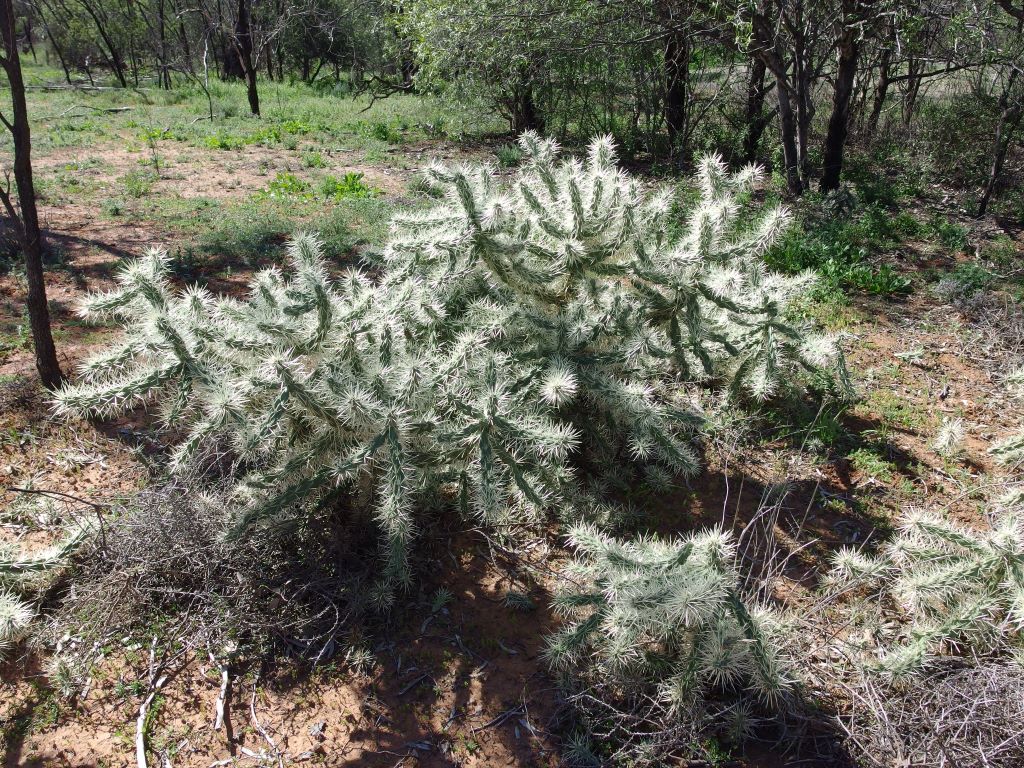
We had to be careful on those tracks as there was Hudson Pear growing beside some of them, and the thorns on those can go through a car tyre, let alone a human foot.

Hudson Pear

From a distance this plant looks deceptively pretty, but it is a major pest.

Not a bush to blunder into!

Back on the highway, noticed that on most areas of slight rises in the land, there were signs of little exploration drills having been done, for opal. Wonder how long it will be before the next big find in the area?

The rises were separated by a series of dry floodways with depth markers. There is a series of swamps and channels, trending to the SW, that obviously fill in flood times. Lake Coocoran is part of that chain, as is, I think, the Narran Lakes further down.

Turned off the highway to go see Angledool, another place where there were once some opal diggings. Apparently it was also called New Angledool, but I have no idea where the old one was.

As we turned off the highway to the east, there had been a sign saying opals for sale but we saw no further directions to same, or indications of any commercial activity of any sort in the area. It was a strange little locality – a few lived-in houses and a number of empty ones. We saw two churches, but no indications that either is still used.

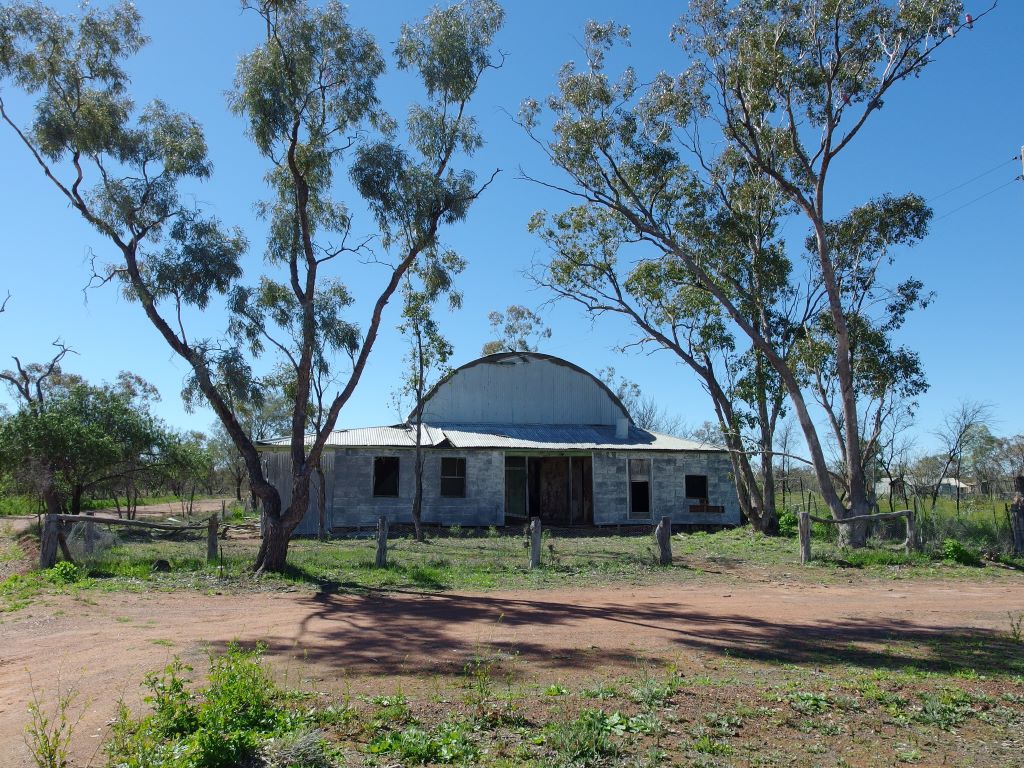
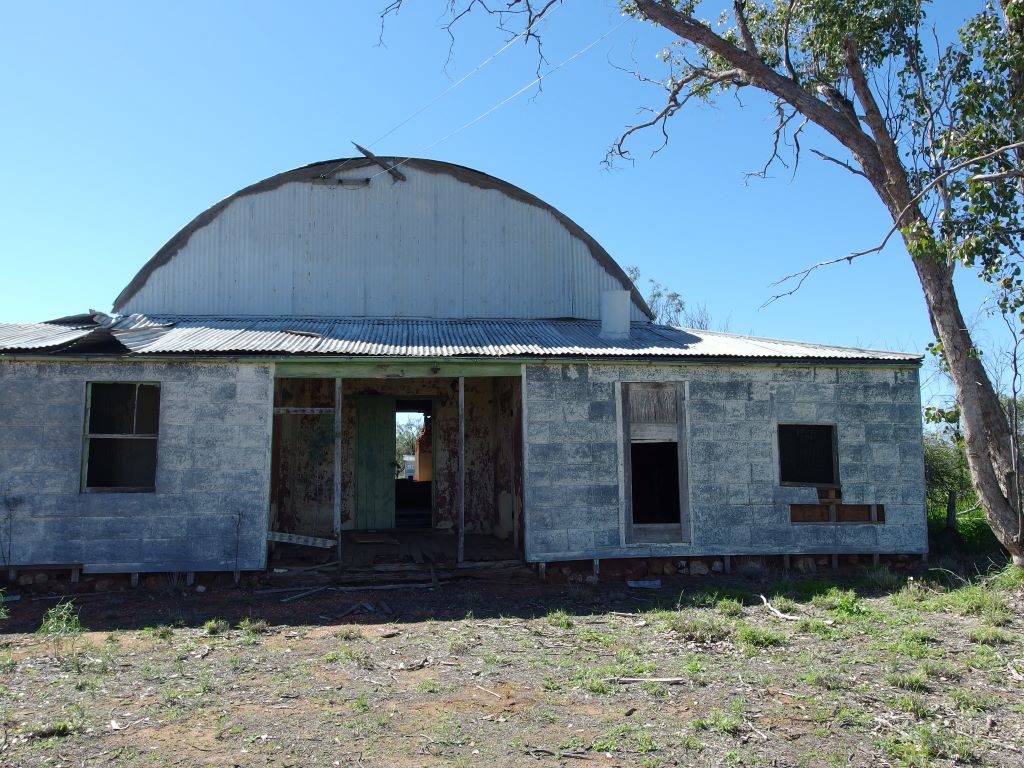
Stopped at the old hall, a fascinating structure, now derelict but still photogenic.

Angledool Hall

It had an unusual roofline – a hump running the length of the roof centre. A couple of old post and rail parts of the fence might once have been hitching rails for horses.

It was hard to work out what it was made from, apart from the obvious corrugated iron of the roof – maybe a form of mud bricks? Sad to see it falling apart, but I guess that is a story repeated many times over in settlements across the nation, made redundant by modern transport and farming developments.

A sad picture of abandonment

Gave Couey a run and ball chase on a track beside the old hall, That started dogs on the nearby farm barking, Oops.

Decided Angledool is really spooky.

Deserted old house at Angledool

On to Hebel. A bot before the border, the road crosses several channels, one or two of which could make for pleasant bush camping locations.

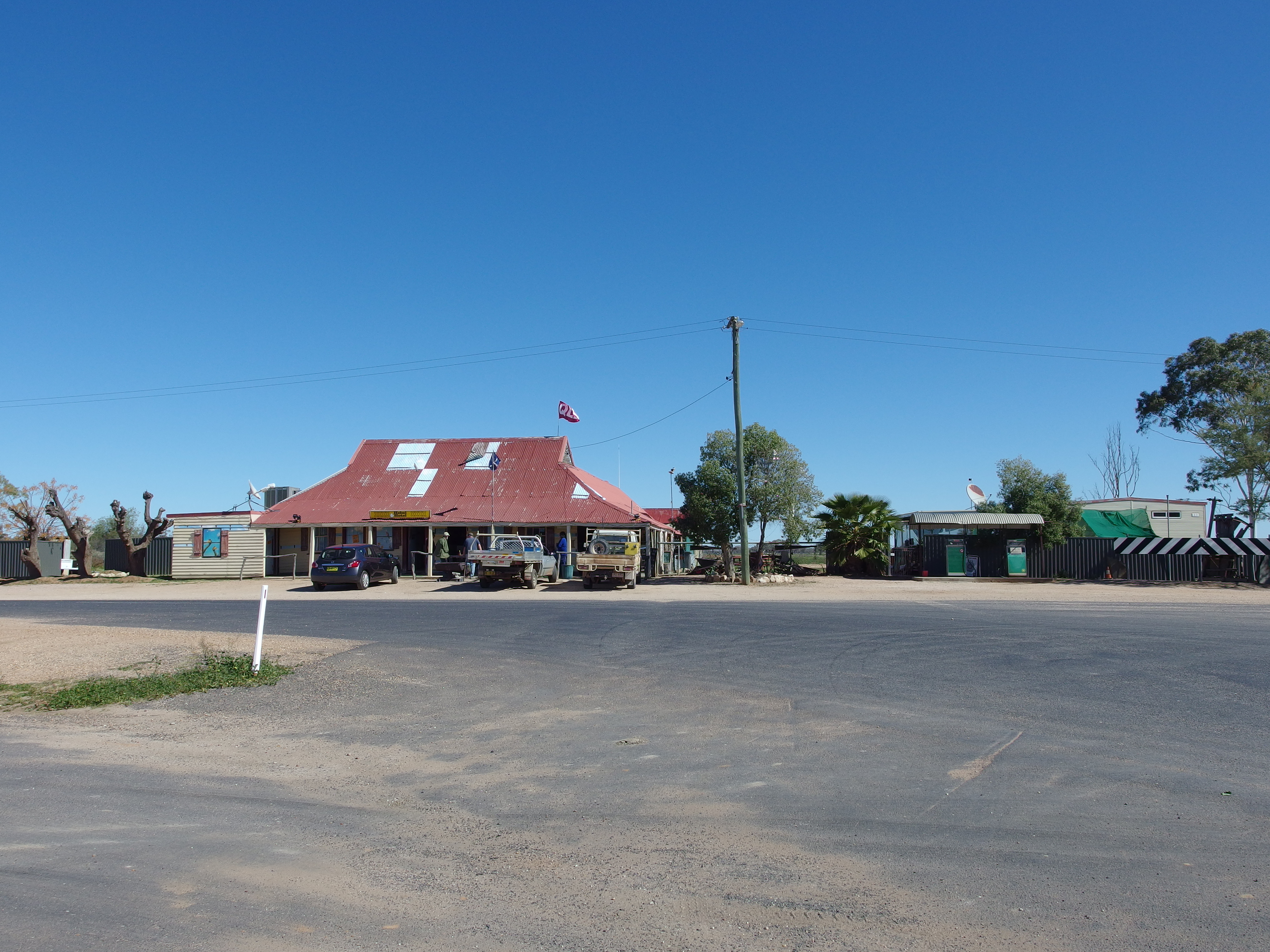
Couldn’t see much change in the village, since our last visit. The hotel had a few cars parked outside but was not exactly doing a roaring trade.

Hebel Hotel

Across the road, the General Store had been prettied up a bit more, was all, We went in and had a browse in there. About a dozen people were eating out on the veranda dining area. The Store info emphasized the home made food that it sells. John had been highly anticipating getting a lovely home made pie for lunch, but did not like the look of the ones on offer – most unusual for him. He got an ice cream. I bought a bottle of mineral water and a stubby holder.

The General Store and associated businesses – motel and small caravan park – were for sale, priced at $520,000, because the owners had been there for nearly twelve years and wanted to retire. It seemed to me almost totally dependent on passing traffic and this would be seasonal in nature. The Castlereagh Highway is not really one of the main north-south routes. To me, it would not be an attractive place to live.

Hebel General Store

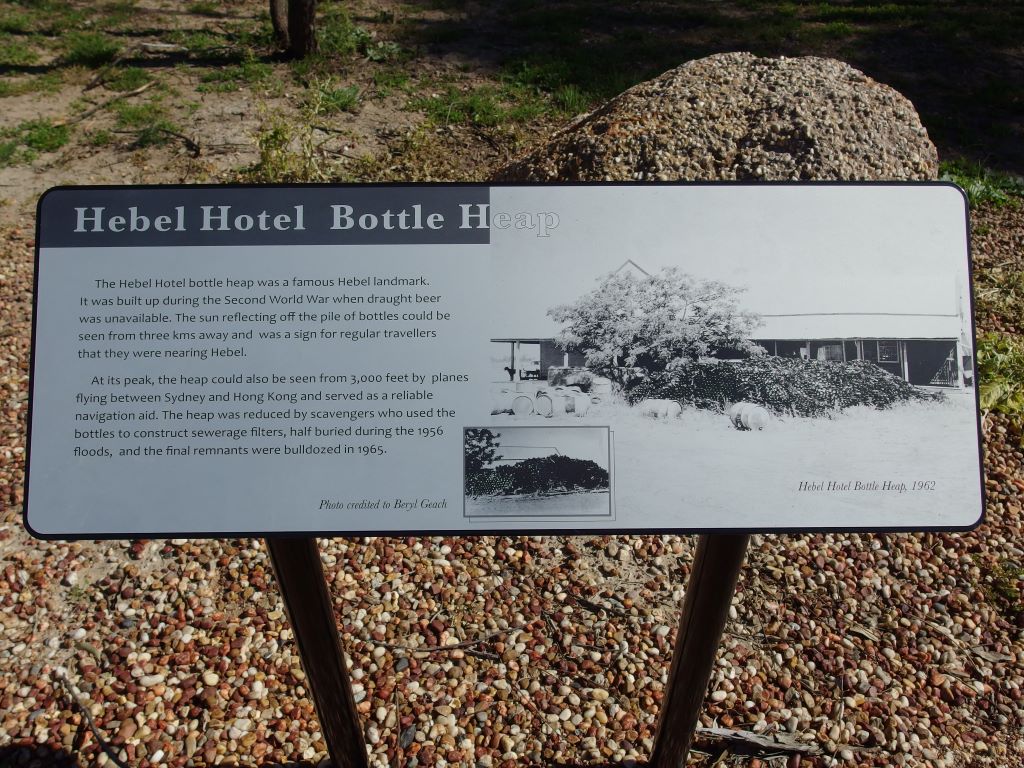
We walked around the Historical Circle display, featuring historic facts about Hebel, trying to make the most of what there is. Example being the information about the old bottle dump that used to be by the hotel. This was so big that it was a navigation aid on the Sydney-HongKong plane route!

Hebel Hotel Bottle Heap

The historical display was quite well done and worth the browse around.

An interesting perspective…

Drove the very short distance to the Bokhara River picnic area, with its adjacent free camping area right by the river, and quite attractive. There were a couple of vans set up there and another pulled in while we were eating our packed sandwiches. The picnic area was very pleasant.

Bokhara River

Couey had to stay in the car though. I did not want wet dog in the car and there was no way we would be able to keep her out of the river. Took her for a short walk on the lead and she just kept trying to lunge and pull me towards the water.

While we ate lunch, chatted with some other travellers who were returning south after a trip to Cape York. They had taken a commercial tour up the Cape, from Cairns. Said they were relly glad they had not tried to take their own 4WD, as the roads were atrocious.

Rabbits not welcome in Qld!

On the way back to Lightning Ridge, took the turnoff on Lone Pine Road. Passed a couple of homesteads and some big fat sheep. The road deteriorated quite badly. It had previously been driven on whilst wet and had dried with big, deep, ruts. There were a couple of vague tracks leading off it. After maybe 7 or 8 kms, we turned around. I was pretty sure it did go to diggings, but there were no signs to same so presumably visitors were not welcome. I could see why the Visitor Centre in town did not have any information about it.

Our day out to Hebel was also our wedding anniversary. John didn’t realize.


Leave a comment

2015 Travels August 7

DISAPPEARING DATA     AUGUST 7

Disaster struck early in our time at the Ridge.

Before we’d left home, John had me download all the twenty one e-books I am allowed at one time to borrow from my local library. This was done using our home broadband with its huge data allowance (because of John’s penchant for World of Warcraft). My books stay accessible for three weeks, after that they get “expired” and cannot be read.

Our Telstra mobile plan allowed us 8Gb of data downloading per month. After that, we still had access but at a very slow speed. When we were away in 2013 we used the internet for the usual emails, my checking of some forums I followed. I downloaded books as needed, and John played his games. The data allowance lasted just fine.

This trip, John was using his new-ish tablet to take some photos and was still messing about learning its operations. I didn’t pay much attention – one of his toys.

Someone unhappy because her sleeping space occupied by a TV viewer

When we checked into the caravan park here, there was a sign to the effect that their Wifi access was kaput and they were waiting on a repair person. So the usual “free” daily hour of access for guests was not available. We didn’t normally use this anyway, so it wasn’t an issue.

I began to have trouble downloading my emails. Like – a Send/Receive could take 45 minutes. I don’t have that many emails… I complained about this once or twice to the technocrat husband, who brushed off my complaints as being due to my supposed technical incompetence.

I then assumed, given the park’s problems, that it might be a general town issue, somehow.

A couple of days after my latest complaint, John opened up his laptop to check if he needed to enter anything on the club bowls website that he was running. Things did not work as they should. Suddenly, it was no longer just my issue. He checked to see how much of our data allowance had been used. Shock! Horror! All gone!

I pleaded innocence. And more innocence. I hadn’t downloaded any more books. Etc. John didn’t think HE had used his laptop all that much, to date, on the trip. Eventually, he thought to check the tablet and worked out that some setting had been left turned on, that resulted in heaps of data allowance being gobbled up. The red face wasn’t mine…

Just an interesting sky

So we faced the prospect of more than two weeks before the next data allocation started. Our emails would be grindingly slow to download – if they did so at all. Forget any other function using the internet. At one stage I wanted to check out a caravan park website; nup, wouldn’t download.

Even worse, my three week e-book expiry time came and went on my e-reader. No more books. Fortunately, I had stockpiled some regular paper books, bought with Xmas vouchers “just in case”. So I went back to reading the old fashioned way, which I kind of preferred, but which is costly at the speed I read.

Eventually, and much frustration later, John decided that the ultra-slow speed of our attempted data access was much slower than it should have been, under the terms of hius contract. He phoned Telstra. (It has been rare that a trip goes by without him having to contact the telco about something). It was agreed that, yes, things should not have been that slow. They would be adjusted. But what actually happened was that we seemed to immediately get restored to totally normal access. Nice Mr Telstra. We were just regretful that John hadn’t done that ten days earlier.

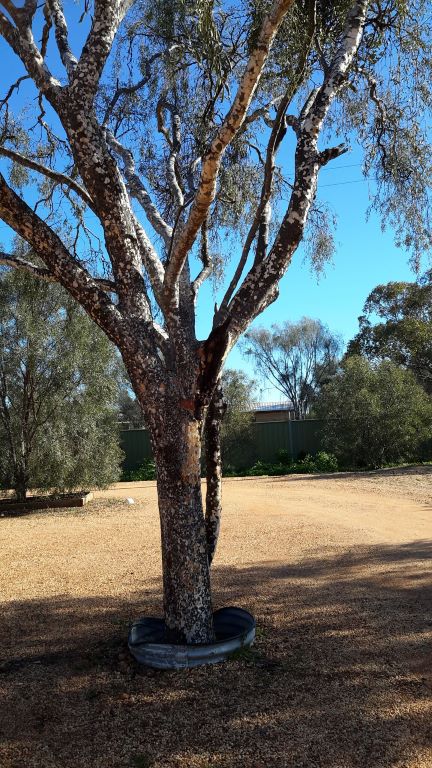
Leopardwood tree

Apart from lessons to be learned about the use of “gadgets”, it was a rather thought provoking exercise on how dependent we had become on internet access. At least when we thought we should have it. I could quite happily go off camping somewhere remote and not even think about emails, or whatever. But in this scenario, there was a real sense of deprivation. Hmmm…

Apostle Bird


Leave a comment

2015 Travels August 4

A DAY OUT AT THE GRAWIN     AUGUST 4

The Grawin is the name given to a series of opal fields some 70kms west of Lightning Ridge by road. They were mostly developed slightly later than the fields around the Ridge.

There are actually four general opal fields of The Grawin, though each has localities within it: the Grawin and Glengarry which have been mined almost as long as Lightning Ridge; Sheepyard which dates from about 1985 and is the most southerly; and Mulga Rush, the newest, dating from 1999. The best of the black opal is found out there. One piece, about the size of a fist, was named “The Light of the World”.

Some say that the Grawin area is like Lightning Ridge used to be, back in the “old days”. That comment is usually made quite nostalgically.

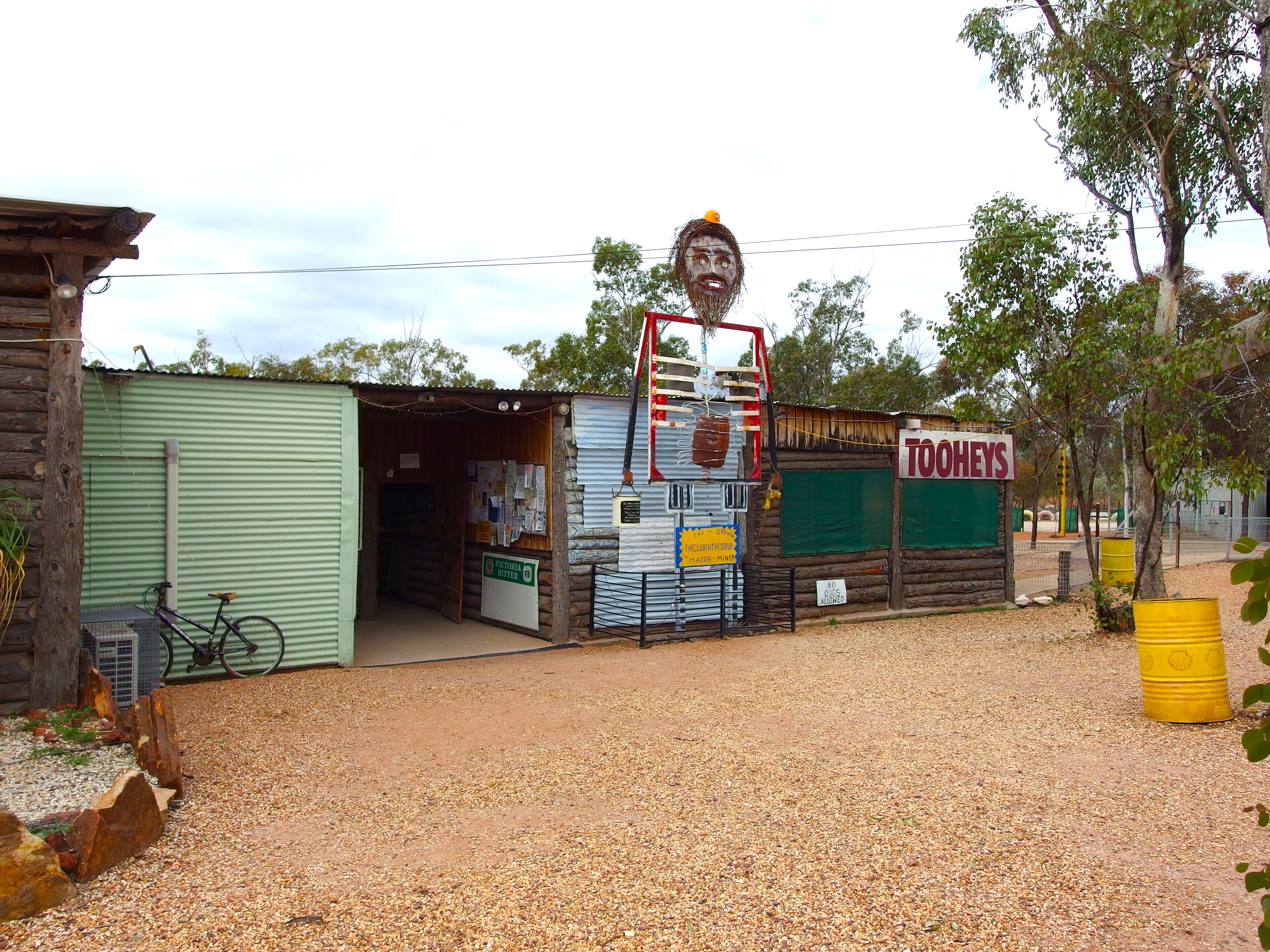
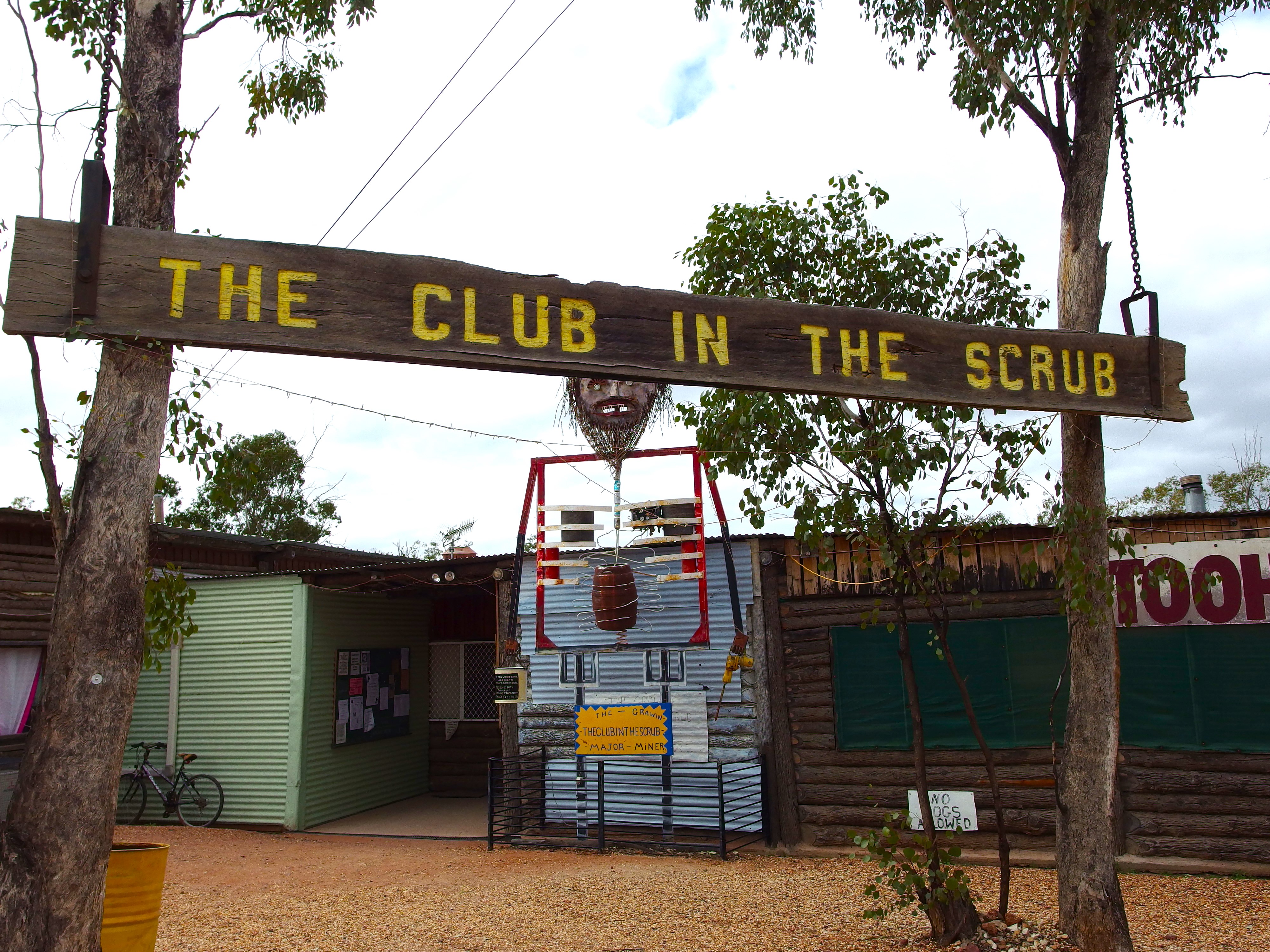
There are three drinking establishments at the Grawin fields: the Club in the Scrub, which is adjacent to the very rough golf course, hence the “Club”. There is the Glengarry Hilton, ironically named. The Sheepyard Inn is the most distant of the three.

There is a small general store, of sorts, at the Grawin. And that’s about it – apart from lots of holes in the ground, many miner’s camps which are mostly ramshackle affairs, some very large dumps of waste dirt from the mining process, and a maze of tracks connecting the camps and diggings. There are none of the modern amenities or services of Lightning Ridge – nor any formal law enforcers – and it seems that those who live out here like it that way.

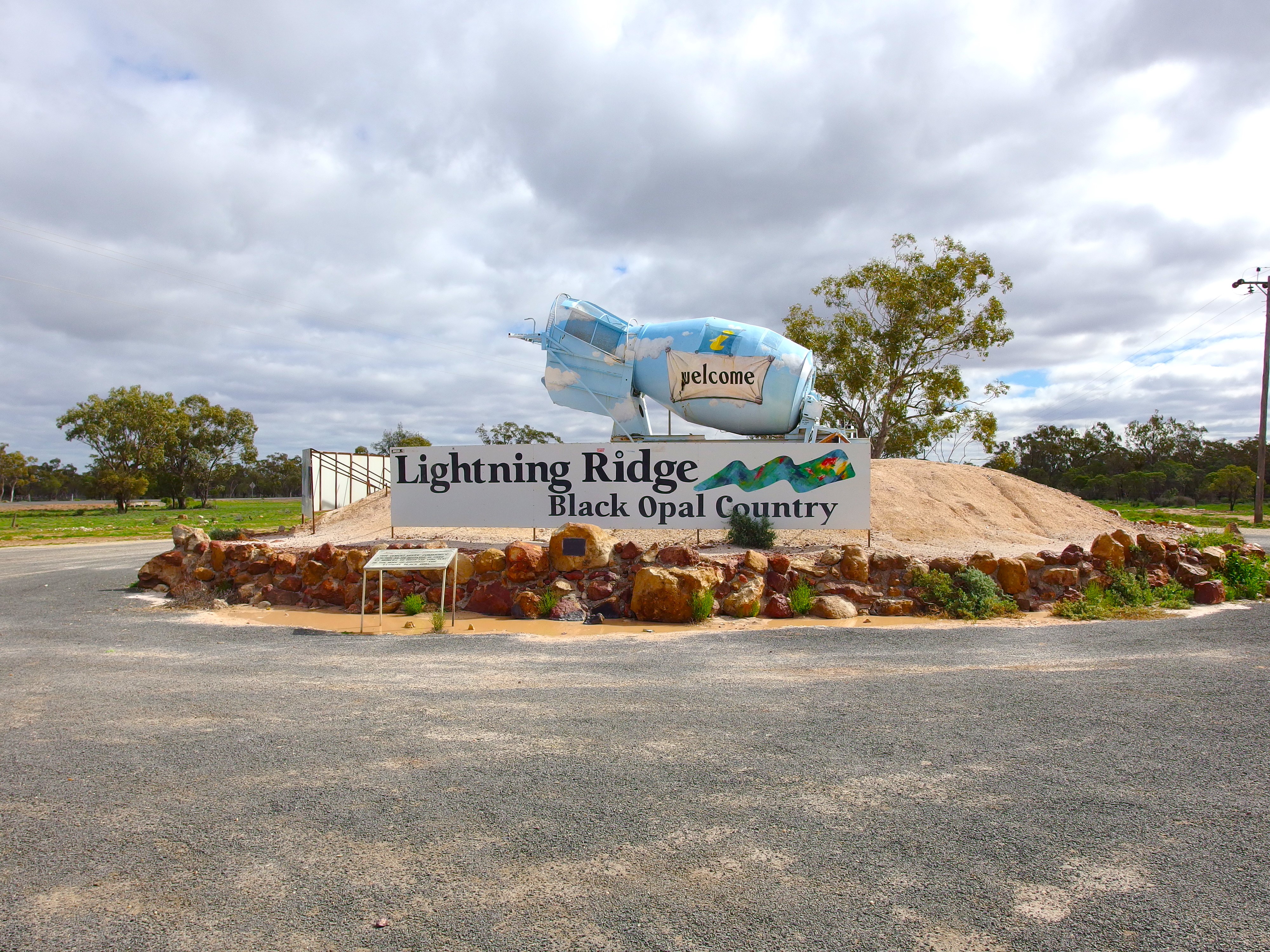
We headed out of town to the highway. Stopped at the highway corner to inspect the tarted-up “agi” that is the feature of the welcome signs. An agi is an old cement mixer, used to wash the opal dirt and so make separating out any opal bearing rock easier. There are lots of these on the fields.

Noticed a little informal memorial around the back. Very much Lightning Ridge style…

Memorial

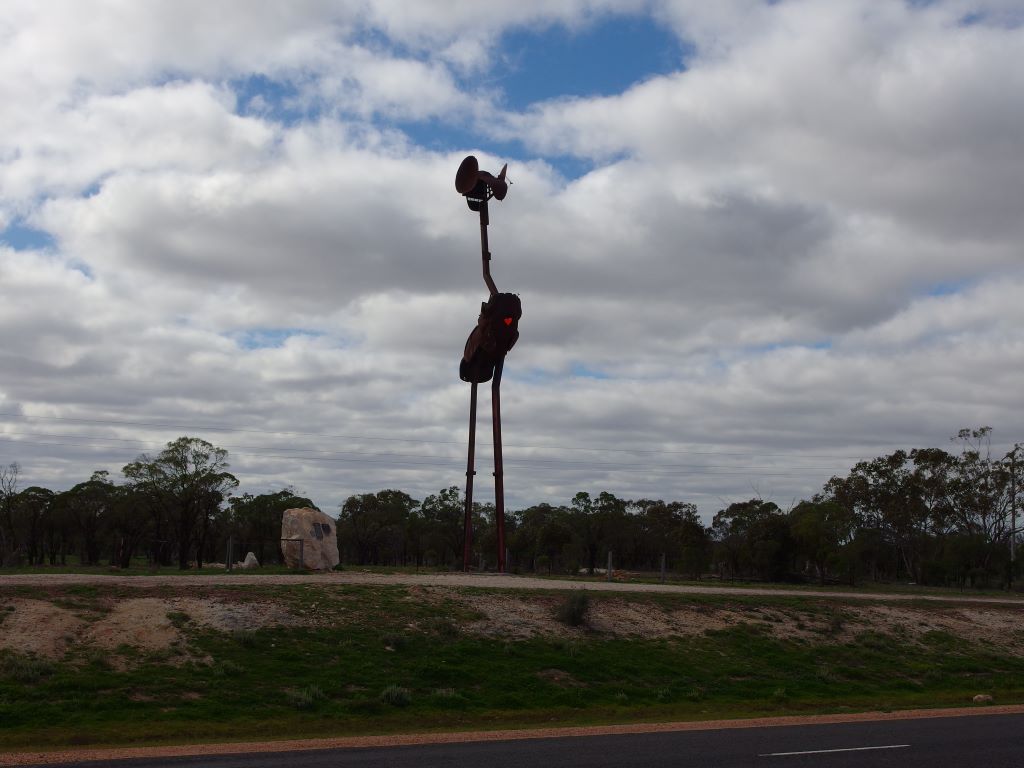
It was only a few kms down the highway to our next stop – Stanley the emu. This is a very large sculpted emu, the creation of artist John Murray, whose gallery is in town and whose iconic works often features stylized emus. Stanley is a true creature of Lightning Ridge, being crafted from “stuff” found about the place, including car doors.

Over the road from Stanley is the modern rest stop and free camping area.

Rest stop and free camp area

Then we turned onto the Cumborah road. The country was quite green, the dams were full, and there was quite a bit of surface water lying around. Someone had earlier told us that the green of the country was deceptive – that some earlier rain had caused the weeds to grow and there was not a great deal of proper feed yet – in that sense, the drought is still on.

By one stock grid was a sign saying “farmed goats” – presumably to stop some people thinking the goats were feral, and shooting them. Could see the any tree foliage in the goat paddocks was cut off  in a neat, dead-straight line, at about reaching height for a goat.

Travelled through a variety of landscapes: grazing land, crop land, cypress pine woodland, mulga country. It is a varied and interesting drive.

Cumborah village appeared a battling little township that consisted of some occupied houses and a few farm related services. We turned to the north here and some 13kms later came to the turnoff to the Grawin. The sealed road ended at this point.

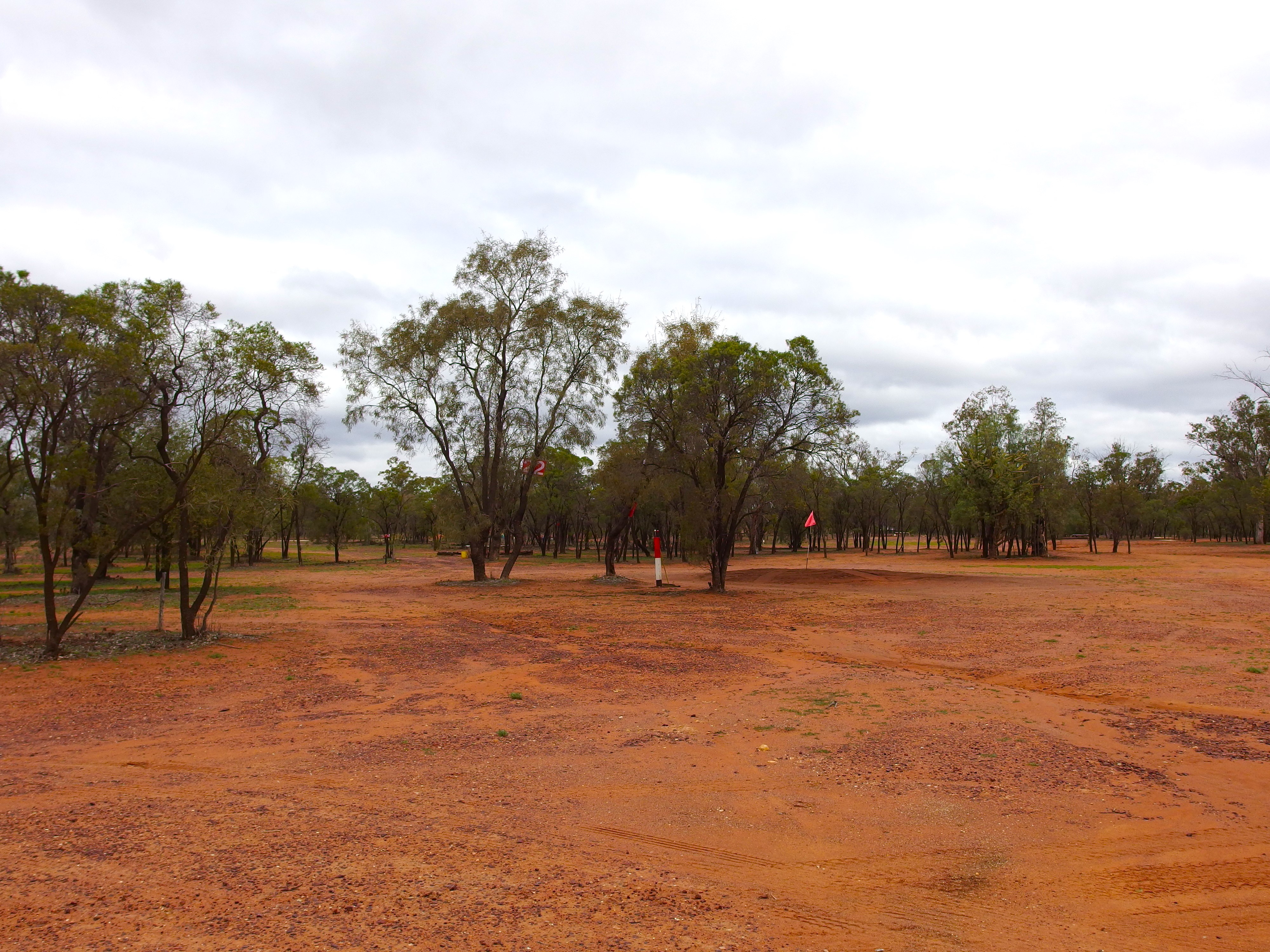
A few kms along the dirt road we turned off to follow a track through the golf course to the Club in the Scrub.

Golf course at the Grawin

Browsed about in the building, reading  notices and looking at old photos.

The Club in the Scrub

John saw a man leaving with a box of freshly cooked chips that smelled great, so we ordered a $6 box. Lunch! I paid $10 for a laminated mud map of the fields, produced by a local guy called Duck. The man behind the bar was careful to tell me that the route it showed through the fields was not accurate, that some left turns should be right ones. I couldn’t quite follow his explanation, but figured that any map was better than none. According to the GPS unit in the Terios, we were driving through featureless paddocks out here!

On the Grawin weather rock

While we waited for our chips, watched a handful of local ladies playing bingo.

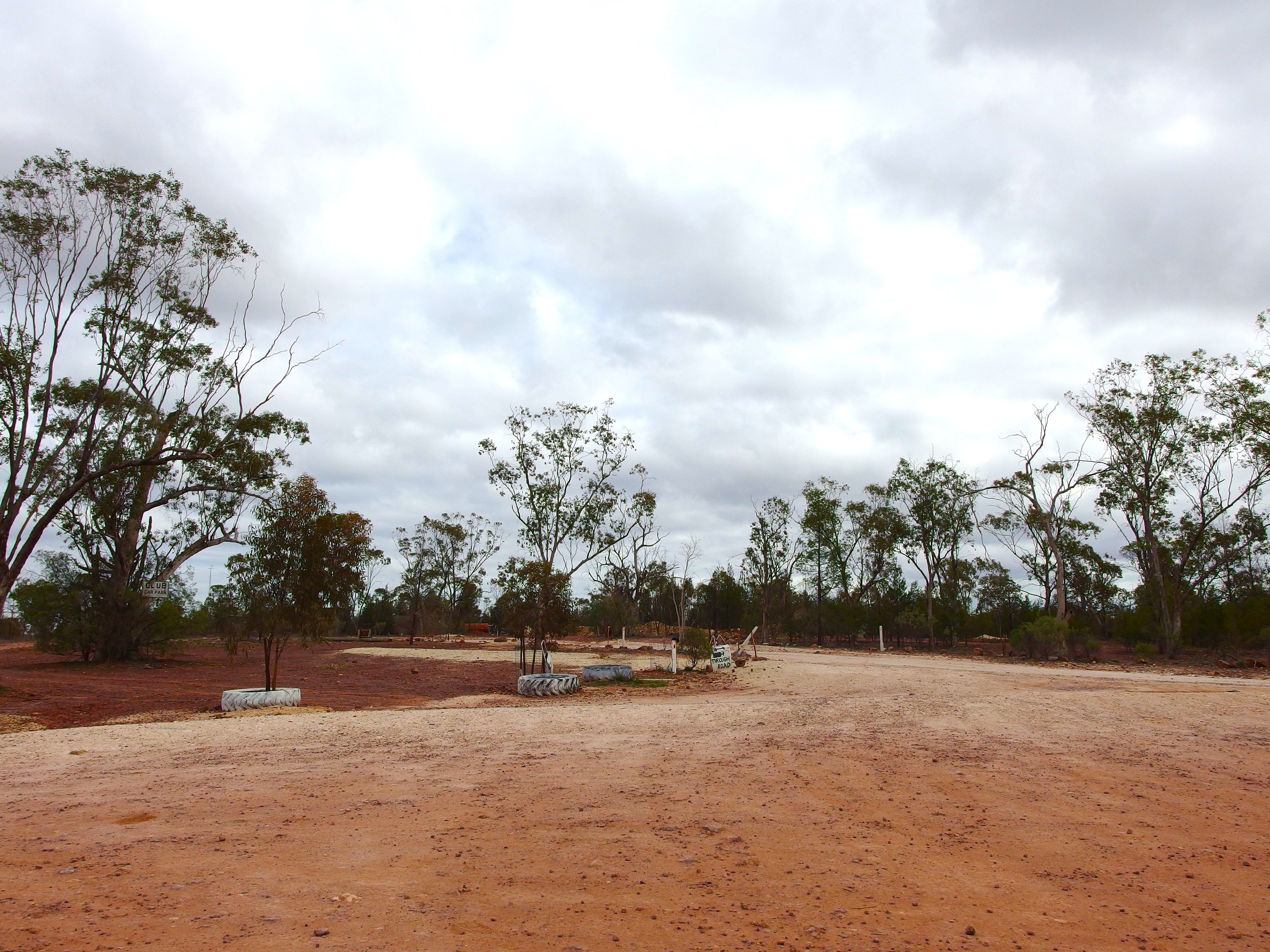
Sign points to the through road

A noticeable feature of some claims beside the track through the Grawin was the vacuum pumps positioned above the shafts – to suck up the dirt from below, as opposed to loading it onto some sort of hoisting machine. High tech on the fields!

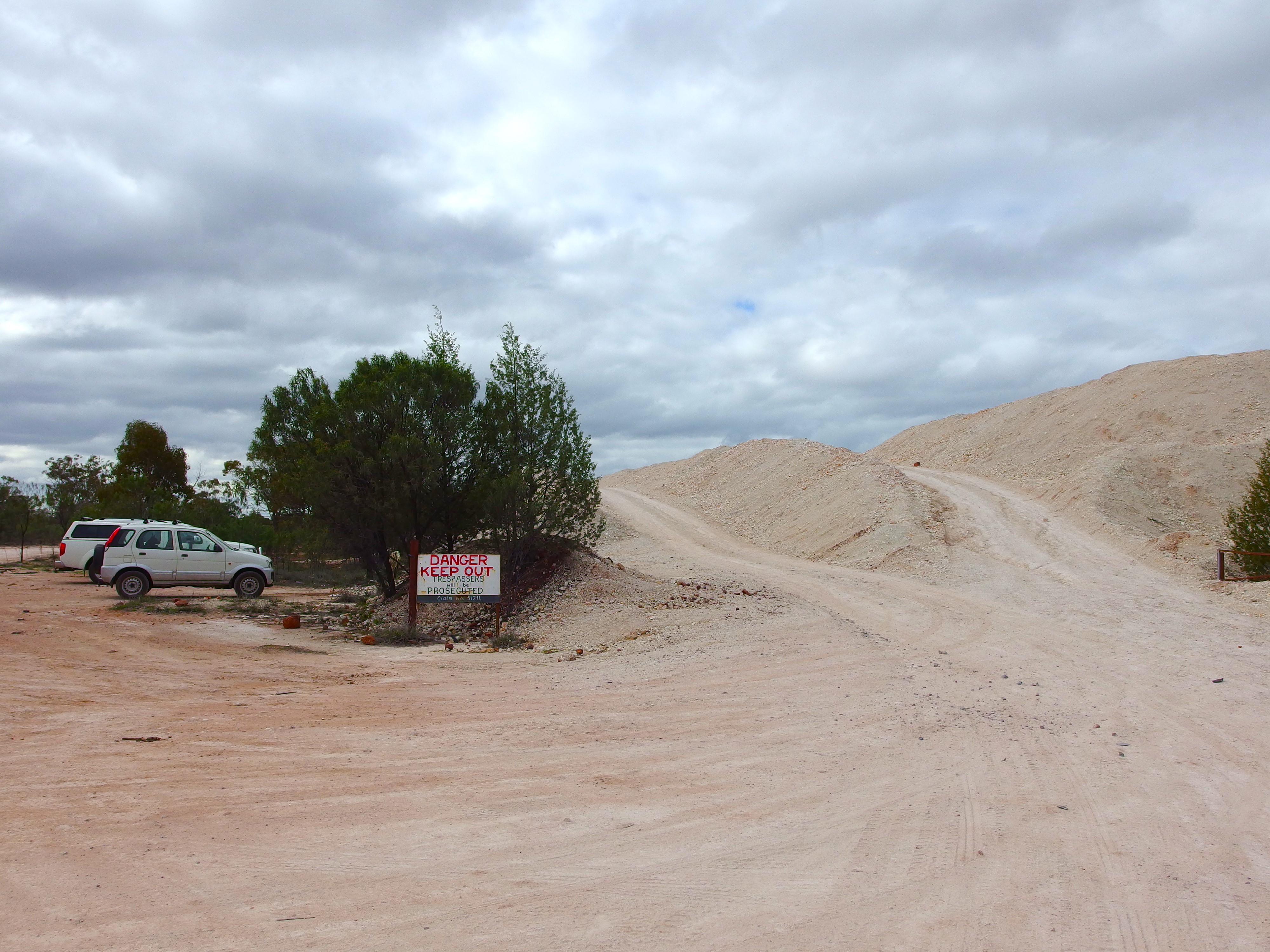
We stopped at the big waste dumps at Mulga Rush.

Mulga Rush dump heaps

Only dump trucks allowed up there

John walked up to have a bit of a fossick on the heaps up top. I took Couey for a short walk, complete with muzzle, which she hates, but one doesn’t know what might be around out here.

View from the top

Then she went back into the car and I walked up to the top of the current dump and took some photos.

Noodling on the dumps

There were a few other people – all tourists, I think – scrabbling around up there, too. John did not stay long.

Roads every which way

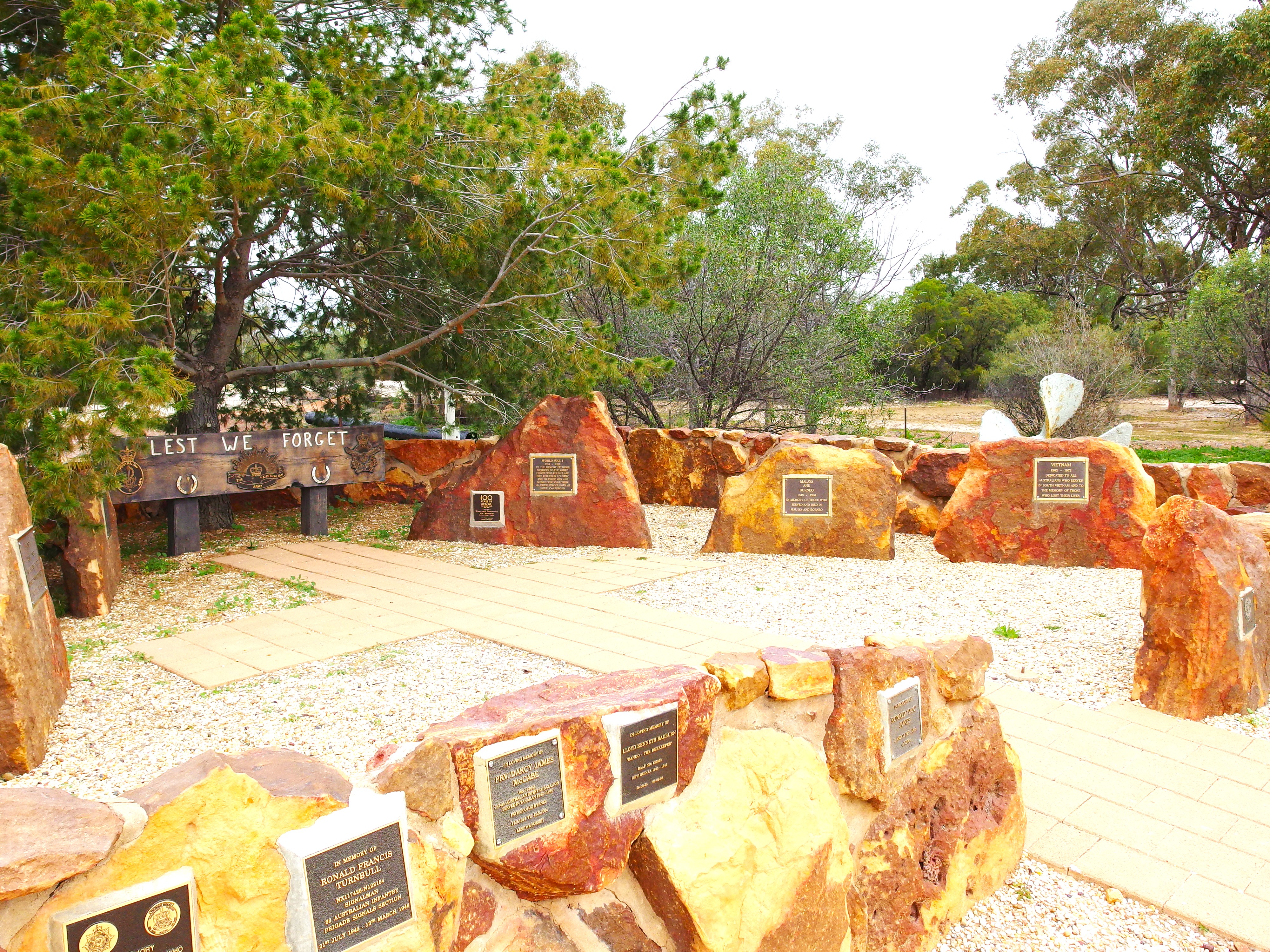
We drove on towards Sheepyard Flat and stopped at the War Memorial on the way.

War Memorial

It was really well done – just in the scrub, overlooking a small lake which was probably once a washing dam.

The Memorial commemorates all of the conflicts that Australians have fought in.

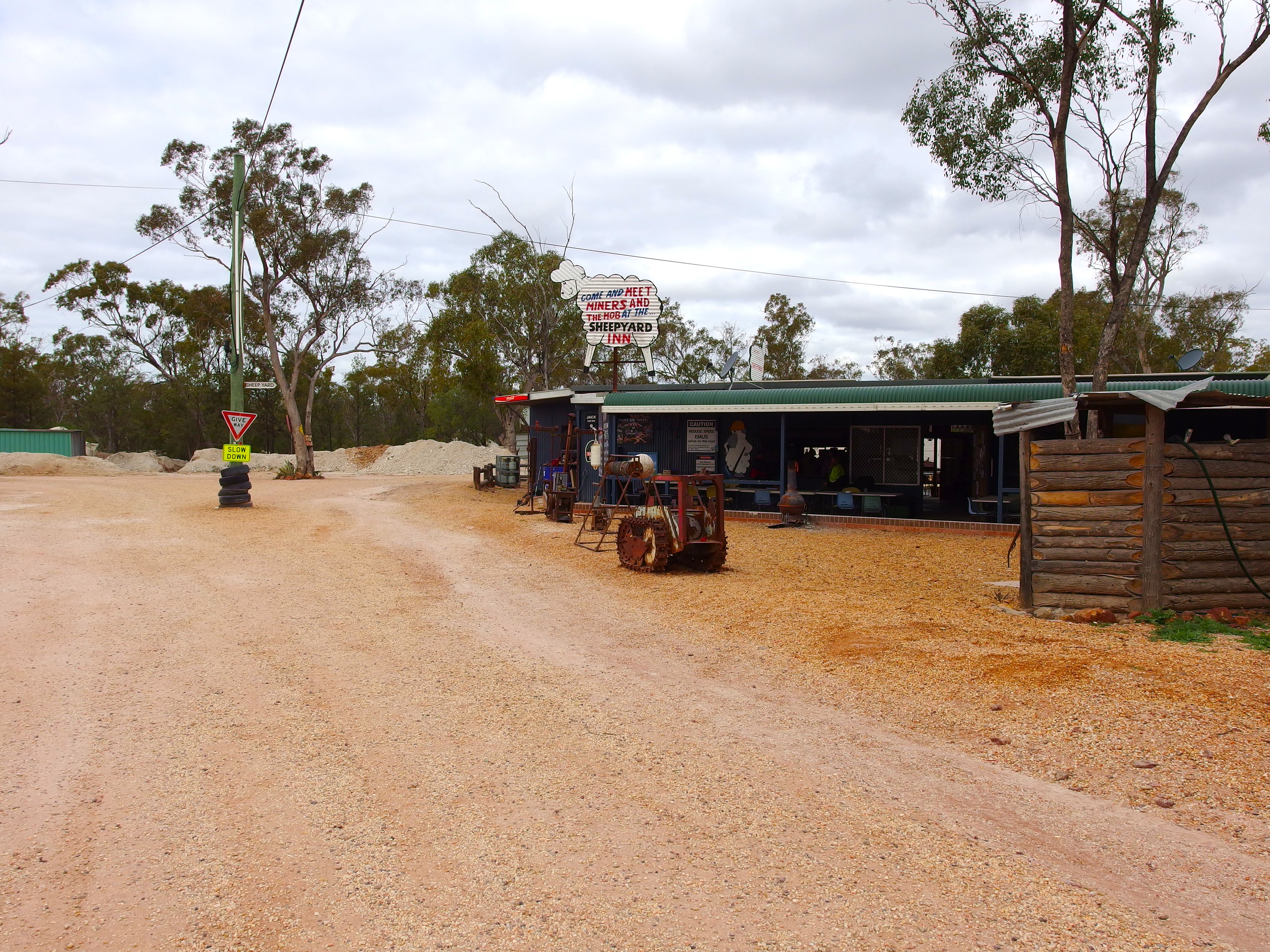
Continued on to the Sheepyard Inn. This has made itself into rather a commemorative place for Vietnam War veterans. The emphasis on this suggested that a number of vets have fetched up in the mining camps of the area. Inside what is essentially a large shed, there are several large whiteboards where visiting vets record their names and numbers. There was a surprisingly large number of such records posted.

Sheepyard Inn

Having stopped there, we felt the need to patronize the place. John had a beer. I bought a can of Coke and wandered about, taking photos.

Sheepyard Flats

The area was an absolute maze of tracks.

The density of claims and shacks on them, in this area, was quite high.

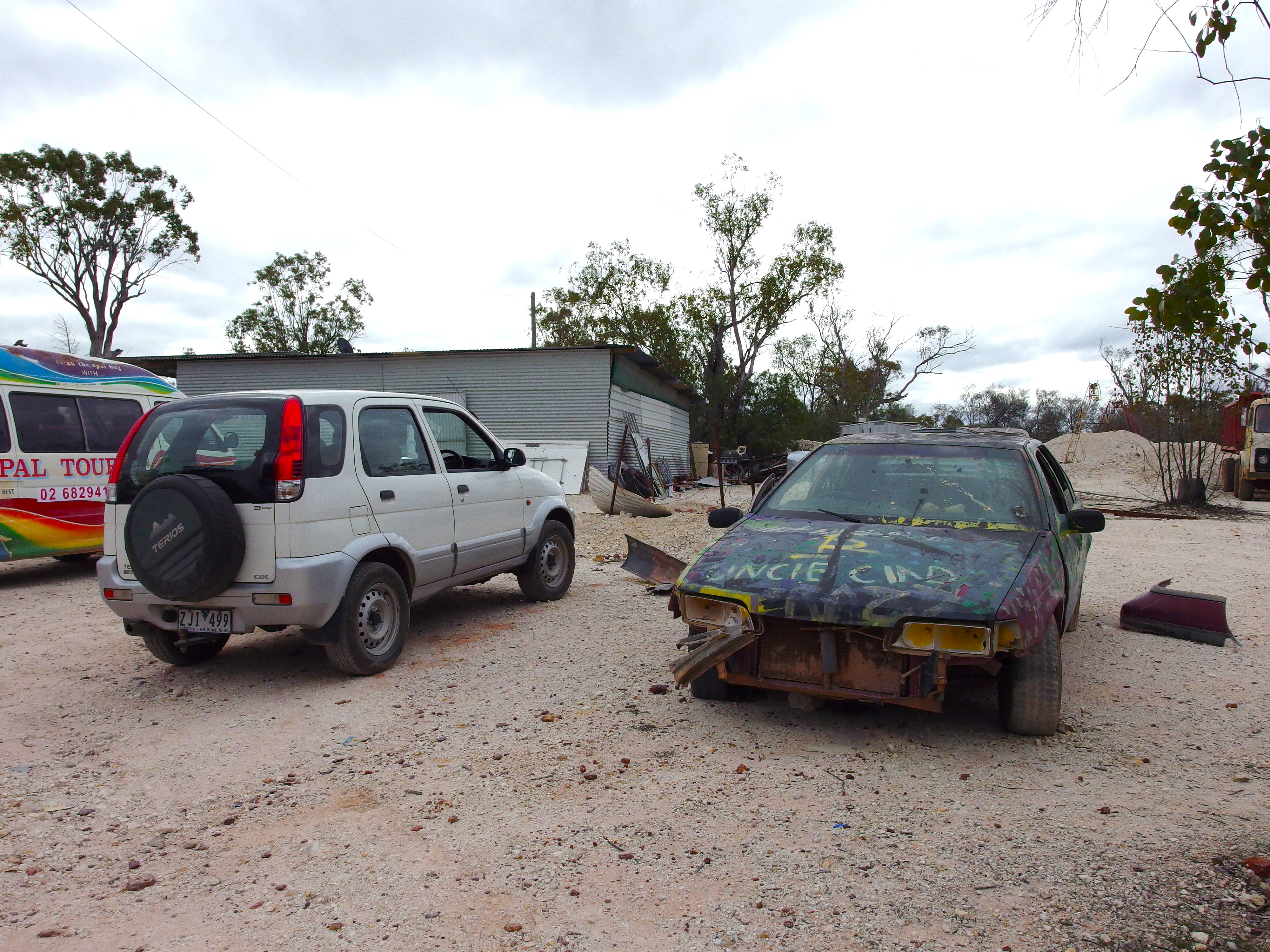
Some of the vehicles we saw being driven around the tracks here were testament to a relaxed attitude to some laws, in these parts. Roadworthiness or registration were not always a priority, it seemed.

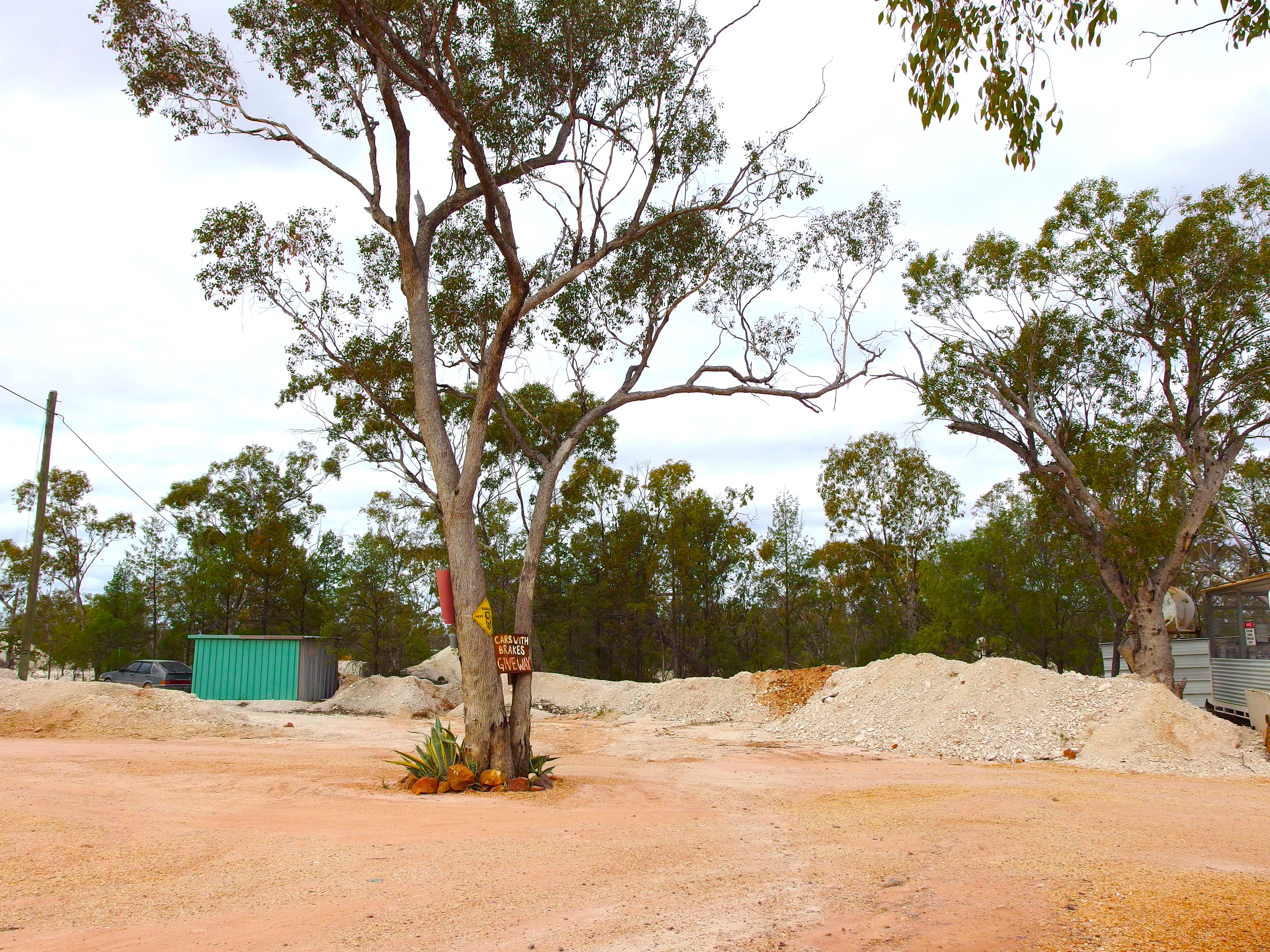
A sign at a track corner “Cars with brakes give way” may well have been intended as more serious than just a joke.

Cars with brakes give way…

We got lost after leaving Sheepyard. Turned left when should have turned right. After about ten minutes driving, realized we were out of the mining area and heading south. U-turned and got ourselves onto the right track after an unintended tour of downtown Sheepyard. There were some mean gutters and ditches across the tracks around Sheepyard. Guess it kept speeds down.

When we were driving through these fields, they all appear flat but they, in fact, follow a long, low, shallow ridge.

We did not go into the Glengarry Hilton. A number of day trippers have lunch there, but we’d had our chips earlier. I was now going to take the sandwiches I’d made for lunch, back to the Bus, to toast for tea.

Back on our 2013 trip here, we had gone out to the Grawin several times for John to fossick on the dumps. Little appeared to have changed in the intervening time. It was still an interesting day out and one I would do again, on any future trip, just because there is so much to look at, and it is so unique.


Leave a comment

2015 Travels August 3

OUR PATHS CROSS AGAIN      August 3

Whilst John was browsing the main stall in the inside building at Opal Fest, he spied two familiar faces at one stall. He waited until they had no customers, then approached and asked if they were still mining at Opalton and if they remembered him – from about five years back? They said he seemed familiar, and they chatted for a while.

John’s sense of time passing is not the greatest. It was actually fifteen years ago that we had encountered these two. Guess time flies when you are living an interesting life!

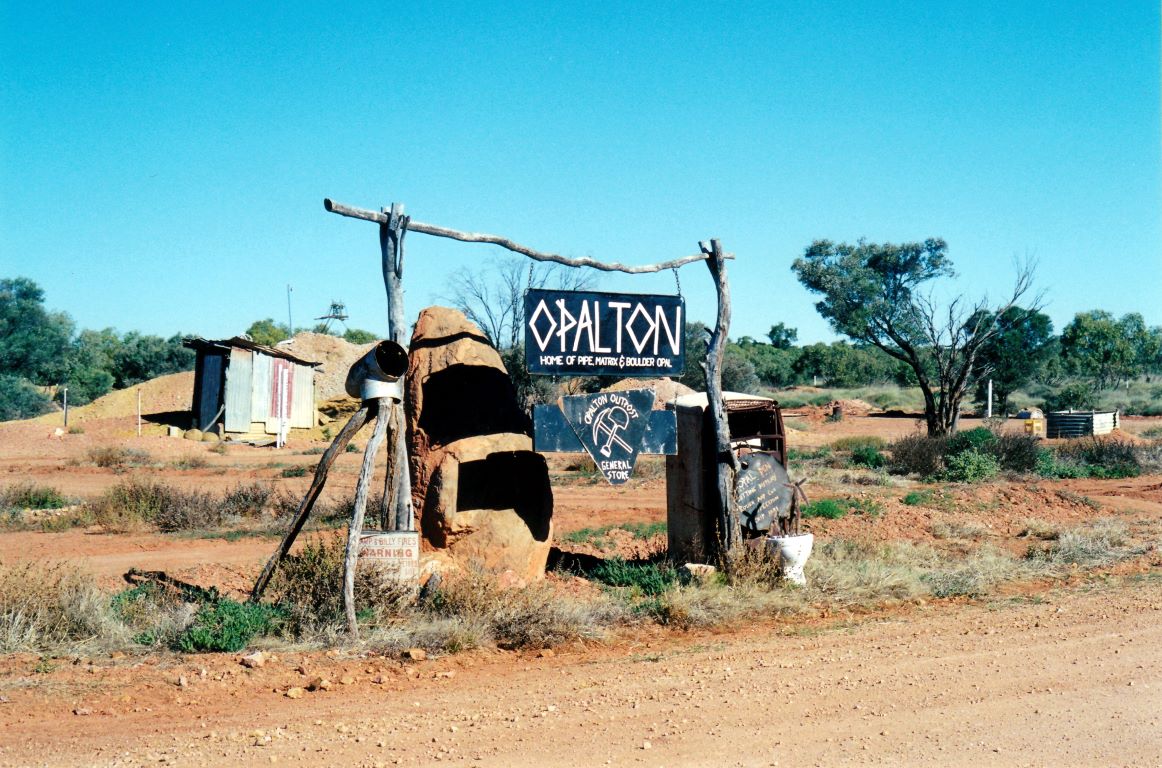
Back in 2000, when we were still travelling full time, heading NW in Qld, we fetched up in Winton. On an exploring drive, came across Opalton, some 120kms of dirt road to the south. About a hundred years before, it had been the humming centre of a big opal rush. When interest in opal waned, in the twentieth century, Opalton became almost a ghost settlement. What buildings there had been crumbled away.

Opalton historic area

But in recent times, there had been a resurgence of interest in mining the distinctive boulder opal that is found in the area. The section of the old diggings where there were lots of mullock heaps, was declared a fossicking area – only to be explored with hand tools. The old shafts in there had filled with water.

When we came across Opalton, there was a store of sorts, called The Outpost, a telephone box, and a rough camping area by the mullock heaps, being caretaken by an elderly pair of fossickers. We loved the area and the atmosphere of the camp and so decided to move the van out there for a week or two.

Opalton Bush Camp

In preparation, John, who had seen a dam and creek in the area, was in the Winton butchers. When he asked if the butcher had any scraps he could use for yabby bait, another customer – a rather glamorous lady – asked where he was going yabbying. He replied “Opalton”. She told him that she and her partner had a claim out that way, at Debbil Debbil. John arranged with her to visit them at the claim while they were camped out there, and that visit duly happened.

Open cut opal mining at Debbil Debbil

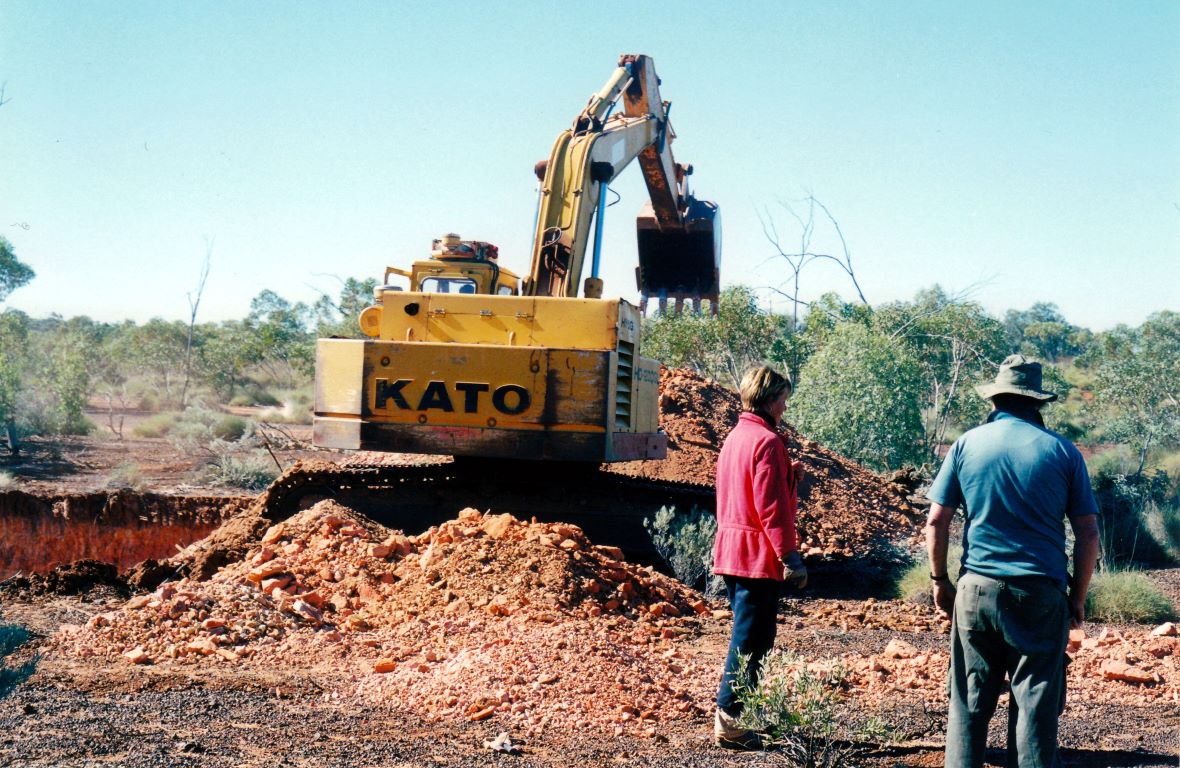
We spent a great afternoon with L and J, at their camp and claim. Watched how they were open cut mining, and learned to use a wire to divine for fault lines in the rock, with which opal was often associated. At their camp, saw a huge piece of boulder opal that the miner who shared their camp had found that afternoon – worth upwards of $35,000, he thought.

Divining for faults

That was only the second season on the claim for L and J. They hadn’t done any mining to speak of, before coming out here. The season extended over the cooler months. In summer, it was too hot and water was too limited so they retreated back to their home on the coast.

To date, they had not found any opal, but were hopeful still, We thought it was damned hard work for no return.

A year or two later, we heard that they were still digging at Debbil Debbil, but still had not found opal. Occasionally after that, we wondered what had become of them.

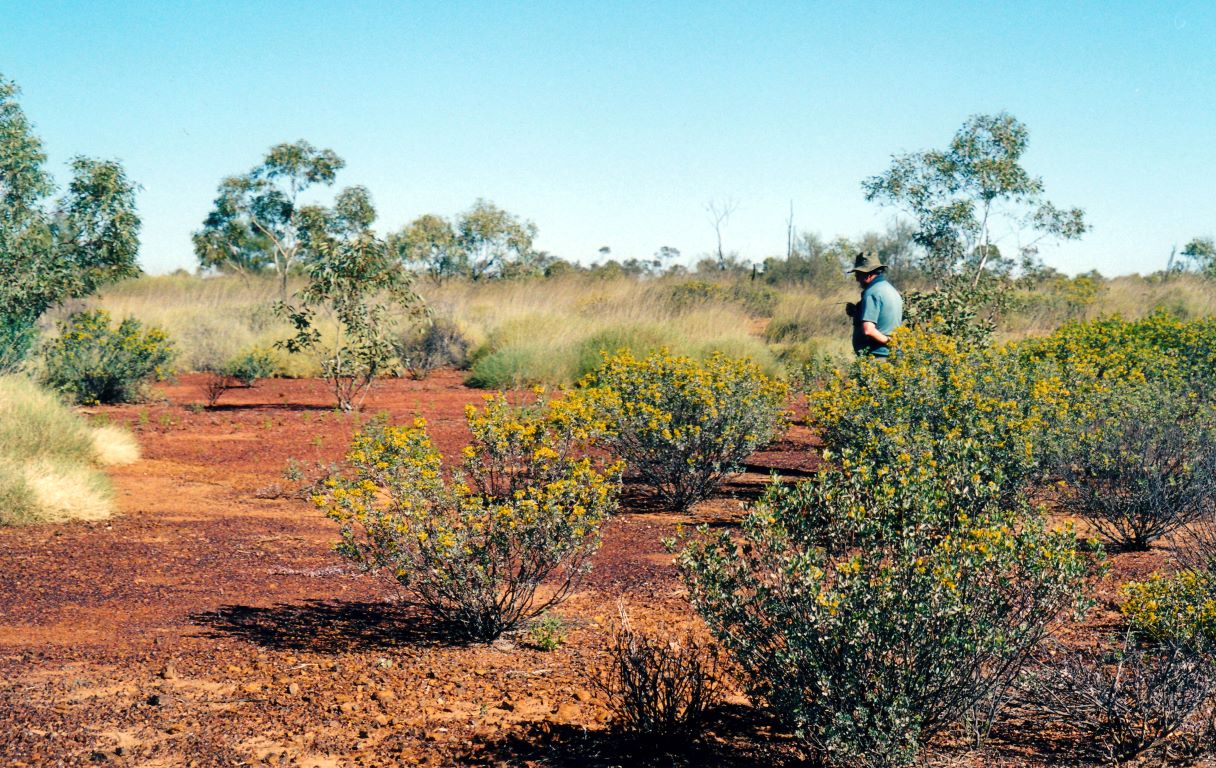
The semi-arid country around Opalton

Here they were! With a great stall, selling Queensland boulder opal, much of which they had mined themselves. There was also some very nice jewellery featuring same, which they designed and had made up for them. As with the best opal jewellery in Lightning Ridge, the stone was cut to bring out its best, then the setting designed for just that stone.

They told us that they still had some claims in the Opalton area, which they would dig at some future date, but were currently mining some 100kms west of Winton, off the Boulia road. They still spent only the winter months at their claims, then took their finds back to their Gold Coast base, where they cut and rubbed them and did the jewellery design, plus attending markets all over the place.

The boulder opal stall of our friends. Unusual boulder opal occurrence in rock

They were set up at a caravan park in town that had seemed convenient for the Fest, but were not happy there. They did not like it that some locals – non-campers – kept coming in, wandering around, using the amenities, leaving a mess, then begging users of the laundry for money to wash their clothes.

After they had packed up, on the Sunday afternoon, they came out to visit us at our park, and then immediately booked themselves into a site here for next year’s Opal Fest time.

We spent several hours over afternoon tea that turned into Happy Hour, over drinks and nibbles. L and J relaxed after the long hours spent at the stall. They were happy with the event, obviously, since they planned to return in 2016. It was a brief respite for them as they had to leave early the next morning to go back to the Gold Coast for a big opal Expo there.

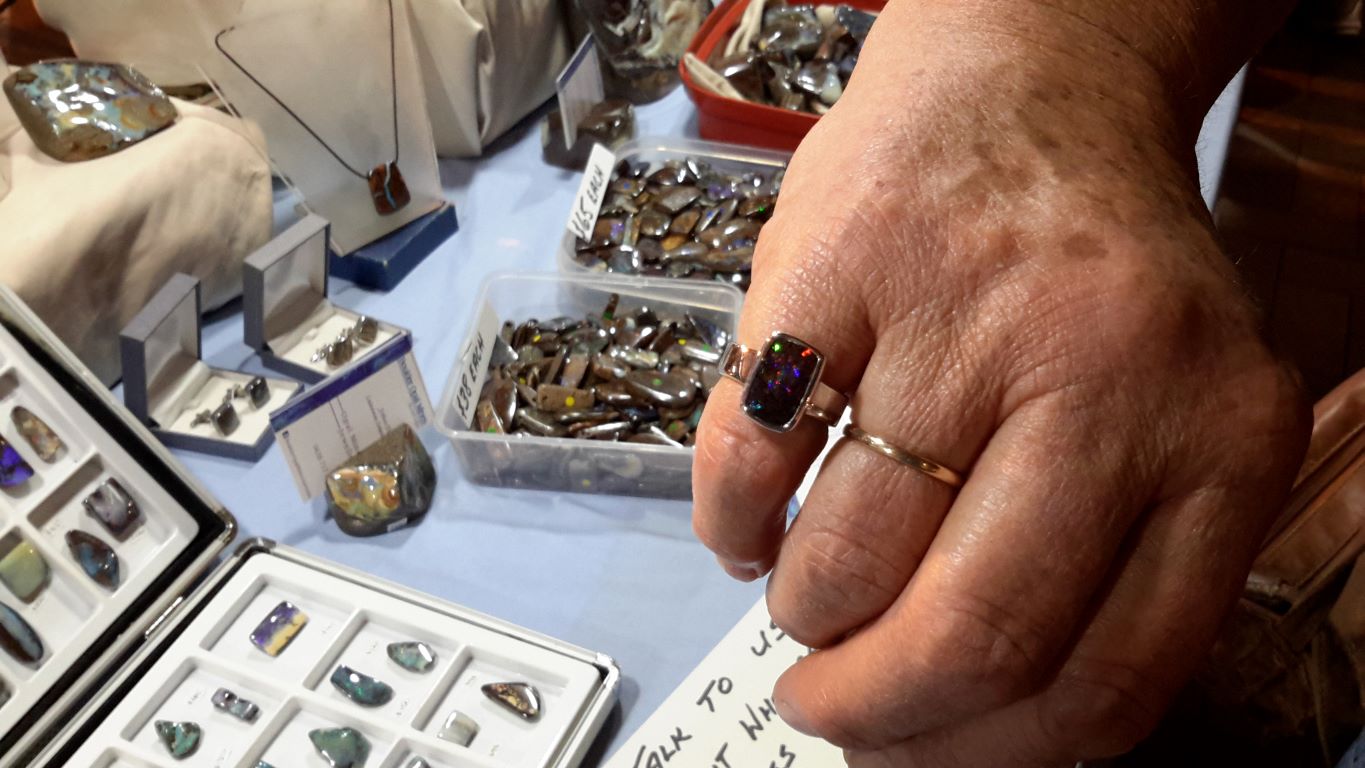
The Queensland boulder opal is quite different from the classic opal of places like Lightning Ridge and Coober Pedy. Here, the best opal is found in seams that are thick enough for solid opal to be cut and shaped. The Queensland boulder opal colour occurs in ironstone and can’t really be separated from it. The best boulder opal stones have the opal surface on top of the sandstone base, but other stones just have the opal flashes in the ironstone – small flashes of absolutely brilliant colour, in amongst the brown of the parent rock. There can be wonderful variety of colours, too, in boulder opal. In many ways, I prefer it to the usual opal.

Boulder opal ring

L and J have a website that features their boulder opals at: boulderopalsaustralia.com  This tells their story, gives information about opal, and features some of their product.

It was great to see these two again – and to know that their efforts and patience finally were rewarded.


Leave a comment

2015 Travels July 31

OPAL FEST     JULY 31

Opal Fest is held in Lightning Ridge every year. Every second year this is combined with the International Opal Jewellery Design Awards and it becomes a really big event. There is always a gala Ball held featuring that year’s Opal Queen.

To quote from the promotional material: “Jewellers, buyers, wholesalers, miners, rock hounds, lapidary enthusiasts and tourists are invited to experience the best Lightning Ridge has to offer with this culmination of information, spectacular jewellery, collectibles, great deals and fantastic networking opportunities.

The LR Opal Festival boasts over 150 stalls with a huge range of products including gemstones, tools, lapidary supplies and lifestyle products.”

Caravan park still a bit damp

The setting up for this year’s event began on Wednesday 29 July. Exhibitors and stallholders dismantled their wares on the afternoon of Sunday 31 July.

There were three sections of stall holders/exhibitors. Upstairs in the Bowling Club building was the exhibition section associated with the Design Awards. A $5 entry fee was charged to go look at these exhibitions, which included an opal with a price tag of $500,000. Yes, a cool half million dollars.

Downstairs is the large, undercover, beer garden section of the Club. There were over a hundred stalls set up here, selling opal, jewellery, specimen pieces, tools associated with opal cutting and jewellery making. There were also stalls with things like preserves and fudges.

Outside, along the wall by the beer garden entry were more opal sellers and food stalls.

Across the road in a large yard area was a section that was more the style of the Sunday markets, with a variety of stalls, perhaps best described as the lower end of the price scale.

After the set up on Wednesday, the whole shebang opened on Thursday. This was the day when the big buyers, mostly from overseas, swooped and did their buying. We were told that there is increased Chinese interest in opal, now.

Friday night saw the Design Awards Gala Dinner – $100 per person, dress formal. Not quite our scene! We were told later that a special feature of this year’s dinner was the presentation to Len Cram of the OAM he had been awarded for services to the opal industry.

Saturday night the Opal Queen Ball was held. $25 a ticket. Dress – black tie. Again – not of interest to us. The prizes for the lady chosen as the 2015 Opal Queen were certainly worthwhile and in keeping with her role as an ambassador for the opal industry at events like the Australian Opal Exhibition on the Gold Coast, and the Black Opal Racing Carnival in Canberra.

We went to the Bowls Club area on Wednesday, to have a look at the setting up and browse the stalls already in place in the outdoor market area. John spent some time at a large stall of tools. Not opal related, just general tools. He bought a tyre fitting that he thought would make it easier to access the inner Bus wheels to check air pressure and inflate them. I was surprised at the extent of stalls of clothing and the like. It is obviously worth their while to come a considerable distance, as many of these were not local. Must be more money in that sort of thing than I thought. Maybe the locals stock up at this annual event?

Bruno’s Pizza – a local café – had a van set up, selling woodfired pizzas. Another van was selling curly chips – something new to me.

John went to Opal Fest on Thursday for several hours. He came back quite awed by the upstairs, quality, exhibits in particular. He had seen the half million dollar opal – displayed by my favourite opal gallery in town, which sells only opals the family dig up themselves.

I found out that the single lady in the caravan on the next site to us was here assisting her sister – in the caravan beyond that – who had a stall at the Fest. Sister made and was selling dichroic glass jewellery. Over the four days they did quite well, it seemed.

John went back for another look around on the Friday and had a very pleasant surprise encounter, which I will explain in a later entry.

Stanley the Emu welcomes visitors to Lightning Ridge

By the weekend, the park was totally packed. All normal sites were full as was the unpowered dirt and gravel section. There were lots of campers set up in the “bush” section. The performers at Happy Hour – in a grassed area by the camp kitchen – were really attracting a good crowd. The place was humming and the atmosphere in general was a festive one.

John persuaded me to go back to Opal Fest on Saturday for a final look around. The local “football” match was at home so there were crowds of locals at the sports ground adjacent to the Bowls Club. This made parking even more chaotic than usual.

As we wandered the stalls in the undercover area, I noticed that the Aracic family had a stall featuring the books written by Steve Aracic about opals in Australia and opal mining. We had a couple of his excellent books at home.

A stall that caught my attention was that of Mudgeeraba Chutneys. A long way from their Gold Coast base…They had an extensive range of Indian style chutneys and a tasting set up. I succumbed, and after tasting some, bought three bottles of different chutneys. I received a recipe leaflet for an eggplant dip, that they served up in a pappadum crisp with a dollop of their chutney on top. Was really yummy and would make a great “nibbly” to pass around with drinks. I love eggplant, though John does not share that taste.

From what we heard about the place, the 2015 Opal Fest was a great success. We certainly found it interesting. It is a good time for tourists to visit the Ridge – providing they have booked their accommodation in advance … well in advance.

Self-explanatory


Leave a comment

2015 Travels July 30

THURSDAY JULY 30       THE BORE BATHS

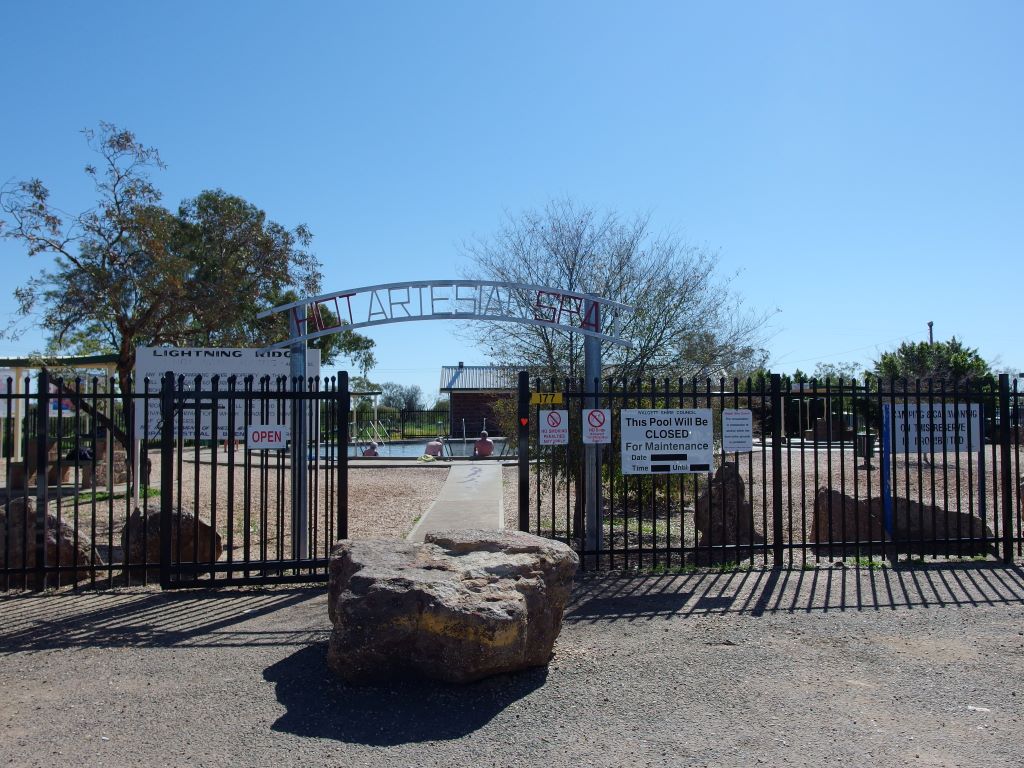
About two hundred metres from the caravan park are the Lightning Ridge Bore Baths.

Many of the park’s guests walked to the Baths, sometimes wearing their bathers, sometimes wearing clothes that hid more of the ravages of time. The ageing body is not a pretty sight in bathers – I am the first to admit it!

Lightning Ridge Bore Baths – Hot Artesian Spa

There is a string of several such bore baths across northern NSW. They are a real feature at Moree, where they are incorporated into at least one caravan park. Some travellers move from one lot to the next, especially where there is free or cheap camping nearby that enables them to stay for an extended period.

The basis of this popularity is the belief that such bore baths have beneficial or healing properties. The water is warm to hot and, coming from underground as it does, must contain a variety of minerals.

Mid-winter bathers

The artesian water of the bore baths is at least two million years old, in that it is that long since it fell as rain on the intake beds of the eastern highlands, and was absorbed to become groundwater.

The formation and movement of artesian water

In that time, it has moved through the various porous rock beds to places way beyond where it fell as rain. These vast areas of underground water make up the Great Artesian Basin.

Pioneering settlers discovered some places where this water came to the surface naturally – a clue as to what lay below. The mound springs found along the Oodnadatta Track come to mind here.

Map at the Baths showing extent of the Great Artesian Basin

In other places, the pioneers drilled bores down to the artesian waters of the Basin, and up the water came – in vast quantities. And – in some places – at extremely high temperatures, such as we found when we visited Purni Bore on the western edge of the Simpson Desert, in 1999.

The artesian bores watered stock. In some places the water was potable enough to supply drinking water for farms and even towns.

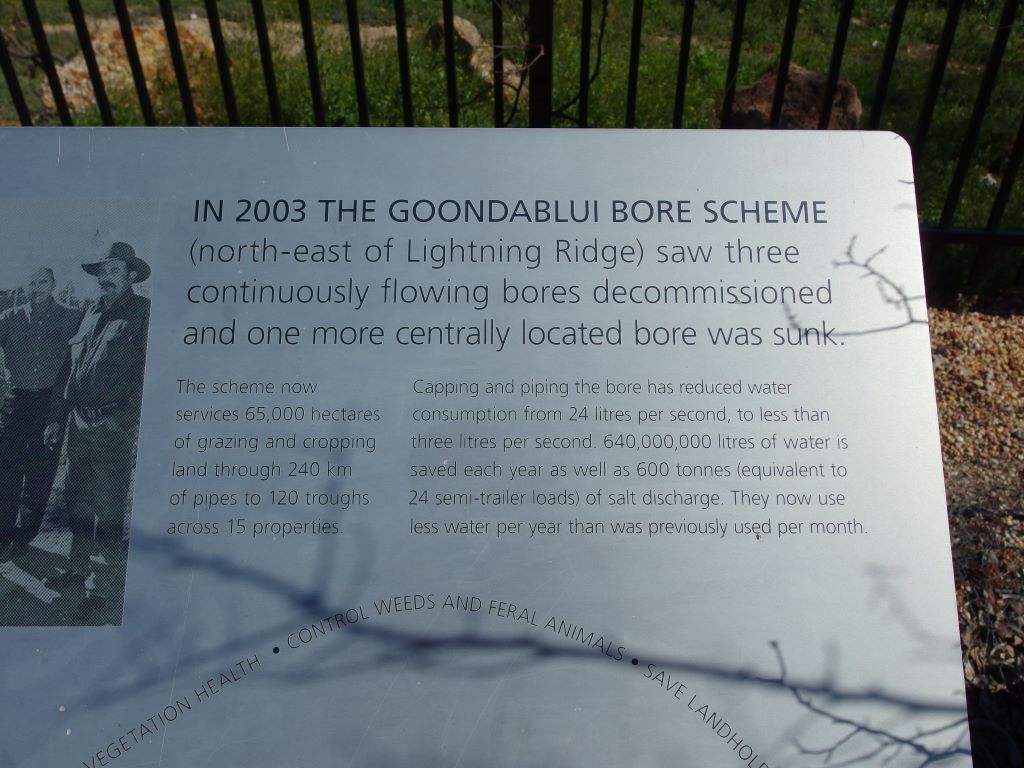
But much of the water that flowed from the thousands of bores that tapped into the Artesian Basin flowed away unused. It is now known that the stores of underground water have been significantly depleted and so bores are being capped, so their flow can be controlled or stopped. Environmentally, this helps conserve the stocks of underground water. However, in places the outflows from bores had created large wetland areas, attracting birds and other wildlife. The capping of some bores has eliminated those.

Sign at the Bore Baths

At Lightning Ridge in the early 1960’s, a group of local graziers sunk the bore and constructed the Bore Baths. The water in the baths is in the 37-41 degree range. Use of the Baths is free and they are open 24 hours a day, except for a couple of hours in the mornings when they are cleaned.

There are signs at the Bore Baths saying No camping. For obvious reasons, dogs are not allowed into the baths area.

For many of the opal miners on the fields around the town, this would have been their means of getting clean. It is only more recent that the facility has become an attraction for tourists.

As we were parked near the road to the Baths, I did notice that there was the occasional traffic to the baths, through the night.

The flow of this bore is now controlled, so the flow quantity is reduced, but there is still sufficient through flow to keep the waters hot and clean. By the caravan park fence that is closest to the Baths, there is a large dam, which I thought contained some of the outflow water from the Baths. This was directed off for use by miners in the dirt washing process that was part of opal mining.

Schematic showing effects of bore capping program

We did not partake of the waters. A sign at the entrance warned that people with heart conditions should not venture into water that hot. John eliminated! Even if the two open wounds on my leg did not preclude me, I didn’t find the idea of the baths all that attractive. This was quite illogical, because the through flow probably ensured they were cleaner than the local swimming pool where I used to do water aerobics. I had, in the past, dunked myself in well used watery places like Coward Springs on the Oodnadatta track, and Mataranka. Maybe, next visit, I would venture in?


Leave a comment

2015 Travels July 26

SUNDAY JULY 26     THE SUNDAY MARKETS

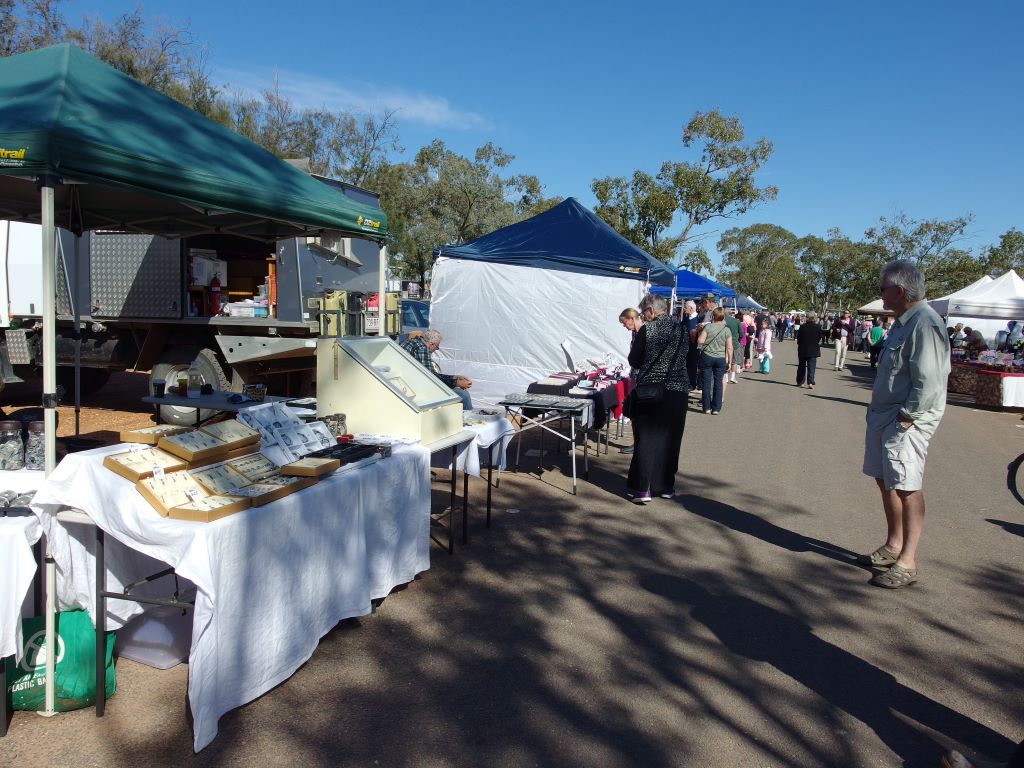
Every Sunday morning the markets are held in an area beside the Visitor Information Centre.

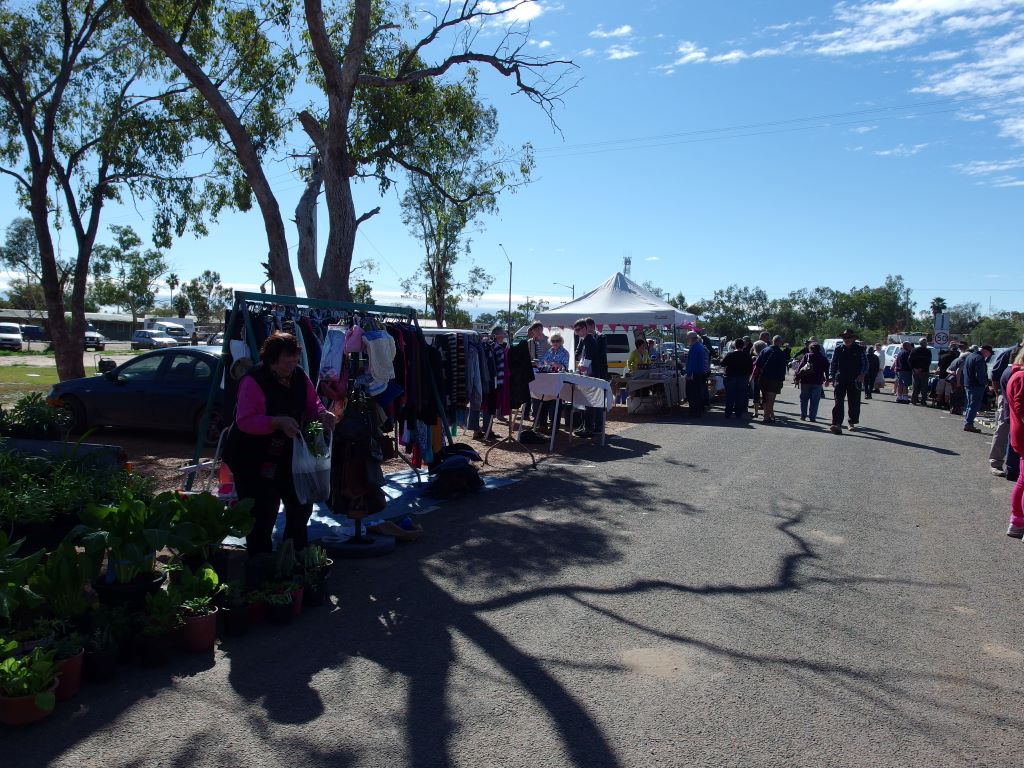
By the time the stalls have set up, along both sides of an old paved road area, there is not much parking space left for customers, so cars tend to park alongside both sides of the main road, fairly haphazardly. If an event like this was held at home, there would have to be traffic control units and marshals wearing high-vis gear. It is quite refreshing in a funny sort of way, to have to just fend for oneself, without the intrusions of the nanny state.

Sunday Markets in full swing

The main focus of the stalls is, of course, opal. Some of the stall holders are miners who offer material they have found themselves, usually in the rough as found, or as “rubs”, where just enough potch and surrounding material has been taken off to give some idea of the opal colour within. Some material is as loose pieces – usually the better quality stuff. Some is filled into bottles and jars and sold as bulk. This latter can be quite tempting, because there may be a couple of really attractive looking bits, in amongst a whole lot of not so good pieces.

Other opal stalls are maintained by those who are middle men – they buy from miners who can’t be bothered selling what they mine, or who are desperate for a cash flow. Some have a mix of their own and others’ material. Generally, there has been a sort of natural filtering effect here, in that these middle men have purchased only stones they think they can profit from, so their offerings are fair quality. But one usually pays more for this, too.

Typical stalls

Then, there are some opal jewellery stalls. Given the general nature of such markets, with cheap overheads, the product here tends to be opal cut to be fitted into pre-cast settings. Often it is doublet or triplet (not solid opal) which is cheap enough to appeal to market patrons – tourists who think they are getting a bargain, and those who do not know that not all “opal” is the same. Some of these stalls do not show on their labelling what is doublet, triplet or solid, and if you do not know to ask, or check for yourself, will not tell you. By comparison, most of the gallery shops in town have signs in their display cases saying what is contained within, or in some cases, state that they sell solid opal only.

Solid opal is, an indicated, a piece of solid stone with opal flashing colour within. There is a grading system for the base or background colour of opal, ranging from the really dark “black” of the best Lightning Ridge opal, through a whole gradation, to the milky white background colour of Coober Pedy opal. The Lightning Ridge black opal is regarded as the best opal and is the most valuable.
A doublet opal is where a thin piece of opal is mounted on top of an uncoloured piece of potch/stone. A triplet contains an even thinner shaving of opal, sandwiched between a dark stone background and a clear cover – quartz or plastic. These are layman’s definitions, not technical ones. As these contain less opal, they are less valuable. A rule of thumb we were told, this trip, was that a doublet stone is about ten percent of the value of a solid of similar size and colour; a triplet about four per cent.

Down there is my favourite cake stall…

Unlike gemstones such as diamonds, sapphires etc, which are uniform enough within themselves to be faceted to a geometric shape, each piece of opal is different. Its best presentation is where the stone is shaped to bring out the colour show. Where opal is cut to fit the cheaper, pre-cast settings, the true colour may not be best brought out. So, often, it is not the best opal that is used for such jewellery. As with most things, one pays a premium for quality – of both stone and setting.

Most of the opal galleries in the town are not represented at the markets.

In amongst the opal stalls are a variety of others. There was a good second-hand book stall, where the books were arranged by author, rather than at random. A few stalls sell an array of used goods – everything from second-hand solar panels to rusty metal of indeterminate purpose. There are the usual market type stalls selling sarong style clothing, knotted scarves, baby booties and the like. One extensive stall sold fresh fruit and vegies – both good quality and good value, I thought. There were a couple of preserves stalls – jams, sauces and chutneys. I saw a plant seller too.

Market stalls with main road across to the left

My favourite stall was that of a lady who sold cakes, slices and the best boiled fruit cake – by the half or whole cake. We gladly parted with $6.50 for a half cake that was so yummy.

On our first Sunday in town, we went to the markets. I wanted to buy cake, John wanted to be tempted by bottles of opal. We came home with cake, some very nice truss tomatoes and other assorted vegetable matter – about which John could not get excited. There was a small jar of chutney to flavour that night’s pork loin roast dinner. It was a good morning’s work, because our loot consisted of what was needed, not multiple impulse purchases of local stone.


Leave a comment

2015 Travels July 25 to August 20

SATURDAY JULY 25 TO THURSDAY AUGUST 20     LIGHTNING RIDGE

We ended up staying at Lightning Ridge for four weeks.

Our original booking was for two weeks – to cover the period around Opal Fest and give us time for any other activities we wanted to do in the area. Then, we had planned, to make our way across to the northern NSW coast, for a “beach fix”.

As our first two weeks were nearing an end, I realized that the state of my leg, still with two open ulcerated areas, would prevent any beach walking and paddling. Hadn’t really thought about how I would deal with sand in wounds before then. Dumb. So John decided we might as well stay put at the Ridge. The weather was beach-like anyway, and we were enjoying the town and this caravan park. And being lazy! The decision was made enough in advance for us to be able to remain on the same site.

Very comfortable on this site

A lot of our days here were uneventful and much the same, so not interesting enough to write up individually. Some special events and aspects will get their own entries, later…

In the meantime, this is how we passed most days…

Each morning, I would wake up about 8am and would take Couey for a walk right around the “settled” area of the park, which was quite extensive and took about 20 minutes, unless we stopped to socialize.

There was always much of interest along this route for Couey to sniff, so it could be a stop-start walk at times. I found plenty of bird life to watch while she worked out who had passed since she was last that way.

Grey crowned babbler

Because the park’s powered section, of 98 sites, was full every night, and because there were those non-booked arrivals in absolute need of a powered site, who would fit in anywhere they could be placed, it was interesting each morning to see these different arrangements. Someone who was having to wait days for repairs and parts was parked up in front of one of the big work sheds, where a long power lead was fed out to the rig. They had a less than inspiring view of the car wash bay and the dump point – but, hopefully, considered themselves fortunate to have a spot at all.

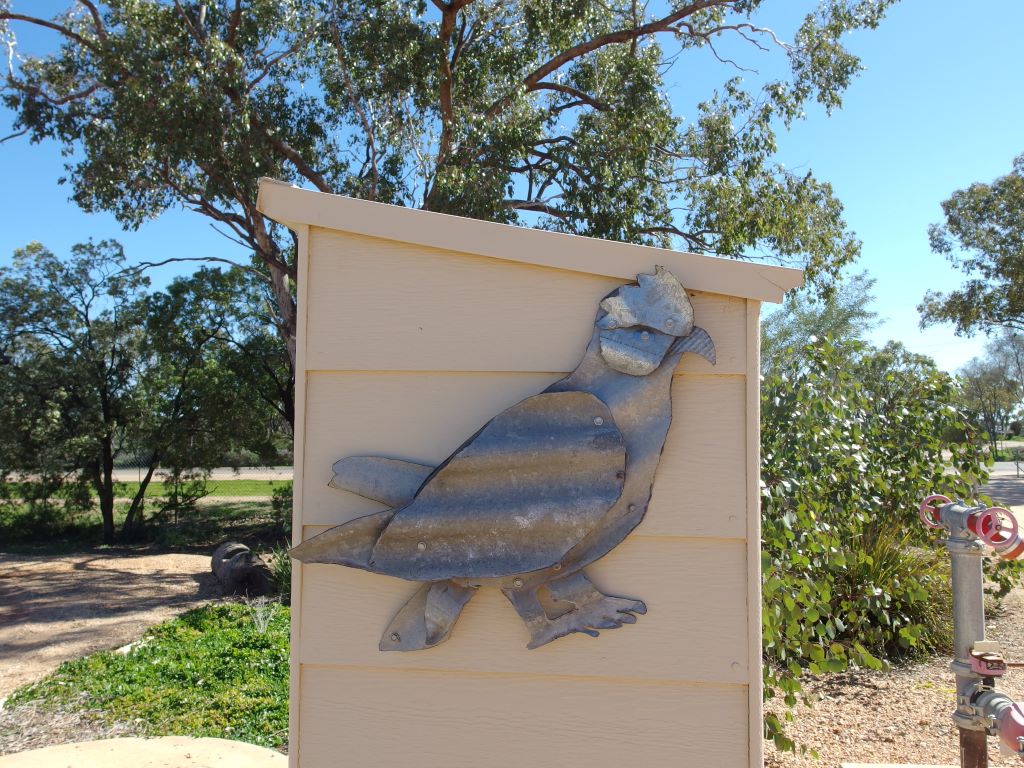
Metal art by the entrance

There were places on the perimeter road around the powered sections, where there were holding or pumping tanks for the sullage lines, buried to ground level. These had an electric power inlet to make them work. A couple of these had an extra power point and sometimes travellers occupied the adjacent, wide, roadway, like a site. As with the shed, these were provided to help out travellers in real need. However, I was not sure that the man who did the daily rounds emptying the rubbish bins appreciated when these people spread themselves right out across the roadway, blocking it and causing him to have to go bush to get around them. Not just him, either – we walkers were blocked too!

Lots of the park’s native plantings were in flower

Also of interest on my morning perambulations with the dog, was the unpowered section – an extensive area. Around the period of Opal Fest, it was totally full too. No real marked sites here, so it was a bit random and Rafferty’s Rules. Towards the end of our stay, there were fewer rigs there. The majority of those parked there were waiting for a powered site to become available.

Once the ground – that was very boggy when we arrived – dried out, there was usually two or three camps set up in the “bush” section, where people could really space themselves well apart.

Part of the large unpowered section of the park

Once our morning walk was done, it was dog breakfast time. I was having to keep morning and evening blood pressure readings for my doctor, who was still tweaking the combination and dosage of pills to keep that in order. Once that was taken, I could take said pills – and then had to wait at least half an hour before eating or drinking. Then, mostly, by that time I couldn’t be bothered with breakfast, so just had two mugs of plunger coffee, which I really savoured.

John would continue to sleep through all of this. Dog would usually have “asked” to go back in Bus, where she could guard him – and sneak up on my bed to do so. I had learned to cover my bed well, immediately after getting up, with a large old sheet.

Gotta be here to do the guarding properly….

To fill the mornings, I read, wrote up my diary, wrote postcards, embroidered or knitted, most days. Would sit outside under the awning if the weather was dry and warm enough.

Eventually, John would surface and breakfast – late.

I might need to head off to the fairly well stocked IGA for a hunting and gathering session before lunch. The small size of Bus fridge meant that this happened a bit more frequently than I liked. Our diet was heavy in salad and vegetable matter – “added bulk” did not only apply to the dietary label! John also drank quite a lot of milk and I could only accommodate 1 litre bottles of this, so regular replenishment needed. Of course, I am “difficult” or “fussy” – his terms vary – because I cannot stand full cream milk in my coffee. So my bottle of light milk also took up space on the fridge door, that could otherwise be filled by his cans of beer. I was never sure why I was the unreasonably choosy one, when he couldn’t stand light milk? We managed…

Afternoons might be more of the same, punctuated by a couple of dog exercise walks, or we might go off on a little sightseeing jaunt, or a browse of some opal shops.

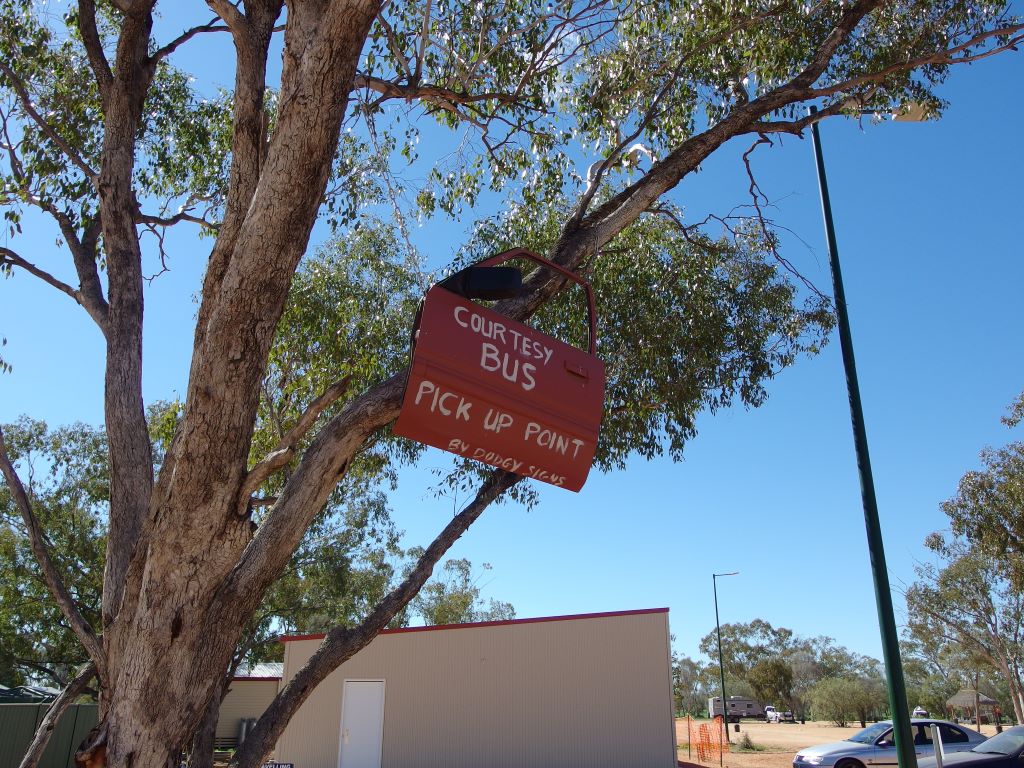
Tour bus collection ….. by Dodgy Signs

Occasionally, the man went off and played bowls.

Couey always got an afternoon walk session where we went over to the bush area, past any campers there, and then she was let off the lead. We walked the length of the perimeter fence and some of the little tracks through the low scrub. She would range ahead, maybe thirty metres or so, then come back and check on me, then range out again. That’s the cattle dog instinct at work.

Great park for the dog

There were plenty of fallen trees and branches in the bush area and we’d taught Couey to hurdle some of these. Such fun that she would seek out things to jump. She always looked longingly at the very big dam on the other side of the fence, that was the outflow from the Bore Baths, we thought. She would just love to go swimming in that – but the fence was very sturdy chain wire mesh, thankfully.

During the early part of our stay, the many large, muddy puddles along the way caused us angst – and her much enjoyment. As the days passed, the puddles shrank and became more muddy and less watery – and we discovered that the car wash bay was good for more than cars… The ensuing hose downs never deterred her from mud wallows, though.

Sometimes in the late afternoon, we would have a happy hour outside before tea – if the weather was particularly nice. If we had sociable neighbours, with them too. I bought a small cask of Sauv Blanc for such occasions, which I preferred to beer.

Some brilliant sunsets

Such were our days. Very relaxing, but with some regular gentle exercise.

Every three days I would have to change the dressings on my leg. Back in May/June, this used to take about an hour, as soaking was involved. Now that healing was – finally – well advanced, it was much quicker, taking about half an hour, by the time all the needed stuff was set up. The hard part was peeling off the really tight knee-high stocking – and getting it back on again without dislodging the new dressings. Always a chore I did not look forward to.