This Adventurous Age

Adventures travelling and working around Australia.


Leave a comment

2002 Travels September 13

FRIDAY 13 SEPTEMBER     DOOMADGEE TO KINGFISHER CAMP

At the best of times, I do not like days with this date. Good things do not happen on them!

The community atmosphere was still tense and strained, after yet another rowdy night. The raided truck had obviously been the source of significant alcohol supplies.

I took my usual classes in the morning, without incident.

The little girl’s parents came to the school to meet with the DP and John – arranged through the DP – to discuss what had happened. There was, of course, no acceptance by them of her bad behaviour, but they went away, presumably happy that they had been heard about how sweet and innocent and well behaved she was – and how it was all the teacher’s fault. The mother was a really strange lady – she arrived all dolled up with heavy makeup, itself most unusual amongst aboriginal women there, and wearing a red hat. “Swept in” would best describe her. Well, that child was going to bring her lots of grief in future years, for sure.

I was teaching and really did not know much of what was going on.

At lunchtime, with John still feeling shaken, and unsupported, we decided that he would go home for the afternoon. He could pack our van with most of our belongings, just in case we felt it wise to leave the community. Given how little we had in the house, that would not take long.

I took my VET class in the afternoon. Trying to get them to comprehend the rules for refrigerating various foodstuffs, keeping things like raw chicken separate, was hard going. It really was too far beyond most of their real life experiences.

After I got home, packed some foodstuffs – again, there was not a great deal to pack – and we left for Kingfisher Camp, on nearby Bowthorn Station. We only had about 70kms to go and got there just as the caretakers were about to close up for the day. It was still daylight, though.

We paid $16 for a powered site, and booked for two nights.

The caretakers had their own residence provided, by the track that went on to the camping area, by the Nicholson River. It was some 30kms from the Bowthorn Homestead itself.

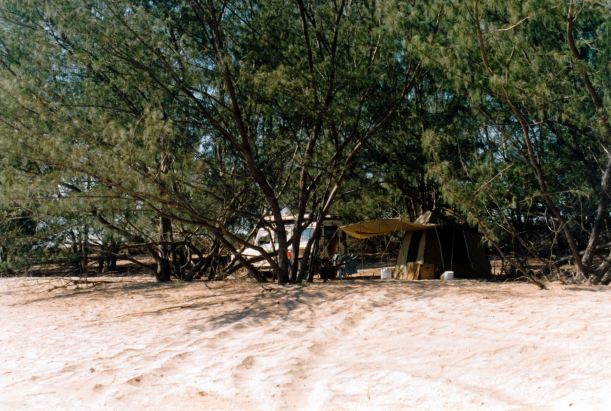
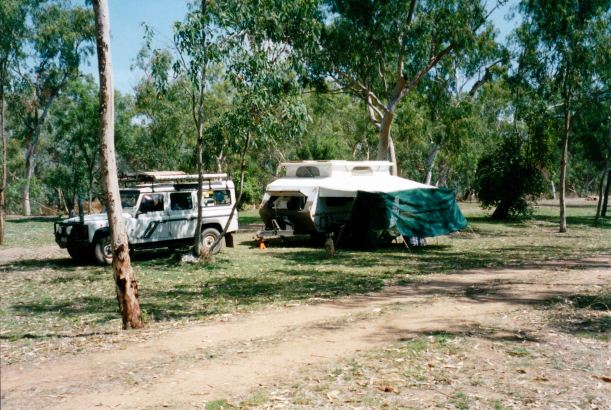
We set up on a very pleasant grassed area in an almost empty campground. The tourist season was tailing down in these parts. The amenities were in an atco style building, but clean and good. Being in a green, grassy area was so pleasant, after the dry dustiness of Doom.

Resize of 09-14-2002 01 Kingfisher Camp camp.jpg

Well grassed camping area at Kingfisher Camp

John was very quiet and depressed. At least, we enjoyed a good night’s sleep.


Leave a comment

2002 Travels August 2 – September 13

OUR TIME AT DOOMADGEE

Friday 6 September – Thursday 12 September

It felt like we were settled into a kind of routine now – as much as one could be. There was still the ever-present sense of alertness, because anything could happen. And still the disturbed nights.

I had decided that, next term, I would definitely get my own private food order sent up from Mt Isa – and wear the freight cost. We really did need meat, chicken and the like. The pre-packaged, vaccuum sealed bacon – which was all I was prepared to buy from the “butcher” was not something we could eat all the time. Neither were baked beans. The store did not run to meat alternatives like tofu or even packets of dried beans.

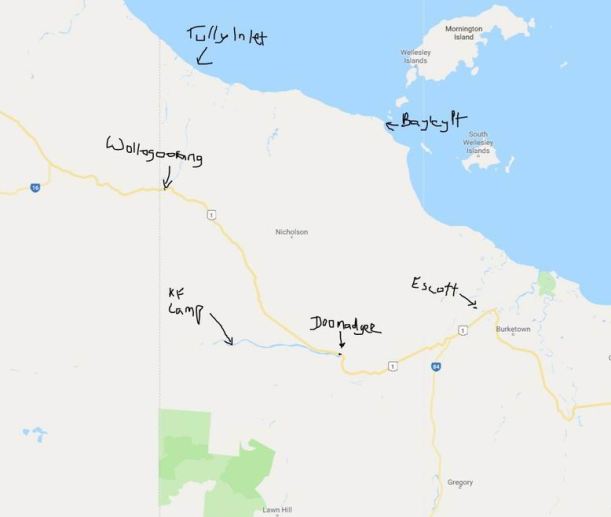
We took ourselves out of town, with the van, for the weekend – to Escott Lodge, just out of Burketown.

We had to go almost to Burketown, before taking the road to the left, the 17kms  to Escott, which was a working cattle station, with campground and accommodation as a sideline. It had quite a well set up caravan area, with power.

The Nicholson River flows through the station, not far before emptying into the Gulf.

We left straight after school on Friday, and were there and set up well before dark. We enjoyed a full and peaceful night’s sleep!

Resize of 09-07-2002 03 Escott camp spot.jpg

Our camp site at Escott

On Saturday morning, after breakfast, we drove into Burketown – we had not been there before. John filled Truck – at $1.04 cpl, it was 16 cents a litre cheaper than at Doom.

I had thought I would be able to stock up a bit on food, especially fruit, vegies and meats, but there was very little in the one store. I was greatly disappointed. The lack of decent foodstuffs is becoming a bit of an obsession!

There was not much to see in the township at all. It is inland from the coast, because of the salt and mud flats closer to the coast. The Albert River goes past the township – both Lawn Hill Creek and the Gregory River join into the Albert, further upstream. Its main reason for existence seemed to be as the headquarters of the Burke Shire – which covers much of this part of the state. We did not linger.

Back at Escott, we explored some of their driving tracks and wandered about beside the river. Then we relaxed back at the van and chatted with some “proper” travellers staying in the park.

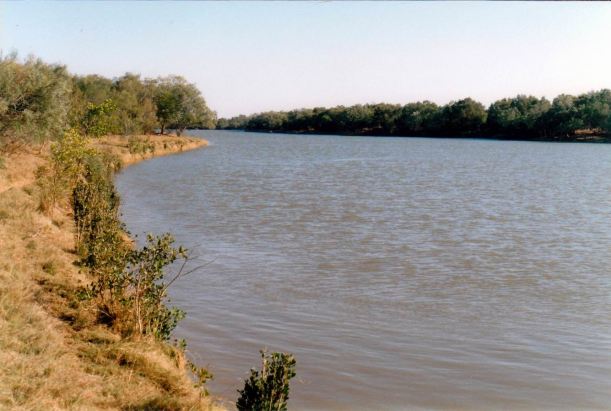
Resize of 09-07-2002 01 Nicholson R at Escott.jpg

The Nicholson River at Escott

There was a light plane, with pilot, based at Escott, offering scenic flights. The pilot called around, touting business, and we decided to do a flight on Sunday morning.

After another wonderfully solid night’s sleep, and then breakfast, we wandered down to the airstrip. The flight was great and excellent value, we thought. There was just we two, and the pilot.

Resize of 09-08-2002 04 Escott we are going flying

We are going flying!

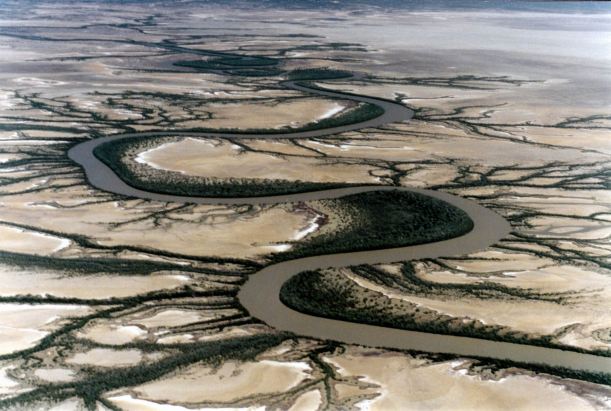
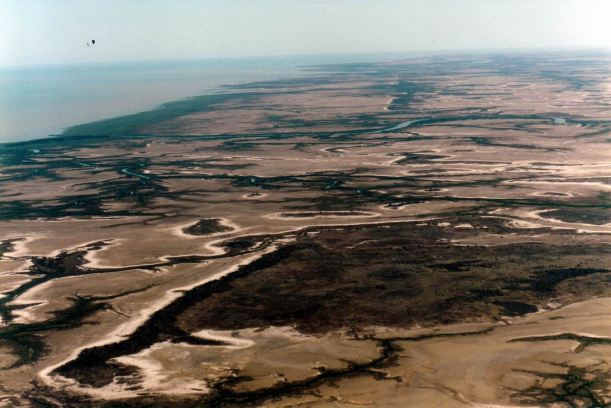
We flew over the lower reaches of several of the Gulf rivers, gained a much greater appreciation of the extent of the mud flats that line much of the Gulf coast, flew over Burketown, and got some good views of the station. We saw a crocodile sunning itself on the surface of the Nicholson River. The various station dams we could see, had cattle pads radiating out from them in all directions. I loved the flight.

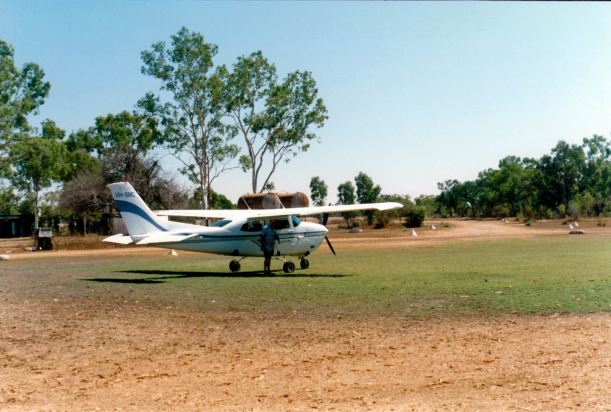
Resize of 09-08-2002 05  Escott airstrip and Nicholson R.jpg

The Nicholson River & the Escott airstrip

Resize of 09-08-2002 07 Nicholson River from air

The lower reaches of the Nicholson River

Resize of 09-08-2002 08 Gin Arm and Gulf.jpg

Gin Arm and the Gulf of Carpetaria

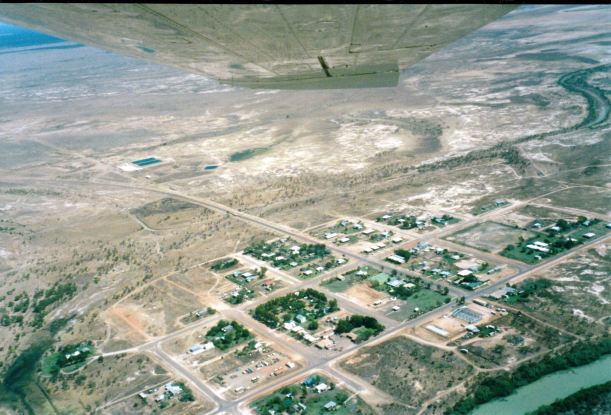
Resize of 09-08-2002 11 Burketown

Burketown

Resize of 09-08-2002 looking along gulf shore.jpg

The extensive mudflats that fringe the Gulf shores

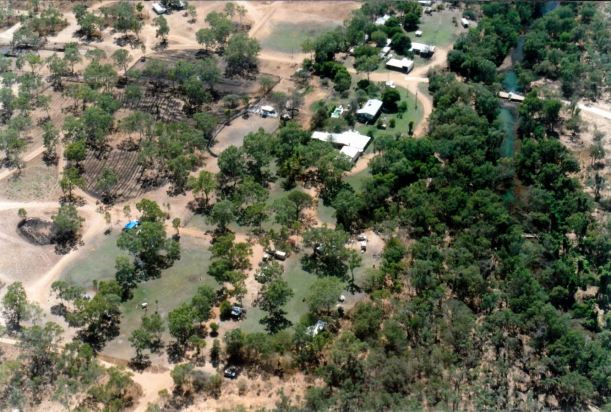
Resize of 09-08-2002 14 Escott and campground and us

Escott campground from the air

Then it was pack up and drive back to reality at Doom.

The usual week changed nature mid way.

The woman who had been taking the large class of – nominally – Grade 2 and 3 misfits and challenges, had departed town a couple of weeks back. Her reason was to go temporarily to see a sick sibling, but we all knew she was at breaking point and would not be back. By gathering in all the problem children from other classes, she had created an unmanageable group – and I think was having difficulty acknowledging that she couldn’t cope.

John had been asked, quite often, to take her class. He’d found hundreds upon hundreds of “busy work” photocopied worksheets that the children had worked on, over a long period of time, piled in cupboards and on tables – not corrected or done anything with. It was a measure of how far things had declined.

Even I had been asked to take this class a few times – and teaching at that level was not my forte, at the best of times. I do not have the temperament for a primary teacher!

The kids were mostly hyper-active, to put it mildly. She had obviously been shoving the copied worksheets at them to try to keep them quiet. One afternoon, they got to view a video, while I was supervising them. Shrek. They loved that, and were quiet, and relatively well behaved.

Thursday, as we walked to school, there was a strange, ominous atmosphere about the place. We noticed a number of empty wine casks lying around, which was unusual – in this supposedly dry town, it was tacitly accepted that beer would be obtained from outside, and drunk, but nothing stronger.

The Wednesday night had been very rowdy.

Some of the older students were clustered in little groups in the school grounds, and seemed apprehensive, and then not able to focus in the classroom. There was clearly something unusual and unsettling going on.

We found out later that a supply truck, taking grog supplies to the Burketown pub, had broken down on the road from Gregory Downs. The driver had left the truck and gone into Burketown – ostensibly to arrange repairs, but he may also have – wisely – decided he didn’t want to spend the night alone out there with all that alcohol.

Somehow the word had spread quickly amongst some of the Doom locals, and the truck had been raided. So there had been wine and spirits flowing copiously through the night in town.

On Thursday, John was asked to take the problem class, in the morning. One of the children was a Grade 1 girl, who was quite unmanageable and had been taken on by the misguided woman. She was, we thought to ourselves, probably affected by foetal alcohol syndrome, and was the very spoiled only child of parents belonging to one of the dominant families. They fancied themselves a cut above the rest of the community and swanned about the place. dressed up to the nines – more suited to a city race meeting than poor old Doom! There was something really “off” about them.

Anyway, the girl quietly made herself a very large ball of bluetack – there must have been several packets of this that she had pilfered from somewhere. The aboriginal teacher’s aide lady just sat and watched her do this – they never intervened, even when the children could have done with some “local” authority. She eventually had a ball about the size of a large cricket ball.

The girl then threw the bluetack ball – with some force – at John. he’d had his back to her and turned, at the wrong moment, and the thing landed right over his heart. It kind of winded him – he said later that it felt that his heart actually skipped a beat or two. He went to the girl, knelt on the floor in front of her, took her by the shoulders to get her to pay attention to him, and said – loudly – that she was not to do things like that. The girl started to cry and the teacher’s aide rushed out and came back with the DP.

Everyone got really serious because John had actually laid hands on the child. No concern that he was hurt – later, quite a significant bruise appeared on his chest. Or consideration, that if the heavy ball had hit another student, they could have been injured, like concussed, or worse.

John was quite shaken by the whole event and the way it had been taken, and the DP took the class for the rest of the session. Then the SM took over for the rest of the day. The Principal was away on business elsewhere for the week. The students were actually quite subdued – and they were also intimidated by the SM’s size and authority, so they behaved fairly well for the rest of the day. The DP actually said to John that he should observe and “see how it is done”! So patronizing to a man who had successfully run a primary school of several hundred students, for many years. There was no punishment at all for the child.

We discussed it all at home, that night. We agreed that the child should not have been in the class at all, and John should not have been asked to take them anyway. He was not hired as a straight classroom teacher – would not have accepted such a job, anywhere, after being out of normal classrooms for over twenty years, as a Principal. He had been hired as a literacy specialist, to work on that side of things, in small groups, and assist teachers in working on same.

John was apprehensive about possible repercussions if some of the locals decided it was a major deal – and we knew that any excuse to make an issue where whites were concerned, prevailed amongst many here. The DP and SM said they would try hard to defuse the situation. In a normal school, of course, the family would have been called in, and the child disciplined and probably excluded for a time.

We discussed going away somewhere for the coming weekend and working things out for ourselves then.


Leave a comment

2002 Travels August 30 – September 5

OUR TIME AT DOOMADGEE

Friday 30 August – Thursday 5 September

We did not go out of the community to stay, this weekend, but pottered about at home instead.

We went for a drive on Sunday, back across the river ford, then back south, down the track we’d come in on. After a little way on this, branched left. We knew there was an alternate route towards Lawn Hill, that crossed the Lawn Hill Creek at a ford, and wanted to see if we could find this. I am not sure that we did, but we found some creeks, and it was pleasant, exploring a little.

Resize of 08-05-2002 doom area

The Doomadgee area

In the late Sunday afternoon, went to a BBQ, along with other staff, at the Principal’s place. I had to take something, from our limited stocks. Made a carrot cake, and even managed to ice it – I’d had some icing sugar in the bus stocks. Too much to hope for that I could get cream cheese at the store. It was enjoyable to have a social occasion – and even more enjoyable to eat meat (they visited Mt Isa regularly enough to have stocks of same in the freezer).

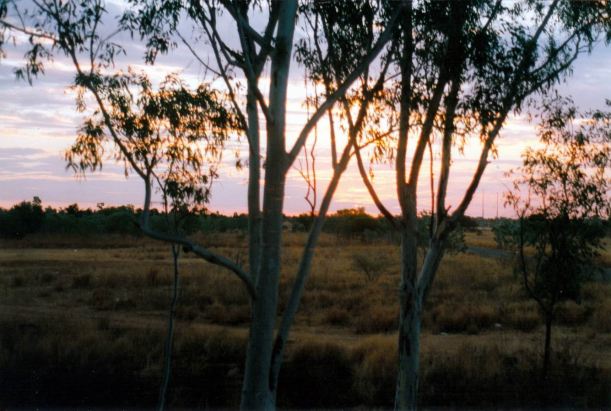
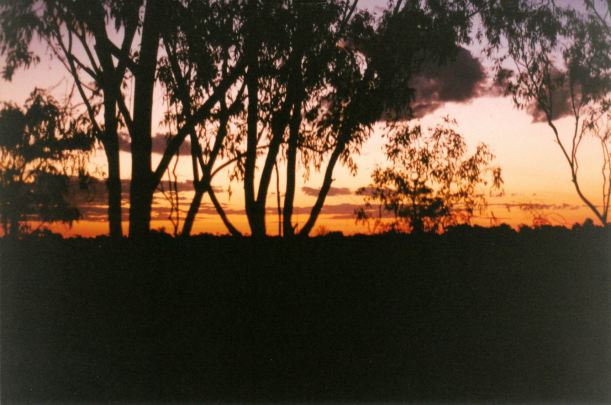
Resize of 08-21-2002 Doomadgee sunset

Doomadgee dusk


The visiting chef program came to school this week. She was at the school for two days – commuting from Burketown, of course. She was a very energetic lady. She worked with my VET girls, and a few of the secondary boys who had been selected as a reward for good behaviour. They would work with her for two full days.

The idea apparently was that such a program would show students what work in a commercial kitchen was like and maybe enthuse them for same. It might have been applicable in schools where the local community had such things – and some prospect of employment in same. But in a place like Doom, I fear it was an activity without much point to the students. However, it was a novelty in what passed for a routine up here.

She was to work with them to produce a buffet lunch, to which the community elders would be invited. Fortunately, she had ordered her supplies well in advance, and they had come on the weekly truck and were waiting for her. She brought some equipment with her – like a pasta maker – but was somewhat limited, like me, by lack of general equipment. Welcome to my world!

She made a work plan, just like in a restaurant. She certainly did get the students working, but with no real understanding of what they were doing. There was not time enough for that – and she just talked at them. But they worked well enough through the first day. On the second day, the various dishes (e.g. spag bol, fried rice, iced cakes), came together, though the whirlwind that was the chef did most of the work.

Word had supposedly gone home to the elders on the first night, and about 10 actually turned up for lunch. They seemed rather bemused by it all.

After a big cleanup, it was all over and chef departed for her next gig – Mornington Island.

John was asked to take the feral boys’ group for part of a day, to free the two men who usually took them for some curriculum consultation with the DP. He had a torrid time! They were to be taken in the school’s Coaster bus, to the area where a rodeo ground was being built, and were to get some practical work experience by helping there. They did not take well to the idea of any work! John tried to get them shifting some lengths of metal, but after a few steps one or other would drop their end – usually without any warning to the one on the other end. “Too heavy mister”.

An elderly man was driven into the work area by a younger one, who was very solidly built. The elder asked who John was. Then he said that one of the boys had his smokes. The rather weedy student denied it, whereupon the other boys hoisted him upside down by the ankles – and the smokes and lighter fell out of his pocket. They were returned to the elder. The solid man angrily informed the boy that, when he got home that night, solid man was going to kick him in the nuts! John decided retreat was in order, and quickly ushered the boys back onto the bus to make their escape – while the boys made rude gestures out of the bus windows at the men! When they got back to school, it was too early for big lunch, so John took them to the oval. They refused to do any sport, but danced what they said was a corroboree, in a tight ring around him. He felt rather threatened by this, but held his ground.

After lunch, he had to take them back to the rodeo ground. Some inspector type from Mt Isa was at the school and had to go along. He spent the whole time with his head buried under his arms, cringing – fear? Horror? Carting that lot around was like transporting a bus full of evil monkeys.

When they got back to the school again, John pulled the bus up close to one of the walkway stanchions. Before he could turn off the engine, one of the boys shoved the lever back into gear – and the bus jumped forward into the pole!

I had been experiencing some issues where a patch of skin on the inside of one ankle had gradually become white, over some period of time. Hitherto trouble free, it had now become very itchy. I thought it was probably from fleas in the tatty carpeting that covered most classroom floors, but thought I might be able to get something to alleviate the itching, if I saw a doctor. So off I went to the hospital, after school. I drew the African doctor, who was very hard to understand. He was determined to do a blood test on me – for HIV! He was not all that interested in the leg and offered no diagnosis, nor medication. I told him my blood was hard to draw. He was determined, though. After some 20 minutes of him trying assorted places, and getting a very slow flow from one, I was on the verge of passing out. I was less than impressed with the whole episode. Never did bother going back for the test result!

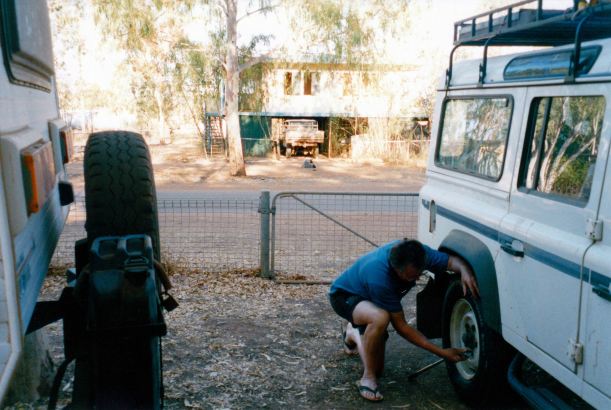
The new tyre John ordered from Mt Isa finally arrived and he got it fitted at the works depot, then at home put the wheel with new tyre onto Truck.

Resize of 08-31-2002 01 Doomadgee, new tyre from Mt Isa.jpg

John changing the wheel on Truck. The party house is behind him.

The party house was particularly noisy this week. Loud bouts of yelling and swearing late at night – from both women and men. The language and some of the suggestions about what they could do to each other were definitely not printable!

Resize of 08-15-2002 doomadgee sunset.jpg


Leave a comment

2002 Travels August 2 – September 13

Our time at Doomadgee

Friday 23 August – Thursday 29 August

We had Truck packed, and ready to leave straight after school. Set off to go camping at the Wollogorang coast, for the weekend.

Drove the 140kms to Wollogorang Roadhouse, over the road that was sometimes corrugated and rough, especially after Hells Gate.

When we reached the Roadhouse, they said that they did not allow travellers on the track to the coast after 4pm, (and it was now about 4.30pm) because it took 4 hours to do the 80km drive to the coast. We managed to persuade them to relent, after describing our circumstances.

Paid $50, on top of the camp fee of $12 a night. We would get the $50 back, when we returned the rubbish bag they gave us, containing our rubbish from the weekend. Good idea, that.

We received a mud map. of sorts. It had a lot of creek crossings, marked by straight lines across the track. Some distances were given: 28.5kms to turn off to the right; 16kms to Sandy Crossing (but there were a few of those!); 30kms to Well; 5.5kms to beach.

They were not wrong about the 4 hours! The sun went down and the moon rose above the trees. The track twisted about – and assorted station side tracks left it. We began to have very serious doubts about whether we were going the right way, as the moon moved around all points of the compass.

But just when we were considering stopping by the track for the night, and sorting it out in the morning, we came to the Beach House – an old tin station house – and knew we were ok.

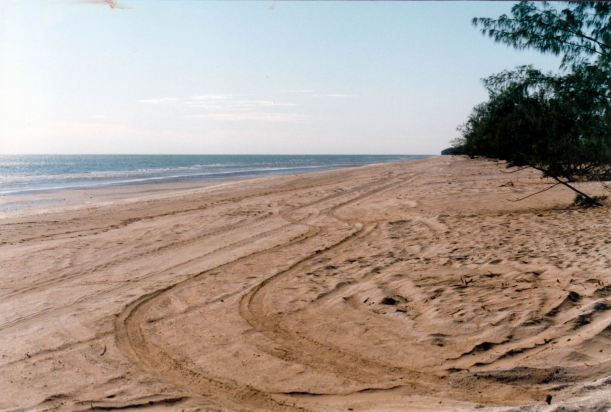
We came out onto the beach just beyond that, through a stand of she-oaks. By then, we just wanted to get camped, as it was after 9pm, so drove only a short distance to the west, along the sand, then went up into the trees and set up camp.

We put up the dome tent. The rustling of the breeze in the she-oaks was lovely.

By the time camp was established enough for the night, it was nearly 10pm. We had a quick, light tea, of biscuits, and went to bed. It was just wonderful to go to sleep to the sound of the sea and the trees – and no community noises!

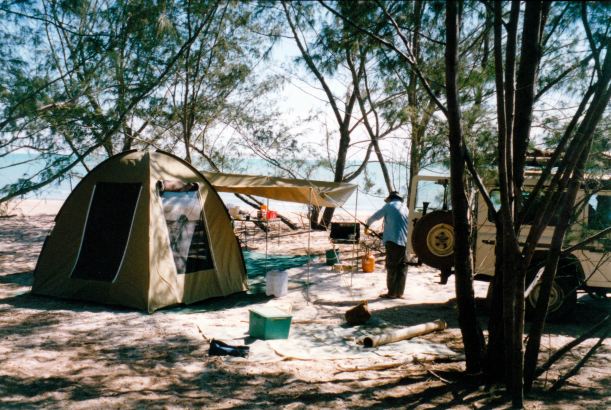
Resize of 08-24-2002 01our camp at Wollogorang beach.jpg

Our camp by the Gulf of Carpetaria, on Wollogorang Station

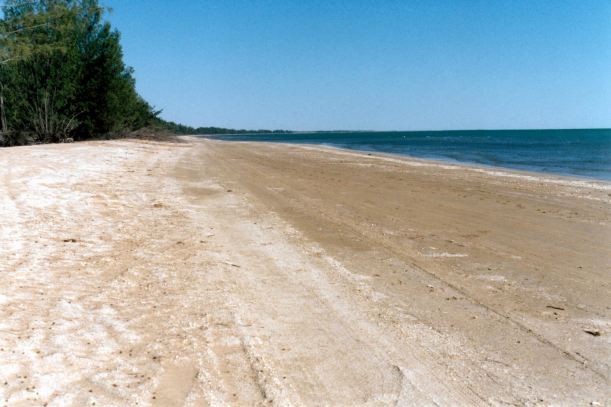
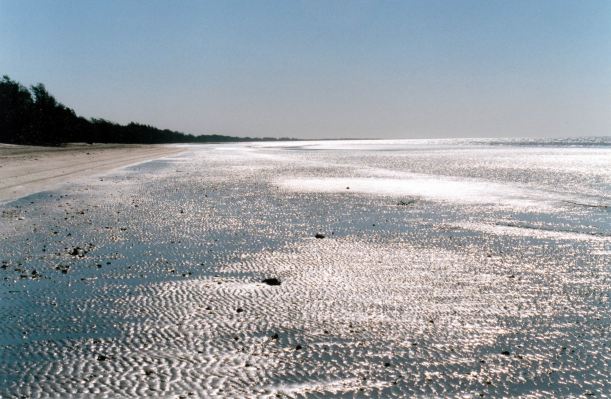
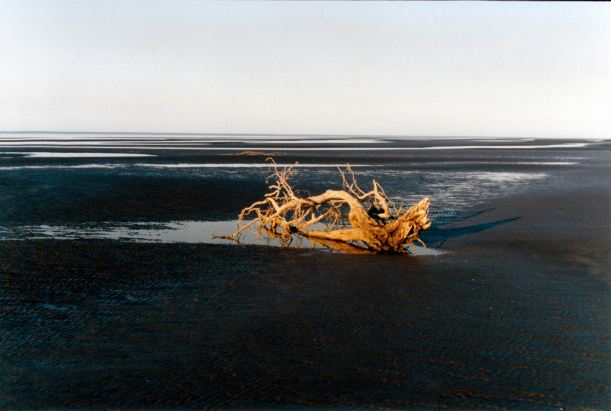
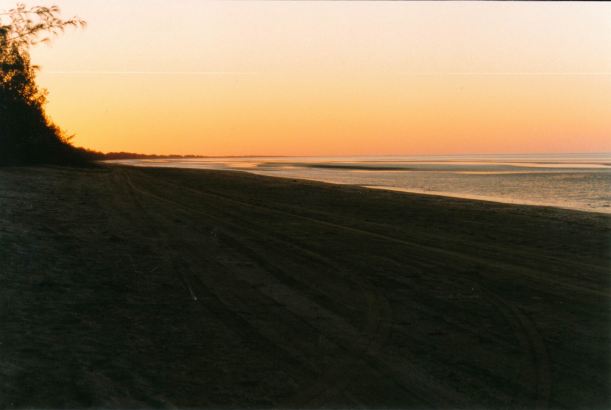
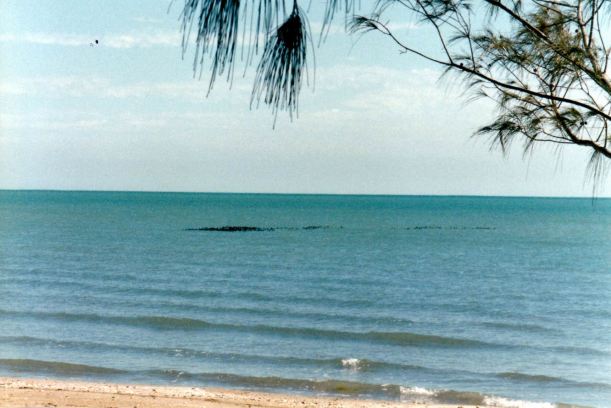
On Saturday morning, we could see where we were. Couldn’t have done better if we’d chosen the camp in broad daylight! The beach stretched each way. The section we were on was 20kms long. From the entrance to the beach, it was 12kms west to Tully Inlet, and 8kms east to Massacre Inlet.

Resize of 08-24-2002 03 Wollogorang beach view west.jpg

Outlook to the west, from our camp

Resize of 08-24-2002 02 Wollogorang beach view east

Outlook east from our camp – with our tyre tracks from the previous night

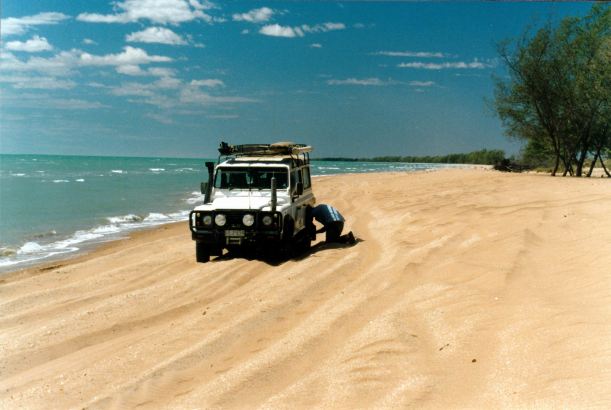
We knew that Tully Inlet was the place to try fishing – and we really wanted to catch some edible protein! So we drove along the beach in that direction, on fairly firm sand, even with the tide a fair way in. Did have to let down the tyres part way along.

Resize of 08-24-2002 05 dropping tyre pressure for sand. Wollogorang.jpg

Letting some air out of the tyres, on the beach drive to Tully Inlet

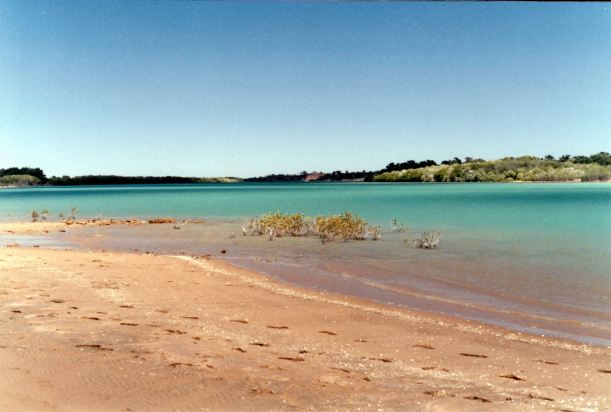
Tully Inlet was a broad opening, with bright aqua water and fringing mangroves, in places.

Resize of 08-24-2002 06 Tully Inlet, Wollogorang

Tully Inlet

We set up and fished. I caught a fair sized threadfin salmon – it would be lovely eating. John got some too.

Resize of 08-24-2002 07 threadfin salmon.jpg

Threadfin salmon – great eating

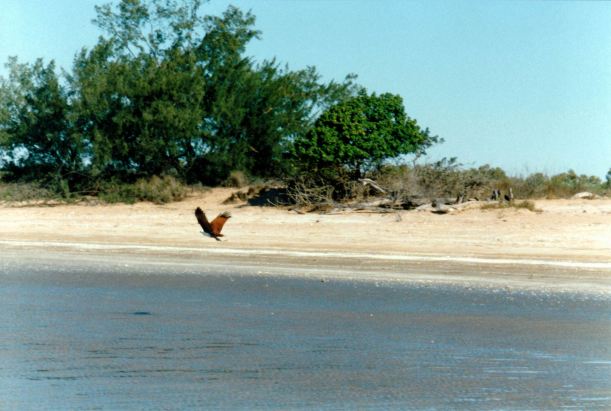
After cleaning – a Brahminy Kite and a white breasted sea eagle benefitted from the innards – the fish went into the Chescold fridge to take back to Doom. There were several meals worth.

Resize of 08-24-2002 08 osprey at Tully Inlet

Brahminy Kite coming in for some fish offal

Resize of 08-24-2002 15 Wollogorang beach, late afternoon.jpg

Late afternoon – tide out

Resize of 08-24-2002 14 Wollogorang beach scene

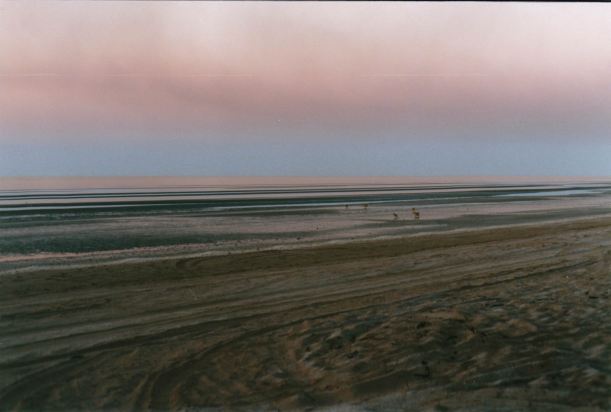
Late in the afternoon, back at camp, we saw kangaroos come down to the water – apparently to drink. I didn’t know they drank sea water.

Resize of 08-24-2002 19 Wollogorang dusk and roos.jpg

Kangaroos on the beach at dusk

The dusk and sunset were beautiful. The place was so relaxing. We had another peaceful, unbroken, full night of sleep.

Resize of 08-24-2002 20 Wollogorang beach sunset

On Sunday morning we did a little exploring after John topped up the fuel tank with the 25 litre container of diesel. We had a look around the old Beach House. It would have been a great place for the station people to come for a break from the heat further inland – but, of course, not accessible in the wet.

Resize of 08-24-2002 04 our Wollogorang camp from beach

Our camp from the beach

Resize of 08-25-2002 01 old beach house Wollogorang.jpg

The old Beach House

We followed a track to the east, towards Massacre Inlet, but it petered out.

Resize of 08-24-2002 sea at wollogorang

Standing room only out there!

We had to pack up and be on the track back, by late morning, in order to be back at Doom before dark. We really did not want to be driving after dark again!

The return trip along the track to the Roadhouse was much improved by being able to see the scenery that we’d missed in the dark, before. It was interesting.

Resize of 08-25-2002 04 crossing Settlement Ck Wollogorang.jpg

The Settlement Creek crossing on the Tully Inlet track

Resize of 08-25-2002 rough.jpg

Back at the Roadhouse, on Friday, we’d been told of a group that was going to try to follow the old, original Gulf Track, to the west, to the Calvert River. Basically this had been the route of Leichardt’s Expedition in the 1840’s. That track was not maintained, nor much marked. The current road to the west goes much further inland, where there are fewer nasty stream crossings and swamps.

We turned in our bag of rubbish – there wasn’t much – and got our $50 back.

We bought 10 litres of fuel at Hells Gate Roadhouse, and some more beer.

Resize of 08-25-2002 06 was boat and trailer.sign says bugger

Seen beside the Gulf Track – once was boat and trailer. Sign propped on it read “Bugger”.

Got back to Doomadgee in reasonable time. I was quite relieved to see that our van had survived our absence unscathed – that had been the only concern of the weekend.

I put a couple of packs of fish in the freezer of the fridge – had to spread out our protein treats over the next few weeks!

It had been a wonderful, too brief, weekend. Coming back to Doom was not easy. It would have been so good to be able to have stayed camped at the coast for a week or more.

The rest of the week was what passed now for routine, here. I filled in for S, with the secondary girls, one morning. I had the usual run-in with the not-so-charming F who was determined to do what she wanted – which was wandering around the classroom annoying the others.

John and I usually walked to and from school together. It was only a couple of blocks, through a fairly quiet area. One morning this week, John went earlier than me, to set something up. As he walked up the street, there were two teenage girls, fighting in the middle of the road. Their mothers were leaning over their fences, opposite each other, urging the protagonists on. As John drew near, they stopped fighting, and it was “Good mornin’ mister” from all, as he passed, whereupon they resumed the fight. There were the occasional funny moments in this place!

Two women from Mt Isa TAFE were visiting for a couple of days this week, to check out the VET courses. Like so many visitors, they would not stay overnight in the community, but drove in from Burketown each day, almost 100kms each way on the rather rough-ish road. And back in the afternoon. Such is the reputation of Doom.

They were not much help to me. I’d hoped for some clues on methods of delivery of the modules of work, especially the practical work, but they basically just indicated I should keep on with what I was doing. Which I’d only really just started doing! It didn’t seem to worry them that none of the course had been delivered in the first half of the year, or that it obviously wasn’t going to get finished in the time left for the year. All very casual. I wondered if anyone had even checked the VET work that my predecessor had supposedly been doing?

The school had, this week, to do the annual LAP tests, for Grades 1,3 and 5. John had been quite horrified, back when he was hunting furniture, to find last year’s results of same still packed away and not ever opened! So much for their possible use as a diagnostic tool. They showed that Doom had been the worst performing school in Qld, even amongst the other comparable aboriginal schools. No surprise there.

It was decided, when he talked with DP about this, that the students should be prepared for this year’s tests with a little practice first. Likewise the teachers, in the administration of the tests. The maths tests required some to use calculators – which were totally foreign to the students. But the school had a set of calculators locked away, so the grade in question was given some training in the use of calculators.

The tests were duly sat, with both John and I doing some supervision of same. John followed up to ensure that all the students who should have sat, did so when next they came to school. It was a thankless task.

Obviously, the preparation of students, and taking the tests seriously, had an effect. We heard, the following year, that the literacy results had jumped up from the abysmal results of 2001 – so much so that the DP got an award for services to literacy teaching!

I was established by now with the one-on-one literacy work that I’d been assigned to do with the one girl. She was nominally a Year 9 student, but her reading age was about what I would see as Prep level. But she was a nice lass, and co-operative about coming to our sessions – held in the staff room area where my desk was – with the door open, even if it risked interruption by marauding males! I had been given some flash cards with simple words on, and prepared more as I saw they were needed. Our short sessions every morning were divided between work with the flash cards, on word identification, and work on actually reading from simple readers. I really didn’t think that just 20 minutes a day was going to make a great deal of difference – she really needed to take readers home to practice with, but of course that does not happen here.


Leave a comment

2002 Travels August 2 – September 13

Our time at Doomadgee

Friday 16 August – Thursday 22 August

The 16th was Reporting Day. The students’ progress reports were given orally to those parents who could be bothered coming to the school to get them. Nothing went home in print here. The reporting process did not affect us, as we had not yet taught.

By the end of the week, I had the same bug that John had last weekend, and had Friday home in bed, anyway. Temperature, shivers. cough, headache, sore throat. With his prior example I did not bother trying to get medications from the Hospital, but used what was left of what he’d had.

We had been told that everyone who came new to town, got sick, and that we should, when better, arrange to get Hepatitis B shots. Very Third World…..

I was already making a list of things to buy in Mt Isa or Townsville, in the next school holidays. Panadol – lots of it. Chicken noodle soup packets – for some reason this was not stocked in the store. Lots of chicken, meat and fish – even if I had to buy dry ice to transport it back.

We spent a lot of time in the evenings, and over the weekend, trying to work out teaching programs. I decided to do the simple cooking things with the boys. The girls doing the VET course would do some cooking too, mixed in with their theory sessions, and to illustrate the basic points of those, like food handling hygiene! I would start the Mothercraft with pregnancy care, maybe with the signs of pregnancy. The store did not stock testing kits! I was sure, though, that these girls had friends who were not attending school, who were already mothers, so they would not be ignorant about it all.

On Sunday, we did some exploring around the area. I was feeling up to this by then, and willing to grab any chance to get out of the community.

John had gained permission from one of the elders to drive out to the site of the Old Doomadgee mission, on the Gulf coast, near Bayly Point. We knew that the local people went out there regularly, fishing and hunting for turtles, at the coast. It was about 100kms away.

We set out on the road from Doomadgee, to the north, but turned back before we got near the coast, because there were starting to be lots of side tracks and we had no idea of the right way to go. There were no signposts, of course – the locals know the tracks, and tourists are not permitted to travel the local roads. The road was surprisingly good, though – regularly graded, it was clear. The country was just the same old flat savannah scrubland.

Back in town, we drove out to look at the weir on the Nicholson River, and the ford. The river was really attractive here – although it would contain crocodiles.

Resize of 08-18-2002 02  Nicholson R Doomadgee.jpg

Nicholson River

This week saw us commence taking classes. My first cooking session with the secondary boys went better than I expected. It was unusual to be teaching with another teaching watching on, though. I presumed that the SM thought he was needed to keep the boys under control, but it may have been a cultural thing, to have the male presence. Then again, the SM may just not have wanted to give him free time!

I did not appreciate having to do the shopping for the classes. It was a real hassle, and hot, walking to the store and back, carrying the shopping. The office lady made me feel I was imposing on her, needing to do the Requisition Form.

I encountered some unexpected issues in my first lessons. I’d assumed the students would have a basic knowledge of measurement – hadn’t even really thought about it. Not so – no concept of fractions like half a measuring cup! So we had to do some learning, with measure cups and water, at the sinks.

Another concept was time. We had a morning session and I asked – if we wanted the food for big lunch, at 1.30pm – and it took 40 minutes to cook, what time did it need to go in the oven? 10 o’clock, missus? 8 o’clock, missus? All answers wildly out. These were kids aged 14+. What hope would they have in the normal, outside world? What on earth had teachers been doing with them for 8 or 9 years?

I sat in on the meeting led by the DP, with the teachers, to plan their main teaching unit, or theme, for the term – nearly three weeks into same! This is something I would have thought should have been done last term, in preparation, but who was I to know? S decided to do a newspaper theme with the secondary girls, and produce one at the end of term. With no newspapers available in the community, rather an abstract idea, to my way of thinking.

John and I talked about what came next, as we began to settle in. We decided we’d take the van out, in the September school holidays, and try to arrange storage for it and Truck – maybe at the Ringrose Transport yards, in Mt Isa. We would fly back to Doomadgee. Then, at the end of Term 4 – on 6th December – we would be able to fly to Mt Isa on the daily plane, collect the van, and head south for Xmas. If we did not get it out in September, early wet season rains could close the Nicholson River ford and we would not be able to get the rig out. We did not want it stuck in Doomadgee, with the risk of floods and cyclones either.

Resize of 08-18-2002 04  approach to Nicholson ford Doomadgee.jpg

Approach to the Nicholson River ford – flooded in the Wet Season

The Principal already seemed to be trying to get John to think about taking over as Principal when he finished his two year stint here, at the end of the year! He definitely wanted me to take over the SM’s job! But I thought we were too inexperienced in local ways, not to mention those of Qld Education, to do so.

The SM did seem to have one role he did well, and which I could not do – yelling at the older boys when they misbehaved. He seemed to be able to intimidate them into some form of obedience, just by bulk and loudness.

John liked the respectable wages we received here. He was talking already about perhaps returning in 2003 – or applying to work up on Cape York! I had my reservations about all this.

John had talked with the man who ran the Council workshop about how to get a tyre to replace the one we’d ruined on the drive up here. He phoned and ordered one from a tyre place in Mt Isa, to be brought up on the next Ringrose transport truck. The workshop man would help John fit it. This was going to be an expensive new tyre! Because the spare from the caravan was interchangeable with the Truck, we could use that as a spare, so we could still go places while waiting for the new one.

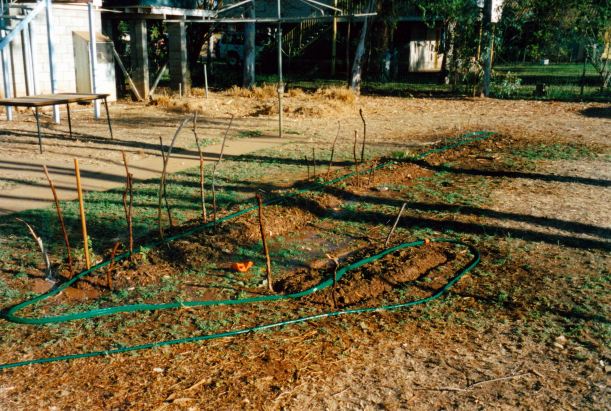
John started a vegetable garden in the back yard. He used the spade we carry, to dig some beds, and had brought some packets of seed with him from Adels Grove.

Resize of 08-31-2002 02 Johns Doomadgee veg patch.jpg

John’s new vegie patch

I was finding the interruptions to our sleep, every night, quite wearing. On top of the party house across the road, and the dog packs fighting amongst themselves and chasing the mob of horses around the streets, there was the noise associated with the emergency night time visits of the Flying Doctor, to evacuate someone to Mt Isa. The plane would come low overhead and depart the same way. There would be a number of cars escorting the unfortunate patient, screeching round the corner in front of our bedroom window, then returning after the plane left. We needed to get out of the place, just to get a couple of solid nights of sleep!


Leave a comment

2002 Travels August 2 – September 13

OUR TIME AT DOOMADGEE

Friday 9 August – Thursday 15 August

On Friday there were only about ten students at school! The weekend was the annual Mt Isa Rodeo, which meant that the Monday was a public holiday in these parts. Rodeos are major entertainment in the Qld country areas, so there was a mass exodus from the town.

We had thought about spending the long weekend camping at the coastal camp area run by Wollogorang Station, to the NW of here, against the NT border. The thought of being by the sea was an attractive one, and there were very limited places on the Gulf coast where one could access this.

However, on Friday John developed flu symptoms and he spent the whole weekend feeling thoroughly miserable. It seemed a nasty bug. It was most unlike John to be sick. Through the ensuing week he went to the hospital to try to get some medicine to alleviate his symptoms. The doctor prescribed Panadol, Vitamin C and a cough mix. The hospital pharmacy was out of Panadol and cough mix, so he was given an anti-histamine instead! Not quite the same.

On Sunday we drove to Hells Gate Roadhouse, on the Gulf Track, some 80kms to the NW. Apart from getting out of the community, the purpose of this expedition was to buy a couple of cartons of beer, having been told by some of the other teachers that having same for our private consumption, was alright.

The drive was a dusty one, through flat scrub and grassland country.

There is an escarpment of the edge of the range country, outcropping at Hells Gate. Back when the pastoralists were starting to occupy the lands to the west, with strong resistance from some of the native tribes, mounted police would escort droving parties as far as the escarpment, on the then rough track. After that, they were on their own, often facing hostile attacks. Hence the name.

Resize of 08-04-2002 hells gte airstrip

Hells Gate airstrip, beside the Gulf Track


At the Roadhouse, there were a couple of other vehicles, from Doomadgee, stocking up on beer.

Resize of 08-11-2002 05 bower at Hells Gate RH with flowers.jpg

Bower bird creation at Hells Gate Roadhouse

Apart from the Roadhouse and its attendant little camp ground and a kind-of small motel, there was an air strip. We noticed an advertising sign for the fairly new Kingfisher Camp tourist venture, to the south of there – another place we could go for a weekend away.

Resize of 08-11-2002 04 sign at Hells Gate RH

By the end of the second week at the school, it had been established that I would teach Home Eco to some of the secondary boys – so that was one of the late morning time slots. The SM figured that, since I had been cooking at Adels Grove, this could be my teaching role. I figured out that being trained to teach History, Geography and Politics had really not equipped me for this!

There would be a male teacher in the room with me when I had the boys’ class.

I would deliver the TAFE VET course in Kitchen Operations for three of those time slots a week. More on that later! I would take a Mothercraft course with the secondary girls’ class for one slot a week. I would do some one-on-one remedial reading work with one of the secondary girls for about 15 or 20 minutes every morning, under the direction of the literacy lady. For the rest of my time I would act as an assistant to the SM and Deputy Principal, though they were yet to agree to the exact time division between them.

It soon became obvious that I would also fill in – for the morning literacy and numeracy sessions until little lunch – for the secondary girls’ teacher, when she was away. I was quickly to discover that she was always away for one day a week, and sometimes two.

It was also soon obvious that assisting the DP meant chasing up the classroom teachers for documentation of their courses and associated paperwork that she had not to date been able to extract from them. They generally seemed to see her emphasis on planning and the like as a nuisance and were not inclined to do what she wanted! However, given the realities of trying to operate in these classrooms, I could sympathize with them not feeling like they had the time, or need, to do her paperwork. I was certainly pretty sure that what happened in the classrooms did not match the theory she had planned!

I was allocated desk space in a staff/storage area, of sorts, close to the secondary girls’ room. No-one else seemed to use it much, so it became rather lonely, working in there.

As well as the above duties, there was also the usual yard duty at the breaks, and before school – several sessions of this a week. These were not particularly comfortable times – the students were often very unruly on breaks and it was hard for me to know just what was acceptable, here.

The SM gave me a key to the Home Eco centre, which was to be my domain. This was kept locked when not in use. There was not much point to this, I soon found, as all sorts of other people must have had keys too. The woman who ran the intermittent breakfast program certainly did – although she was not supposed to use the kitchen for that, but had a separate little room nearby. But she obviously raided the gear – and food supplies – if she got a chance. She did not return anything thus “borrowed” – or wash it up! It fell to me to go hunting for my missing equipment, and clean it.

Other locals obviously had access too. I would find that groups had come in when I wasn’t there, or on weekends, and done things like make up lots of containers of cordial for special occasions – and they would have left the floor a sticky, dirty mess – for me to clean, since there was no other cleaner.

I investigated my new teaching domain. There was a large kitchen, with benches, stoves – only some of which worked, and sinks. The drawers and cupboards at the work stations had the gear one would expect – measures, implements, saucepans – but not one had a full set of what should have been there.

Resize of 08-30-2002 cooking class.jpg

The Home Eco room during the Visiting Chef program. Note the mesh over the windows

The two fridges had been turned off for some time, but left closed, so they smelled awful, and had gone mildewed on most surfaces. I attempted to clean these.

There was a laundry area off the kitchen, with a washing machine that worked.

There was a large, locked, pantry and storage area for foodstuffs and portable equipment. This also contained a number of portable sewing machines and associated gear. There was little in the way of stored food staples though.

I was to find out that my departed predecessor had preferred to try to teach sewing rather than cookery, and had the students making beanbags. I doubt any of these that got finished would have lasted long in the sort of homes they mostly lived in! There were a number of unfinished ones in a corner of the store.

Clearly, whatever might have once been in the storeroom in the way of equipment, had “walked”. There were no mixers of any sort. There was one electric frypan, but cords and lids for several more. When I mentioned the total absence of any form of sharp cutting knives, the SM said the school had spent a lot of money at the start of the year on a really good set of chefs knives. There was no sign of these, but he hinted that he may have been looking after them at home!

I soon had to solve the shortage of equipment by taking some of my own to use – knives, electric frypan, kitchen tongs. Anything of mine was carried back and forth from the house, as I needed it – and never left unattended in the kitchen. Even left in the supposedly secure store area at school, it would soon have walked. Several times I had to retrieve the one school frypan from the breakfast lady.

The first task in the Home Eco centre was to give it all a reasonably thorough clean, before it would be fit for use. I think I was probably still in shock at hearing that there was no cleaner. It was a bloody big area, too.

Food supplies for classes were something I would have to shop for, from the Store, complete with Requisition Slip obtained from the Office Secretary. Ho hum – back to bureaucracy. There was no budget, of course. The limitations of the community store would affect what I could do.

There were no curriculum documents either. I was on my own in terms of what got taught in Home Eco and Mothercraft, and found it rather daunting. There were just no records anywhere of previous programs – apart from a few I unearthed in the school library from back in the Mission days. These clearly showed how far the school education had regressed since then!

So, with nothing to guide me, I soon decided that the practical cooking sessions would just feature things the kids might be able to do themselves, at home – i.e. of some real practical value, in combination of what they might like to eat. Apple crumble, fried rice, bacon and eggs, came to immediate mind. The food had to be able to be made and cooked within 80 minutes, too – and with the very limited cooking resources in the kitchen.

By the entrance to the kitchen was a row of hooks with some aprons on – but these were not often worn. There was also the shelf of assorted school shoes, as dictated by OHS requirements.

I did find some course outlines and work booklets for the VET Kitchen Operations course, stuffed in the store cupboard at the back of the kitchen. In theory, some of the girls had been doing this course since the start of the year. In practice, my predecessor preferred to have them sewing! The SM was so well organized that he could not even provide me with a list of the students the school had paid for to do the course! And, of course, there were no results for the first semester. Wonderful! I should just have to start at the beginning, and see how far we got.

I spent some time during this week, trying to get some help/information. I walked to the local AbHealth Office to see some of the local ladies to try to get some idea about what they thought would be acceptable, culturally, in the Mothercraft class. I didn’t want to repeat the mistakes made by S, when she taught some very explicit sex education to the girls, without consulting anyone in the community. I did not get very far. The ladies were polite, but totally vague and non-committal. They probably found the idea that mothercraft needed to be taught, rather mystifying – or even that it was a “craft”. Many of the local children seemed to be bringing themselves up!

John was allocated a room for his literacy work – but with no furniture in it. No-one was much help to him. Eventually he found a store room with a few tables and chairs in, and got the students to help him move them in and set up the room. It was not ideal conditions for teaching, but what was, in this place?


Leave a comment

2002 Travels August 2 – September 13

OUR TIME AT DOOMADGEE

Friday 2 August – Thursday 8 August:

I have already described our initial arrival tasks and things we had to organize. We moved most of our possessions from the van to the house – mostly for their security.

We would be paying rental – a token amount – for the house, to the Education Department. This would be a deduction from our salaries.

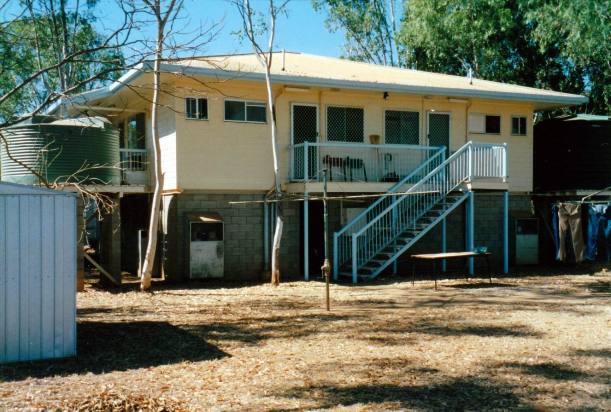
We decided that the house would “do” – it was big enough for us. The second bedroom took the things we wanted to store, from the van, plus the ironing board that came with the place, was set up in there.

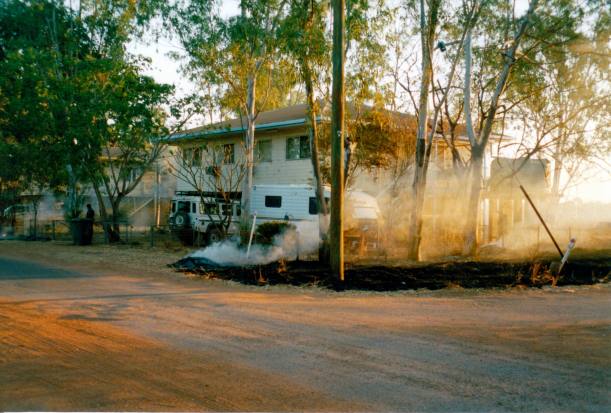
John decided that his main task for the weekend would be to burn the long grass around our fence line – before the locals decided to put a match to it, and maybe burn the van! It took him a good part of the two days, doing small sections at a time, and patrolling carefully with rake and hose.

Resize of 08-03-2002 03 6A and 6B Potter St Doomadgee.jpg

Making our perimeter safer

Made our initial foray to the store and was very unimpressed with what was (not) available. I did manage to get some soy milk, which was a bit of a surprise. Also bought Weetbix and some elderly potatoes and onions. No fruit available. We did have some food from the van freezer, but it was obvious that meals would become a challenge, without a decent meat source, and not being able to trust the frozen products. Rice and pasta would have to star! I also had some vegies and eggs that I’d bought from Adels.

I would get a better idea when able to get to the store within a couple of hours of the weekly truck arrival, of what fresh and perishable produce there might be.

A few weeks later, I was planning that I would bring back a supply of frozen meats, when we returned from the outside world, after the Term 3 school holidays. I thought I might be able to set up an arrangement with Woolworths and Ringrose Transport in Mt Isa to get my own private supply on the weekly truck.

We discovered the first afternoon that the sun sets behind the house – the late afternoon sun came through the kitchen window. Sunsets here were very pretty. Not much else was!

Resize of 08-09-2002 05 Doomadgee sunset.jpg

Sunset seen from the back verandah

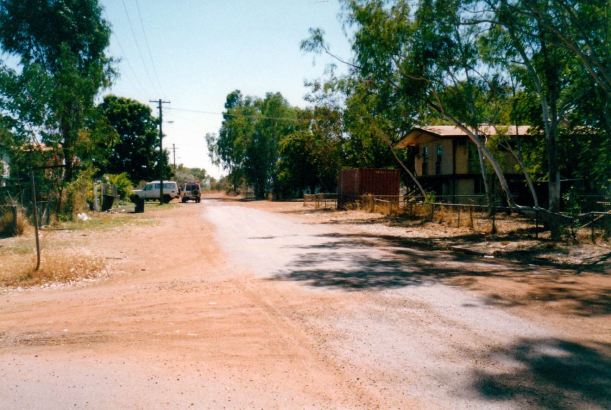
We went for a walk down our street, towards the main road. We did not feel all that secure about doing so, because of the packs of dogs that were around. I had a feeling that we would not be getting much walking exercise in this place!

Resize of 08-11-2002 back of house.jpg

The back of the house – gas bottles in locked cage

Monday was our first day at work. We both felt eager to discover what plans they had for us. The answer very soon became apparent – no one had really thought about it!

The SM took us to a securely locked storeroom – of which he was the key’s only custodian – and issued us with things like pens and writing paper. Despite how far it was into Term 3, he still did not have a timetable worked out for the secondary students – all three classes of same! There was only a handful of elective and TAFE programs to be allocated time slots. It certainly was not rocket science! He had been telling the teachers to figure out for themselves, what to do with the students!

John made it clear that he believed he was here to work on literacy programs. Through the week, he met up with the staff lady who dealt with the remedial work for students, and also the occasionally visiting psych lady. Neither seemed at all interested in working with him on remedial literacy programs. In fact, they gave off a definite aura of hostility.

Eventually it was sorted out that John would have – for some of the time – a small class of boys who needed remedial reading work. John said he would fill in elsewhere as needed – definitely not a wise move!

We just puttered about, through our first week, trying most of the time to work out what the hell was going on.

Thursday was Sports Day – like a house athletics competition. We helped out with the oversight of some events. I was already getting to know a few of the older girls’ names and was able to spend some time chatting informally with them during the sports.

One funny episode occurred during the sports, which were held on the school oval. A couple of boys, probably aged about 12 or 13, were walking back from the direction of the store, towards houses beyond the school, carrying a couple of bags of shopping. Seeing the sports happening, they just dropped the shopping, left it where it fell, and raced onto the oval to join in the sports.

John refuelled Truck at the Store, this week, paying $1.22 cpl.


2 Comments

2002 Travels August 2 – September 13

The school:

On paper, there was an enrolment of 360 students, in Years 1-10. There were 28 teachers, plus about 16 aboriginal teachers’ aides- only a few of whom turned up on any given day, and not in any predictable manner. These were all women. An aide would sit in a classroom – chosen by her – and watch proceedings, but did not actually do anything else. So they were more observers than any actual help to the teacher.

One of the several major problems for the school lay in the clan group/family warfare of the community. Certain groups of students would not attend school when other groups were there. Ditto the teachers’ aides. Classroom and playground dynamics remained a mystery to us.

The enrolment figures were derived from the start of the school year – in the Wet season – when Doomadgee was cut off from anywhere else. So, going to school was something to do. By August, there were about 60 students who attended fairly regularly. Others drifted in and out, from day to day, depending on what else was going on in the region, and their mood, and whether there was something like sport happening.

It was obviously very hard to run classes systematically, when no-one knew until 8.45am, whether there would be 0 or 50 kids in a class! Some primary classes had been formed from fairly regular attendees, and teaching here could be a bit more predictable and able to be planned. An example was a composite class of Years 2,3 and 4 of regular attendees. Other classes were designated for catching the day’s unpredictable arrivals. An example was a Year 2,3,4 class of irregulars – on any given day there could be no-one, or 50, in this group! So teaching bodies had to quite often be shuffled around at the start of each day.

For some of the irregular attendees, it might be their first day back at school for a week, or a month, or a term! They may decide to leave again, part way through the day, and not be seen again, maybe ever. Trying to deliver any meaningful or effective schooling to this group was well nigh impossible.

There was one secondary girls’ class, covering, nominally, Years 8-10. The 14 girls in this group attended most days. I use the term “nominally” because the achievement levels of these Year 8-10 girls ranged from about Year 3 to Year 7, as we would understand it. There was a smaller, equivalent boys’ class – usually about 7 of them. As well, there was a class of “feral” secondary age boys – fairly regular attendees but basically un-educable, due to their lack of any discipline or self control, and/or any accumulated learning to date. The school was obliged to do something with them. Two young male teachers were usually assigned to this group, together – to take them to practical, physical and outdoor activities, totally removed from the rest of the school. They were, essentially, uncontrollable and at times a danger to themselves and each other, not to mention the teachers!

The Principal – who had been responsible for persuading John to come up here – seemed to spend a lot of time away from the place. He was on various committees, union and working groups that met in places other than Doomadgee – Mt Isa, Cairns etc. We actually wondered if he was somewhat wary of being in the place, and possibly inadvertently doing something that would spark another riot.  He usually drove to wherever his meetings were, rather than utilizing the daily Mt Isa-Doomadgee-Cairns plane, so the time taken driving added to the time he was required to be away.

The Qld Education Department offered inducements for staff to go to schools like Doomadgee, Mornington Island, places on Cape York. For someone who took on the Principal role – and he was quite young for this – two years running Doomadgee would guarantee him Principalship of a better school. The majority of the teachers were in their first or second year of teaching, and for most of them, this was the only way they could get accepted into the Department. If they lasted two years, they became permanent. So, from their cohorts of recent graduates, they had not been chosen for other schools. So, the majority of the staff were enduring their two years. But there were some who were trying their hardest to make a difference.

The Deputy Principal was the lady who lived in the other half of our duplex. She was middle aged and an experienced teacher. We found her really genuine in her efforts to improve the quality of educational delivery in the place, if somewhat idealistic. I guess one had to have hope and idealism to survive in such a school. The teenage girls seemed to respect her, as much as they did anyone. Under her guidance, the focus of the school was on literacy and trying to improve same.

The Senior Master had spent time on Mornington Island, before coming here, so he was experienced in difficult indigenous schools. He was a loud and bulky man and these qualities seemed to have some disciplinary effect on some of the boys. He was responsible for the daily organization of the school. When we arrived, it was weeks into Term 3, and there was still no operating timetable!

There was a part time, experienced,  lady designated as the literacy/special education director. She seemed to see John as a threat, from the outset, and was not at all helpful.  Another experienced lady came in part-time from somewhere else, a few times, as the Psychology advisor.

A woman who had been teaching for a few years was the secondary girls’ teacher. She took them for all core work: literacy, numeracy, social studies and the like. In the time we were there, she never worked a full five days straight – always taking off either a Monday or Friday, each week. She was quite open about this; there seemed little the admin could do about it. She consorted with some of the locals and went off on three day camping weekends with them. The leading women in the community disliked her intensely – apparently she had offended local custom by giving the girls some rather frank sex education classes. But the girls obeyed her – albeit in a fairly surly way. I didn’t see much evidence of respect for her, though. I will refer to her as “S” – for secondary.

S had also clashed, earlier in the year, with the teenage daughter of one of the prominent community families. Daughter had gone off to board at Shalom College, in Townsville, at the start of the year – nominally at Year 10 level. However, Shalom posted her back home, sometime in Term 2. The girl was semi-feral and very disruptive – possibly because she was, under it all, quite intelligent. She and teacher had then clashed, on a school trip to Cairns, and the girl had brandished a pitchfork at the teacher. Student had had a period of exclusion from school but after that ended, refused to attend. S refused to have her back, so it was a stand-off. By my standards and expectations, she’d have been permanently expelled and not allowed back at all.

Unfortunately, when S was on one of her weekly days off, somehow the word would get round that I was taking the girls’ group, and the disruptive girl would show up. I wished she wouldn’t! She was insolent, totally full of herself because of her family’s prominence, and even after the Shalom experience, showed no indication of being motivated to improve her low standards, despite said intelligence. As far as I could tell, she came to school to make the point that she could – and to swan around making a pest of herself in class. Fortunately, the rest of the secondary girls were quite pleasant, and willing to try in class.

The experience of this girl was typical of what happened to those students who were sent away to other schools. They just didn’t last out there. There was too much of a gap, in learning terms, between where they should have been, and where they were. The same often applied to behaviour too, especially in a boarding school context. Very sad.

S’s teaching methodology was to get the girls to work on photocopied handout sheets – taken from various sources, not made up herself to suit the kids. From the piles of these in the classroom, it was clear she didn’t bother to check or correct the sheets they completed. There was very little actual instruction on how to do anything. I formed the impression that this sort of handout work was the main way of trying to keep the kids busy, in many of the classrooms.

The girls did enjoy the time, each morning, when S read to them from a novel. A book was quite a novelty.

When we started, there was a local lad on the teaching staff, who had qualified to teach in some sort of special program for aboriginals – he was a real success story. Doomadgee was his first teaching post, and he turned out to have made a mistake in coming home for it. Not long into our stay, he resigned – because the living conditions in his family’s home, and the lifestyle the family expected him to participate in, was not compatible with working standard days. Sleepless nights, inability to do any work at home, or keep any school materials safe there, contributed. It was very sad, but symptomatic of the barriers facing those who have more ability and drive than the average community member.

An American drama/music teacher who was there when we arrived, disappeared a few weeks later. He disgraced himself on a weekend visit to Escott Lodge, with some extremely drunken behaviour, and was banished.

One of the primary teachers was a bit older than the average – around thirty. She worked in a Grade 2-3 class – not the best of these groups – but seemed to be constantly gathering in students outside that range, that the other teachers found hard to work with. I couldn’t tell whether this was to try to help them survive, or to demonstrate her own superiority. The result was that her very large class contained some challenging behaviours. Later in August, she – supposedly – left for parts south, to see a sick sister. It was fairly obviously an excuse to get out of a situation in which she was not coping. We knew she would not return.

Through much of Semester 1, there had been a Home Economics teacher, but she had fled in Term 2, and not been replaced. Our house had been hers.

After a few weeks, I decided that, of the entire staff, there was only one I would definitely have in a school I was leading, with another two possibles. Forget the rest, in terms of being, or becoming, talented and enthusiastic teachers.

The school had a canteen, run by local mothers. School staff input was not welcomed here. It would not have met any canteen standards in a normal school, in regard to hygiene, food preparation, adherence to use-by dates. During the mornings when lunches were being prepared, toddlers in filthy nappies and with streaming noses, played on the floor or were sat on the benches to watch. A number of dogs wandered in and out. The canteen did not open regularly, but three times a week provided “free” (government funded) lunches for the students. These were usually white bread sandwiches, dim sims, and the like.

The brown kites – of which there were large numbers around the community, due to its volumes of rubbish lying about – were very well fed on free lunch days. Kids would take a bite or two from a sandwich, decide they didn’t like the filling, and chuck it away.

One local lady ran a breakfast club, of sorts, to give some children breakfast before school. It operated very intermittently and unpredictably, and only fed a few kids. I suspected there was some government funding for this, and that the few who were thus fed, came from her own extended family.

There was so much money being poured into the school and its associated programs – and so little return for same. So much waste. There was a room full of expensive musical instruments – many broken. A program would be proposed, be equipped and begin, then the teacher would be gone, and that was it.

There was funding for sporting excursions – which meant going to places like Cairns. At least, the kids enjoyed those and benefitted from glimpses of the world outside the NW Gulf country.

A (funded, again) visiting chef/cook came for two days while I was there, and ran a program with the better behaved secondary girls and boys. Supposedly, it was to show them what work in the food industry was like. However, she did most of the work, assigning the students to basic tasks they could manage, without them really knowing where what they were doing fitted into an overall plan. The students could not really relate to the processes that resulted in the array of food served to their parents and some community elders, for lunch on the second day. As I had already found, their kitchen skills were rudimentary, at best.

Resize of 08-30-2002 Doomadgee visiting chef and class.jpg

Visiting chef with course participants

There was a small house-like building, off to one side from the school, that was used for accommodation for outside advisors, and similar visitors to the community, who needed to stay overnight. There was no other guest or commercial accommodation in Doomadgee. Visitors rarely stayed in the community; some went to great lengths to avoid doing so! The preferred option was to stay in Burketown and drive the 90 kms or so, of rough road, each way, even doing so for days in a row.

Qld was introducing the Prep year of schooling in 2003, and there was talk in the school of housing the Preps in that building.

The Technology room, and the Home Economics room, each had an array of school shoes, of varying sizes. The students had to wear shoes in these classes, to adhere to safety standards – mostly they were barefoot the rest of the time. This ensured a degree of punctuality to these classes, as the later comers had to take what shoes were left, regardless of fit.

There was a room equipped with computers – enough for maybe 25 students at a time. This was able to be linked, via Skype, to the outside world. The best teacher – of the best attending kids – had her students doing a regular hook up with those from a southern school.

There did not seem to be any shortage of sports or PE gear. There was a hard surfaced playing area – quite sizeable – that was roofed, and with basketball rings. This area was used for school assemblies too, with the students sitting on the hard surface.

The school had a swimming pool – not in use while we were there, because it was the “cold” time of the year. It also had its own LWB Coaster bus.

In the admin area, there was a well-locked room that was the supplies store, where teaching requisites were kept. This was a school where students were issued with basic needed materials – to be kept in the classrooms at school and not taken home.

There could be no homework given – the majority of students did not have necessary requirements (like writing implements) at home, nor an environment conducive to same. Anything sent home would be lost, damaged. There could obviously be no such thing as a home reading program. Students at all levels wrote with lead pencils, kept in a container in the classroom. Sharpening these to a real point, and using them to stab others, was something we had to watch out for.

Some classrooms had old, tatty, carpet on the floor, complete with a quota of fleas, in some rooms.

All the school windows had heavy duty crimsafe type screens. The secondary girls’ classroom had all its windows heavily draped with blackout curtains. Once the girls were inside for the session, the door to the outside was locked and covered with its black curtain. This was because males from the community would otherwise be hanging about outside, and making pests of themselves, to the extent that some of the girls would not feel safe – teachers too!

There were a couple of occasions, in the uncurtained Home Eco room, where small packs of roving males did peer in the windows and make obscene comments; the door was very securely locked, though, and this room was in a more central part of the school, where they were less likely to venture – compared to the girls’ classroom which was at the edge of the building cluster.

Despite the security mesh or bars on the school windows, there was regular breaking of glass by stones thrown after hours or at weekends. The resulting broken glass lying around was of concern, given that many of the students went around barefoot.

Some 80% of the students had some degree of hearing loss, as is the norm in such communities. All the classrooms were equipped with the Sound Field system, where the teachers wore a box that amplified their voice in a way that allowed all students to hear more clearly what was being said. This in itself was a considerable capital investment.

The childrens’ hearing loss was mostly the result of untreated ear infections when younger. Or poorly treated ones – the chances of a child in the community actually completing a course of prescribed antibiotics were very low. To help counteract the issue of ear and sinus infections, first thing every morning, each primary class was taken outside, by their teacher, complete with large box of tissues, and bin. The students sat for ten minutes, blowing their noses, supervised by the teacher. For some reason, nose blowing was not the norm for younger community children – they just ran, dripped, or got blocked! This was a less than charming way to start the day!

Too many of the students were malnourished and hungry. Scabies was endemic, we were told. As were head lice. We were told by the Senior Master that he put undiluted hair conditioner liberally on his hair, each morning, and did not rinse it off, and this seemed to keep nits at bay. It did nothing for his looks, though. Within days of our arrival, I phoned K and P and asked them to buy and mail up the most effective head lice treatment they could find. There was nothing like this available in the store.

Kids came to school tired, because they roamed the streets freely until all hours, or were on the fringes of loud, all-night gatherings of adults. Even those families who tried to run what we would see as “proper” households, were grossly overcrowded, with 10-20 people per house, and disturbed by the noise from neighbours.

Things that we take for granted in our lives were not present here. Like having a clock, or watch. The school siren was set to be able to be heard over most of the community, as a signal that it is time to come to school. So it was sounded a couple of times after 8am each morning.

A lot of the students were fascinated by the watches that the teachers wore. In that same vein, being allowed to write for a short time with a biro was a great reward.

Children often did not know how old they were, nor when their birthday was. Some of the teachers, who had such data for some, made birthday cakes – often the only indication the child had that it was their birthday.

We take print around us for granted. Not so, here. The school had a library, but these were the only books in the community. There were no newspapers or magazines sold in the store, nor written information around the place. In a culture that is oral based, teachers had to try to change childrens’ mindsets to even think of print as a source of information or entertainment. Though maybe the coming age of computers would kind of jump that step?

School started at 9am and ended at 2.45pm. After roll call and nose blowing, the whole school completed a two hour literacy session. This was the key focus of the school. Then there was a 30 minute “little lunch” break. Then followed 40 minutes of numeracy across the entire school. I felt there should perhaps be less of an imbalance in the times devoted to each of these. After this, the secondary students went into 80 minutes of TAFE programs, three days a week. The TAFE programs on offer were wood/technology related, hospitality or (for a selected very few) computing. The other two days, in this time slot, they did art, woodwork, home economics, mothercraft, computing and the like. “Big lunch” – 30 minutes – went from 1.30pm until 2pm. Numbers of the students did not reappear after this, so the 45 minute afternoon session was for odds and ends – like PE and sport – which had some chance of making them reappear.

Leave a comment

2002 Travels August 2 to September 13

FRIDAY AUGUST 2 TO FRIDAY 13 SEPTEMBER    DOOMADGEE

I have gone into considerable detail in my following descriptions of life here – simply because it was so different and so outside the experiences and comprehension of the majority of Australians. I think it needed to be told “how it is”. I wish I had more photos to illustrate the text, but this was not a place where one felt free to wander and photograph.

The community:

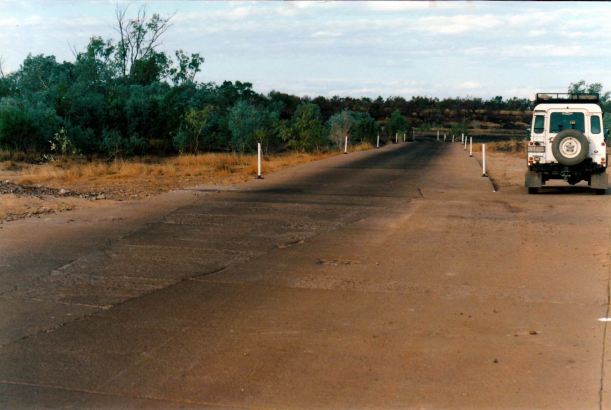
Doomadgee is located by the north flowing Nicholson River, which at that point is wide, crocodile infested, and not particularly attractive. The community is on the west bank of the river. In the wet season, the cement ford across the river to parts east, usually gets covered by water too deep to traverse. All other roads out of Doomadgee are dirt and become impassable in the wet, so Doomadgee gets cut off by road from the outside world.

Resize of 08-18-2002 01 Nicholson R weir at Doomadgee.jpg

The weir across the Nicholson River, just upstream from the road causeway crossing

The surrounding country is flat and the typical savannah mix of shrubs, low straggly trees, and grasses. In August it was dry and dusty.

The community had a population of about 1600. The handful of white people who lived there were teachers, hospital staff, police, workers who kept things like the electricity plant, sewerage system and water supply, going; and council administrators. From what we saw, it was fair to say that, without white people running things, they would grind to a halt.

The place began as a mission settlement – at Old Doomadgee, on the coast to the north – in the early 1930’s. Due to regular cyclones, and problems getting fresh water, the mission was soon moved to the present inland location. Under the direction of the missionaries, the place was quite functional, although the Christian Brethren operated by a fairly strict set of rules. There was a cattle station, a piggery, vegetable growing that supplied the surrounding area. There was a school and sound education for the children, and health care. The mission supplied permanent and temporary stock workers to surrounding station, droving crews, and female domestic staff to the surrounding district.

In the late 1960’s, after some years of agitation by the labour movement, and by urban liberals, it was decreed that aboriginal stockmen and pastoral workers should be paid the same wages as their white counterparts. Many of the northern station owners then decided, that if they had to pay the same wages, white workers were preferable. They were more reliable, not disappearing for ceremonial or family business. The station owners were not prepared to go on supporting the often large family groups associated with the pastoral workers – who lived on the stations, on “their” country – and who had been supplied with food staples and clothing, as part of the workers’ “wages”.

The aboriginal groups thus displaced were forced to move to nearby towns, or to missions. The stockmen who had derived purpose and self esteem from their work, lost this. The family groups became dependent on welfare – mission and government based.

This was an example of a concept, driven by urban white idealists, that seemed fair and just, in theory – but which was not based on the realities of the situation. Aboriginal policy is littered with these! It could be argued that much greater disadvantage came from the equal pay decision, than benefit.

In this way, the population of Doomadgee came to consist of five different “families” or skin groups or clans – who had no natural kinship with each other and who, moreover, had long standing hatreds and feuds between them. These persist to this day, but were kept under some degree of control in the mission days.

In the early 1980’s, control of missions was handed back to “local control” – another idea that seemed right to the distant idealists, but which has proven to have created mammoth problems in the resulting aboriginal communities.

At this time there were some 800 people in Doomadgee. In 1983, control passed to the locals, under a Deed Of Grant in Trust (DOGIT) over a defined area. The last missionary departed in 1988.

So, we found a hugely dysfunctional community, crippled by feuding, totally welfare dependent, with a rapidly growing population as babies were born to teenage mothers, and with major drug, alcohol and gambling problems.

When we were there, the police numbered nine – a large number for a population of about 1600, but necessary. There was a police compound – securely fenced – that contained the police station and some police housing.

There was a small hospital that seemed to be reasonably well equipped. There were two doctors – one was an elderly man, rumoured to have alcohol issues; the other was African, newly in Australia, who was extremely difficult to understand, and who seemed to have limited capacity to comprehend English, let alone the aboriginal version of same! There were a number of nurses – white. The hospital also served the function that a  chemist shop would in a normal town. One could not buy anything pharmaceutical at the store – not even Panadol, or cough mixture (contains alcohol!). You had to visit the hospital and see a staff member to obtain anything like that.

We were soon to find that the Flying Doctor plane was a regular arrival at Doomadgee – sometimes multiple times a day, and at least twice a week at night. Our house was at the end of the airstrip, and the arriving and departing plane flew very low, and loudly, over us!

Resize of 08-28-2002 plane leaving as seen from back veranda doom.jpg

Plane departing airstrip – seen from our back verandah

The story was that the medical staff were too intimidated to treat even routine medical issues, but evacuated virtually every case to Mt Isa. This was because, earlier in the year, a toddler had died on the steps of the hospital, as her carers were taking her in for treatment. Because there must be “blame” assigned for such things, this was regarded as the fault of the hospital. So then there had to be a riot, to show their displeasure and extract payback. The fact that it was the Wet season and there was little else to do, may have had something to do with it all. Anyway, riot they did – spectacularly. The whites in the community had to take refuge in the police compound and planes were sent to fly them all out to Mt Isa. Eventually, after much damage about the place, for which the government funded repairs and replacements, things settled down again. But that was why matters medical were sent to Mt Isa, and why we found so much current fear amongst the white population, of doing something that would spark off another massive riot. Probably in the next Wet season!

There was one community store, which was also the fuel outlet. The store was basically a large, shed-like building, cavernous and echoing. In a small side section, opening into the main store, was a butcher’s shop, of sorts. This sold basic cuts of meat, although the cuts were pretty rough, and smallgoods. One paid the butcher in his shop – the meat did not get tallied through the store check out. Unfortunately his establishment smelt very strongly of rotten meat. The meat displayed was often green looking. The butcher himself did not look very clean. He shut the shop before school finishing time, each afternoon, so he could go out and about in the community in his ancient Mr Whippy van, selling soft serve ice creams to the kids. There was no way I was going to buy his meat, having smelled the place, but I had to go in there sometimes, to buy a packet of vacuum sealed bacon, shipped in from the outside world – smallgoods of any sort were not available out in the main store. So it became a matter of rush in, when there was no one else there, and try holding my breath while the transaction was completed!

The indigines were not totally reliant on this butcher, at least in the Dry season. Numbers of them went camping and fishing at the coast – at Old Doomadgee – getting fish and turtle. Some would spend time at Lawn Hill National Park, fishing, and there were other waterholes on creeks closer to Doomadgee, for day trips to fish. From what we heard, at least one of the locals was in the habit of killing cattle out in the bush, and selling the meat.

Fortunately, we were warned, right at the outset of our time there, by one of the other teachers, who worked in the store on Saturday mornings, not to buy any frozen goods from the store. They had been having regular problems with the freezers breaking down. Each of the large cabinet freezers had a thermometer on it. She said that the staff did not bother to read these and usually did not pick up a malfunctioning freezer until the contents had thawed. Then, they simply moved the goods to another one and re-froze them. She said it was quite possible that a chicken or packet of vegetables had been defrosted and refrozen four or five times! This knowledge reduced our food choices in Doomadgee yet further!

The community store was supplied from wholesalers through Mt Isa and, as at Adels, the supply truck came once a week. We soon got to know when that was and would try to get to the store quickly, after school on that day, in order to get the “fresh” fruit and vegies we wanted – the supplies never lasted long. These were horrendously expensive and very varied in quality. Prices were not displayed on much, and so purchasing was a mystery until reaching the checkout. On my first shop, I bought a rockmelon – no price displayed, of course. It was $8!

The store had most basics, though there were a lot of gaps. There would usually only be one brand of anything available, like tinned tomatoes. It also sold limited clothing, and thongs. Batteries and knives of any sort were in a locked cabinet. There were no pharmaceutical items, nor items like turps or methylated spirits (because these could be drunk in place of alcohol). They did seem to have huge quantities of cigarettes and tobacco available – probably the most comprehensive range of anything in the store!

Some local ladies were attempting to run the store. The checkout staff were locals. Working here met their CDEP (work for the dole) requirements. There had been a new, white, manageress appointed at the start of the year – she’d had experience running a community store in a community way down south. We got to know her husband, who was a teacher at the school. It seems she had tried to manage the place along more commercially efficient lines than had the previous manager. One of her innovations had been to instal some monitoring cameras at the checkouts. She then commenced to sack operators who were putting goods through without actually charging for them – apparently a common practice; as was stealing money from the register, and/or giving money to relatives as they came through. All fairly widespread practices, she found. Then the family of one sacked girl got upset, rounded up their friends and they all rioted – again, a common happening in this community. They torched her 4WD vehicle (a “normal” way of expressing displeasure with someone) and attacked the store – especially the cash registers – with machetes, also threatening her with same. This had happened several months previous but she was still down south, on medical/stress leave.

Obviously, the women who were trying to run the show had glaring gaps in their expertise. Apart from the freezer issues, ordering was obviously haphazard. They could be out of basics for a week or three.

The old practices in the store were clearly back! My first time in the store, my trolley contained only a few items – the rockmelon, a box of soy milk, a small tin of milk powder, some teabags, some potatoes and onions. The woman in front of me had a trolley piled really high. She asked the register girl for three cartons of cigarettes, too. The tally for her goods was $50. Mine came to $45. I noticed that the cartons of cigarettes were not registered at all, and only every fifth item or so – the cheaper ones – got tallied. I found it hard to believe my eyes – there was no attempt to conceal what was going on. This was before we had talked to our colleague about what had become of his wife – then much became clear.

The local ladies would not work on Saturdays, because the CDEP terms did not require it. The store was only open for groceries and fuel on Saturday mornings because some of the teachers staffed the registers! On weekdays, the store shut somewhere between 4 and 5pm – it was random – so having the teachers volunteer in the store was the only way people like teachers and other 9-5 workers in the place, could shop and get fuel.

We discovered very quickly that shopping in the store could be quite unpleasant because the hygiene of some of the locals was not great. Queuing at the checkout behind a person who had recently been eating turtle was definitely to be avoided!

Resize of 08-09-2002 02 living room.jpg

The sum total of our living room furniture

Another aspect that struck us on the first store visit was the total lack of any printed material. No newspapers, magazines, books. No advertising material. No labels on things. Very few signs on anything. Reading was clearly foreign to most of the community.

At some stage, there had been a little caravan park, up by the main road, but this had fallen into disrepair. This was a pity, because – at least in the dry season – this could have been a good enterprise, employing locals. Not that we saw much indication that most locals were interested in being employed!

We were soon to discover that the school was unable to find people willing to be employed as cleaners. The teachers had to do whatever cleaning there was done! So the school was far from pristine. I think the hospital had similar issues. It was much easier to claim welfare than actually systematically work at something. Some were on the CDEP program, working some hours at the store, doing a few hours as teacher’s aide at the school, or cleaning up around the township and other assorted labouring work, for the hours required each week. It seemed to us that the CDEP program in Doomadgee was pretty token. The majority of the people did nothing for their welfare money, except – in the case of the teenage girls, breed! This gave them more money.

No one in the community seemed interested in capitalizing on the increasing tourist numbers going past in the dry season. Apart from the lack of any tourist accommodation, of any sort, there was a generally hostile air when tourists did deviate from the main road into the community, to get some fuel, visit the store, or just drive through for a look. They didn’t linger!

When the protracted Native Title negotiations were going on over the establishment of the zinc mine, one of the conditions imposed at the behest of the indigenous leaders was that the company had to train and employ a significant number of local indigenes.  They were trying to do their bit, but had found it impossible to fill their quota with locals who wanted to work. This was yet another gap between theory of what seemed right, and the reality of how it is up here.

One of the main community leaders was a person of very mixed ancestry, only a very small proportion of it actually aboriginal. His reputation in the district was of a thug, and corrupt. He was often in trouble with the law over things like illegal firearms, illegal meat slaughtering and supply – of stolen cattle, assault and the like. After we left Adels, he organized a sit-in at the mine, over some manufactured grievance. It lasted for a couple of weeks and coincided with when he was supposed to appear in court over his latest charges. Of course, he did not attend! The sit-in occupied the mine’s kitchen and canteen area – of course! This ensured comforts for the sitters-in. The mine workers were fed at Adels Grove, for the duration.

Doomadgee was, technically, a “dry” community – no alcohol sold or permitted. But we were told, upon arrival, that a blind eye was turned to having beer. Spirits and fortified wine were out.

There was a steady stream of locals driving either to the east, to the Burketown hotel, or west, to the licensed Hells Gate Roadhouse, to purchase their supplies. Both places were about 90kms from Doomadgee. Under local pressure on the council grader drivers, the road was usually fairly well graded as far as Hells Gate – but deteriorated markedly beyond that. I presumed that in the Wet season, there would be enforced drying out – which might account for some of the aggression abounding at that time.

There was a local “party house” over the road from our place. This seemed to always contain a fairly large number of people. There was not enough housing in Doomadgee for the size of the population. There was usually a campfire going in the front yard of this house, and people sleeping around the yard on old mattresses. It seemed quite anomalous in the morning, to see a carton of long life milk and a box of Weetbix, sitting next to the campfire. They cooked their meat on the campfire, so the smell of charred meat often drifted across the road and filled our house.

It was certainly a noisy establishment, where there was no shortage of alcohol, most nights, although Thursday (welfare payment day) through to Sundays were the worst for noise. After that, we assumed, the money, and beer, were running short. There was much very loud arguing, abuse and name calling, foul language, and regular fights. We were told that someone had been murdered there, with a star picket, a couple of weeks before we arrived. Everyone knew who did it, but no-one was telling the police, it seemed. One of the little kids told John the name of the guy… “xxxx, he did it, Mister”.

Thursday and Friday are pension/CDEP “paydays” – hence the following few days are the roughest in the community. It could be almost quiet by Wednesdays. We became a bit accustomed to the general rowdiness of the place. Apart from the noise of arguments and fights, there were often vehicles hooning about, especially on drinking nights. The roaming packs of dogs fought a lot. There was also a mob of horses that roamed the streets – extra noisy when these were chased around by the dogs. Another party house, a few doors up, often had really loud music going all hours. We could hear it clearly; the couple of young teachers who had the house next door really suffered.

Resize of 08-11-2002 03 Potter St Doomadgee view nth.jpg

Looking north along our street – at night the realm of dogs and horses

We did feel really sorry for the police who worked in this place. Theirs was a thankless and unrewarding life, it seemed, constantly trying to keep the peace and protect the people from themselves.

In the scrub, a distance beyond our place, were the remains of the old piggery. We soon found out that this was a not a direction we should go walking in – it was where the local youth, and some older ones – went to smoke gunja and sniff petrol. Both substances were much abused in the community.

Resize of 08-04-2002 03 from back verandah towards old piggery.jpg

From our back verandah, looking towards the old piggery, in the distance

We made an effort, at the outset of our time here, to go walking, for exercise. But we never felt really safe, doing this, because of the packs of dogs that often seemed like they were looking for an opportunity to attack. We always carried our walking poles, for that reason. During our time there, the pet dog of one of the teachers was badly injured by some local dogs that jumped the fence into its yard and savaged it.

We walked to and from school – only a couple of blocks. We usually did this together. I did not ever feel secure enough to go walking on my own. We knew that a young female teacher had been raped here, last year – and that this was not the first instance of a white female being attacked in the community. So, soon, the only walking we did was going back and forth to school. We felt that the Truck was actually safer from vandalism, parked at the house, rather than at the school!

Resize of 08-03-2002 02 van at Doomadgee house.jpg

The Truck and van parked at the front of our house


Leave a comment

2002 Travels August 3

FRIDAY 2 AUGUST   ADELS GROVE TO DOOMADGEE   125kms

Packing up was finalized – John had done some, after work, yesterday.

Truck was hitched up to the van for the first time in almost two months.

Our goodbyes were said – again.

We took the track north, back across Louie Creek, but at the intersection with the road to Gregory Downs, kept going north, to Lawn Hill Station. Negotiated our way around that and continued on, crossing Lawn Hill Creek not far north of the homestead.

Resize of 08-02-2002 05 fording Lawn Hill Ck.jpg

Crossing Lawn Hill Creek

From there, it was follow the main station track, roughly north, opening and closing several gates encountered.

Resize of 08-02-2002 06 gate on Lawn Hill Station

We passed what we called “Cow Corner” – a place on Lawn Hill Station where several fences intersected, and where there were water troughs, where there always seemed to be a congregation of cows.

Resize of 08-02-2002 07 cow corner Lawn Hill Station.jpg

“Cow Corner” on Lawn Hill Station

Resize of 08-02-2002 08 Lawn Hills cows

The distinctive hump backed cattle of northern Australia

The track crossed a couple of dry gullies that would be running creeks after rain. Near one of these, a large bustard stood by the side of the track and just watched us pass. I hoped it was a good omen.

Resize of 08-02-2002 09 plains wanderer bustard.jpg

Plains Wanderer

Just north of the fence and gate that was the boundary between Lawn Hill and Bowthorn Stations, there were some elderly truck remains. Just as we reached this, realized that a back tyre on Truck was fast going flat. It was an old, bald tyre, so that was not too surprising.

Resize of 08-02-2002 10 old truck Lawn Hill Station

This old-timer had seen better days

Changing the wheel was pretty routine. At least there was no passing traffic to worry about.

Resize of 08-02-2002 11 flat tyre border Lawn Hill and Bowthorn.jpg

Wheel change

At a T intersection, we took the track to the right. The left one was the “back” track to Bowthorn Homestead and Kingfisher Camp, a camping area the station had set up on the banks of the Nicholson River. That took us through to the Top Road – the dry season dirt road that runs east-west, from the end of the sealed road at Normanton, through Burketown, Doomadgee, into the NT, to the next piece of sealed road at Borroloola, some 720kms.

From that intersection, we were soon at the ford over the Nicholson River. This was long, cemented, and with a couple of bends that meant one could not see if another vehicle was approaching, on the narrow section. To our left as we crossed, not far from the ford, was a weir across the river that created a long, large waterhole, and helped ensure that the ford was dry, at this time of year.

The Doomadgee community township was on the far side of the river. It was laid out in a sort of grid, stretching back from the Top Road – which meant that travellers only needed to go into the community if they required fuel or supplies from the community store. There used to be a sort of roadhouse and campground at the Top Road, but that was run down and unused in our time there.
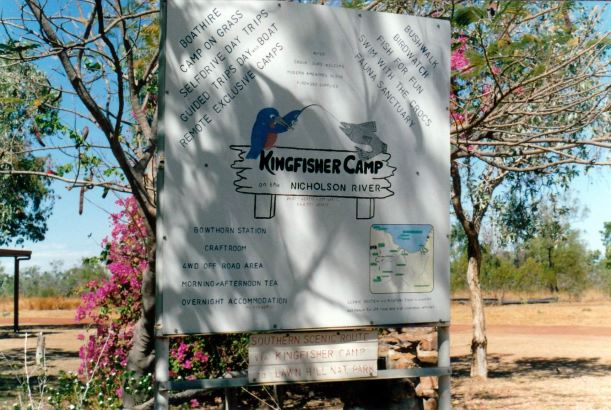
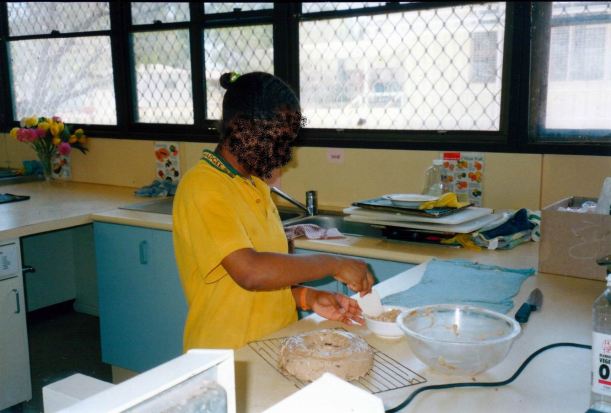
It was the school lunchtime when we reached Doomadgee.

I waited in Truck, parked outside the school, while John – who had been the one doing all the contacting and negotiating with the place – went in to say we had arrived, and get keys and directions for our house.

I think it was fair to say that, on first impressions, there was no part of Doomadgee that was attractive, and I remained unimpressed with the venture.

We made our way to 6A Potter Street – half of a high set duplex, on a street corner. There were a number of school houses in a row, here, and the Principal’s house was further up the street. Unfortunately, as we were to discover, the government houses were mixed in with those of the locals.

At first sight, the house looked alright, although I was not impressed with the trails and spatters of dried blood that went up the front steps. This was apparently the result of a recent fight between a couple of locals, and was an indicator that they felt free to intrude on the place, despite fences and gates.

I was never to feel secure in the house, or to go out without half expecting a break-in while we were away.

The other half of the duplex was occupied by the Deputy Principal, who lived there alone, although her son, who worked on Bowthorn, sometimes came to stay a night. I thought she was quite brave, living there alone, and wondered if she was relieved to have someone else in occupancy next door. Our place had been lived in, though, until the end of Term 2, a few weeks ago; then that staff member departed and didn’t come back – a fairly common occurrence here, we were to find.

We were only at the school ourselves, as it turned out, for six weeks, and in that time, three more teachers departed abruptly, and we were the fourth and fifth!

One of the duties of S, the Senior Master, was to oversee the staff housing, and associated matters. So it had fallen to him to ensure our place was in order. He had put in a not unusual, incompetent effort. The house had clearly been emptied of any furniture that others wanted – probably led by S himself. But there was a new bed and mattress, which S had managed to get delivered from Mt Isa. It had only just arrived. We had to assemble it – lucky John carries a range of tools.

The house had two bedrooms, both with built in wardrobes. There was a living/dining room, an adjacent kitchen, and a bathroom. The non-fixed furniture, apart from the new bed, consisted of a fridge – rather miraculously in working order, two rather grubby armchairs, a small dining table with two chairs, a small bookshelf, a telephone table – with phone, a coffee table, and an ironing board. There was a built in cupboard in the living room, and a fair sized pantry cupboard in the kitchen, which had a gas stove – also in working order. The bathroom consisted of a shower recess and basin; there was a separate toilet. There were ceiling fans in most rooms and three split system air-cons, fairly elderly and racketty ones. There were venetian blinds on the windows and security screening over all the accessible windows and doors.

Resize of 08-09-2002 03 kitchen.jpg

The kitchen was functional

The place was clean enough – not sure who had seen to that. It seemed to have been painted and refitted fairly recently.

Resize of 08-09-2002 04 into bedroom.jpg

There was plenty of security screening

Behind the kitchen was a narrow veranda, shared with next door, from which there was another set of steps down. Under the house was a car parking and storage space, and a laundry area, shared between both houses – washing machine and trough. There were two outside clothes lines, and lines strung under the house as well. The area was clearly not used for vehicle parking!

We decided quite quickly to park the van in the yard – it would be too tempting and vulnerable to the attentions of the locals, if left outside the fenced area. It took a lot of careful manoeuvring, and pushing and pulling by us, to get it into the corner, close to the front of the house, where we could keep a bit of a watch on it.

We then had to go, before the store closed, to purchase a power card. This plugged into the meter and then we would have power – until the charged amount ran out, when we would have to buy another card. We guessed this system, which we had never encountered before, avoided issues associated with unpaid power bills! It made sense, in a place like this.

Then we discovered that the two large gas bottles for our house were empty. Not only empty, but disconnected – suggesting yet something else that had been appropriated following the departure of the previous occupant. At least, someone had found two empties for us to get filled. They were in a locked cage, but S would have a key to this, and others might, too. Back to the store!

After I had scrubbed the blood off the front steps, we made trips up and down, moving things we might need into the house, and things we just didn’t want to leave in the van.

We had some foodstuffs in the van – basic staples and some frozen meat, but I decided that tomorrow morning would have to see a visit to the community store, to see what was available, especially in the fruit and vegetable line.

This day had been an exhausting one. Despite noise coming from what seemed to be a fair sized and rowdy crowd at the house across the road, partly drowned out by the rattles from the air conditioner in our bedroom, we did get some sleep.

Resize of 08-02-2002 to doom.JPG