This Adventurous Age

Adventures travelling and working around Australia.


Leave a comment

1998 Travels August 22

SATURDAY 22 AUGUST   CHILI BEACH TO HANN RIVER ROADHOUSE   416kms

We decided this morning to move on. The incessant wind blowing here is uncomfortable and keeps one on edge. It really prevents much in the way of proper relaxation, and the events of last night haven’t helped us feel secure, camped here. We made an efficient pack up.

It took us four hours to get back to the main road, as we detoured to look at the rainforest, the Pascoe crossing on the Frenchmans Track, and the remains of a WW2 bridge in the National Park.
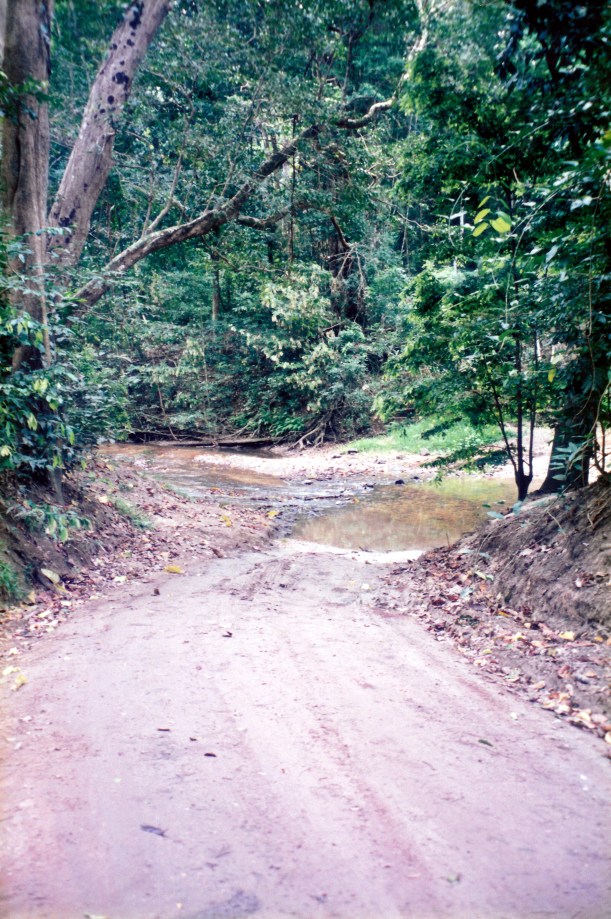
08-22-1998 02 trk Iron Range NP.jpg

Road through the Iron Range National Park

08-22-1998 01 rainforest Iron Range NP.jpg

The rainforest of the Iron Range National Park

08-22-1998 03 ww2 bridge.jpg

Remnants of WW2 road bridge in Iron Range National Park

At one point in our explorations, John dropped me off where I wanted to take photos, then continued on to find a place to turn around. Then a carload of aboriginals came along, and stopped. I explained to them that there was no problem and  I DID have transport. I was very pleased that John and Truck hove into view, at that point!

The Frenchmans Track Pascoe crossing looked quite daunting and was certainly not one we would have attempted.

Thus we got back to the corrugated and “dippy” main road. There are so many “DIP” signs along the way and passing travellers with imagination, time to stop, and black paint, have amused themselves by adding to the signs, in very creative ways. DIPsomaniac. DIPerdimenico. Big DIPper. DIPstick. DIPlomatic, and so on. I am not sure whether the one we photographed was poor spelling, or ultra-creativity….

08-22-1998-05-peninsula-devt-rd

Was it intentional?

We ate lunch parked on the sandy bed of the Archer River. Could see where it floods in the Wet – there would be no getting through then. A couple of cement culverts take the Dry season flow under the road, but they would be a long way under water in a really wet spell.
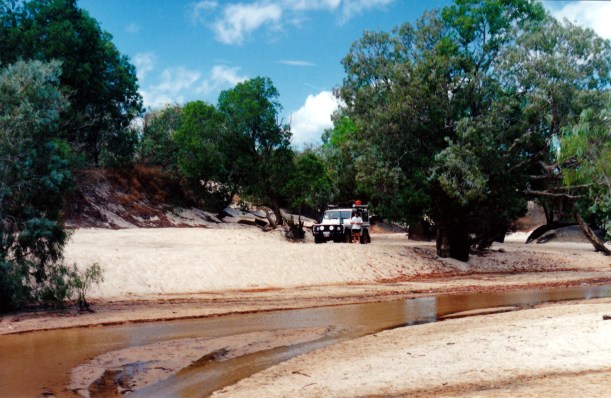
08-22-1998 07 lunch at Archer River.jpg

Lunch stop at the Archer River

08-22-1998 09 Archer River.jpg

Archer River – dry season mode. The trees leaning downstream are an indication of the force of wet season flows

08-22-1998 08 archer r crossing.jpg

Peninsula Development Road crossing of the Archer River

Stopped at Musgrave Roadhouse for fuel – 86cpl. (We’d topped up from a jerry can whilst at Chili Beach.) Treated ourselves to a can of Coke each at the roadhouse, and bought some port – it is a long time since we’ve had any of that! At Musgrave, was where we came in from Lakefield National Park, so the road south from here is new ground.

By the time we reached Hann River Roadhouse, we’d had enough for the day, so set up in their campground, at a cost of $10 for a powered site – very reasonable.

There was a large grassed, and fenced, area, quite a bit of shade and the shower area was immaculate. I really enjoyed that shower! The trees and regular watering ensured there was plenty of bird life around. John got up close and personal with a kookaburra that came to inspect his setting up work, though it was probably hoping we had food lying around. This is a very pleasant place for a short stay.
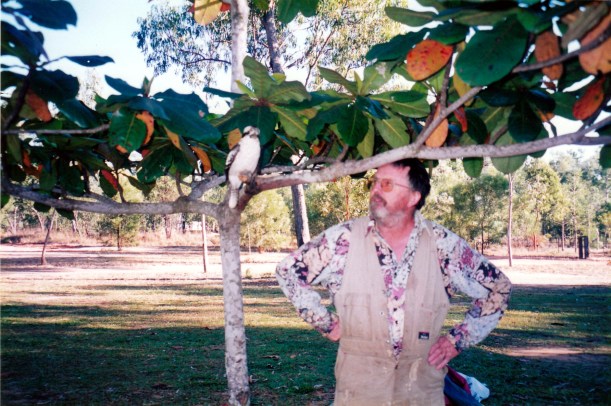
08-22-1998 10 hann r rhouse.jpg

John and friend at Hann River Roadhouse camp ground

Tea was fettucine with bottled pesto.

As this is our last night on the Cape proper, we reflected and commented to each other on the aboriginal issues here. We have certainly found a great deal of anti-aboriginal feeling amongst the whites who live up here, who have a strong belief that the aboriginal agenda is to get rid of all whites from the Cape. The whites feel discriminated against, in that some laws they must obey are not enforced for aborigines. There is a belief that policy and laws are made “down south” by idealists who have no idea or first hand experience of the realities up here. The remaining pastoralists are resentful over the buy back/hand back of leases, the demands for more National Parks, and what they see as neglect of those that exist, in relation to things like feral animal control.

The aborigines seem happy to take the tourist dollar wherever they can, but have a very poor concept of service, or value in return. A hearsay story doing the rounds is that a recent meeting proposed an access charge to the Cape of $1200 a person! Presumably, wiser heads will prevail over that one.

It seems that governments are beginning to “audit” local council accounts in aboriginal communities up here – due to the extent of rorts that can no longer be ignored, and the fact that over $10million is currently owed by locals to their councils. That represents a lot of money per head.  From what we have seen on the Cape, any half-way reasonable auditing should produce some pretty shocking results.

It has also become evident to us that the nation is pretty porous in the borders up this way. Locals talk of the easy movement between the Top and PNG, by small boat. The threat of insect – and people – borne disease from the north, seems real, especially those carried by mosquitoes.

It has been an interesting experience, unique, and rather depressing in some ways. I do not think we will come this way again though.
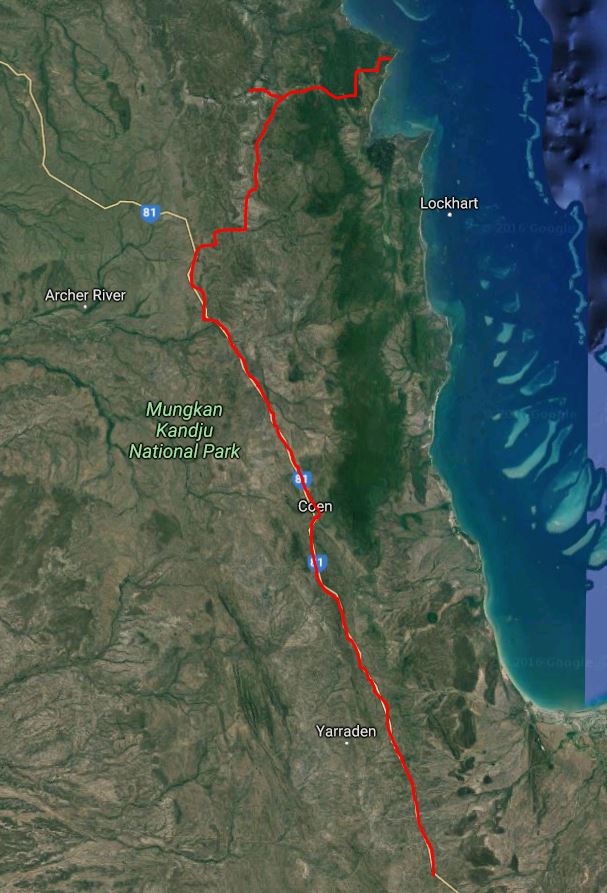
08-22-1998 chili bch to hann r.JPG

From Chili Beach to Hann River Roadhouse


Leave a comment

1998 Travels July 13

MONDAY 13 JULY   HANN CROSSING TO COEN   210kms

Today was quite hot.

We did a calm pack up and left Hann Crossing at about 10am. At the main Lakefield Track, we turned right. The track was reasonable – some corrugated sections.

Not far from camp, we crossed the actual Hann River – Hann Crossing where we were is a bit of a misnomer. There were a series of stream channels to cross – mostly dry, but dips that had to be taken slowly. The Morehead River had a little water in it.

We drove over the Nifold Plain, which we think must be black soil country – grass, few trees, lots of termite mounds, flat. It was actually quite surreal and rather monotone.

07-13-1998 01 Nifold Plains vista.jpg

Lots and lots of termite mounds

07-13-1998 02 nifold plain.jpg

The main road north through Lakefield National Park

The track swung to the west and then south west, as we drew nearer to the coast of Princess Charlotte Bay.

We took a side track to the south that led to the Low Lake and explored some tracks around its edges. It is a lovely, large, swamp, probably the prettiest we have seen, to date.

07-13-1998-03-low-lake-lilies

Low Lake was quite extensive

07-13-1998-04-low-lake

Beautiful Low Lake – but dangerous critters probably lurk in there!

Back on the main track ,we stopped briefly at Saltwater Creek crossing, where there were sizeable waterholes each side of the crossing. John saw fish jumping there and wanted to try his luck. He lost his silver wobbler lure on a snag on his first cast! I saw a croc, floating, downstream from the crossing. We did not stay long!

A few kms from Saltwater Creek, after a long, sandy, dusty stretch of road, a squealing noise suddenly started coming from the front of Truck. Our initial reaction was that it was a tyre going flat. We stopped – the tyres were ok. John experimented with going forwards and then backwards a few times, and decided it might be a stone in the brakes, because the noise only happened going forward. After a few more reverses, it stopped altogether.

At the western edge of the Lakefield National Park, we passed Lotus Bird Lodge. Had this place offered camping, we’d have stayed there, because with the number of swamps and little lakes around it, the bird watching would have been great.

The Lakefield track rejoined the main Peninsula Development Road at Musgrave Roadhouse, where we had a break. The roadhouse building was a telegraph station on the Overland Telegraph Line, and was built in the 1880’s.

07-13-1998 05 musgrave roadhouse.jpg

Refuelling Truck at the historic Musgrave Roadhouse

Bought diesel – 86cpl. Treated ourselves to a cold can of beer each – cost $3.10 each! We went to the creek at Musgrave and ate our lunch – enjoyed the beers no end. I cooled my feet in the little creek rapids.

07-29-1998-micky-washing-her-feet-dulhunty

07-13-1998-hann-crossing-to-musgrave

Our route from Hann River Crossing through to Musgrave Roadhouse

Pushed on towards Coen.

The road began to have some really deep (like 20 foot) dips, into creek crossings, often with a big bump in the bottom. They went down and up again quite steeply, and the creek at the bottom was often only a trickle. Some were dry, or just a puddle – which meant you could not see what was in there! They were – mostly – signposted “DIP”. Around the first one we encountered there was a lot of scattered ex-vehicle rubbish, like battery brackets, and assorted pieces of metal. This debris was less at the second big dip and reduced considerably after that, though there had obviously been some really slow learners using this road!

In one dip there was a 4WD with a camper trailer – he had jack knifed the trailer around into the side of the vehicle and done some damage. It was fairly easy to see that he had hit the bottom way too fast. The man did not give any indication that he wanted us to stop, as we edged by – so we didn’t.

There were some dusty and rough patches. Saw a broken battery by one of these.

There were a couple of areas of low ranges and Coen has hills around it.

Mostly, we could do 70-90kmh and hence avoid the worst of the corrugation impacts, whilst being constantly alert for a lurking, non-signposted dip.

07-13-1998-musgrave-to-coen

From Musgrave Roadhouse, north up the Cape to Coen

Coen is a small, dusty, mostly aboriginal settlement. There are a few basic businesses: hotel, guest house, store, servo – and a welder with clients queued up!

The Coen campground was behind the store and Post Office. We got a powered site in the small and rather grotty establishment – for $11 a night. John needed to charge some batteries on power and we were looking forward to a proper shower.

There were a few more permanent guests in the campground – government workers. Later in the day we got chatting to one – a contracted DPI fruit inspector, who was really interesting. He had been in the police and military police and been all over. He said the local aborigines regard Coen as theirs and whites must watch where they go and what they do. We told him how we’d been inspected for fruit at the Laura River. He said that it was all rather a futile effort because some of the aboriginal communities and camps won’t let the inspectors near their fruit trees – like out at Port Stewart – so the fruit fly gets a real hold anyway.

We set up the small tent and John set about charging his torch battery.

The campground was not too full. It smelled – of drains, and swampy. The amenities were not real flash; there were two rooms in the Ladies, with a shower, toilet and basin in each. The Men’s was an Atco portable donga room. John reported it as rather wet and messy. We soon realized that the toilets were used by the local aborigines who walk freely through the campground. There are no public toilets in Coen, apparently.

We bought some frozen mince at the store, and half a dozen cans of beer at the hotel.

After driving for much of the day, we needed some exercise, so went for a walk and a look around the township – as one does. Walked along the main street to the end of the shops and houses, to where we could see down into the dry Coen River bed. Started to walk down to look more closely at the river – then saw that there were huge heaps of wine casks under the trees. Modern day middens? Some locals sitting under a tree gave us nasty looks, then a group walking down the bank came close and started muttering amongst themselves. We felt threatened and retreated back to the campground. I wasn’t game to try to take a photo of the wine cask midden.

Next to the campground is a big council type machinery depot. As we sat by our tent in the late afternoon, watched the aboriginal workers bring back grader, tractor, front end loader. We also noted, after dark, that the lights had been left on, on some of the vehicles!

The fruit inspector man told us that the local aboriginals were given the contract to maintain the roads around here, and funding bought nice new machinery for this. Obviously, the white companies that used to do the work upped sticks and left, so there is no one now to train the locals or to properly maintain the plant. Thus, there is a downward spiral of deterioration. The road upkeep has suffered as a result. We were to see, further north, much evidence of this.

It was good to shower and feel clean again! Even though the shower water did not drain away and the tide rose! I just hoped that the inches of water I was standing in were from my shower only. Yuk! There is a major drainage problem somewhere around here – hence the smell.

Tea was hamburgers made from the mince I bought, on the last of the pita breads.