
MONDAY 28 FEBRUARY QUEENSTOWN
This morning seemed to herald a more promising weather day.
After breakfast, and making some lunch, we went to the National Parks headquarters again, and got the key for the Mt McCall Track. Washed the underneath of Truck at a servo.
We took the Mt Jukes Road, south, out of town. This paralleled the brown coloured Queen River for a while, to where it ended at its junction with the King. Then the road trended south east, roughly, until we eventually came to the southern part of Lake Burbury, which we followed south.
We saw a spotted quoll walking across the road near Mt Jukes – have never seen one of these in the wild, before. A quoll is a carnivorous marsupial. This one looked a bit like a large, spotted cat, but with a different shaped face.
It was still quite misty, out to Lake Burbury; we had assumed this would lift as the day went on – and it did.
The track continued, generally south, until, about 37kms from Queenstown, we came to the junction with the Kelly Basin/Bird River Road. Our Mt Mc Call track trended to the south east again.
We soon came to the locked gate and locked it again behind us.

Key is needed to go any further
The road had been really good until the Kelly Basin Road, then it quickly became rougher and steeper. In places, the track was quite rocky and there were some steep hill climbs and descents, but it was all quite manageable.

Somewhat steep and rough!
I used my Franklin topo map and the GPS to try to keep track of where we were on the track. I was mindful of the warning in the rough track notes we had, that, at the end, the track stops abruptly and without warning, at a 300 metre log haulage way drop down to the Franklin River below!

Sections of the track felt like the top of the world!
The drive was extremely scenic and different, especially as the mist lifted. We saw some most incredible vistas from the track.

White quartz outcropped along parts of the track
Near the end of the track, some 22kms from the gate, it went very steeply uphill, then very abruptly down. I chose to walk this last section, as really steep downhills give me the heebies. At the end was a fair sized clearing in which to turn around – despite what we had been told, there was certainly room for more than one vehicle.
We parked in the turnaround, ate lunch, watched birds. We inspected the haulway remnants, where logs harvested from the surrounding forests were “dropped” down into the Franklin River and would eventually be floated down this to the Gordon and thence to Macquarie Harbour.

Old logging haulway – logs dropped 300m down this to the Franklin River below
At one stage, we thought we could hear voices from below, faintly – maybe rafters on the Franklin?
It certainly was wild and lovely country and we felt privileged to have been able to do this drive – and so happy that we’d made the effort.

View to Mt Owen from the Mt McCall Track
The drive back out was even more breath taking as we could see vistas that had been invisible in the morning mist. Much of the way was through quartz capped hills and ranges, like Frenchmans Cap, which was as the crow flies, not that far away. There were vistas into deep, thickly forested valleys.
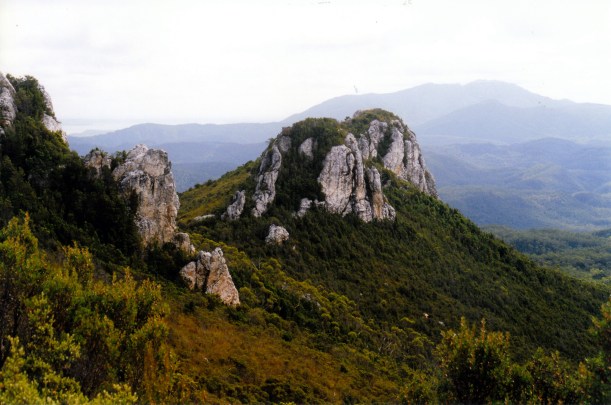
Really rugged country
In places, we could see the track winding away over the top of the ridges.

The Mt McCall Track winding away over the ridges
We stopped at the Lake Burbury lookouts to see the views over this and to the back end of Frenchmans Cap in the distance.

Looking over Lake Burbury towards Frenchmans Cap
On the way out of town, this morning, we had passed a big Huon pine sawmill. There were great heaps of the timber stacked about. John was amazed at the quantity. We called in on the way back – it was Bradshaws Mill. Although it was 4.30pm, the owner and his son allowed us in to browse around. John was really taken with the pallets of offcuts they sell – he thought they were great value. They had some great slabs and carving pieces too. They have recently amalgamated with the mill at Strahan, we were told.
Huon pine is a really unique timber because its natural oils make it repellent to insects, and it does not rot away. It is also very slow growing and can grow to many hundreds of years old. Thus, the rings in the timber are really close together. The early colonists realized that Huon pine was a perfect timber for boat building, and the logging of it became an industry, supposedly the reason that the Macquarie Harbour penal settlement was established. It is no longer legal to cut down Huon pine trees, but when areas were going to be drowned by hydro dams, the Huon pines there were cut and preserved for the future. Now, three companies have the right to retrieve and mill this Huon pine, Bradshaws being one of them.
When Huon pine is first milled, it is quite pale in colour, but ages to a golden caramel colour. I love the smell of it – quite distinctive. There can be beautiful speckly patterns in the timber – called birds eye – and this is the most valued form for woodworkers.
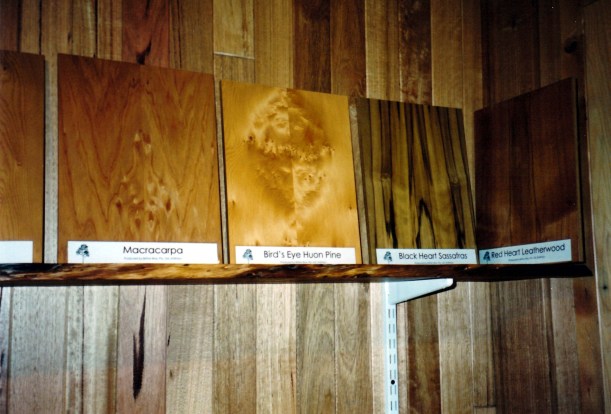
Birds Eye Huon Pine
We did not stay too long, given the time, but John indicated to them that we would be back.
We returned the gate key to National Parks, and filled our large water container from the standpipe near the Parks Office, there for this purpose. The locals drink it so I guessed we could too. Presumably it is piped from somewhere up in the mountains that is distant from the pollution of the area closer to town.
We were too late to pick up the paper.
Tea was pasta with bacon and mushroom creamy sauce.
This had been yet another truly memorable day in Tasmania. We drove 138kms.
 This Adventurous Age