
TUESDAY MAY 9 (1) BOORT TO WARRACKNABEAL 170kms.
We managed to get up at 8.15 on this very cold morning.
Left the park just before 10am, without rushing the pack up unduly. The stay here in Boort had been enjoyable. It was a place we might return to, another time, just to relax by the lake.
It had turned into a lovely day for driving: sunny, but not too hot.
Refuelled in Boort, to be on the safe side. $1.274cpl.
I had planned to take us via Wycheproof and maybe stop at that lovely bakery café there, for an early lunch. Then, we would be able to stop at the painted silo at Brim, and look at that, on our way to tonight’s destination.
However, John decided to follow the GPS directions, rather than mine, after entering Warracknabeal as the destination. Predictably, it directed us via Charlton and Donald. I had not wanted to go that way, thinking we would probably be doing the Warracknabeal to Donald leg in a few days’ time. Oh, well, it might look a bit different, going the other way.
My secret consolation for being ignored was that John missed out on an indulgent lunch!
The road between Boort and Charlton was much more interesting than the way I’d wanted to go. There were huge olive plantations, starting not far out of Boort. The land looked to have quite a good red soil. There were some irrigation channels. I saw one sign at an olive acreage, reading Boundary Bend Olive Company. Later, I checked this out. Their web site claimed their Boort operation is one of the largest olive plantations in the world, with nearly a million trees planted.
Until then, I had not realized that Boort had become so significant in the Australian olive production scene.
Further on, there were vineyards too: Lake Marmal vineyards. I had never come across wines of this brand, so maybe they grow grapes for other winemakers.
There were eucalypts growing along the road side. Occasionally, there would be one with a really bright, smooth, orange trunk and branches. These appeared to be a mallee type, often with more than one trunk, and it looked like the orange colour appeared after older bark peeled off. Most attractive looking.
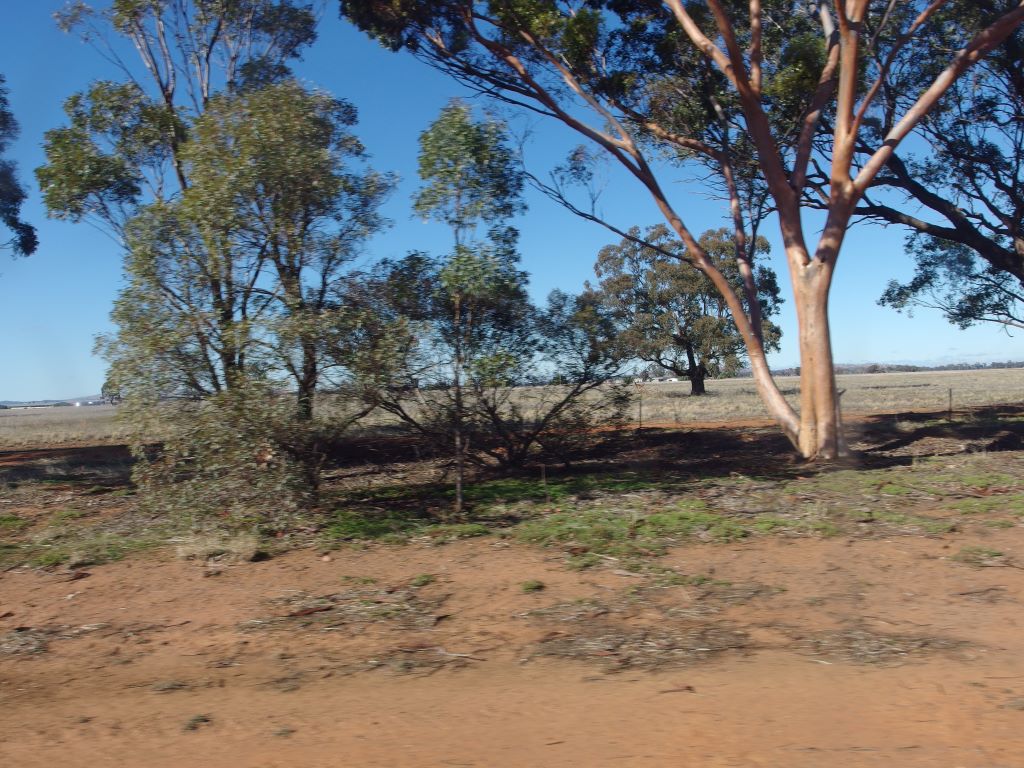
Unusual orange-trunked mallee eucalypt trees
Clearly, this part of Victoria has a Mediterranean type of climate.
We had, of course, been to Charlton before and stayed a night here on a previous trip. There were the ubiquitous blue plastic covered heaps of grain here too, but these were different – they had bird netting over them. Charlton has a really big silo complex, too.
Last time here, we’d been impressed with the efforts this little town was making, to revitalize itself. This time, it seemed even more go-ahead and vibrant. We saw no evidence of the floods that had affected the area last year.
Took the Borung Highway, towards Donald. Although, “highway” was misleading, given its condition. About 14kms from Charlton, passed the Wooroonook Lakes rest and camping area – another place I’d never heard of. From what we could see of the lake, it looked smaller than the Boort one we’d been camped by, but pleasant enough. There were some camping rigs set up there, and some camp power poles, so there were obviously some powered sites.
There are so many lakes scattered through the Wimmera region – something else I hadn’t known.
Some of the land down this way looked to be affected by the dryland salting that has become a significant problem in some agricultural areas. There was a saltbush plantation in one area. It is still very much sheep and wheat country.
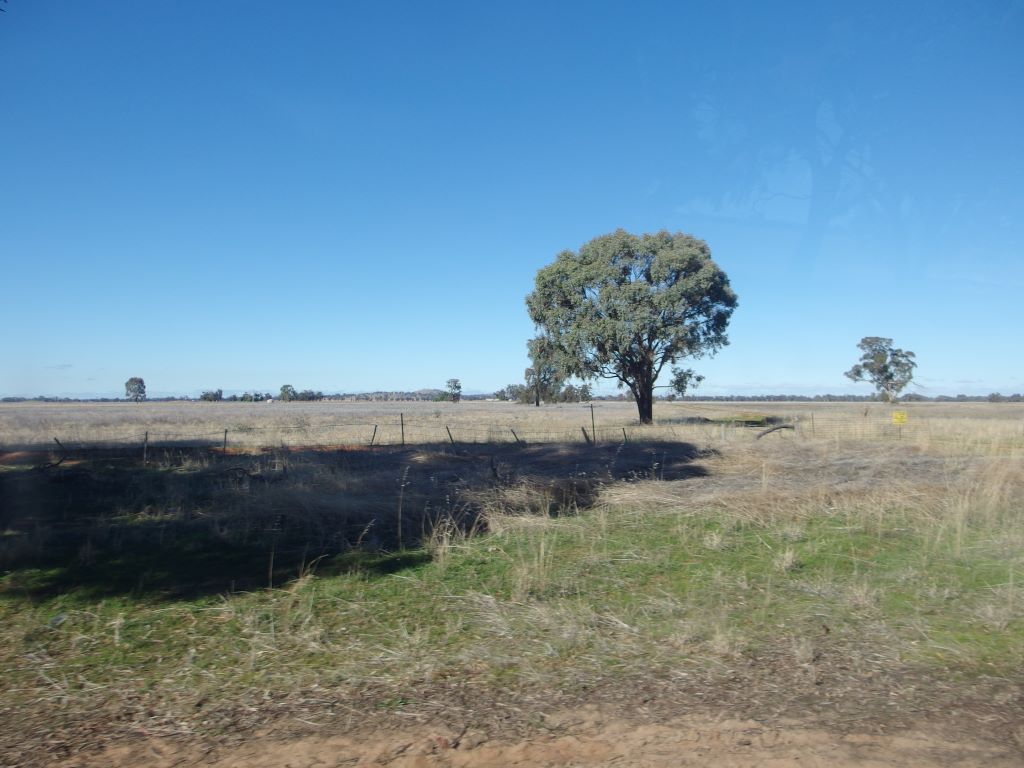
Wimmera country
Road signs warned “Caution – slow moving farm machinery use this highway”.
We did not stop in Donald. From passing through, it looked to be just a standard little country town. There was a caravan park that looked pleasant enough, beside a little lake.
Stayed on the Borung/Sunraysia Highway, which skirted south of the Buloke Lakes. At Litchfield, turned left. There had been a railway beside the road for some of the way, with warning bells and flashing lights, not just the uncontrolled crossings one often gets in the country. But where we crossed it at Litchfield there were boom gates too. From that, we concluded there must have been some serious train Vs vehicle encounters here in the past.
The roads we travelled today were really bad in some sections – bouncy and uneven. This was the result of frequent large trucks using roads not originally built to take their weight and number of wheels. It made for uncomfortable travel, especially in a vehicle like ours. It makes me so cross that, in an area that obviously has a network of rail lines, there is this almost total reliance on trucks. I do wish our State government would be more pro-active in encouraging/forcing more usage of railways for freight movement. There are just too many trucks on our roads.
Arrived at Warracknabeal around noon. A sign at the entrance to town informed us that it is the birthplace of Nick Cave – who knew? Or, in our case, cared?
Went straight to the caravan park. I had phoned the given number this morning, before leaving Boort, and been told there were en-suite sites available and just to pick one that was unoccupied and had the key in the door!
We found that there were twelve en-suite sites, in a double row in the centre of the park. About half of them were occupied by clearly longer term stayers. The available sites were scattered in amongst the long-term occupied.
We found a site where, from our outside sitting area, we could look across to the large creek that bordered the park. Yarriambiallik Creek. Try saying that one in a hurry! The en-suite was adequate – clean enough, though looking rather aged. The site was gravelled.

Warracknabeal site
A few sites up from us, the resident had a couple of very yappy, aggro little dogs, that carried on furiously whenever anyone moved into their line of sight. A wire mesh fence had been put up around the site, so the horrible things had a “yard” to run in.
This was a Council park. The lady on the next site told us that she had been here since last September, and that her husband had died two weeks ago. She said the Council wanted to refurbish the en-suite sites and were thus trying to get the long-termers to move out. It si not look like the Council was having much luck with that.
The en-suite site cost us $25 a night. Ordinary powered sites were $20. The long-termers paid a weekly rate of $125 or $100. I could see why the place was attractive to them.
It was actually a really attractive setting. There were plenty of trees, but not over our sites, so no worry about branch drop. It had rather a “bush” feel about it. Plenty of birds about. Campers on the ordinary sites that fronted onto the creek had clearly had campfires there.
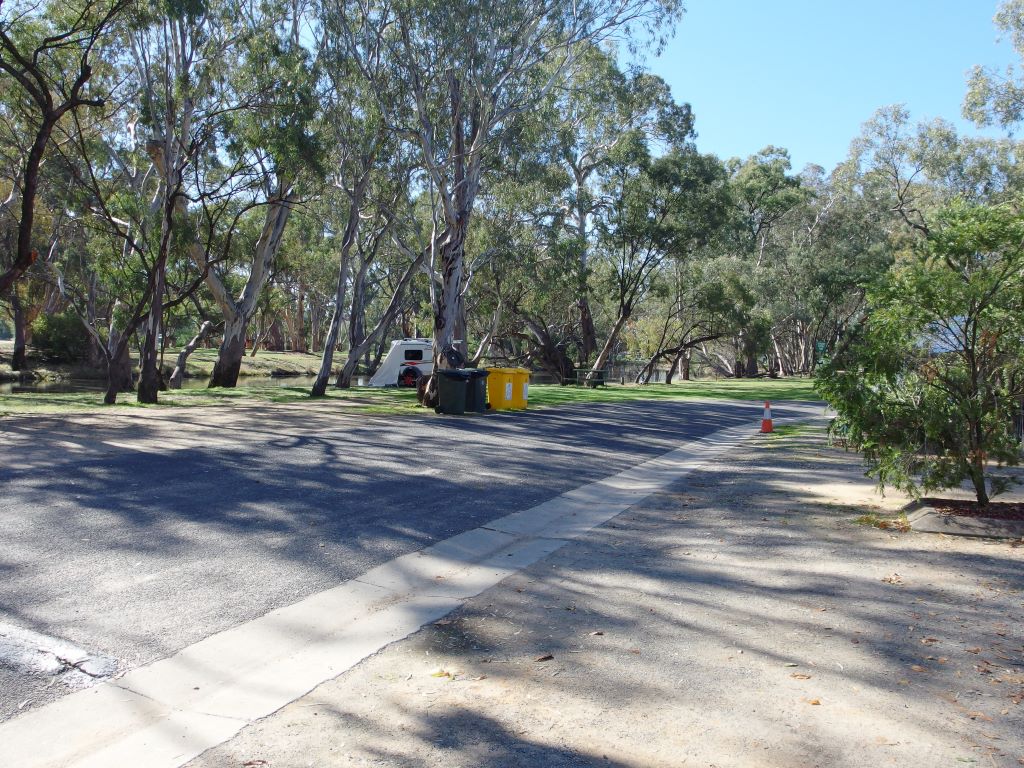
Creek side section of park
A walking track along the creek extended both ways from the park, so it was a good place to take dog for her exercise walks. After we were set up, John took Couey a little way along the creek bank walk, to let her off the lead and throw the ball for her. Of course, after a couple of retrievals, she ignored him and shot off into the creek for a swim. As if it wasn’t obvious that this would happen! I tossed him a couple of towels and left him to do the drying.

 This Adventurous Age