This Adventurous Age

Adventures travelling and working around Australia.


3 Comments

2017 Travels May 9 (1)

TUESDAY MAY 9 (1)    BOORT TO WARRACKNABEAL     170kms.

We managed to get up at 8.15 on this very cold morning.

Left the park just before 10am, without rushing the pack up unduly. The stay here in Boort had been enjoyable. It was a place we might return to, another time, just to relax by the lake.

It had turned into a lovely day for driving: sunny, but not too hot.

Refuelled in Boort, to be on the safe side. $1.274cpl.

I had planned to take us via Wycheproof and maybe stop at that lovely bakery café there, for an early lunch. Then, we would be able to stop at the painted silo at Brim, and look at that, on our way to tonight’s destination.

However, John decided to follow the GPS directions, rather than mine, after entering Warracknabeal as the destination. Predictably, it directed us via Charlton and Donald. I had not wanted to go that way, thinking we would probably be doing the Warracknabeal to Donald leg in a few days’ time. Oh, well, it might look a bit different, going the other way.

My secret consolation for being ignored was that John missed out on an indulgent lunch!

The road between Boort and Charlton was much more interesting than the way I’d wanted to go. There were huge olive plantations, starting not far out of Boort. The land looked to have quite a good red soil. There were some irrigation channels. I saw one sign at an olive acreage, reading Boundary Bend Olive Company. Later, I checked this out. Their web site claimed their Boort operation is one of the largest olive plantations in the world, with nearly a million trees planted.

Until then, I had not realized that Boort had become so significant in the Australian olive production scene.

Further on, there were vineyards too: Lake Marmal vineyards. I had never come across wines of this brand, so maybe they grow grapes for other winemakers.

There were eucalypts growing along the road side. Occasionally, there would be one with a really bright, smooth, orange trunk and branches. These appeared to be a mallee type, often with more than one trunk, and it looked like the orange colour appeared after older bark peeled off. Most attractive looking.
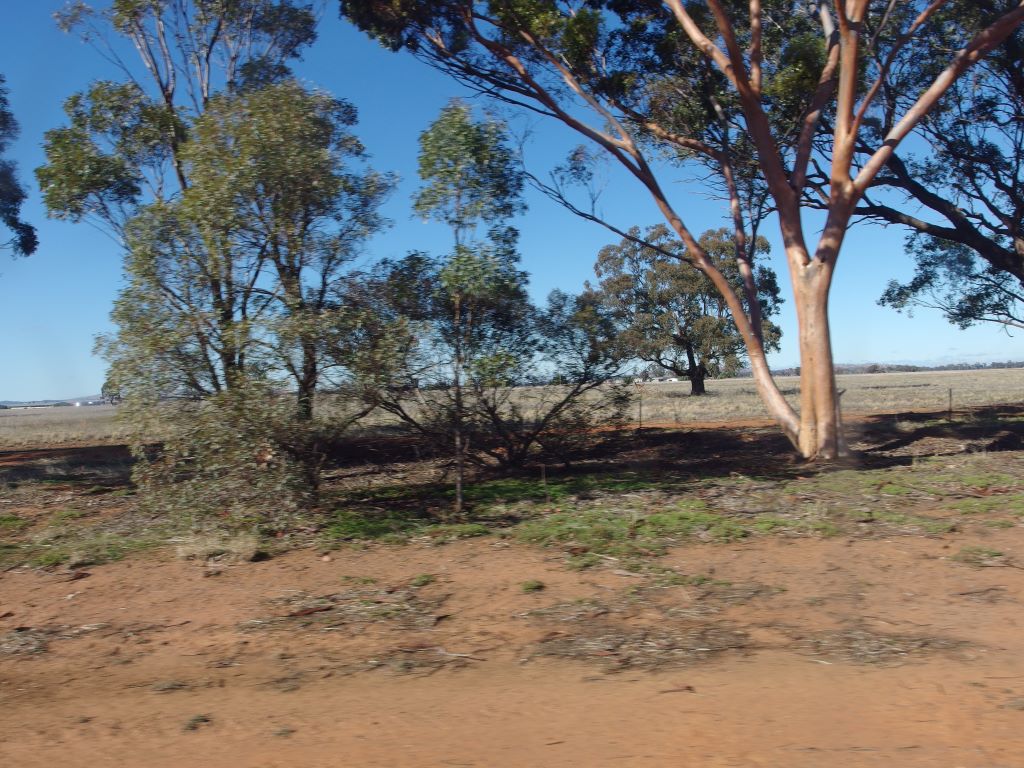
Unusual orange-trunked mallee eucalypt trees

Clearly, this part of Victoria has a Mediterranean type of climate.

We had, of course, been to Charlton before and stayed a night here on a previous trip. There were the ubiquitous blue plastic covered heaps of grain here too, but these were different – they had bird netting over them. Charlton has a really big silo complex, too.

Last time here, we’d been impressed with the efforts this little town was making, to revitalize itself. This time, it seemed even more go-ahead and vibrant. We saw no evidence of the floods that had affected the area last year.

Took the Borung Highway, towards Donald. Although, “highway” was misleading, given its condition. About 14kms from Charlton, passed the Wooroonook Lakes rest and camping area – another place I’d never heard of. From what we could see of the lake, it looked smaller than the Boort one we’d been camped by, but pleasant enough. There were some camping rigs set up there, and some camp power poles, so there were obviously some powered sites.

There are so many lakes scattered through the Wimmera region – something else I hadn’t known.

Some of the land down this way looked to be affected by the dryland salting that has become a significant problem in some agricultural areas. There was a saltbush plantation in one area. It is still very much sheep and wheat country.
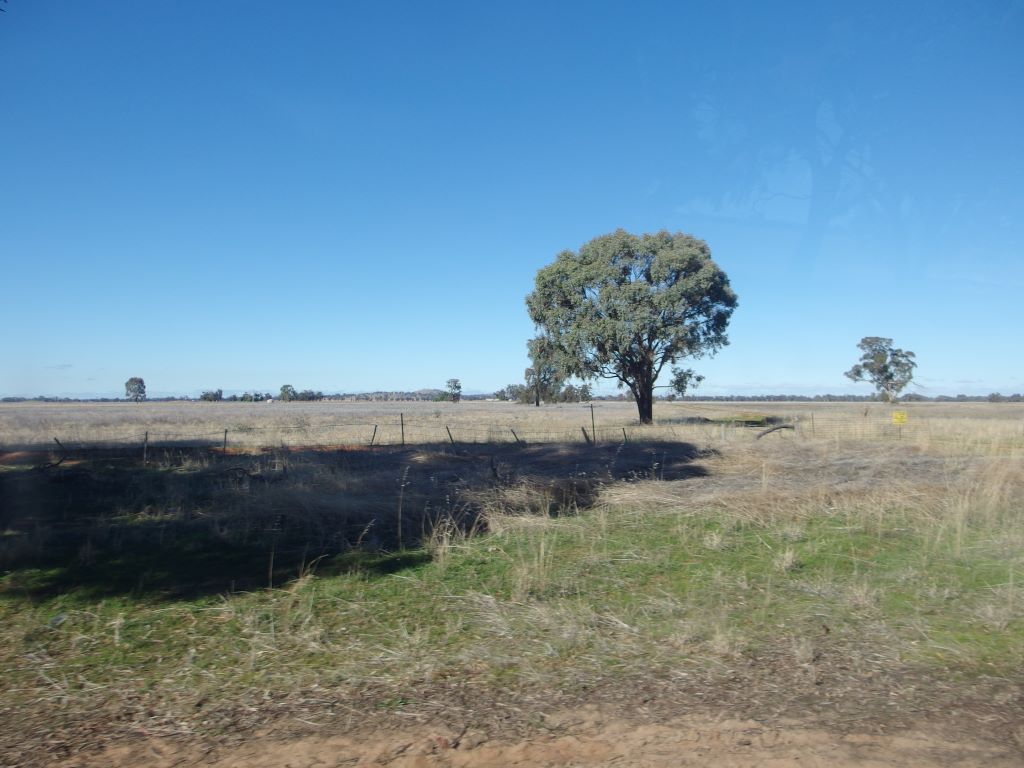
Wimmera country

Road signs warned “Caution – slow moving farm machinery use this highway”.

We did not stop in Donald. From passing through, it looked to be just a standard little country town. There was a caravan park that looked pleasant enough, beside a little lake.

Stayed on the Borung/Sunraysia Highway, which skirted south of the Buloke Lakes. At Litchfield, turned left. There had been a railway beside the road for some of the way, with warning bells and flashing lights, not just the uncontrolled crossings one often gets in the country. But where we crossed it at Litchfield there were boom gates too. From that, we concluded there must have been some serious train Vs vehicle encounters here in the past.

The roads we travelled today were really bad in some sections – bouncy and uneven. This was the result of frequent large trucks using roads not originally built to take their weight and number of wheels. It made for uncomfortable travel, especially in a vehicle like ours. It makes me so cross that, in an area that obviously has a network of rail lines, there is this almost total reliance on trucks. I do wish our State government would be more pro-active in encouraging/forcing more usage of railways for freight movement. There are just too many trucks on our roads.

Arrived at Warracknabeal around noon. A sign at the entrance to town informed us that it is the birthplace of Nick Cave – who knew? Or, in our case, cared?

Went straight to the caravan park. I had phoned the given number this morning, before leaving Boort, and been told there were en-suite sites available and just to pick one that was unoccupied and had the key in the door!

We found that there were twelve en-suite sites, in a double row in the centre of the park. About half of them were occupied by clearly longer term stayers. The available sites were scattered in amongst the long-term occupied.

We found a site where, from our outside sitting area, we could look across to the large creek that bordered the park. Yarriambiallik Creek. Try saying that one in a hurry! The en-suite was adequate – clean enough, though looking rather aged. The site was gravelled.

Warracknabeal site

A few sites up from us, the resident had a couple of very yappy, aggro little dogs, that carried on furiously whenever anyone moved into their line of sight. A wire mesh fence had been put up around the site, so the horrible things had a “yard” to run in.

This was a Council park. The lady on the next site told us that she had been here since last September, and that her husband had died two weeks ago. She said the Council wanted to refurbish the en-suite sites and were thus trying to get the long-termers to move out. It si not look like the Council was having much luck with that.

The en-suite site cost us $25 a night. Ordinary powered sites were $20. The long-termers paid a weekly rate of $125 or $100. I could see why the place was attractive to them.

It was actually a really attractive setting. There were plenty of trees, but not over our sites, so no worry about branch drop. It had rather a “bush” feel about it. Plenty of birds about. Campers on the ordinary sites that fronted onto the creek had clearly had campfires there.
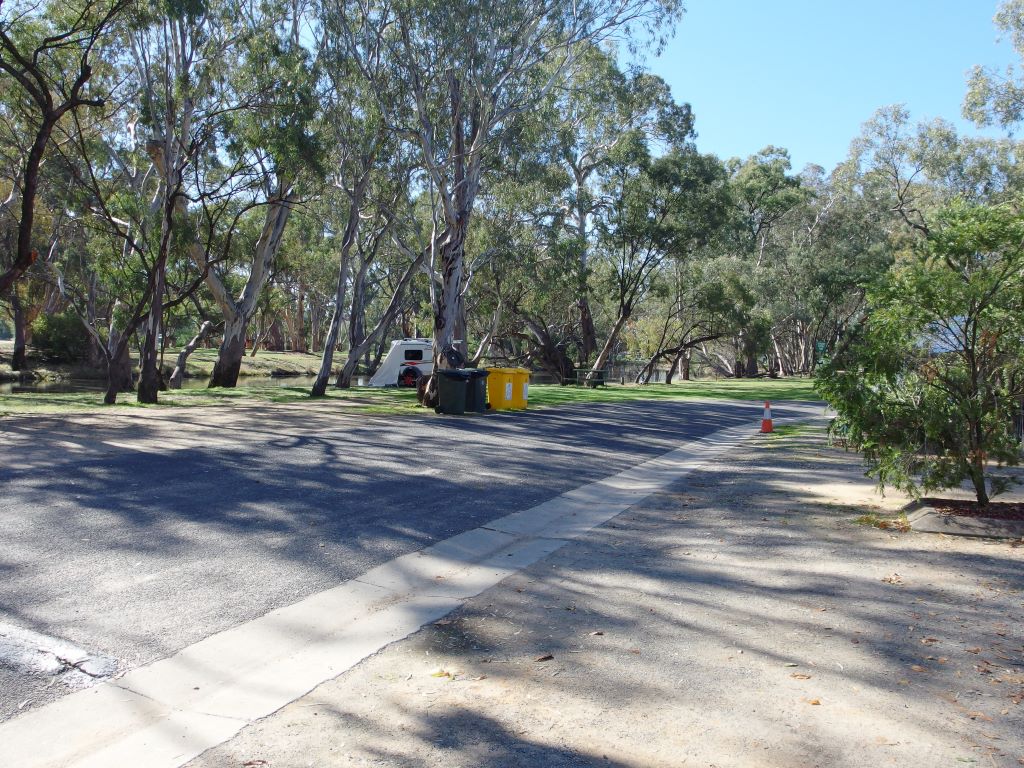
Creek side section of park

A walking track along the creek extended both ways from the park, so it was a good place to take dog for her exercise walks. After we were set up, John took Couey a little way along the creek bank walk, to let her off the lead and throw the ball for her. Of course, after a couple of retrievals, she ignored him and shot off into the creek for a swim. As if it wasn’t obvious that this would happen! I tossed him a couple of towels and left him to do the drying.


Leave a comment

2017 Travels May 7

SUNDAY MAY 7     BOORT

It was a cold morning, with a biting wind.

Couey got her morning ball games, but no lake play – it was far too cold.

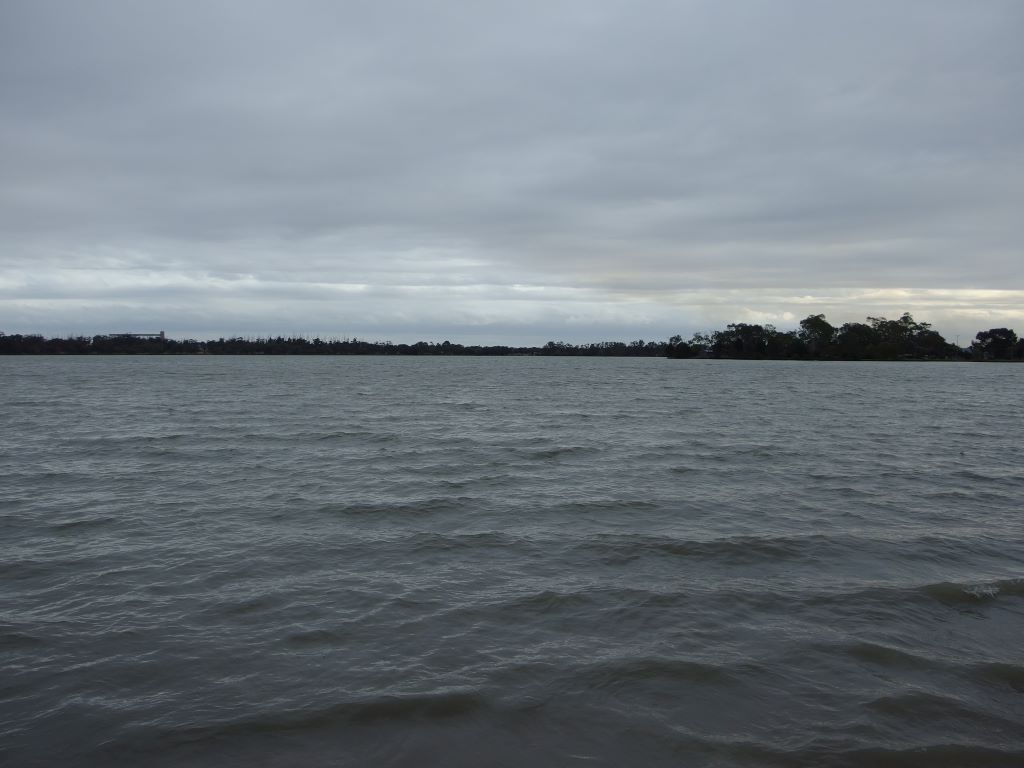
A gloomy day

When I made lunch, realized that John was very low on milk, so after eating we drove to the local supermarket, hoping it would be open, but fearing that, in a small country town, it would not. The sign on the closed door said they shut at 1pm, but the owner was still inside, at the cash register, finishing up with a customer. He saw me peering in and opened up for me. Lovely of him. That wouldn’t happen in the city!

Since we were out, John decided to keep driving, Headed to the east, towards Durham Ox. Weird name. My map – a tourist information one – showed a road we could use to do a round trip, alongside the Loddon River. When we came it, the surface was dirt and I was not prepared to gamble on it, having seen the heavily rutted state of some of the other area roads, after what must have been fairly recent heavy rains.

So we drove on to Durham Ox, which was basically just an intersection, turned around and retraced our way. On the approach back to town, John stopped  at a place that was having a clearing sale – he’d noted it on the way out. He went in to browse. I stayed in the car. He did not buy anything, which was wise given our lack of spare space. It was mostly farm related items anyway.

Next, we drove right around Little Boort Lake. There were some good looking, mostly modern, homes across the road from the lake, with good views over it. Clearly, the “best” part of town.

The main Boort Lake looked to have a lot of dead trees and reeds growing in it – not as attractive as the “little” one.

John wanted to look at the large silos we could see in the distance from the caravan park, so we drove in that direction, then kept on going on a dirt road as far as Woolshed Swamp, where the road became a bit boggy. Commonsense prevailed and he turned around and we went back.

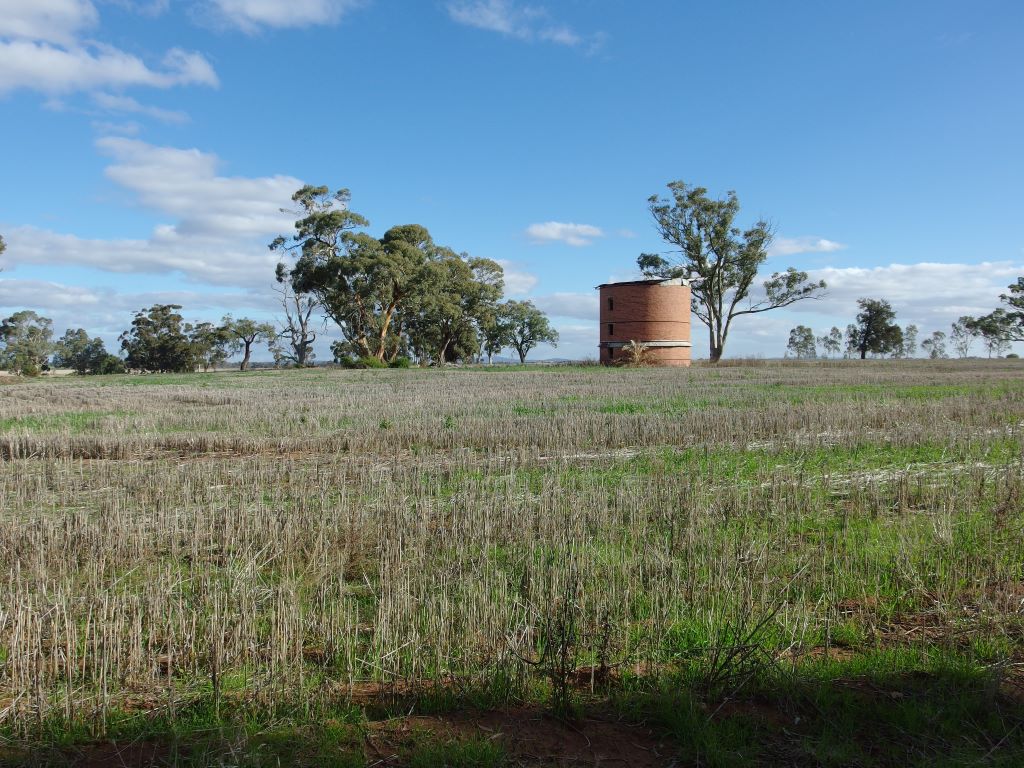
Saw an interesting old brick structure in a paddock, near the railway line. A brick cylinder, with what looked like windows at intervals up it. I thought it might be a silage pit? From something we saw days later, seemed it was probably a water tower, presumably related to the railway, though that was a few hundred metres away. Maybe the rail route had changed?

Mysterious brick structure…Water Tower?

There was so much grain stockpiled around this district. The receiving area at Boort had numerous grain heaps, under the pale blue plastic sheeting.

When we got back to camp, I took Couey for a walk in the opposite direction to usual. The caravan park was partly wedged between the lake and an irrigation canal. We walked to where the canal exited from the lake, where there was a board-walked section through some swampy ground, and a footbridge over the canal. There was another Mens Shed metal sculpture in the canal mouth – a large dragonfly.

Saw a number of ducks swimming on the canal. Every day since arriving here, we’d heard gunshots at different times of the day, and from not too far away. At the same time, there had been no ducks on the lake, just coots, the occasional swamp hen and one shag. I’d assumed the shooting was duck hunting and hoped the ducks had all fled to somewhere safe. However, today I realized that there was a clay target shooting club nearby, and this was the source of the noise. I was pleased to have seen some ducks happily swimming.

The caravan park from across the lake

There were no other vans in this afternoon, This is the first time we had been alone here, in this part of the park.

Tea was fries and some blue grenadier fish I’d brought, frozen, from home.

Watched some TV.


Leave a comment

2017 Travels May 6

SATURDAY MAY 6     BOORT

After the usual morning walk with Couey, I drove to the shops to get the Saturday papers.

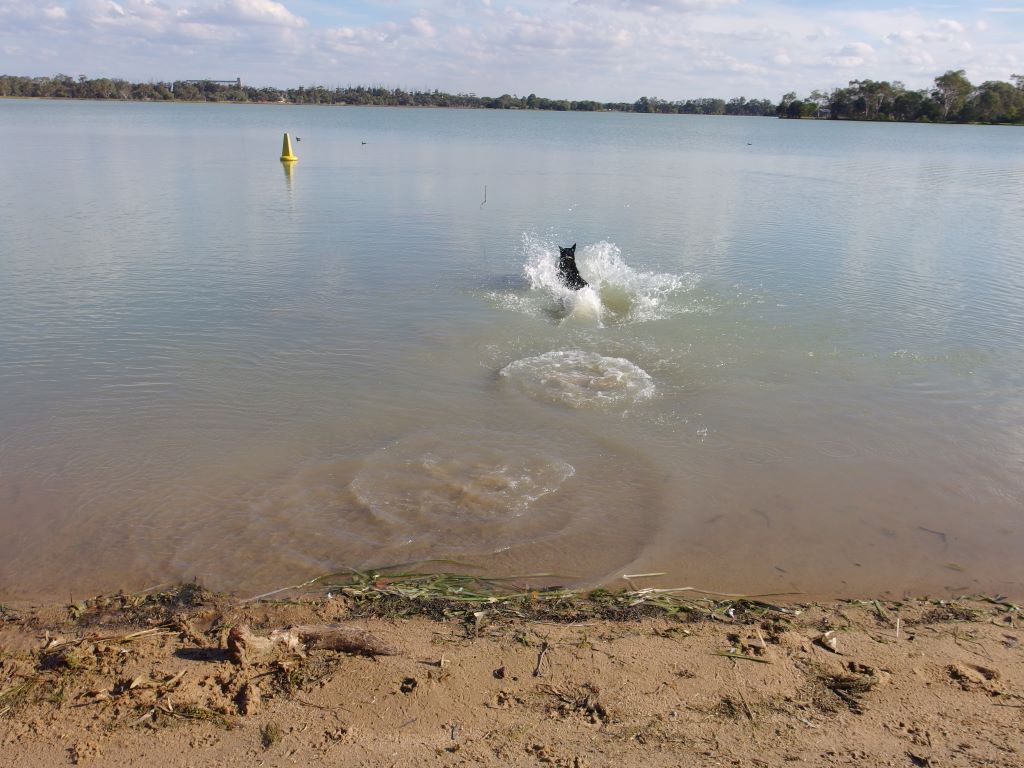
We gave Couey a stick session in the lake.

Now that’s enthusiasm…

Decided to stay an extra two days here. We are enjoying exploring the area and just relaxing. The dog is adoring a lake in her backyard. So, no rush to move on. I walked up to the office and extended our stay.

The owners had had a rough night, they said, courtesy of a group of farm workers, who they had staying in a cabin – the closest one to the office and house. They had been drinking and being rowdy until 3am. The owners had gotten up to try to control them, several times. This morning, some of the men were trying to fix a window they’d damaged. They were drinking again (still?). One said he’d drive to the hardware store for materials they needed, but the park owner said he would drive them. I thought he was being much more responsible about their welfare than the men deserved. The lady owner said she would really like to evict them, but if she did, they had nowhere else to stay and the local farmers’ schedules would be seriously disrupted. Owning a caravan park really can have its down sides!

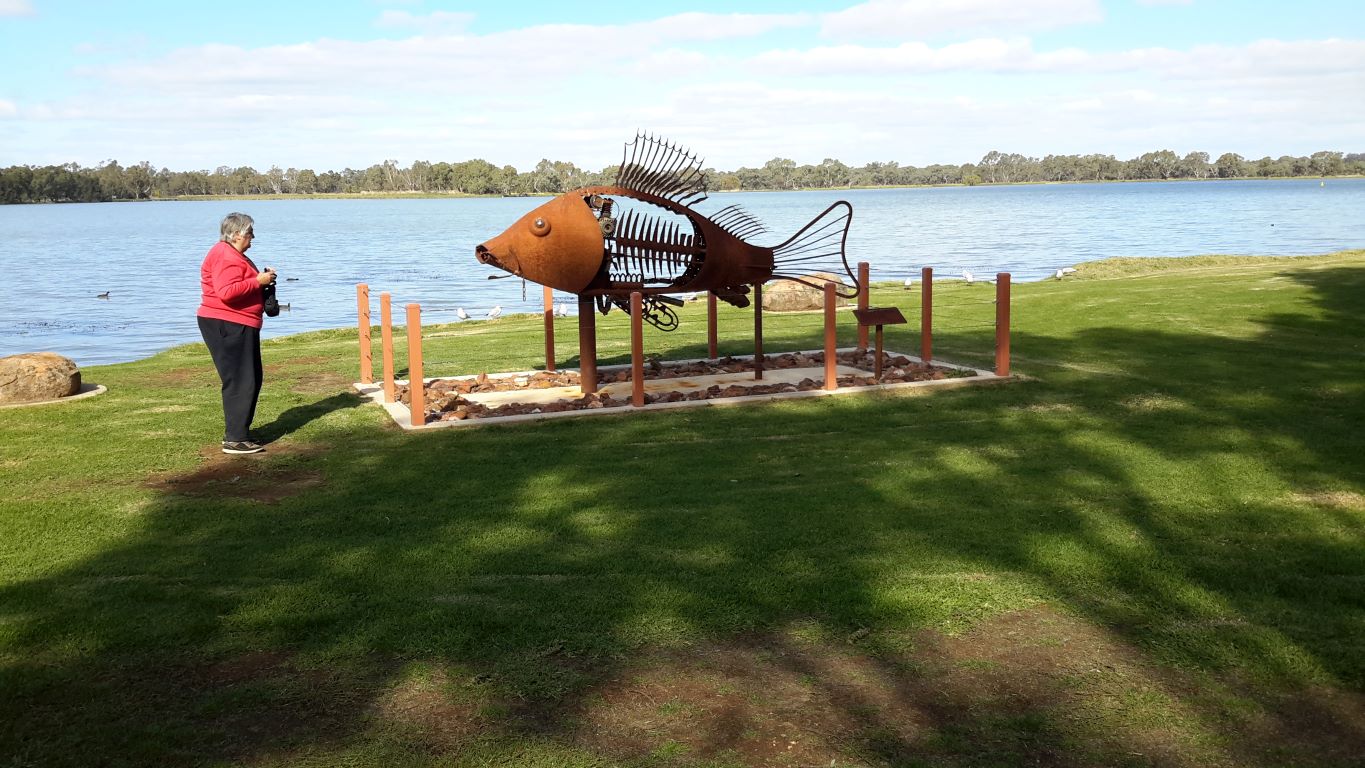
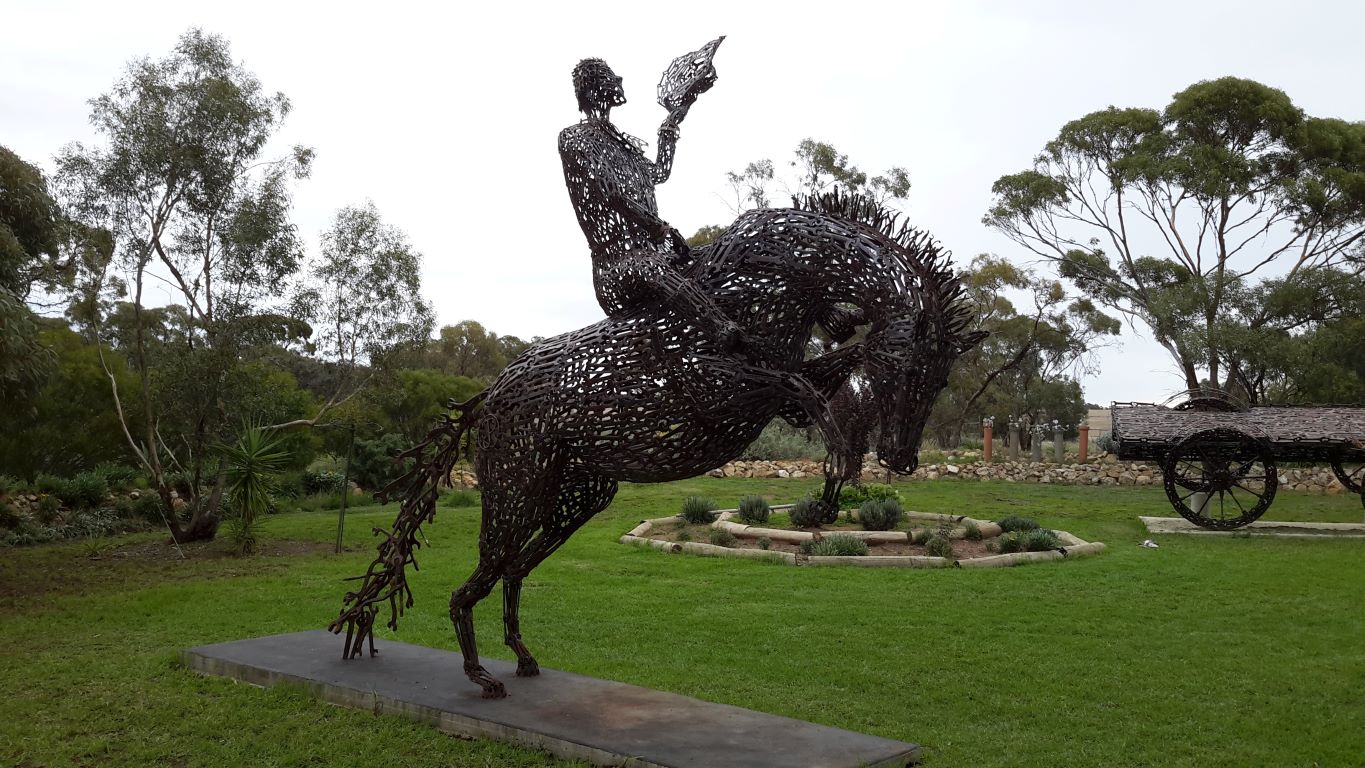
John and I walked Couey along the lake front as far as the metal sculptures. These were done by the local Mens Shed. I thought they were wonderful.

Fish sculpture by the lake

John left at 1.30 to drive out to the Spanner Man tour. I had been able to get through by phone this morning and book him in for that. I’d decided I did not feel like something that would involve a lot of standing around, and that Couey and I would thus be better off at camp.

There was a cold wind blowing this morning, During the day it clouded over and became increasingly windy. So much so that, while John was away, I thought I should lower the awning. I dropped it down so the edge was just below head height and that seemed to lessen the flapping around to an acceptable level. I wanted to keep it sheltering the door area, if possible, to keep the grass dry from dew and maybe rain.

Windy day

The wind made the day very cold so I stayed in Bus, reading the papers.

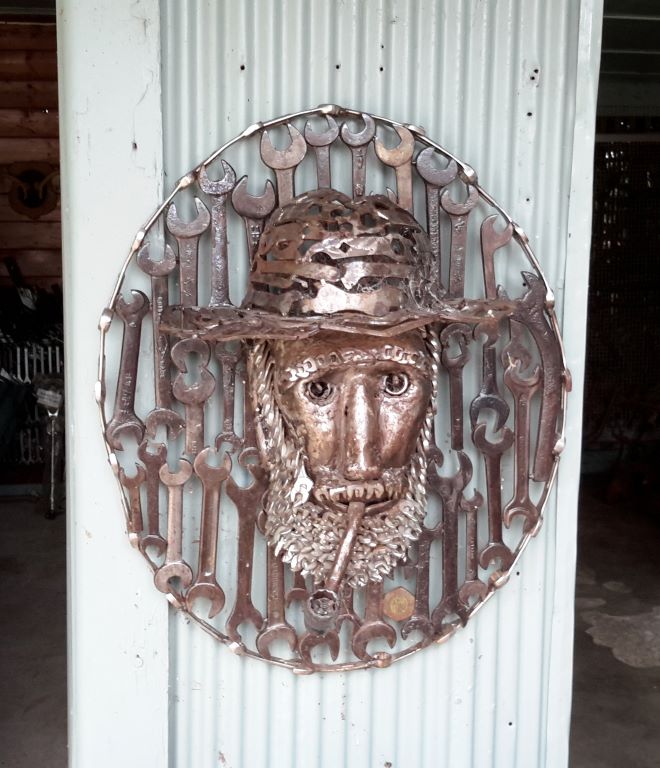
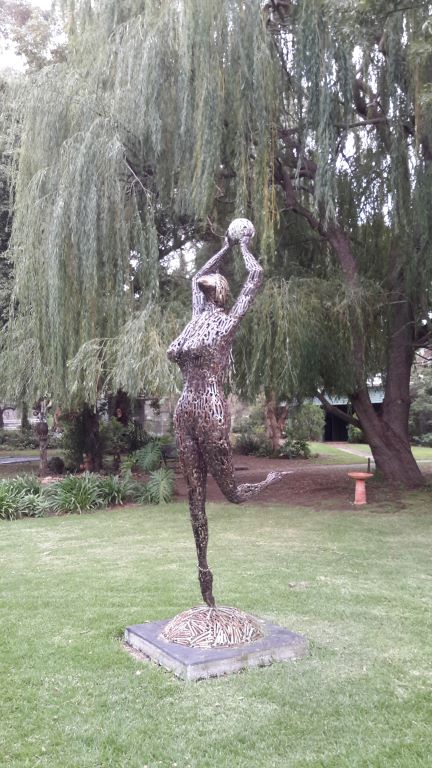
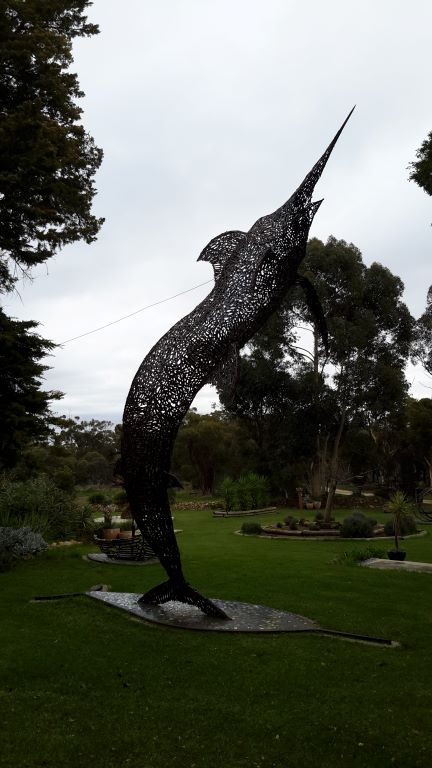
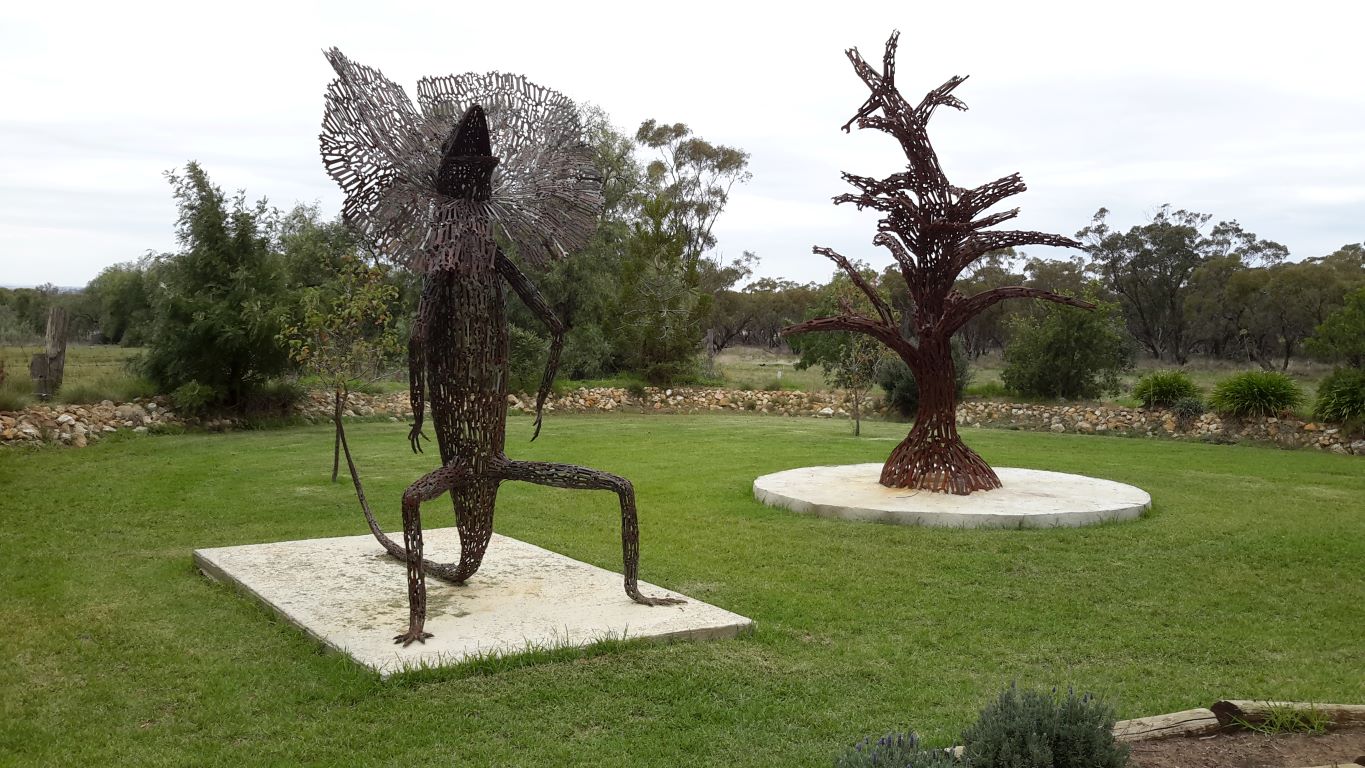
It was almost 5pm when John got back. He said the tour was well worth the $10 charge. They were shown around a large garden that contained many large sculptures constructed out of spanners. These were sourced from clearing sales and the like, but also new from stores. Apparently the local hardware chain had a really good special on spanners recently, and the Man bought several thousand! He was wheelchair bound and had not been well, do there had not been much recent output.

Spanner Man

Looking at John’s photos, the sculptures are amazing. One would admire the movement and fluidity captured, in any sculptural medium, but to think this is done with spanners…

Netballer made from spanners

Marlin in gardens at the Spanner Man’s

Frill necked lizard and tree

Cowboy

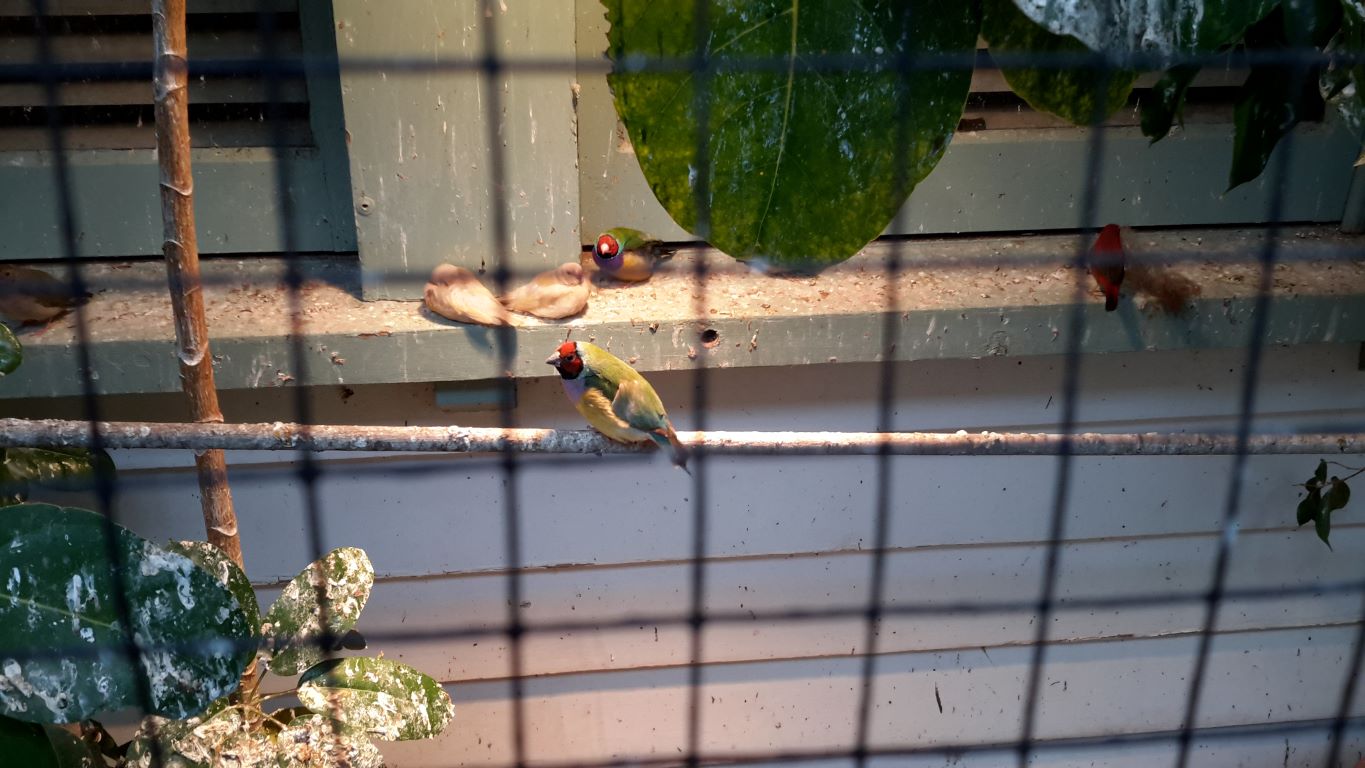
The tour also looked at some large aviaries in the grounds. John was really taken by the exotic macaws, but especially by the Gouldian Finches. Despite some dedicated searches over the years, at places like Mornington in the Kimberley, and Pungalina in the Gulf Country, we had never managed to see these finches in the wild, where they are really rare. They are fairly commonly kept as aviary birds, though.

Gouldian Finches

The Australian Wildlife Conservancy has done a lot of research into the decline of these finches in the wild, at their Mornington property in particular. The conclusion is that these seed eating finches are severely disadvantaged by the hot, uncontrolled fires of the late Dry season, that totally destroy thousands of hectares at a time. Before European pastoralism, the aboriginals did early Dry season burning, which was not so destructive, and which tended to burn more limited areas, in a kind of mosaic pattern. This reduced fire fuel and prevented many of the bad late season fires, and conserved large swathes of vegetation for the wildlife. So AWC has run a campaign to get the current pastoralists of the Kimberley to adopt this type of burning, with some pretty impressive results to date, in terms of species recovery.

Tea was chicken noodle soup, followed by cheese omelettes. I tried a short cut, and instead of grating tasty cheddar cheese, just put Kraft cheddar slices on top, before folding over. That was really yummy – much nicer than the usual way. John had baked beans with his omelette, too.

Watched football on TV. I faded early again, as I tend to do when we are camping, so took myself off to bed about 9pm.


Leave a comment

2017 Travels May 5

FRIDAY MAY 5     BOORT

We slept in a little this morning. It turned into a lovely day, after a chilly early morning.

After breakfast, did some ball throwing with the dog, on a grassy area in front of some empty cabins, down at the end of the park. Then, she ignored my commands (pleas?) and took herself off into the lake for a wallow in the water. A wet tummy is heaven! Later, since she was already wet, John threw a stick into the water for her, a few times. She loves that game. Her retrieval is a bit hit and miss, though, which is why we don’t use a ball.

A local attraction was the Spanner Man’s display. I’d been told at the office that one needed to book ahead for a tour of that. I tried to phone. There was no answer and the message machine informed that they did not take messages, and to try again later. Hmmm – not a very customer friendly way to do business.

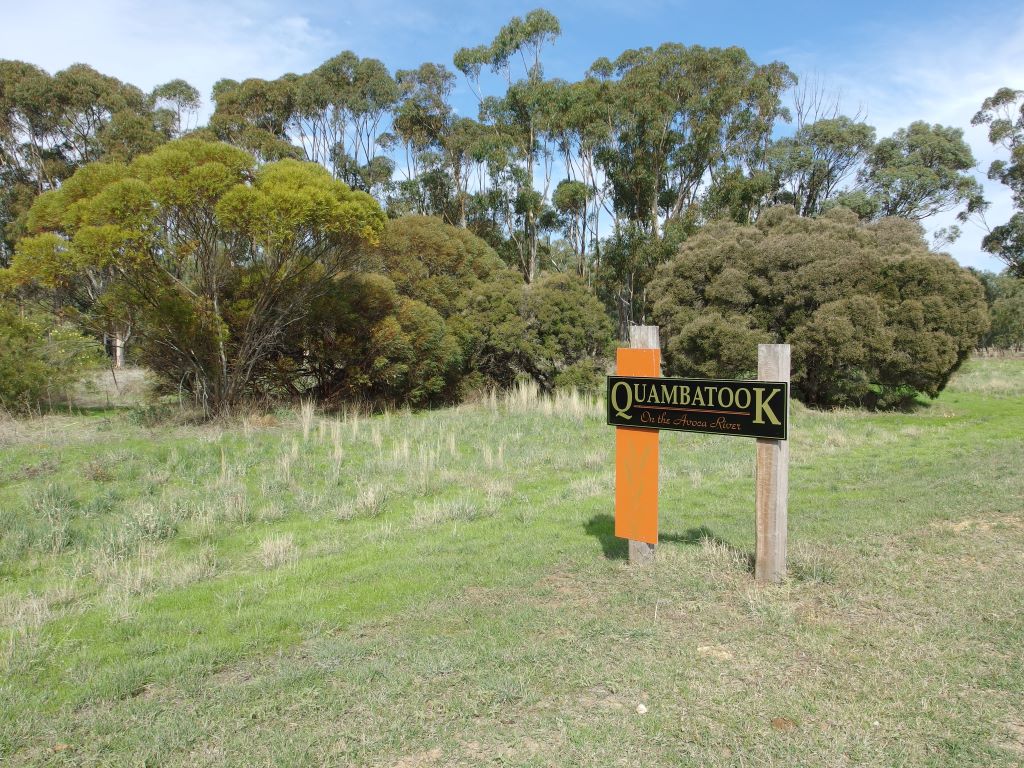
After all that, we got rather a late start to go off for a drive. I thought we were just going to go north for a little way and maybe check out the location of the Spanner Man’s premises. However, once headed out, John kept going – all the way to Quambatook.

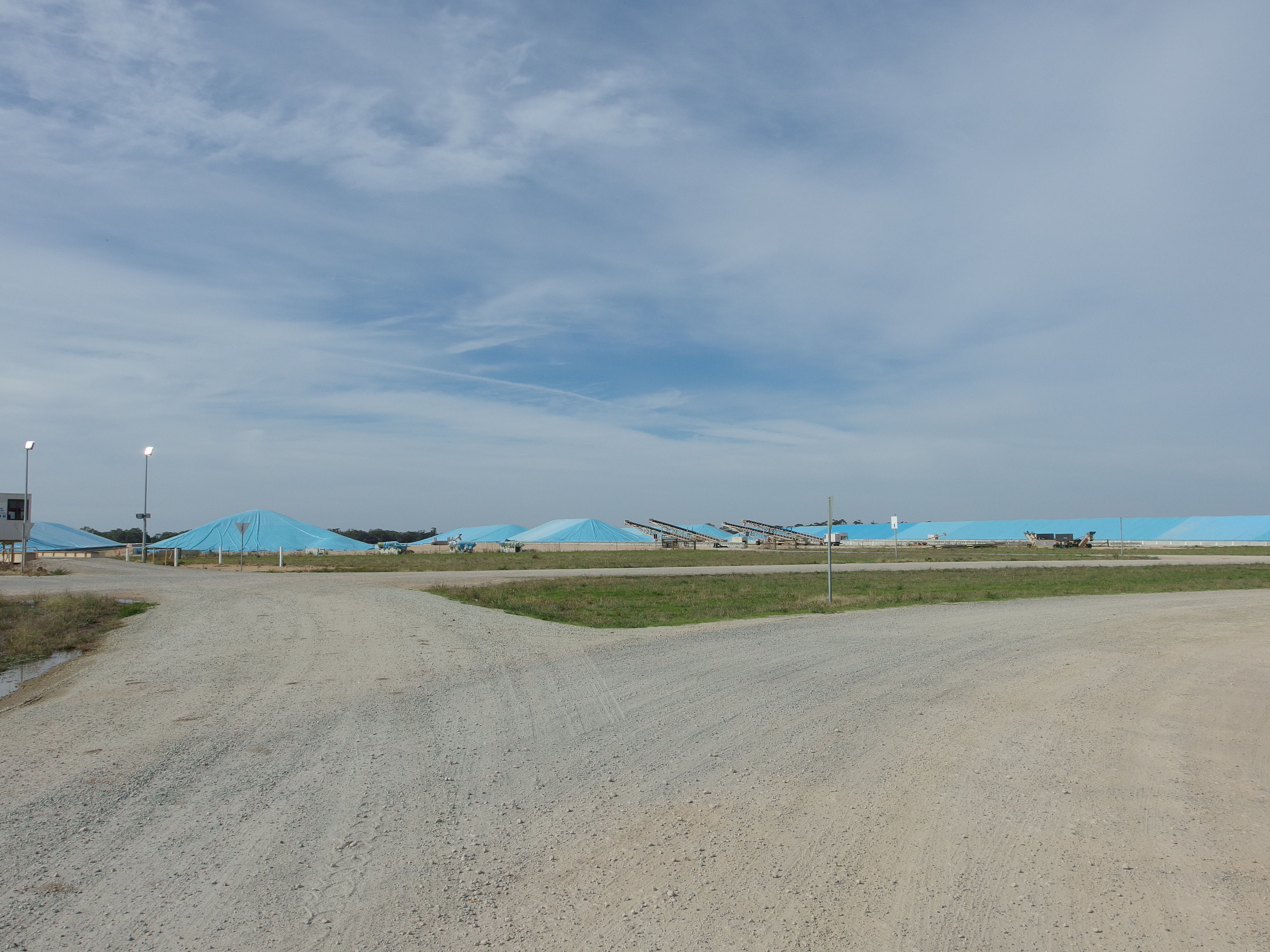
Apart from a fairly large area of grain storage – heaps covered by blue plastic sheeting – we found the place a rather sad and battling little town. As with many such towns these days, a number of closed-down businesses indicated that it had once been larger and more significant in the area. Now, there was a General Store rather than a supermarket, and it was combined with the Post Office.

Given the huge grain storage area, I did wonder about the mouse population of the area?

Grain storage at Quambatook

We explored a couple of roads outwards for a little way, as John likes to do, then headed west, to Dumosa, then the Calder Highway and Wycheproof. This was interesting enough travel, through sheep and grain country. It was fairly flat, but there was some variety. Also, some irrigation channels.

I saw a decent sized brown snake, sunbaking on the road a short way ahead of the car. John didn’t see it at all. Observant driver! I made some sort of “Oh, look out” comment. I think we missed it? John turned the car around to go and have a look, but it had gone. At least, I hoped it had, and wasn’t up under the car somewhere! Imagination is not always an asset.

Later, back in Boort, we heard talk that there had been lots of brown snakes around. I would have expected, with the cold nights now, that they would be in hibernation, but supposed that autumn mice were still around the grain areas and this was an incentive to stay out and about longer.

At Wycheproof, I went to the IGA supermarket to get some fruit and ended up buying other produce too. It seemed fresher and more recently replenished than the stocks at Boort.

Gave Couey a comfort walk for a little way, then put her back in the car.

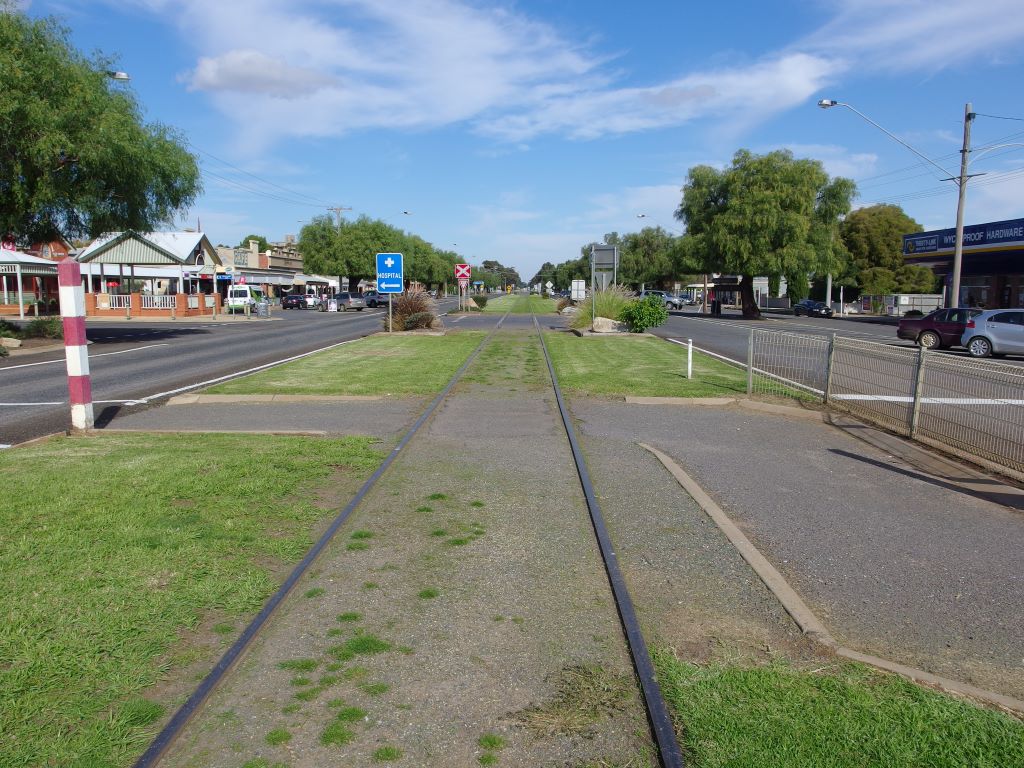
Wycheproof is a town where the railway line runs down the centre of the main street – the highway. I would love to be there when a train actually came through. There were no fences or barriers – the onus is on drivers and pedestrians to watch out. I suspect that any train that does come through does so very slowly.

Wonder if they have a lollipop person on the train crossing too?

The time was getting on, so we went to buy lunch at a good-looking establishment. Bakery on Broadway. (Broadway is the actual name of the main street through town, despite it also being the Calder Highway). John chose a sausage roll and a cheese and vegemite scroll. He could not resist buying a Boston Bun – for tea. I had a very yummy ham and salad roll. We had coffees too. Sat in their outside dining area and ate. We noted this place for future travel, as an excellent place to stop to buy lunch.

Wycheproof seemed to be another small town that was rejuvenating itself, having somehow an active, more vibrant air about it. I guess being on the highway helps, but not all towns so located have managed to turn that to advantage. Anyway, great bakery, with modern product lines.

The Broadway Wycheproof

Back to the car. Turned off the highway, for Boort. On the edge of Wycheproof, passed Mt Wycheproof which, at about 43 metres, is the smallest registered mountain in the world! Now that’s a question for Trivial Pursuit…

Coming in to Boort, passed through a dry swamp area, part of a real complex of lakes and swamps around the town. We also passed burning off grain stubble. Yesterday, from the caravan park, we’d seen the smoke from that.

Boort swamp

Our “little drive” turned out to be about 200kms! John’s “little adventures” have become notorious in our circle. We might be adding to the legend.

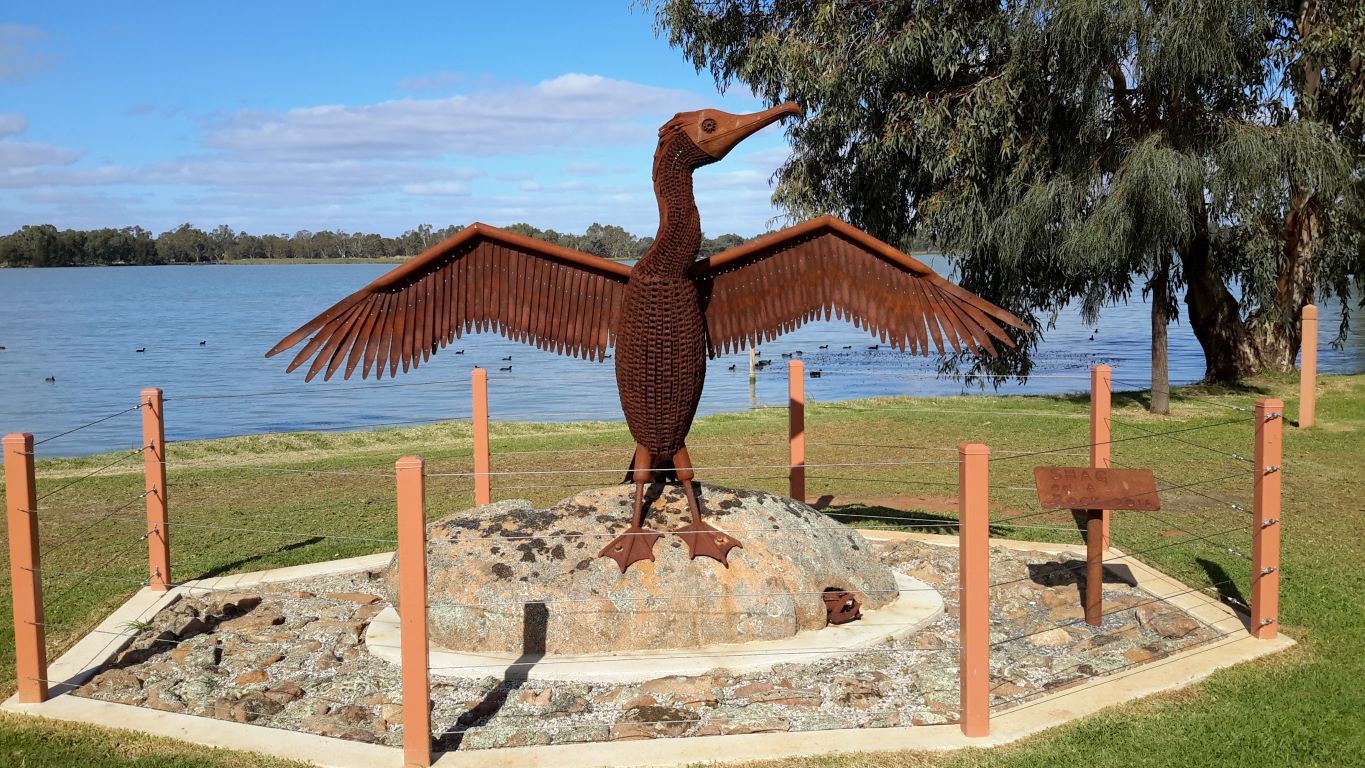
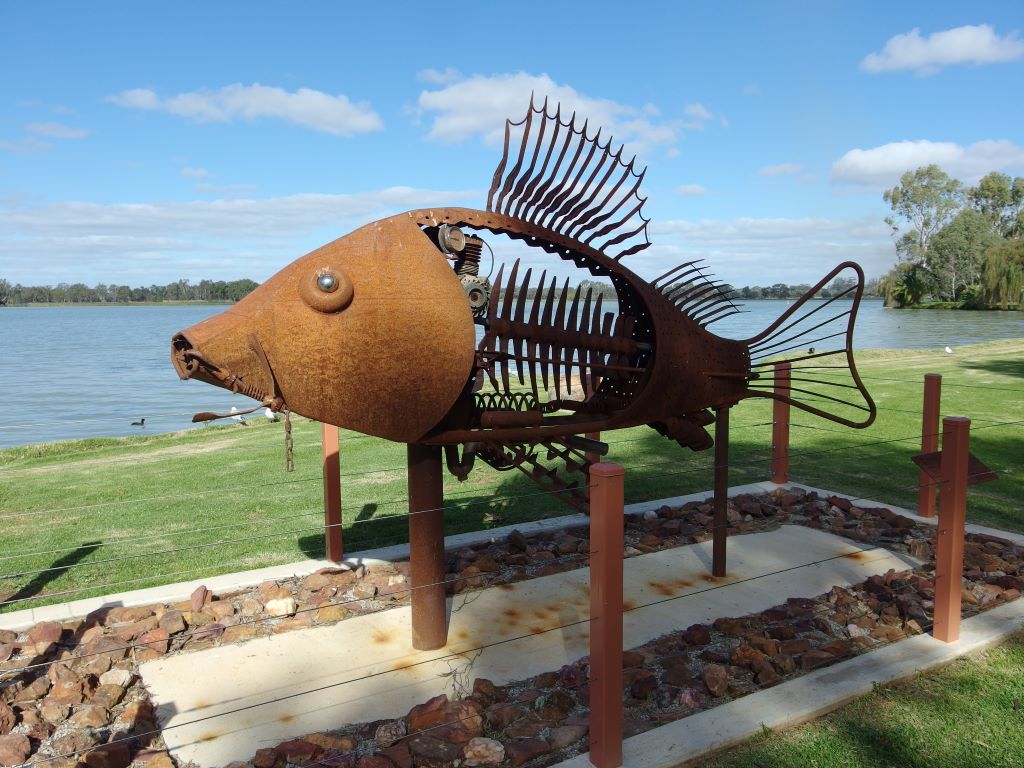
John had a nap. I walked Couey along the lake front, past the boat ramp, playground, BBQ’s, and the sports area, as far as some parkland that had a couple of intriguing metal sculptures – of a redfin fish and a large bird.

Metal shag by the lake at Boort
Very clever…
Detail of the sculpture of a fish

There was also an historic pump engine on display – used for irrigation water pumping. I’d had no prior idea that there was irrigation in these parts.

The walk took me along the Federation Walk – a paved path that featured a plaque for every Prime Minister since Federation in 1901. It had not been updated since Kevin Rudd’s first term, though.

Boort had really done this lakefront precinct well. There were a couple of seating arrangements, obviously done by the Spanner Man. One was a tall, stand-alone sort of sculptured column, with smooth seats around it. The other was arranged around the base of a tree. Brilliant concepts and workmanship. Each piece used a hell of a lot of spanners!

Tea was chicken noodle soup and the Boston Bun.

Watched football on TV. I couldn’t stay awake and was in bed and asleep well before the game finished.

Sunset from our site


3 Comments

2017 Travels May 4

THURSDAY MAY 4     MARONG TO BOORT     113kms

It was certainly a frosty night. The sheets covering the windscreens were quite stiff when removed.

Left the park at 10.10am, having slept later than intended. So easy on these cold mornings to snuggle under the doona and think “just a few more minutes.”

Today was the shared birthday of son and his wife, turning 43 today. I texted them birthday wishes as we drove along. We’d given them their present last Sunday – a two-person dining table they’d wanted John to make for them.

Travelled north west along the Calder Highway. Another advantage of the lovely Marong park was that, for north-west travellers, it was already beyond the Bendigo city traffic and maze of roads.

The day was sunny, with blue sky. Quite pleasant inside Bus.

A lot of the little towns in this region date from the gold rush days of over a century ago and usually have some remaining buildings typical of the consolidation era that followed the immediate rushes. Some towns are doing better than others, these days, though. Clearly, some are capitalizing on tourism through the region.

The Loddon River at Bridgewater on Loddon was very full.

On that town’s outskirts was the array of curved mirrored parabolas of the solar farm. These collected and concentrated solar energy for feed in to the power grid. That, at least was the theory, when this experimental array opened in 2012. It was closed down in 2015, not because the technology was faulty, but because of politicking around issues like feed-in tariffs and renewable energy subsidies. Presumably, it would not take much to get the array working again, if governments and the power businesses could get their acts together. Not for the first time, I reflected that democracies are not the most efficient systems of government.

The array looked like something from outer space. Alien.

The main street of Inglewood had some of the old, two-storeyed buildings that date from the nineteenth century. A claim to fame of this town is being the birthplace of Sir Reginald Ansett, founder of Ansett Airlines, for a long time one of the two main domestic airlines in Australia.

Inglewood

The distilling of eucalyptus oil, from local blue mallee gums, began at Inglewood about a century ago and the area is still a major source of this product, with a museum about it in the town.

There were far too many trucks on the Calder Highway. We really should have a serious campaign to get goods moved by train again. So many roads are deteriorating so quickly. Temporary fixes do little to improve road quality or, indeed, safety. Surely, overall, the costs of our reliance on road transport are so much greater, when one factors in ongoing rates and taxes spent on roads, plus related road deaths and casualties?

On the subject of railways, I decided that I do not like the angled railway crossings of these parts. It is very hard for the driver of a car – let alone a vehicle like our Bus – to check the rail line when it comes in at an acute angle from behind, to the left. There are bells and lights on the crossings along this highway, but even so…

I was on a mission today. My family history research had finally unearthed some information about a rather mysterious great grandfather. He was the only ancestor of that generation about whom I’d been able to find nothing, for several years. He clearly existed, having fathered several children, amongst them my grandfather, but how and when he appeared in Tasmania, whether it was of his free will or otherwise, and ditto disappeared again, had no documentary trail at all, that I could find.

In recent months, I seemed to have found him, with a different surname, as a newly married assisted immigrant to SA, in 1848. The trail next revealed him in gold rush Melbourne, having apparently left wife and children behind in the new settlement of Adelaide, and marrying my grandmother in 1852. Apparently, he was rather flexible with his vital details of name and birthdate, using a couple of variants. Who knows to what extent this was deliberate, or the result of the literacy deficiencies common in those times. I suspect he was well endowed with cunning, though, if not principles.

This second family, now using his middle name as surname, relocated to Tasmania – the young Deloraine area – in the mid 1850’s. But then he disappeared from records there, seemingly in the late 1860’s. My imagination had him amongst the numbers of men who simply disappeared in the often harsh conditions of backwoods Tasmania of those times.

But now I had discovered him, dabbling with gold seeking, bigamy and marrying yet again – back under his original birth name – at Inglewood in the late 1870’s. He died near Wedderburn in 1896.

Mt Korong – mentioned in found records of ancestor

I wondered how many of his numerous descendants from the offspring of his three marriages, are aware of the existence of three family lines? I had never heard any talk that suggested the Tasmanian branch knew of same. In fact, no-one ever seemed to know anything much about him, at all.

Today, I wanted to visit the Wedderburn Cemetery, where he and his third “wife” are, according to death records, interred in Plot 160 of the Church of England section. I was hoping for a grave marker, and information, and to photograph the grave.

Wonder if my ancestor walked – or farmed – around here?

We drove straight to the cemetery, out on the Boort road. There was an area where John could park Bus, at the front, so we did that and walked in. In my naivety, assumed I had enough information to find the grave. Located the Church of England section, and we searched every headstone and grave marker in it. Couey free ranged and had a lovely time. There were signs that lots of rabbits roamed here, so she had lots of fascinating smells to follow.

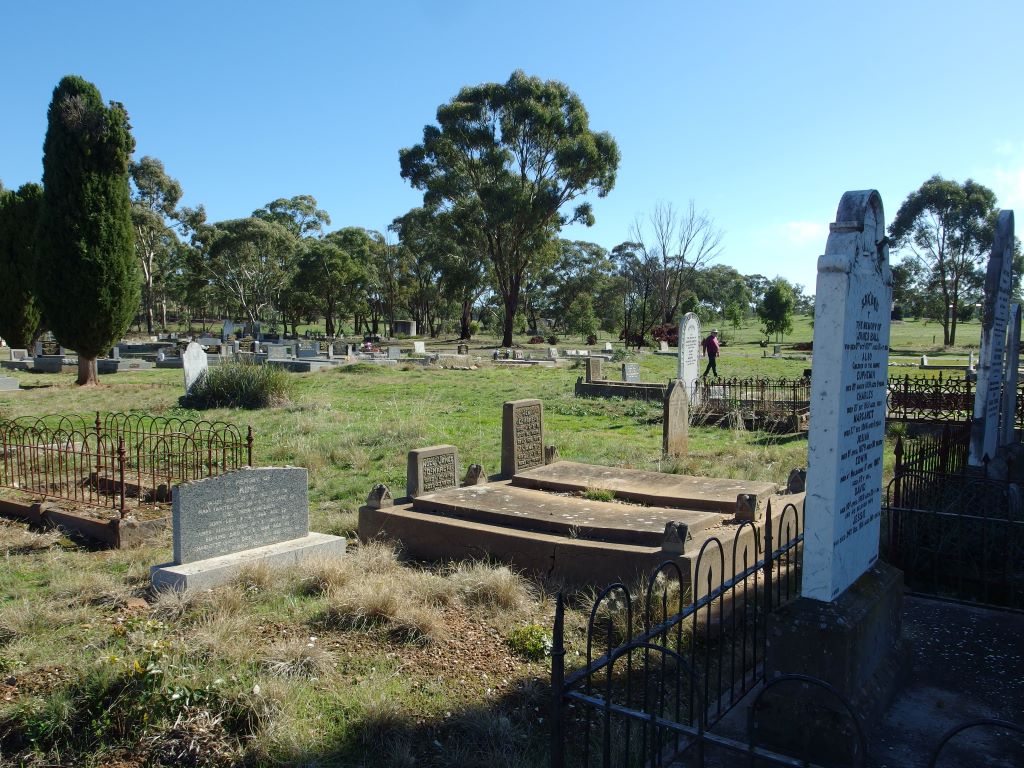
Church of England section

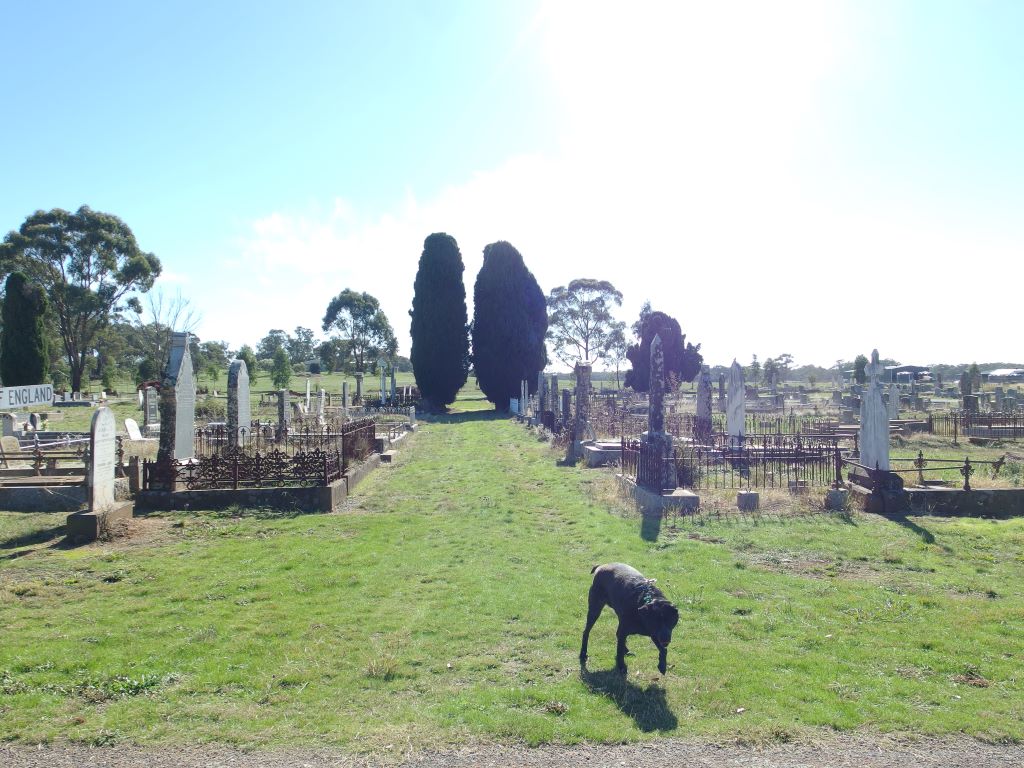
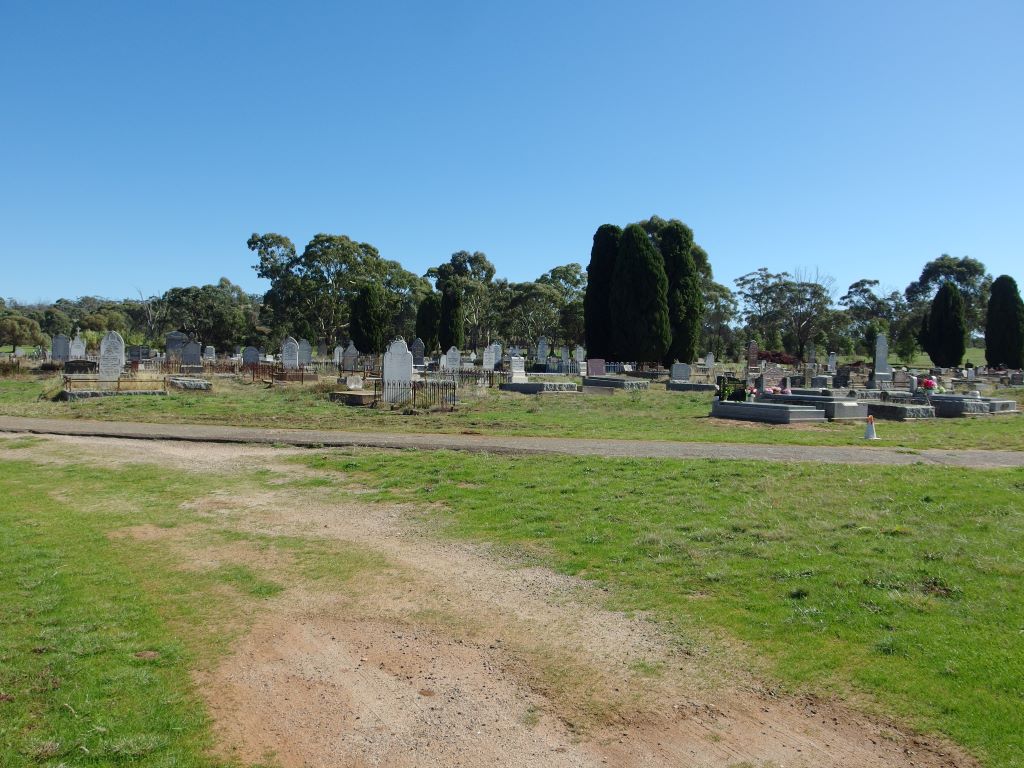
The Wedderburn Cemetery was a lot bigger than I had anticipated!

Only part of Wedderburn Cemetery

I was put out to discover there are no plot numbers on the headstones and grave markers. Nor was there any apparent chronological sequence to sites. Not sure what the cemetery equivalent is of needle in a haystack.

A lot of headstones to read!

Spent about an hour, searching. No mention of Daniel or Annie anywhere that I could see. It got quite hot, and my back began to really hurt. So we did what I should have been smart enough to do, in the first place, and drove back into town, to the Information Centre. The two ladies there seemed a bit disconcerted when I asked if they had a map of the cemetery, but very helpfully phoned the Secretary of the Cemetery Trust, and reported that he would meet us out there. Wonderful service!

Drove back out, and the man arrived soon after. He had the same information as I’d found online, but in original copy format. He explained that Daniel was buried in the “public” section of that area – i.e. for poorer people. That figured! He also explained that his neat map of the layout bore no resemblance the reality on the ground. Really?

Back in 1896, such public section graves were allowed a three foot width and there were not to be any headstones, fences, markers or the like. However, in the intervening hundred plus years, the grave standard moved to a four foot width, and some people began to fence or edge their ancestors’ graves, and put in headstones, encroaching on the neighbouring graves as they did so. The multiplier effects of this account for present confusions.

Our helper knew there was no marker for the grave we sought, but by locating the “neighbours” was able to lead us to a mound of earth that was – probably and approximately  – Plot 160.

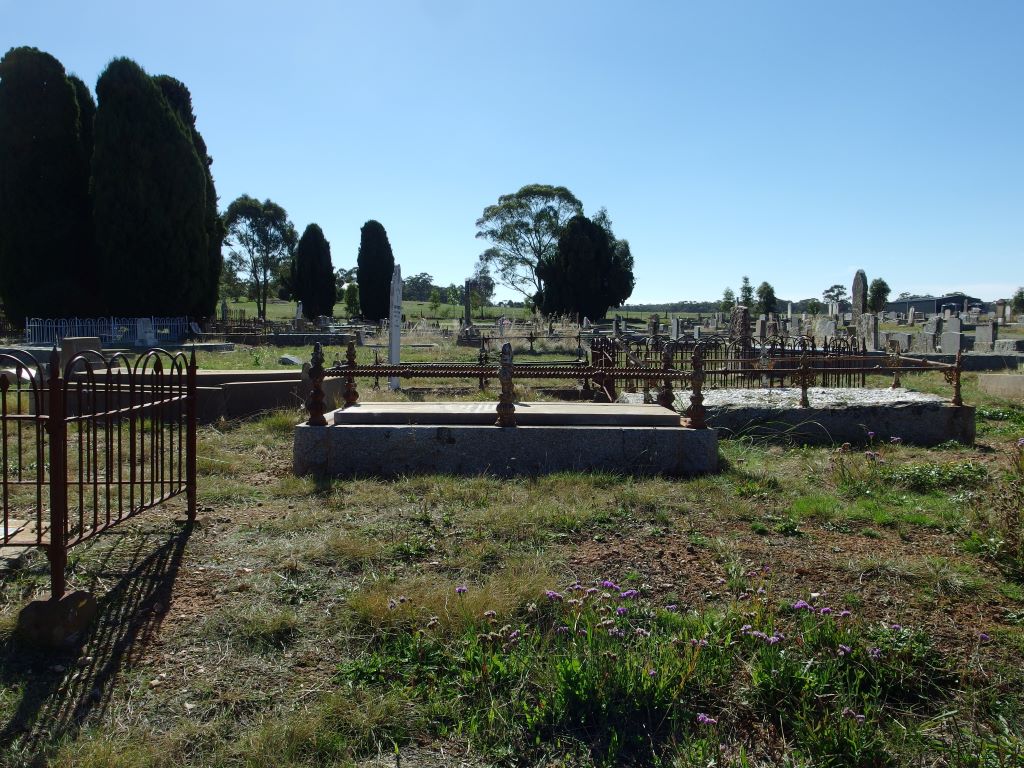
Great grandad in that central mound? Approximately?

A local historian also arrived, and came to talk to us, giving more information about the general burial practices of the time. There seemed to be a degree of competition between the two men. The Secretary checked his copies of the records and said that Plot 173 had originally been recorded as Daniel’s grave, but that had been crossed out and 160 put in. Who knows what really went on?

So we went to another mound of earth that was approximately 173, nearby. I took photos of both.

Or under this one?

It seemed there was no more information to be gained here – and no helpful headstones.

John arranged to meet the historian at his place, after we’d had some lunch. The man was going to check his files at home to see if he had any further information.

Back in town I walked to a bakery and bought a pie for John and a toasted Mediterranean focaccia for me, and coffees. $23. Very nice lunch, I thought.

The historian was waiting outside his place for us. He had nothing on Daniel, but had found an original death notice for Annie, and a local newspaper write-up of her funeral in 1912. He had records of the graves in the nearby Woosang cemetery, showing a number of people descended from the only child of that third marriage, a daughter.

So, it seemed that I had a number of distant part-cousins living around the Woosang and Charlton areas. With what I now knew about our ancestor-in-common, I doubt they would be interested in meeting me! Given that Daniel’s daughter from his first wife – the one abandoned in SA – had about ten children, there must also be any number of others in SA! All very interesting, but frustrating. Wish I could go back in time and talk with some of these people.

I was really grateful to the two Wedderburn men who gave up their time and tried so hard to help.

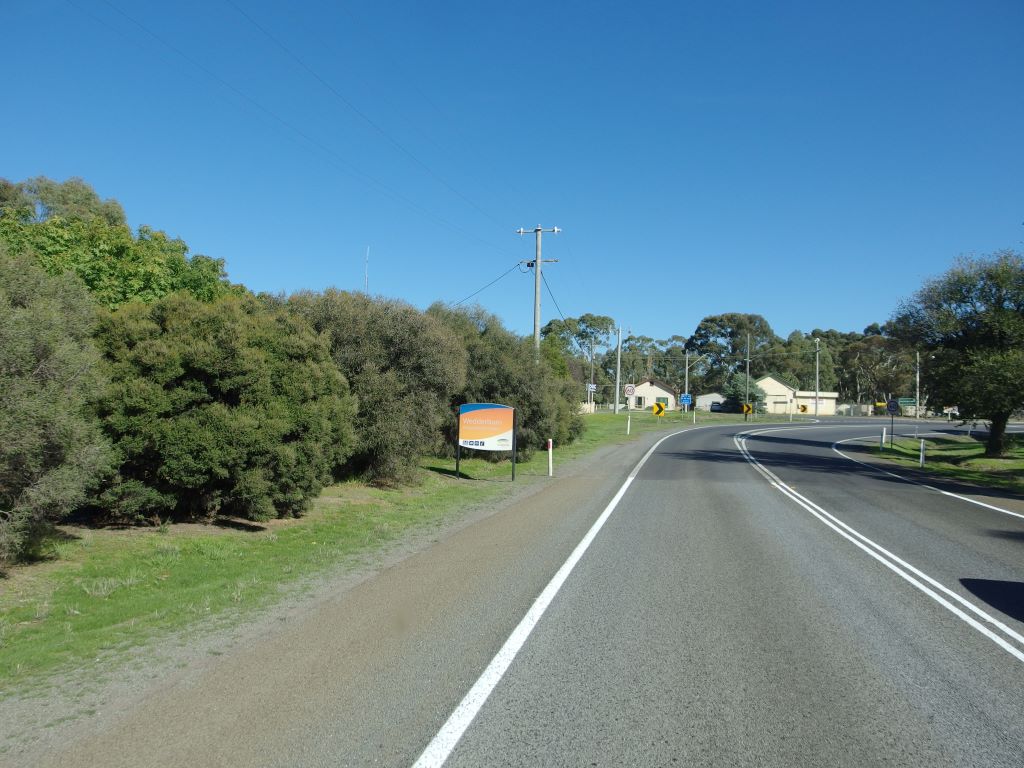
Wedderburn

2pm when we left Wedderburn to continue on to Boort. It was a pleasant drive, through sheep and grain growing country, some of it irrigated, which surprised me.

Booked into the Boort Lakes Caravan Park. $35 a night. Our site was excellent – on thick grass, backing on to the Little Boort Lake, and in the centre of a group of about ten such sites. It was not far to a small amenity block – older demountable style one. The main one was a bit further away. We had a shade tree next to us.

The park reminded me, for some reason, of the one at Copi Hollow, near Menindee, in that it mostly consisted of permanent holiday cabins and structures built around caravans, with just a couple of fairly small sections for travellers like ourselves. With a boat launching ramp next door, and a water ski club, the lake was obviously a summer holiday playground for the region. Like Copi Hollow, it was very pleasant in this “off” season, but I would not want to be here in the summer holidays, or at Easter.

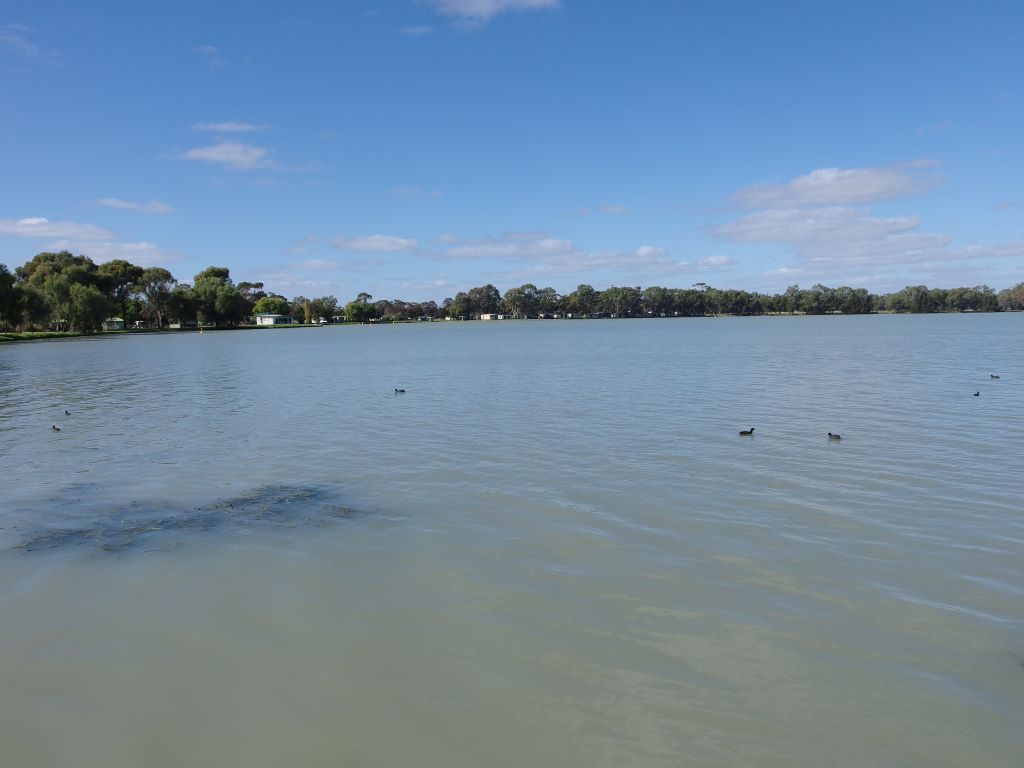
Boort Lake

This was a great park for the dog! As the nearby cabins were not occupied, there were plenty of grassy places where we could throw the ball for her. There was a walking path from the park, through adjacent parkland and on around the lake. This was a 3.7km circuit, so the lake was bigger than our local Lilydale Lake. And, of course, there was the water for a splosh about in, whenever sneaky dog could manage it. I got out my supply of dog drying towels!

After set up, drove to the shopping centre, for milk and bananas. Can’t be without the latter, because dog expects at least half a one, each morning. John went of to the hardware store and bought a hair dryer – for use on said dog.

Boort seemed a pleasant little town. IGA supermarket. Newsagent. Hardware store. A couple of hotels, and so on. Their civic provisions were certainly excellent, with tennis courts and a bowls club part of the extensive parkland area.

We sat outside, enjoying the sunshine. Dog “persuaded” John to throw a stick in the water for her to retrieve. Then we had to tie her up in the sun to start to dry. There proved to be no way that hair dryer was going to get anywhere near her. Given her dislike of being air dried at the dog groomers’ I was not surprised. Looked like grand daughter would be receiving an unexpected gift – one hair dryer, surplus to requirements.

This will do very nicely…

A local teenager came past, walking a dog that proved to be a kelpie/koolie cross – beautiful creature and incredibly well trained. Her obedience put our girl to shame. The lass stayed and talked with us for a while – didn’t seem to want to go. When a van pulled on to the next site, she stayed talking with them, too.

After the late lunch, we only wanted soup for tea, so I heated up a tin of pea and ham variety.

The night was chilly, but not as cold as Marong had been.