This Adventurous Age

Adventures travelling and working around Australia.


Leave a comment

2002 Travels August 2 – September 13

OUR TIME AT DOOMADGEE

Friday 9 August – Thursday 15 August

On Friday there were only about ten students at school! The weekend was the annual Mt Isa Rodeo, which meant that the Monday was a public holiday in these parts. Rodeos are major entertainment in the Qld country areas, so there was a mass exodus from the town.

We had thought about spending the long weekend camping at the coastal camp area run by Wollogorang Station, to the NW of here, against the NT border. The thought of being by the sea was an attractive one, and there were very limited places on the Gulf coast where one could access this.

However, on Friday John developed flu symptoms and he spent the whole weekend feeling thoroughly miserable. It seemed a nasty bug. It was most unlike John to be sick. Through the ensuing week he went to the hospital to try to get some medicine to alleviate his symptoms. The doctor prescribed Panadol, Vitamin C and a cough mix. The hospital pharmacy was out of Panadol and cough mix, so he was given an anti-histamine instead! Not quite the same.

On Sunday we drove to Hells Gate Roadhouse, on the Gulf Track, some 80kms to the NW. Apart from getting out of the community, the purpose of this expedition was to buy a couple of cartons of beer, having been told by some of the other teachers that having same for our private consumption, was alright.

The drive was a dusty one, through flat scrub and grassland country.

There is an escarpment of the edge of the range country, outcropping at Hells Gate. Back when the pastoralists were starting to occupy the lands to the west, with strong resistance from some of the native tribes, mounted police would escort droving parties as far as the escarpment, on the then rough track. After that, they were on their own, often facing hostile attacks. Hence the name.

Resize of 08-04-2002 hells gte airstrip

Hells Gate airstrip, beside the Gulf Track


At the Roadhouse, there were a couple of other vehicles, from Doomadgee, stocking up on beer.

Resize of 08-11-2002 05 bower at Hells Gate RH with flowers.jpg

Bower bird creation at Hells Gate Roadhouse

Apart from the Roadhouse and its attendant little camp ground and a kind-of small motel, there was an air strip. We noticed an advertising sign for the fairly new Kingfisher Camp tourist venture, to the south of there – another place we could go for a weekend away.
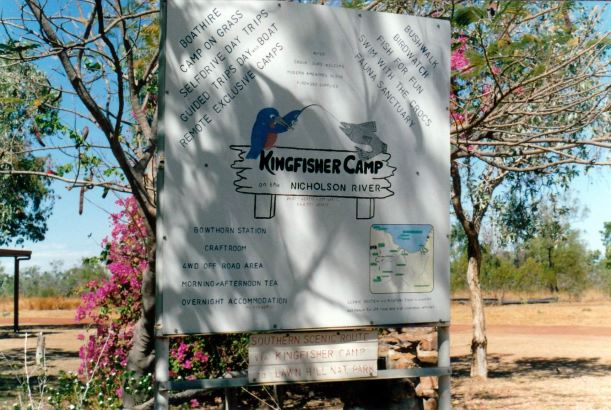
Resize of 08-11-2002 04 sign at Hells Gate RH

By the end of the second week at the school, it had been established that I would teach Home Eco to some of the secondary boys – so that was one of the late morning time slots. The SM figured that, since I had been cooking at Adels Grove, this could be my teaching role. I figured out that being trained to teach History, Geography and Politics had really not equipped me for this!

There would be a male teacher in the room with me when I had the boys’ class.

I would deliver the TAFE VET course in Kitchen Operations for three of those time slots a week. More on that later! I would take a Mothercraft course with the secondary girls’ class for one slot a week. I would do some one-on-one remedial reading work with one of the secondary girls for about 15 or 20 minutes every morning, under the direction of the literacy lady. For the rest of my time I would act as an assistant to the SM and Deputy Principal, though they were yet to agree to the exact time division between them.

It soon became obvious that I would also fill in – for the morning literacy and numeracy sessions until little lunch – for the secondary girls’ teacher, when she was away. I was quickly to discover that she was always away for one day a week, and sometimes two.

It was also soon obvious that assisting the DP meant chasing up the classroom teachers for documentation of their courses and associated paperwork that she had not to date been able to extract from them. They generally seemed to see her emphasis on planning and the like as a nuisance and were not inclined to do what she wanted! However, given the realities of trying to operate in these classrooms, I could sympathize with them not feeling like they had the time, or need, to do her paperwork. I was certainly pretty sure that what happened in the classrooms did not match the theory she had planned!

I was allocated desk space in a staff/storage area, of sorts, close to the secondary girls’ room. No-one else seemed to use it much, so it became rather lonely, working in there.

As well as the above duties, there was also the usual yard duty at the breaks, and before school – several sessions of this a week. These were not particularly comfortable times – the students were often very unruly on breaks and it was hard for me to know just what was acceptable, here.

The SM gave me a key to the Home Eco centre, which was to be my domain. This was kept locked when not in use. There was not much point to this, I soon found, as all sorts of other people must have had keys too. The woman who ran the intermittent breakfast program certainly did – although she was not supposed to use the kitchen for that, but had a separate little room nearby. But she obviously raided the gear – and food supplies – if she got a chance. She did not return anything thus “borrowed” – or wash it up! It fell to me to go hunting for my missing equipment, and clean it.

Other locals obviously had access too. I would find that groups had come in when I wasn’t there, or on weekends, and done things like make up lots of containers of cordial for special occasions – and they would have left the floor a sticky, dirty mess – for me to clean, since there was no other cleaner.

I investigated my new teaching domain. There was a large kitchen, with benches, stoves – only some of which worked, and sinks. The drawers and cupboards at the work stations had the gear one would expect – measures, implements, saucepans – but not one had a full set of what should have been there.
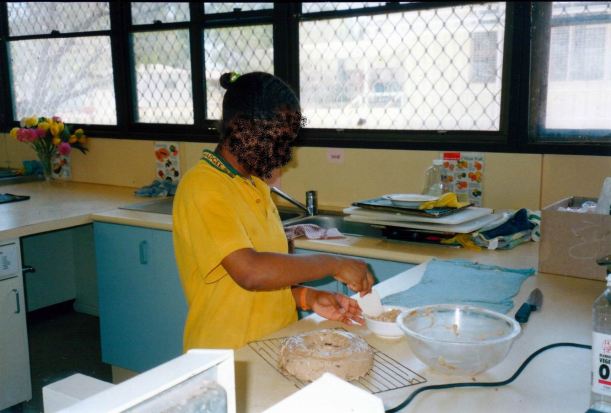
Resize of 08-30-2002 cooking class.jpg

The Home Eco room during the Visiting Chef program. Note the mesh over the windows

The two fridges had been turned off for some time, but left closed, so they smelled awful, and had gone mildewed on most surfaces. I attempted to clean these.

There was a laundry area off the kitchen, with a washing machine that worked.

There was a large, locked, pantry and storage area for foodstuffs and portable equipment. This also contained a number of portable sewing machines and associated gear. There was little in the way of stored food staples though.

I was to find out that my departed predecessor had preferred to try to teach sewing rather than cookery, and had the students making beanbags. I doubt any of these that got finished would have lasted long in the sort of homes they mostly lived in! There were a number of unfinished ones in a corner of the store.

Clearly, whatever might have once been in the storeroom in the way of equipment, had “walked”. There were no mixers of any sort. There was one electric frypan, but cords and lids for several more. When I mentioned the total absence of any form of sharp cutting knives, the SM said the school had spent a lot of money at the start of the year on a really good set of chefs knives. There was no sign of these, but he hinted that he may have been looking after them at home!

I soon had to solve the shortage of equipment by taking some of my own to use – knives, electric frypan, kitchen tongs. Anything of mine was carried back and forth from the house, as I needed it – and never left unattended in the kitchen. Even left in the supposedly secure store area at school, it would soon have walked. Several times I had to retrieve the one school frypan from the breakfast lady.

The first task in the Home Eco centre was to give it all a reasonably thorough clean, before it would be fit for use. I think I was probably still in shock at hearing that there was no cleaner. It was a bloody big area, too.

Food supplies for classes were something I would have to shop for, from the Store, complete with Requisition Slip obtained from the Office Secretary. Ho hum – back to bureaucracy. There was no budget, of course. The limitations of the community store would affect what I could do.

There were no curriculum documents either. I was on my own in terms of what got taught in Home Eco and Mothercraft, and found it rather daunting. There were just no records anywhere of previous programs – apart from a few I unearthed in the school library from back in the Mission days. These clearly showed how far the school education had regressed since then!

So, with nothing to guide me, I soon decided that the practical cooking sessions would just feature things the kids might be able to do themselves, at home – i.e. of some real practical value, in combination of what they might like to eat. Apple crumble, fried rice, bacon and eggs, came to immediate mind. The food had to be able to be made and cooked within 80 minutes, too – and with the very limited cooking resources in the kitchen.

By the entrance to the kitchen was a row of hooks with some aprons on – but these were not often worn. There was also the shelf of assorted school shoes, as dictated by OHS requirements.

I did find some course outlines and work booklets for the VET Kitchen Operations course, stuffed in the store cupboard at the back of the kitchen. In theory, some of the girls had been doing this course since the start of the year. In practice, my predecessor preferred to have them sewing! The SM was so well organized that he could not even provide me with a list of the students the school had paid for to do the course! And, of course, there were no results for the first semester. Wonderful! I should just have to start at the beginning, and see how far we got.

I spent some time during this week, trying to get some help/information. I walked to the local AbHealth Office to see some of the local ladies to try to get some idea about what they thought would be acceptable, culturally, in the Mothercraft class. I didn’t want to repeat the mistakes made by S, when she taught some very explicit sex education to the girls, without consulting anyone in the community. I did not get very far. The ladies were polite, but totally vague and non-committal. They probably found the idea that mothercraft needed to be taught, rather mystifying – or even that it was a “craft”. Many of the local children seemed to be bringing themselves up!

John was allocated a room for his literacy work – but with no furniture in it. No-one was much help to him. Eventually he found a store room with a few tables and chairs in, and got the students to help him move them in and set up the room. It was not ideal conditions for teaching, but what was, in this place?

Leave a comment

2002 Travels August 2 – September 13

OUR TIME AT DOOMADGEE

Friday 2 August – Thursday 8 August:

I have already described our initial arrival tasks and things we had to organize. We moved most of our possessions from the van to the house – mostly for their security.

We would be paying rental – a token amount – for the house, to the Education Department. This would be a deduction from our salaries.

We decided that the house would “do” – it was big enough for us. The second bedroom took the things we wanted to store, from the van, plus the ironing board that came with the place, was set up in there.

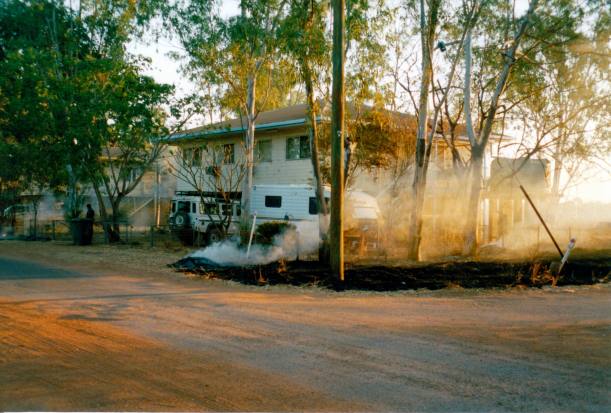
John decided that his main task for the weekend would be to burn the long grass around our fence line – before the locals decided to put a match to it, and maybe burn the van! It took him a good part of the two days, doing small sections at a time, and patrolling carefully with rake and hose.

Resize of 08-03-2002 03 6A and 6B Potter St Doomadgee.jpg

Making our perimeter safer

Made our initial foray to the store and was very unimpressed with what was (not) available. I did manage to get some soy milk, which was a bit of a surprise. Also bought Weetbix and some elderly potatoes and onions. No fruit available. We did have some food from the van freezer, but it was obvious that meals would become a challenge, without a decent meat source, and not being able to trust the frozen products. Rice and pasta would have to star! I also had some vegies and eggs that I’d bought from Adels.

I would get a better idea when able to get to the store within a couple of hours of the weekly truck arrival, of what fresh and perishable produce there might be.

A few weeks later, I was planning that I would bring back a supply of frozen meats, when we returned from the outside world, after the Term 3 school holidays. I thought I might be able to set up an arrangement with Woolworths and Ringrose Transport in Mt Isa to get my own private supply on the weekly truck.

We discovered the first afternoon that the sun sets behind the house – the late afternoon sun came through the kitchen window. Sunsets here were very pretty. Not much else was!

Resize of 08-09-2002 05 Doomadgee sunset.jpg

Sunset seen from the back verandah

We went for a walk down our street, towards the main road. We did not feel all that secure about doing so, because of the packs of dogs that were around. I had a feeling that we would not be getting much walking exercise in this place!

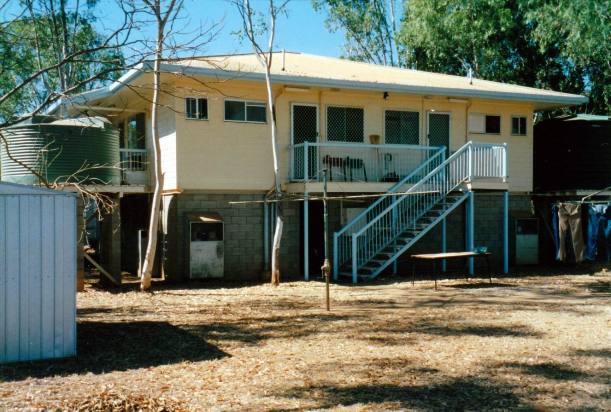
Resize of 08-11-2002 back of house.jpg

The back of the house – gas bottles in locked cage

Monday was our first day at work. We both felt eager to discover what plans they had for us. The answer very soon became apparent – no one had really thought about it!

The SM took us to a securely locked storeroom – of which he was the key’s only custodian – and issued us with things like pens and writing paper. Despite how far it was into Term 3, he still did not have a timetable worked out for the secondary students – all three classes of same! There was only a handful of elective and TAFE programs to be allocated time slots. It certainly was not rocket science! He had been telling the teachers to figure out for themselves, what to do with the students!

John made it clear that he believed he was here to work on literacy programs. Through the week, he met up with the staff lady who dealt with the remedial work for students, and also the occasionally visiting psych lady. Neither seemed at all interested in working with him on remedial literacy programs. In fact, they gave off a definite aura of hostility.

Eventually it was sorted out that John would have – for some of the time – a small class of boys who needed remedial reading work. John said he would fill in elsewhere as needed – definitely not a wise move!

We just puttered about, through our first week, trying most of the time to work out what the hell was going on.

Thursday was Sports Day – like a house athletics competition. We helped out with the oversight of some events. I was already getting to know a few of the older girls’ names and was able to spend some time chatting informally with them during the sports.

One funny episode occurred during the sports, which were held on the school oval. A couple of boys, probably aged about 12 or 13, were walking back from the direction of the store, towards houses beyond the school, carrying a couple of bags of shopping. Seeing the sports happening, they just dropped the shopping, left it where it fell, and raced onto the oval to join in the sports.

John refuelled Truck at the Store, this week, paying $1.22 cpl.


2 Comments

2002 Travels August 2 – September 13

The school:

On paper, there was an enrolment of 360 students, in Years 1-10. There were 28 teachers, plus about 16 aboriginal teachers’ aides- only a few of whom turned up on any given day, and not in any predictable manner. These were all women. An aide would sit in a classroom – chosen by her – and watch proceedings, but did not actually do anything else. So they were more observers than any actual help to the teacher.

One of the several major problems for the school lay in the clan group/family warfare of the community. Certain groups of students would not attend school when other groups were there. Ditto the teachers’ aides. Classroom and playground dynamics remained a mystery to us.

The enrolment figures were derived from the start of the school year – in the Wet season – when Doomadgee was cut off from anywhere else. So, going to school was something to do. By August, there were about 60 students who attended fairly regularly. Others drifted in and out, from day to day, depending on what else was going on in the region, and their mood, and whether there was something like sport happening.

It was obviously very hard to run classes systematically, when no-one knew until 8.45am, whether there would be 0 or 50 kids in a class! Some primary classes had been formed from fairly regular attendees, and teaching here could be a bit more predictable and able to be planned. An example was a composite class of Years 2,3 and 4 of regular attendees. Other classes were designated for catching the day’s unpredictable arrivals. An example was a Year 2,3,4 class of irregulars – on any given day there could be no-one, or 50, in this group! So teaching bodies had to quite often be shuffled around at the start of each day.

For some of the irregular attendees, it might be their first day back at school for a week, or a month, or a term! They may decide to leave again, part way through the day, and not be seen again, maybe ever. Trying to deliver any meaningful or effective schooling to this group was well nigh impossible.

There was one secondary girls’ class, covering, nominally, Years 8-10. The 14 girls in this group attended most days. I use the term “nominally” because the achievement levels of these Year 8-10 girls ranged from about Year 3 to Year 7, as we would understand it. There was a smaller, equivalent boys’ class – usually about 7 of them. As well, there was a class of “feral” secondary age boys – fairly regular attendees but basically un-educable, due to their lack of any discipline or self control, and/or any accumulated learning to date. The school was obliged to do something with them. Two young male teachers were usually assigned to this group, together – to take them to practical, physical and outdoor activities, totally removed from the rest of the school. They were, essentially, uncontrollable and at times a danger to themselves and each other, not to mention the teachers!

The Principal – who had been responsible for persuading John to come up here – seemed to spend a lot of time away from the place. He was on various committees, union and working groups that met in places other than Doomadgee – Mt Isa, Cairns etc. We actually wondered if he was somewhat wary of being in the place, and possibly inadvertently doing something that would spark another riot.  He usually drove to wherever his meetings were, rather than utilizing the daily Mt Isa-Doomadgee-Cairns plane, so the time taken driving added to the time he was required to be away.

The Qld Education Department offered inducements for staff to go to schools like Doomadgee, Mornington Island, places on Cape York. For someone who took on the Principal role – and he was quite young for this – two years running Doomadgee would guarantee him Principalship of a better school. The majority of the teachers were in their first or second year of teaching, and for most of them, this was the only way they could get accepted into the Department. If they lasted two years, they became permanent. So, from their cohorts of recent graduates, they had not been chosen for other schools. So, the majority of the staff were enduring their two years. But there were some who were trying their hardest to make a difference.

The Deputy Principal was the lady who lived in the other half of our duplex. She was middle aged and an experienced teacher. We found her really genuine in her efforts to improve the quality of educational delivery in the place, if somewhat idealistic. I guess one had to have hope and idealism to survive in such a school. The teenage girls seemed to respect her, as much as they did anyone. Under her guidance, the focus of the school was on literacy and trying to improve same.

The Senior Master had spent time on Mornington Island, before coming here, so he was experienced in difficult indigenous schools. He was a loud and bulky man and these qualities seemed to have some disciplinary effect on some of the boys. He was responsible for the daily organization of the school. When we arrived, it was weeks into Term 3, and there was still no operating timetable!

There was a part time, experienced,  lady designated as the literacy/special education director. She seemed to see John as a threat, from the outset, and was not at all helpful.  Another experienced lady came in part-time from somewhere else, a few times, as the Psychology advisor.

A woman who had been teaching for a few years was the secondary girls’ teacher. She took them for all core work: literacy, numeracy, social studies and the like. In the time we were there, she never worked a full five days straight – always taking off either a Monday or Friday, each week. She was quite open about this; there seemed little the admin could do about it. She consorted with some of the locals and went off on three day camping weekends with them. The leading women in the community disliked her intensely – apparently she had offended local custom by giving the girls some rather frank sex education classes. But the girls obeyed her – albeit in a fairly surly way. I didn’t see much evidence of respect for her, though. I will refer to her as “S” – for secondary.

S had also clashed, earlier in the year, with the teenage daughter of one of the prominent community families. Daughter had gone off to board at Shalom College, in Townsville, at the start of the year – nominally at Year 10 level. However, Shalom posted her back home, sometime in Term 2. The girl was semi-feral and very disruptive – possibly because she was, under it all, quite intelligent. She and teacher had then clashed, on a school trip to Cairns, and the girl had brandished a pitchfork at the teacher. Student had had a period of exclusion from school but after that ended, refused to attend. S refused to have her back, so it was a stand-off. By my standards and expectations, she’d have been permanently expelled and not allowed back at all.

Unfortunately, when S was on one of her weekly days off, somehow the word would get round that I was taking the girls’ group, and the disruptive girl would show up. I wished she wouldn’t! She was insolent, totally full of herself because of her family’s prominence, and even after the Shalom experience, showed no indication of being motivated to improve her low standards, despite said intelligence. As far as I could tell, she came to school to make the point that she could – and to swan around making a pest of herself in class. Fortunately, the rest of the secondary girls were quite pleasant, and willing to try in class.

The experience of this girl was typical of what happened to those students who were sent away to other schools. They just didn’t last out there. There was too much of a gap, in learning terms, between where they should have been, and where they were. The same often applied to behaviour too, especially in a boarding school context. Very sad.

S’s teaching methodology was to get the girls to work on photocopied handout sheets – taken from various sources, not made up herself to suit the kids. From the piles of these in the classroom, it was clear she didn’t bother to check or correct the sheets they completed. There was very little actual instruction on how to do anything. I formed the impression that this sort of handout work was the main way of trying to keep the kids busy, in many of the classrooms.

The girls did enjoy the time, each morning, when S read to them from a novel. A book was quite a novelty.

When we started, there was a local lad on the teaching staff, who had qualified to teach in some sort of special program for aboriginals – he was a real success story. Doomadgee was his first teaching post, and he turned out to have made a mistake in coming home for it. Not long into our stay, he resigned – because the living conditions in his family’s home, and the lifestyle the family expected him to participate in, was not compatible with working standard days. Sleepless nights, inability to do any work at home, or keep any school materials safe there, contributed. It was very sad, but symptomatic of the barriers facing those who have more ability and drive than the average community member.

An American drama/music teacher who was there when we arrived, disappeared a few weeks later. He disgraced himself on a weekend visit to Escott Lodge, with some extremely drunken behaviour, and was banished.

One of the primary teachers was a bit older than the average – around thirty. She worked in a Grade 2-3 class – not the best of these groups – but seemed to be constantly gathering in students outside that range, that the other teachers found hard to work with. I couldn’t tell whether this was to try to help them survive, or to demonstrate her own superiority. The result was that her very large class contained some challenging behaviours. Later in August, she – supposedly – left for parts south, to see a sick sister. It was fairly obviously an excuse to get out of a situation in which she was not coping. We knew she would not return.

Through much of Semester 1, there had been a Home Economics teacher, but she had fled in Term 2, and not been replaced. Our house had been hers.

After a few weeks, I decided that, of the entire staff, there was only one I would definitely have in a school I was leading, with another two possibles. Forget the rest, in terms of being, or becoming, talented and enthusiastic teachers.

The school had a canteen, run by local mothers. School staff input was not welcomed here. It would not have met any canteen standards in a normal school, in regard to hygiene, food preparation, adherence to use-by dates. During the mornings when lunches were being prepared, toddlers in filthy nappies and with streaming noses, played on the floor or were sat on the benches to watch. A number of dogs wandered in and out. The canteen did not open regularly, but three times a week provided “free” (government funded) lunches for the students. These were usually white bread sandwiches, dim sims, and the like.

The brown kites – of which there were large numbers around the community, due to its volumes of rubbish lying about – were very well fed on free lunch days. Kids would take a bite or two from a sandwich, decide they didn’t like the filling, and chuck it away.

One local lady ran a breakfast club, of sorts, to give some children breakfast before school. It operated very intermittently and unpredictably, and only fed a few kids. I suspected there was some government funding for this, and that the few who were thus fed, came from her own extended family.

There was so much money being poured into the school and its associated programs – and so little return for same. So much waste. There was a room full of expensive musical instruments – many broken. A program would be proposed, be equipped and begin, then the teacher would be gone, and that was it.

There was funding for sporting excursions – which meant going to places like Cairns. At least, the kids enjoyed those and benefitted from glimpses of the world outside the NW Gulf country.

A (funded, again) visiting chef/cook came for two days while I was there, and ran a program with the better behaved secondary girls and boys. Supposedly, it was to show them what work in the food industry was like. However, she did most of the work, assigning the students to basic tasks they could manage, without them really knowing where what they were doing fitted into an overall plan. The students could not really relate to the processes that resulted in the array of food served to their parents and some community elders, for lunch on the second day. As I had already found, their kitchen skills were rudimentary, at best.

Resize of 08-30-2002 Doomadgee visiting chef and class.jpg

Visiting chef with course participants

There was a small house-like building, off to one side from the school, that was used for accommodation for outside advisors, and similar visitors to the community, who needed to stay overnight. There was no other guest or commercial accommodation in Doomadgee. Visitors rarely stayed in the community; some went to great lengths to avoid doing so! The preferred option was to stay in Burketown and drive the 90 kms or so, of rough road, each way, even doing so for days in a row.

Qld was introducing the Prep year of schooling in 2003, and there was talk in the school of housing the Preps in that building.

The Technology room, and the Home Economics room, each had an array of school shoes, of varying sizes. The students had to wear shoes in these classes, to adhere to safety standards – mostly they were barefoot the rest of the time. This ensured a degree of punctuality to these classes, as the later comers had to take what shoes were left, regardless of fit.

There was a room equipped with computers – enough for maybe 25 students at a time. This was able to be linked, via Skype, to the outside world. The best teacher – of the best attending kids – had her students doing a regular hook up with those from a southern school.

There did not seem to be any shortage of sports or PE gear. There was a hard surfaced playing area – quite sizeable – that was roofed, and with basketball rings. This area was used for school assemblies too, with the students sitting on the hard surface.

The school had a swimming pool – not in use while we were there, because it was the “cold” time of the year. It also had its own LWB Coaster bus.

In the admin area, there was a well-locked room that was the supplies store, where teaching requisites were kept. This was a school where students were issued with basic needed materials – to be kept in the classrooms at school and not taken home.

There could be no homework given – the majority of students did not have necessary requirements (like writing implements) at home, nor an environment conducive to same. Anything sent home would be lost, damaged. There could obviously be no such thing as a home reading program. Students at all levels wrote with lead pencils, kept in a container in the classroom. Sharpening these to a real point, and using them to stab others, was something we had to watch out for.

Some classrooms had old, tatty, carpet on the floor, complete with a quota of fleas, in some rooms.

All the school windows had heavy duty crimsafe type screens. The secondary girls’ classroom had all its windows heavily draped with blackout curtains. Once the girls were inside for the session, the door to the outside was locked and covered with its black curtain. This was because males from the community would otherwise be hanging about outside, and making pests of themselves, to the extent that some of the girls would not feel safe – teachers too!

There were a couple of occasions, in the uncurtained Home Eco room, where small packs of roving males did peer in the windows and make obscene comments; the door was very securely locked, though, and this room was in a more central part of the school, where they were less likely to venture – compared to the girls’ classroom which was at the edge of the building cluster.

Despite the security mesh or bars on the school windows, there was regular breaking of glass by stones thrown after hours or at weekends. The resulting broken glass lying around was of concern, given that many of the students went around barefoot.

Some 80% of the students had some degree of hearing loss, as is the norm in such communities. All the classrooms were equipped with the Sound Field system, where the teachers wore a box that amplified their voice in a way that allowed all students to hear more clearly what was being said. This in itself was a considerable capital investment.

The childrens’ hearing loss was mostly the result of untreated ear infections when younger. Or poorly treated ones – the chances of a child in the community actually completing a course of prescribed antibiotics were very low. To help counteract the issue of ear and sinus infections, first thing every morning, each primary class was taken outside, by their teacher, complete with large box of tissues, and bin. The students sat for ten minutes, blowing their noses, supervised by the teacher. For some reason, nose blowing was not the norm for younger community children – they just ran, dripped, or got blocked! This was a less than charming way to start the day!

Too many of the students were malnourished and hungry. Scabies was endemic, we were told. As were head lice. We were told by the Senior Master that he put undiluted hair conditioner liberally on his hair, each morning, and did not rinse it off, and this seemed to keep nits at bay. It did nothing for his looks, though. Within days of our arrival, I phoned K and P and asked them to buy and mail up the most effective head lice treatment they could find. There was nothing like this available in the store.

Kids came to school tired, because they roamed the streets freely until all hours, or were on the fringes of loud, all-night gatherings of adults. Even those families who tried to run what we would see as “proper” households, were grossly overcrowded, with 10-20 people per house, and disturbed by the noise from neighbours.

Things that we take for granted in our lives were not present here. Like having a clock, or watch. The school siren was set to be able to be heard over most of the community, as a signal that it is time to come to school. So it was sounded a couple of times after 8am each morning.

A lot of the students were fascinated by the watches that the teachers wore. In that same vein, being allowed to write for a short time with a biro was a great reward.

Children often did not know how old they were, nor when their birthday was. Some of the teachers, who had such data for some, made birthday cakes – often the only indication the child had that it was their birthday.

We take print around us for granted. Not so, here. The school had a library, but these were the only books in the community. There were no newspapers or magazines sold in the store, nor written information around the place. In a culture that is oral based, teachers had to try to change childrens’ mindsets to even think of print as a source of information or entertainment. Though maybe the coming age of computers would kind of jump that step?

School started at 9am and ended at 2.45pm. After roll call and nose blowing, the whole school completed a two hour literacy session. This was the key focus of the school. Then there was a 30 minute “little lunch” break. Then followed 40 minutes of numeracy across the entire school. I felt there should perhaps be less of an imbalance in the times devoted to each of these. After this, the secondary students went into 80 minutes of TAFE programs, three days a week. The TAFE programs on offer were wood/technology related, hospitality or (for a selected very few) computing. The other two days, in this time slot, they did art, woodwork, home economics, mothercraft, computing and the like. “Big lunch” – 30 minutes – went from 1.30pm until 2pm. Numbers of the students did not reappear after this, so the 45 minute afternoon session was for odds and ends – like PE and sport – which had some chance of making them reappear.


Leave a comment

2002 Travels August 2 to September 13

FRIDAY AUGUST 2 TO FRIDAY 13 SEPTEMBER    DOOMADGEE

I have gone into considerable detail in my following descriptions of life here – simply because it was so different and so outside the experiences and comprehension of the majority of Australians. I think it needed to be told “how it is”. I wish I had more photos to illustrate the text, but this was not a place where one felt free to wander and photograph.

The community:

Doomadgee is located by the north flowing Nicholson River, which at that point is wide, crocodile infested, and not particularly attractive. The community is on the west bank of the river. In the wet season, the cement ford across the river to parts east, usually gets covered by water too deep to traverse. All other roads out of Doomadgee are dirt and become impassable in the wet, so Doomadgee gets cut off by road from the outside world.

Resize of 08-18-2002 01 Nicholson R weir at Doomadgee.jpg

The weir across the Nicholson River, just upstream from the road causeway crossing

The surrounding country is flat and the typical savannah mix of shrubs, low straggly trees, and grasses. In August it was dry and dusty.

The community had a population of about 1600. The handful of white people who lived there were teachers, hospital staff, police, workers who kept things like the electricity plant, sewerage system and water supply, going; and council administrators. From what we saw, it was fair to say that, without white people running things, they would grind to a halt.

The place began as a mission settlement – at Old Doomadgee, on the coast to the north – in the early 1930’s. Due to regular cyclones, and problems getting fresh water, the mission was soon moved to the present inland location. Under the direction of the missionaries, the place was quite functional, although the Christian Brethren operated by a fairly strict set of rules. There was a cattle station, a piggery, vegetable growing that supplied the surrounding area. There was a school and sound education for the children, and health care. The mission supplied permanent and temporary stock workers to surrounding station, droving crews, and female domestic staff to the surrounding district.

In the late 1960’s, after some years of agitation by the labour movement, and by urban liberals, it was decreed that aboriginal stockmen and pastoral workers should be paid the same wages as their white counterparts. Many of the northern station owners then decided, that if they had to pay the same wages, white workers were preferable. They were more reliable, not disappearing for ceremonial or family business. The station owners were not prepared to go on supporting the often large family groups associated with the pastoral workers – who lived on the stations, on “their” country – and who had been supplied with food staples and clothing, as part of the workers’ “wages”.

The aboriginal groups thus displaced were forced to move to nearby towns, or to missions. The stockmen who had derived purpose and self esteem from their work, lost this. The family groups became dependent on welfare – mission and government based.

This was an example of a concept, driven by urban white idealists, that seemed fair and just, in theory – but which was not based on the realities of the situation. Aboriginal policy is littered with these! It could be argued that much greater disadvantage came from the equal pay decision, than benefit.

In this way, the population of Doomadgee came to consist of five different “families” or skin groups or clans – who had no natural kinship with each other and who, moreover, had long standing hatreds and feuds between them. These persist to this day, but were kept under some degree of control in the mission days.

In the early 1980’s, control of missions was handed back to “local control” – another idea that seemed right to the distant idealists, but which has proven to have created mammoth problems in the resulting aboriginal communities.

At this time there were some 800 people in Doomadgee. In 1983, control passed to the locals, under a Deed Of Grant in Trust (DOGIT) over a defined area. The last missionary departed in 1988.

So, we found a hugely dysfunctional community, crippled by feuding, totally welfare dependent, with a rapidly growing population as babies were born to teenage mothers, and with major drug, alcohol and gambling problems.

When we were there, the police numbered nine – a large number for a population of about 1600, but necessary. There was a police compound – securely fenced – that contained the police station and some police housing.

There was a small hospital that seemed to be reasonably well equipped. There were two doctors – one was an elderly man, rumoured to have alcohol issues; the other was African, newly in Australia, who was extremely difficult to understand, and who seemed to have limited capacity to comprehend English, let alone the aboriginal version of same! There were a number of nurses – white. The hospital also served the function that a  chemist shop would in a normal town. One could not buy anything pharmaceutical at the store – not even Panadol, or cough mixture (contains alcohol!). You had to visit the hospital and see a staff member to obtain anything like that.

We were soon to find that the Flying Doctor plane was a regular arrival at Doomadgee – sometimes multiple times a day, and at least twice a week at night. Our house was at the end of the airstrip, and the arriving and departing plane flew very low, and loudly, over us!

Resize of 08-28-2002 plane leaving as seen from back veranda doom.jpg

Plane departing airstrip – seen from our back verandah

The story was that the medical staff were too intimidated to treat even routine medical issues, but evacuated virtually every case to Mt Isa. This was because, earlier in the year, a toddler had died on the steps of the hospital, as her carers were taking her in for treatment. Because there must be “blame” assigned for such things, this was regarded as the fault of the hospital. So then there had to be a riot, to show their displeasure and extract payback. The fact that it was the Wet season and there was little else to do, may have had something to do with it all. Anyway, riot they did – spectacularly. The whites in the community had to take refuge in the police compound and planes were sent to fly them all out to Mt Isa. Eventually, after much damage about the place, for which the government funded repairs and replacements, things settled down again. But that was why matters medical were sent to Mt Isa, and why we found so much current fear amongst the white population, of doing something that would spark off another massive riot. Probably in the next Wet season!

There was one community store, which was also the fuel outlet. The store was basically a large, shed-like building, cavernous and echoing. In a small side section, opening into the main store, was a butcher’s shop, of sorts. This sold basic cuts of meat, although the cuts were pretty rough, and smallgoods. One paid the butcher in his shop – the meat did not get tallied through the store check out. Unfortunately his establishment smelt very strongly of rotten meat. The meat displayed was often green looking. The butcher himself did not look very clean. He shut the shop before school finishing time, each afternoon, so he could go out and about in the community in his ancient Mr Whippy van, selling soft serve ice creams to the kids. There was no way I was going to buy his meat, having smelled the place, but I had to go in there sometimes, to buy a packet of vacuum sealed bacon, shipped in from the outside world – smallgoods of any sort were not available out in the main store. So it became a matter of rush in, when there was no one else there, and try holding my breath while the transaction was completed!

The indigines were not totally reliant on this butcher, at least in the Dry season. Numbers of them went camping and fishing at the coast – at Old Doomadgee – getting fish and turtle. Some would spend time at Lawn Hill National Park, fishing, and there were other waterholes on creeks closer to Doomadgee, for day trips to fish. From what we heard, at least one of the locals was in the habit of killing cattle out in the bush, and selling the meat.

Fortunately, we were warned, right at the outset of our time there, by one of the other teachers, who worked in the store on Saturday mornings, not to buy any frozen goods from the store. They had been having regular problems with the freezers breaking down. Each of the large cabinet freezers had a thermometer on it. She said that the staff did not bother to read these and usually did not pick up a malfunctioning freezer until the contents had thawed. Then, they simply moved the goods to another one and re-froze them. She said it was quite possible that a chicken or packet of vegetables had been defrosted and refrozen four or five times! This knowledge reduced our food choices in Doomadgee yet further!

The community store was supplied from wholesalers through Mt Isa and, as at Adels, the supply truck came once a week. We soon got to know when that was and would try to get to the store quickly, after school on that day, in order to get the “fresh” fruit and vegies we wanted – the supplies never lasted long. These were horrendously expensive and very varied in quality. Prices were not displayed on much, and so purchasing was a mystery until reaching the checkout. On my first shop, I bought a rockmelon – no price displayed, of course. It was $8!

The store had most basics, though there were a lot of gaps. There would usually only be one brand of anything available, like tinned tomatoes. It also sold limited clothing, and thongs. Batteries and knives of any sort were in a locked cabinet. There were no pharmaceutical items, nor items like turps or methylated spirits (because these could be drunk in place of alcohol). They did seem to have huge quantities of cigarettes and tobacco available – probably the most comprehensive range of anything in the store!

Some local ladies were attempting to run the store. The checkout staff were locals. Working here met their CDEP (work for the dole) requirements. There had been a new, white, manageress appointed at the start of the year – she’d had experience running a community store in a community way down south. We got to know her husband, who was a teacher at the school. It seems she had tried to manage the place along more commercially efficient lines than had the previous manager. One of her innovations had been to instal some monitoring cameras at the checkouts. She then commenced to sack operators who were putting goods through without actually charging for them – apparently a common practice; as was stealing money from the register, and/or giving money to relatives as they came through. All fairly widespread practices, she found. Then the family of one sacked girl got upset, rounded up their friends and they all rioted – again, a common happening in this community. They torched her 4WD vehicle (a “normal” way of expressing displeasure with someone) and attacked the store – especially the cash registers – with machetes, also threatening her with same. This had happened several months previous but she was still down south, on medical/stress leave.

Obviously, the women who were trying to run the show had glaring gaps in their expertise. Apart from the freezer issues, ordering was obviously haphazard. They could be out of basics for a week or three.

The old practices in the store were clearly back! My first time in the store, my trolley contained only a few items – the rockmelon, a box of soy milk, a small tin of milk powder, some teabags, some potatoes and onions. The woman in front of me had a trolley piled really high. She asked the register girl for three cartons of cigarettes, too. The tally for her goods was $50. Mine came to $45. I noticed that the cartons of cigarettes were not registered at all, and only every fifth item or so – the cheaper ones – got tallied. I found it hard to believe my eyes – there was no attempt to conceal what was going on. This was before we had talked to our colleague about what had become of his wife – then much became clear.

The local ladies would not work on Saturdays, because the CDEP terms did not require it. The store was only open for groceries and fuel on Saturday mornings because some of the teachers staffed the registers! On weekdays, the store shut somewhere between 4 and 5pm – it was random – so having the teachers volunteer in the store was the only way people like teachers and other 9-5 workers in the place, could shop and get fuel.

We discovered very quickly that shopping in the store could be quite unpleasant because the hygiene of some of the locals was not great. Queuing at the checkout behind a person who had recently been eating turtle was definitely to be avoided!

Resize of 08-09-2002 02 living room.jpg

The sum total of our living room furniture

Another aspect that struck us on the first store visit was the total lack of any printed material. No newspapers, magazines, books. No advertising material. No labels on things. Very few signs on anything. Reading was clearly foreign to most of the community.

At some stage, there had been a little caravan park, up by the main road, but this had fallen into disrepair. This was a pity, because – at least in the dry season – this could have been a good enterprise, employing locals. Not that we saw much indication that most locals were interested in being employed!

We were soon to discover that the school was unable to find people willing to be employed as cleaners. The teachers had to do whatever cleaning there was done! So the school was far from pristine. I think the hospital had similar issues. It was much easier to claim welfare than actually systematically work at something. Some were on the CDEP program, working some hours at the store, doing a few hours as teacher’s aide at the school, or cleaning up around the township and other assorted labouring work, for the hours required each week. It seemed to us that the CDEP program in Doomadgee was pretty token. The majority of the people did nothing for their welfare money, except – in the case of the teenage girls, breed! This gave them more money.

No one in the community seemed interested in capitalizing on the increasing tourist numbers going past in the dry season. Apart from the lack of any tourist accommodation, of any sort, there was a generally hostile air when tourists did deviate from the main road into the community, to get some fuel, visit the store, or just drive through for a look. They didn’t linger!

When the protracted Native Title negotiations were going on over the establishment of the zinc mine, one of the conditions imposed at the behest of the indigenous leaders was that the company had to train and employ a significant number of local indigenes.  They were trying to do their bit, but had found it impossible to fill their quota with locals who wanted to work. This was yet another gap between theory of what seemed right, and the reality of how it is up here.

One of the main community leaders was a person of very mixed ancestry, only a very small proportion of it actually aboriginal. His reputation in the district was of a thug, and corrupt. He was often in trouble with the law over things like illegal firearms, illegal meat slaughtering and supply – of stolen cattle, assault and the like. After we left Adels, he organized a sit-in at the mine, over some manufactured grievance. It lasted for a couple of weeks and coincided with when he was supposed to appear in court over his latest charges. Of course, he did not attend! The sit-in occupied the mine’s kitchen and canteen area – of course! This ensured comforts for the sitters-in. The mine workers were fed at Adels Grove, for the duration.

Doomadgee was, technically, a “dry” community – no alcohol sold or permitted. But we were told, upon arrival, that a blind eye was turned to having beer. Spirits and fortified wine were out.

There was a steady stream of locals driving either to the east, to the Burketown hotel, or west, to the licensed Hells Gate Roadhouse, to purchase their supplies. Both places were about 90kms from Doomadgee. Under local pressure on the council grader drivers, the road was usually fairly well graded as far as Hells Gate – but deteriorated markedly beyond that. I presumed that in the Wet season, there would be enforced drying out – which might account for some of the aggression abounding at that time.

There was a local “party house” over the road from our place. This seemed to always contain a fairly large number of people. There was not enough housing in Doomadgee for the size of the population. There was usually a campfire going in the front yard of this house, and people sleeping around the yard on old mattresses. It seemed quite anomalous in the morning, to see a carton of long life milk and a box of Weetbix, sitting next to the campfire. They cooked their meat on the campfire, so the smell of charred meat often drifted across the road and filled our house.

It was certainly a noisy establishment, where there was no shortage of alcohol, most nights, although Thursday (welfare payment day) through to Sundays were the worst for noise. After that, we assumed, the money, and beer, were running short. There was much very loud arguing, abuse and name calling, foul language, and regular fights. We were told that someone had been murdered there, with a star picket, a couple of weeks before we arrived. Everyone knew who did it, but no-one was telling the police, it seemed. One of the little kids told John the name of the guy… “xxxx, he did it, Mister”.

Thursday and Friday are pension/CDEP “paydays” – hence the following few days are the roughest in the community. It could be almost quiet by Wednesdays. We became a bit accustomed to the general rowdiness of the place. Apart from the noise of arguments and fights, there were often vehicles hooning about, especially on drinking nights. The roaming packs of dogs fought a lot. There was also a mob of horses that roamed the streets – extra noisy when these were chased around by the dogs. Another party house, a few doors up, often had really loud music going all hours. We could hear it clearly; the couple of young teachers who had the house next door really suffered.

Resize of 08-11-2002 03 Potter St Doomadgee view nth.jpg

Looking north along our street – at night the realm of dogs and horses

We did feel really sorry for the police who worked in this place. Theirs was a thankless and unrewarding life, it seemed, constantly trying to keep the peace and protect the people from themselves.

In the scrub, a distance beyond our place, were the remains of the old piggery. We soon found out that this was a not a direction we should go walking in – it was where the local youth, and some older ones – went to smoke gunja and sniff petrol. Both substances were much abused in the community.

Resize of 08-04-2002 03 from back verandah towards old piggery.jpg

From our back verandah, looking towards the old piggery, in the distance

We made an effort, at the outset of our time here, to go walking, for exercise. But we never felt really safe, doing this, because of the packs of dogs that often seemed like they were looking for an opportunity to attack. We always carried our walking poles, for that reason. During our time there, the pet dog of one of the teachers was badly injured by some local dogs that jumped the fence into its yard and savaged it.

We walked to and from school – only a couple of blocks. We usually did this together. I did not ever feel secure enough to go walking on my own. We knew that a young female teacher had been raped here, last year – and that this was not the first instance of a white female being attacked in the community. So, soon, the only walking we did was going back and forth to school. We felt that the Truck was actually safer from vandalism, parked at the house, rather than at the school!

Resize of 08-03-2002 02 van at Doomadgee house.jpg

The Truck and van parked at the front of our house


Leave a comment

2002 Travels August 3

FRIDAY 2 AUGUST   ADELS GROVE TO DOOMADGEE   125kms

Packing up was finalized – John had done some, after work, yesterday.

Truck was hitched up to the van for the first time in almost two months.

Our goodbyes were said – again.

We took the track north, back across Louie Creek, but at the intersection with the road to Gregory Downs, kept going north, to Lawn Hill Station. Negotiated our way around that and continued on, crossing Lawn Hill Creek not far north of the homestead.

Resize of 08-02-2002 05 fording Lawn Hill Ck.jpg

Crossing Lawn Hill Creek

From there, it was follow the main station track, roughly north, opening and closing several gates encountered.

Resize of 08-02-2002 06 gate on Lawn Hill Station

We passed what we called “Cow Corner” – a place on Lawn Hill Station where several fences intersected, and where there were water troughs, where there always seemed to be a congregation of cows.

Resize of 08-02-2002 07 cow corner Lawn Hill Station.jpg

“Cow Corner” on Lawn Hill Station

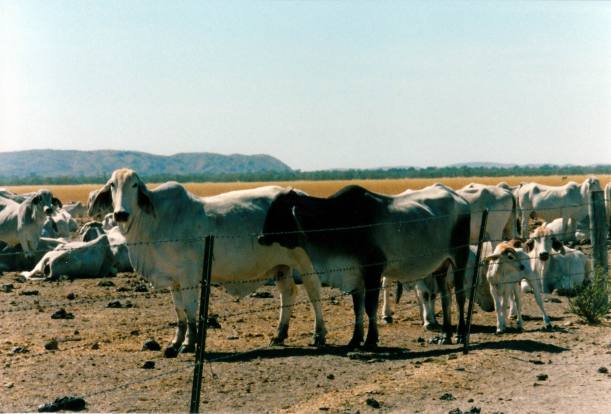
Resize of 08-02-2002 08 Lawn Hills cows

The distinctive hump backed cattle of northern Australia

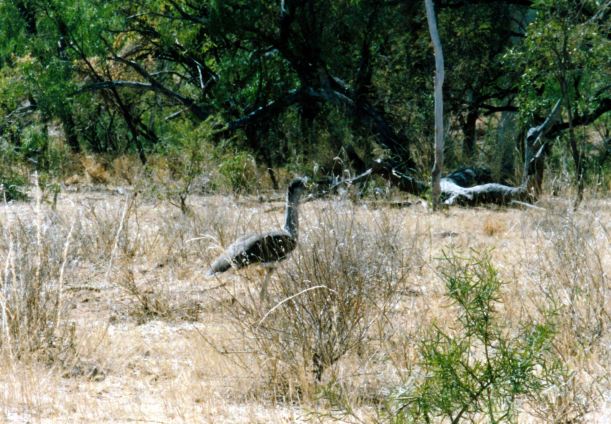
The track crossed a couple of dry gullies that would be running creeks after rain. Near one of these, a large bustard stood by the side of the track and just watched us pass. I hoped it was a good omen.

Resize of 08-02-2002 09 plains wanderer bustard.jpg

Plains Wanderer

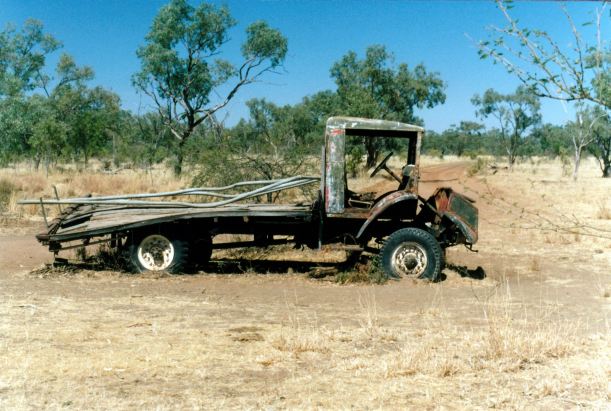
Just north of the fence and gate that was the boundary between Lawn Hill and Bowthorn Stations, there were some elderly truck remains. Just as we reached this, realized that a back tyre on Truck was fast going flat. It was an old, bald tyre, so that was not too surprising.

Resize of 08-02-2002 10 old truck Lawn Hill Station

This old-timer had seen better days

Changing the wheel was pretty routine. At least there was no passing traffic to worry about.

Resize of 08-02-2002 11 flat tyre border Lawn Hill and Bowthorn.jpg

Wheel change

At a T intersection, we took the track to the right. The left one was the “back” track to Bowthorn Homestead and Kingfisher Camp, a camping area the station had set up on the banks of the Nicholson River. That took us through to the Top Road – the dry season dirt road that runs east-west, from the end of the sealed road at Normanton, through Burketown, Doomadgee, into the NT, to the next piece of sealed road at Borroloola, some 720kms.

From that intersection, we were soon at the ford over the Nicholson River. This was long, cemented, and with a couple of bends that meant one could not see if another vehicle was approaching, on the narrow section. To our left as we crossed, not far from the ford, was a weir across the river that created a long, large waterhole, and helped ensure that the ford was dry, at this time of year.

The Doomadgee community township was on the far side of the river. It was laid out in a sort of grid, stretching back from the Top Road – which meant that travellers only needed to go into the community if they required fuel or supplies from the community store. There used to be a sort of roadhouse and campground at the Top Road, but that was run down and unused in our time there.

It was the school lunchtime when we reached Doomadgee.

I waited in Truck, parked outside the school, while John – who had been the one doing all the contacting and negotiating with the place – went in to say we had arrived, and get keys and directions for our house.

I think it was fair to say that, on first impressions, there was no part of Doomadgee that was attractive, and I remained unimpressed with the venture.

We made our way to 6A Potter Street – half of a high set duplex, on a street corner. There were a number of school houses in a row, here, and the Principal’s house was further up the street. Unfortunately, as we were to discover, the government houses were mixed in with those of the locals.

At first sight, the house looked alright, although I was not impressed with the trails and spatters of dried blood that went up the front steps. This was apparently the result of a recent fight between a couple of locals, and was an indicator that they felt free to intrude on the place, despite fences and gates.

I was never to feel secure in the house, or to go out without half expecting a break-in while we were away.

The other half of the duplex was occupied by the Deputy Principal, who lived there alone, although her son, who worked on Bowthorn, sometimes came to stay a night. I thought she was quite brave, living there alone, and wondered if she was relieved to have someone else in occupancy next door. Our place had been lived in, though, until the end of Term 2, a few weeks ago; then that staff member departed and didn’t come back – a fairly common occurrence here, we were to find.

We were only at the school ourselves, as it turned out, for six weeks, and in that time, three more teachers departed abruptly, and we were the fourth and fifth!

One of the duties of S, the Senior Master, was to oversee the staff housing, and associated matters. So it had fallen to him to ensure our place was in order. He had put in a not unusual, incompetent effort. The house had clearly been emptied of any furniture that others wanted – probably led by S himself. But there was a new bed and mattress, which S had managed to get delivered from Mt Isa. It had only just arrived. We had to assemble it – lucky John carries a range of tools.

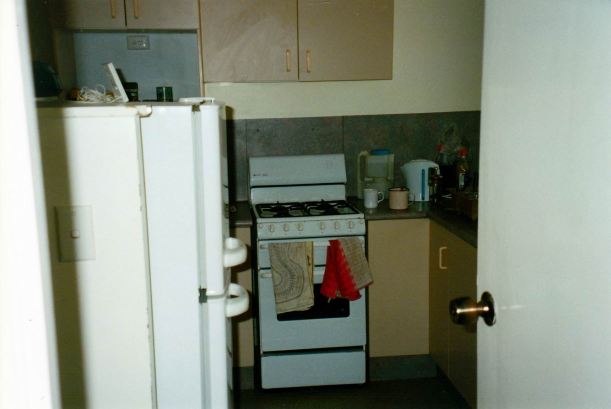
The house had two bedrooms, both with built in wardrobes. There was a living/dining room, an adjacent kitchen, and a bathroom. The non-fixed furniture, apart from the new bed, consisted of a fridge – rather miraculously in working order, two rather grubby armchairs, a small dining table with two chairs, a small bookshelf, a telephone table – with phone, a coffee table, and an ironing board. There was a built in cupboard in the living room, and a fair sized pantry cupboard in the kitchen, which had a gas stove – also in working order. The bathroom consisted of a shower recess and basin; there was a separate toilet. There were ceiling fans in most rooms and three split system air-cons, fairly elderly and racketty ones. There were venetian blinds on the windows and security screening over all the accessible windows and doors.

Resize of 08-09-2002 03 kitchen.jpg

The kitchen was functional

The place was clean enough – not sure who had seen to that. It seemed to have been painted and refitted fairly recently.

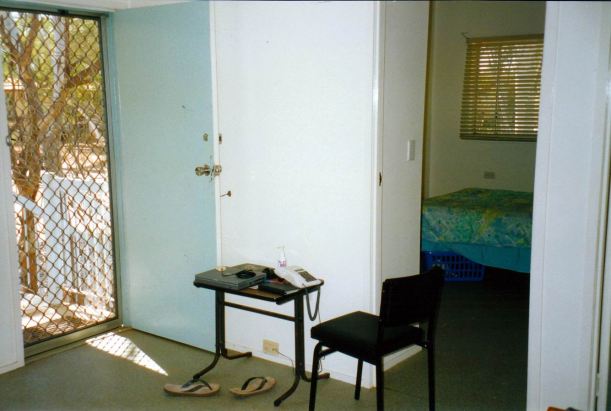
Resize of 08-09-2002 04 into bedroom.jpg

There was plenty of security screening

Behind the kitchen was a narrow veranda, shared with next door, from which there was another set of steps down. Under the house was a car parking and storage space, and a laundry area, shared between both houses – washing machine and trough. There were two outside clothes lines, and lines strung under the house as well. The area was clearly not used for vehicle parking!

We decided quite quickly to park the van in the yard – it would be too tempting and vulnerable to the attentions of the locals, if left outside the fenced area. It took a lot of careful manoeuvring, and pushing and pulling by us, to get it into the corner, close to the front of the house, where we could keep a bit of a watch on it.

We then had to go, before the store closed, to purchase a power card. This plugged into the meter and then we would have power – until the charged amount ran out, when we would have to buy another card. We guessed this system, which we had never encountered before, avoided issues associated with unpaid power bills! It made sense, in a place like this.

Then we discovered that the two large gas bottles for our house were empty. Not only empty, but disconnected – suggesting yet something else that had been appropriated following the departure of the previous occupant. At least, someone had found two empties for us to get filled. They were in a locked cage, but S would have a key to this, and others might, too. Back to the store!

After I had scrubbed the blood off the front steps, we made trips up and down, moving things we might need into the house, and things we just didn’t want to leave in the van.

We had some foodstuffs in the van – basic staples and some frozen meat, but I decided that tomorrow morning would have to see a visit to the community store, to see what was available, especially in the fruit and vegetable line.

This day had been an exhausting one. Despite noise coming from what seemed to be a fair sized and rowdy crowd at the house across the road, partly drowned out by the rattles from the air conditioner in our bedroom, we did get some sleep.

Resize of 08-02-2002 to doom.JPG


Leave a comment

2002 Travels June 17 – August 2

Our Adels experience comes to an end…..

Despite the occasional anxieties of the cooking role, I was really enjoying our stay at Adels, and hoping they would want us for weeks more to come. But my hoped-for longer stay was not to be.

Resize of 07-29-2002 05 cook and odd job man Adels.jpg

Cook and John-of-all-trades

During the Qld school holidays, in July, a traveller who stopped in for fuel and  a tyre repair, turned out to be the Principal of the Doomadgee School. He and John, who was serving the fuel that day, got chatting, and next thing, he had convinced John to go and teach at his school! I initially thought this was because John had been a specialist in literacy/Special Education, but eventually realized it was probably more due to a general teacher shortage there – any body would do! But he promised work for both of us, and a house to live in.

So, John was fired up about moving to Doomadgee, and “making a difference” in aboriginal education. And earning better money! He was never reconciled to what he regarded as our low wages. I could never convince him that – allowing for keep and the superannuation contribution – it was not that bad.

I was categorically against the idea of moving to Doomadgee. I had spent time exposed to the realities of aboriginal education – and community life – via the links of my previous school to one in Darwin, and the annual student visits I had led to the Top End and the Tiwi Milikapiti community on Melville Island. I did not share John’s naive idealism. At Adels, we heard quite a bit on the local grapevine about the nature of the Doomadgee community – none of it positive! The whole idea was distinctly unattractive.

I suggested that I remain working at Adels, John go teach at Doomadgee, and come back here for weekends. He wouldn’t agree to that, of course.

However, before we could be employed by the Qld Education Department, we had to be registered. That was automatic for me, because of my existing independent schools registration, but John had to go through the process. I had hopes that it would not happen – or would take so long that he would give up the idea.

There were phone calls to our house sitter to find and forward John’s necessary documentation from home. It took a few more weeks, but of course the man from Doomadgee was pushing for all the processes to be hurried up, and eventually we were both so employed.

John used one of his days off to drive up to Doomadgee, some 125kms away, by the station tracks – firstly, to check out the route, mindful that we would be taking the van that way. Secondly, to check out the place and ensure we really would have somewhere to live. The Principal was away, but John met the Senior Master who assured him that, although there was not much furniture in the house, he had some on order to come on the supply truck from Mt Isa.

Resize of 07-23-2002 cows lawn hill

Lawn Hill cattle by track to Doomadgee

The Adels people did not want us to go. I had already heard much about the Doomadgee community – one could not live in these parts and avoid hearing how bad it was there. We knew the community was prone to violent riots. We had seen some of the residents come through, on their way to and from the National Park, where they went to fish, and hunt the wild life – including endangered species! White people were not allowed to use guns, spear fishing gear, or light fires indiscriminately in the Park, but no such rules applied to the natives, in “their” Park. We had heard of the main self-appointed activist community leader – and not in a favourable way; he did not even have a great deal of aboriginal blood in him, and was widely regarded through the Gulf country as a ratbag, out to benefit himself.

So, I had to accept the fact of our move.

I spent any free times during our last few days at Adels, wandering around the grove area and along the creek, feeling so sad, and yearning to stay in this beautiful place.

When I phoned daughter to tell her of our impending relocation, she informed me that her first baby was due in February – another grandchild! Great news.

Our last night at Adels was one of some ceremony. The dining deck of the new building was able to be used, for the first time, for that night’s meal. After dinner, we were given a little send-off presentation by the bosses, with gifts of caps, badges and stubby holders. Nice things were said. Everyone on staff knew of my great reluctance to go.

Resize of 08-01-2002 03  deck set up for last dinner.jpg

In the background, the dining dck set up and in use for the first time

Resize of 08-01-2002 02 rod late for dinner

Last to be served…..

At least, from the viewpoint of the management, the main part of the tourist season was tailing down, by the time we left in early August, so there was not so much pressure on the kitchen.


Leave a comment

2002 Travels June 17 – August 2

The area:

We were supposed to have one day off a week. This was sometimes irregular, due to demands of visitor numbers, but was made up later.

On some of our days off, it was hard to get motivated to do much except sleep in, laze around at the van, maybe have a swim in the shallow part of the creek. It was a measure of our inertia that, from the time we left Gregory Downs, till we left Adels, we did only about 600kms – and most of that was done getting there, and in our brief tourist time. We bought only 56 litres of fuel in our time there – at $1.22 cpl.

But we did get out and about a bit.

There was a short walking track, from Adels, up a nearby low hill – Lookout Hill, from which there was some outlook over Adels and the nearby country.

Resize of 07-09-2002 05 gap to lawn hill gorge from lookout hill.jpg

From Lookout Hill, looking to the Constance Range & the gap the National Park road goes through

A bit further afield – and a short drive – was the track up Bill Hill, which was somewhat higher and gave better views. From that, one could just see the overburden hills of the Century Mine, to the east.

Resize of 06-24-2002 moonrise over  century mine.jpg

From Bill Hill, moonrise over the zinc mine

One of the staff couples were in the habit of going off for an overnight of camping, on their day off, just to get out of the place, and away from people. They did not go far – just to nearby Louie Creek, or out to the NE, on Lawn Hill Station, further down Lawn Hill Creek. They had the permission of the station managers to do this.

A few times, we went for short walks in the National Park. One of these took us to the little Cascades, that had formed over tufa rocks – like a very miniature Indarri Falls, and similar to our little falls in the creek, up from the laundry area. Beyond these Cascades was the entrance to the Lower Gorge – out of bounds for canoeists and walkers, except where a walk track touched on it, at the back of the Island Stack.

Resize of 07-06-2002 01 tufa rapids LHNP

Little tufa Cascades at the National Park

Resize of 07-06-2002 02 entrance to lower gorge at cascades LHNP.jpg

The entrance to the Lower Gorge

Resize of 07-06-2002 04 Island Stack from walk track

The Island Stack and walk track to the Lower Gorge

We did go for an exploratory drive, one day, to the north, through Lawn Hill Station and out along the track to Doomadgee, for a way. It was quite easy to get lost in the maze of station tracks around the Lawn Hill homestead. This in itself was an interesting place, perched up high on a bluff above the creek. It was quite an imposing looking house. Below the bluff were lots of sheds, cattle yards and the airstrip. The track to be taken north wove amongst these – very poorly signed – and eventually skirted the bluff and the airstrip, before crossing Lawn Hill Creek further along, and then becoming easier to follow.

Lawn Hill Station quite intrigued me, so I found out what I could about its history from the Boss. The station had been a pastoral lease since the 1870’s, and was one of the largest stations in Qld.

In 1976, a Brazilian cattleman, Sebastian Maia, bought the lease and proceeded to oversee a very successful station. In 1991, the lease was sold to CRA/Rio Tinto, who acquired it and Riversleigh station, in order to do a deal with the local aboriginals, that would allow the zinc mine to go ahead. Although Riversleigh had been ceded to aboriginal control by the time we were in the area, lawn Hill was a little different, in that Maia’s company had a lease back arrangement for a while and continued to run cattle on the property. By 2002, managers were running the place for the company.

Resize of 07-26-2002 02 Constance Range on Lawn Hill Station.jpg

The Constance Range on Lawn Hill Station

In 1984, Maia had donated an area of land to the Qld government, to be managed for the public good, for all Australians. That became Lawn Hill National Park. He added more land to it in 1992. It would appear that he never had any intention that any of his lands would come under aboriginal management or ownership; at the stage when he came to Lawn Hill, there was no record of significant aboriginal occupation of the area in recent times. It was unfortunate that his generous gifting of the spectacular gorge area  for future public access and good – and the decision by the Goss Qld Government to re-gazette the land away from its original pastoral lease status – opened the way for aboriginal claim to the Park.

I read a very interesting – and eye-opening account – of the way the local aboriginals behaved in the Park, and treated the wild life, when they attended for a meeting about the proposed mine – in “Three Years on the Road” by Brett Davis, who was working there at the time. It was also interesting for its description of Adels in the late 1990’s.

On top of a prominent hill, some distance north of the homestead, Maia had a large white cross erected, in memory of his mother. This is a real landmark on the track to Doomadgee.

Resize of 07-26-2002 01 Lawn Hill Station memorial hill

The Cross on the Hill by the track to Doomadgee

We did some more walking in the National Park.

The Island Stack Walk went to the top of a bluff that overlooks the Lower Gorge. The name derives from the fact that one side of the bluff is the creek and gorge, the rest of it is circled by an old channel of the creek, now a small stream. Thus, an “island” had been formed.

Resize of 07-31-2002 11 Lower Gorge and Island Stack.jpg

The Island Stack

The track up was a steep, short scramble. The views from the top were excellent. One could see right down the gorge and creek.

Resize of 07-31-2002 03 Middle Gorge from Island Stack

The Middle Gorge entrance, seen from the Island Stack

Resize of 07-31-2002 07 Lower Gorge and country beyond from Island Stack.jpg

Lawn Hill Creek beyond the Lower Gorge, from the Island Stack

Resize of 07-31-2002 06 Lower Gorge from Island Stack

The Lower Gorge, from Island Stack


We also followed a track beside the old channel/small creek, that took us round to the Lower Gorge, at creek level. There was only access to this at this one small point, to protect wildlife, and sacred sites.

Resize of 07-31-2002 10 Lower Gorge, Lawn Hill NP from track

The Island Stack and the Lower Gorge

Resize of 07-31-2002 09 Lower Gorge wall.jpg

The Lower Gorge wall


Leave a comment

2002 Travels June 17 to August 2

The guests:

The Dinner, Bed and Breakfast tents had varied clientele. Most were from the small groups brought up by the company tours. The owners were working hard to attract other companies’ bus tour groups and there were a couple of lots of those while we were there.

Some travellers did not want to chance their caravans over the road from Gregory Downs, so left their vans there and booked into our accommodation for a night or two.

Some guests flew in, in their own planes. I was surprised to find how many travellers were flying around the country in their own planes. Someone from Adels would pick them up from the airstrip and transport them between Adels and the National Park, as required.

A meal service was not advertised for campground guests, as we did not really have the facilities to expand the meals service, until the new building was finished. But occasionally some would smell the cooking, or wander past, and ask if they could get an evening meal. The boss would set a price of $20 or $25 for this, depending on what was on the menu – this would often put would-be diners off!

The palaeontologists:

The week after we started work, the annual “dig group” arrived, to be accommodated in the tents – and fed – for nearly a fortnight.

Some were palaeontologists, some were experts in natural history, flora/ fauna. They came from the Uni of NSW and the Australian Museum. Many were real experts in the fossils of the Riversleigh fields. Their leader was Professor Mike Archer, of some renown – partly for his view that the extinct thylacine might be able to be re-created via fossil DNA. His wife – a researcher in the same fields, was part of the group, and they brought their two primary school aged daughters.

The scientific group left early each day for the fields. The boss did their breakfasts and made lunches for them to take. They got back about 4pm, and got together out in the eating area to compare notes and finds for the day.

A couple of times during their stay, they gave talks to anyone from the campground and other accommodation who wanted to attend. We served tea, coffee and biscuits after, and the attendees were asked to donate to the RFDS tin.

Mike Archer was an excellent speaker, and the subject matter – mostly dealing with the significance of the Riversleigh fields – was much more interesting than I had anticipated. Quite fascinating, in fact.

The period of their stay was a sustained busy time for us, with normal days off suspended, so it was rather a relief when it was over.

Some general recollections of the time at Adels:

Not long after I’d started work in the kitchen, the cook and I were getting organized for the day’s work, and she was checking the menu the boss had written out. She said that trifle was listed for dessert and that, when she started, the boss had told her it was a popular dessert. But her experience was that there was always a lot left over. We talked about how she made it, and all sounded normal – cake, jelly and custard layers. But then she mentioned that she stirred them all together! I tactfully suggested, as we made it that day, that the layers looked really nice left separate. She took the hint, and the resultant trifle was all eaten. One problem solved!

Some days our cooking schedule was quite tight, if numbers were up and the oven was involved, due to there being only one. The gas came from bottles – and could be guaranteed to run out at the most inopportune time. If we were not using a cooktop, too, it could be some time before we discovered that whatever was supposed to be cooking in the oven – wasn’t!

Campers exploring along the creek would get curious and wander up from the Grove to see what was behind the buildings. Some would come over and decide it was a great camp kitchen. A few times, cook or I came back from our break to find campers setting up to use the kitchen! A couple of lots became quite unpleasant when we explained it was not for public use.

The numbers we were cooking for that night would have been notified to us at 11am. By that time, if it was a company tour day, someone from the office would have rung through with the number on board. Occasionally there would be an unbooked later customer or two, which could throw out numbers as did campers who wanted a meal. The boss was loathe to turn away customers and this could throw our catering out a bit. OK for roasts and silverside, but if it was a fish night, we would usually not have much surplus defrosted.

Guests could be really trying – some because they just didn’t stop to think, others I was sure, deliberately. All the tour guests were asked to advise ahead of any special diet needs. We had a supply of frozen gluten free bread. We coped with the occasional diabetic, and regular vegetarians. But one woman from a non-company tour group, came to us in the kitchen, 15 minutes before service time – the group had been in camp for several hours by then – and told us she was vegetarian, lactose intolerant, and allergic to onions and garlic! The menu for that night was spag bol and bread and butter custard. We pointed out there wasn’t much we could do, with that timing, but give her a plate of salad. She wasn’t happy!

We got really fed up with the men (always males) who would front up to the serving area, as we were dishing up maybe fifty plates of food, and expect us to drop everything and fetch them one of their beers from the coolroom – where we’d agreed to store it as a favour. They would get stroppy when we said they’d have to wait.

One afternoon a lady from a tour group sat out in the eating area, watching cook and I prepare dinner. Not long before serving time, she marched up, declared she was a chef in Sydney and didn’t think our kitchen was up to standard! She pulled the plug out of the sink in which we were washing up prep dishes and declared we hadn’t turned the hot water on frequently enough for dish washing. She turned on the tap – the one, cold, one. I picked up the two buckets we used for fetching hot water and shoved them at her, telling her she would find the hot water about 100 metres that way – and since she’d emptied our sink, she could go fetch the water to refill it! She stomped off then, having embarrassed herself in front of her group members – who appeared amused, so I guessed she’d been throwing her weight around there too. John fetched the hot water.

I am sure our kitchen was not up to Sydney standards – but the Gulf, and the whole outback for that matter – is different. We kept it as clean as we could, and followed the best practices we could.  In all my weeks there, had no reported issues with the food, amongst guests or staff.

We did have to be careful to cover any food left out on the benches, that wasn’t right by us, because the bower birds would fly in on raids. They were very bold. The “walker birds” would clean up anything dropped on the floor. Bar shouldered doves prefer to walk everywhere and we certainly had some very fat ones hanging around the kitchen area.

I did sometimes worry about the untreated water that was our water supply, being downstream of the National Park and its campground and swimmers. But the greatest concern was the high level of calcium carbonate suspended in it. For my own drinking water, I ran the water through my filter jug at the van, then boiled and cooled it. That at least got rid of some of the calcium from it.

There was a big old white bull that had taken to wandering about the campground. He’d obviously found enough goodies around the place to not be deterred by the boss closing the gates at night. He was very good at sneaking in, then wandering about, scaring campers and getting tangled in guy ropes and generally being a pest. One night, he must have somehow fallen into the creek, and couldn’t get out again. Some tourists found him in the morning, floating, with all four legs sticking up in the air! Very dead. It was quite an operation to get the body out, with the fork lift and a truck.

Leisure time at the van was lovely, with the active bird life all round. I never got sick of watching and listening. There was a pair of barking owls in the Grove that we would hear at night, sounding for all the world like yappy little dogs. Sometimes a group of agile wallabies would sneak under our van to sleep. If they were startled in the night, they would bounce up, forgetting about the low clearance – then we would be woken by the thumps and the van shaking.

Resize of 07-07-2002 01 agile wallaby in Grove.jpg

Agile wallaby

A group of primary school children stayed a night, as a school camp. The boss was seen, showing them a very long olive python, handling it and letting them touch it. One of the men asked where he’d found that? Boss said it was the one that lived in the workshop. The men didn’t know of any python in the very dark and gloomy shed, but they had been regularly kicking aside a pile of coiled up “old rope”  that regularly seemed to be in the way when they went in! That work practice changed!

Resize of 07-15-2002 01 Rod and olive python.jpg

Olive python

Resize of 07-15-2002 05 pyhton going back to home in shed

Python heading back to its home in the workshop

Boss lady was extremely busy with the demands of the rapid expansion of the business. This, and the effect of her pregnancy, seemed to impact on her memory. There were a couple of times when she forgot to complete the necessary orders for supplies. She would be part way through doing so, get interrupted, and not get back to same. The first we would know of this was when the supply truck did not have what was needed. We usually had enough stock on hand to get by, although once she had to go and “borrow” vegetables from the cook at the nearby mine.

More serious for the office ladies were the few times she would take a booking on the remote phone handset, whilst away from the office, and then forget to record same. Rather embarrassing when six rigs turned up, at the height of the busy time, expecting six adjacent sites! Boss man was even worse, with after hours booking phone calls – he would rub out an area of the bookings book, record the new name in the space, then leave it for others to sort out! I suspected that part of the reason campers began to be allowed into the Grove area, was as an overflow area for messed up bookings. Everyone, in these early days, was on a sharp learning curve.

It was quite exciting to see the new building taking shape, during the weeks we worked at Adels. It would move the operation of the place up to a much more professional level.

Resize of 07-27-2002 03 new building Adels from front.jpg

This would be the front – shop, reception, toilets, walkway to dining deck

Resize of 06-29-2002 03 kitchen and new building adels

The railing of the new dining deck – new building dwarfed our temporary kitchen

One issue that began to cause some concern whilst we were there was that of the future of the canoe hire at the National Park. This had operated for years before the sale of Adels Grove, having been initially established by the prior owners. The local aboriginal leadership was beginning to make statements to the effect that – if Adels wanted to keep doing the canoe hire, they would have to employ local aboriginals to run it. We had already seen how the aboriginal Rangers at the park operated – swanning about in their uniforms and doing nothing! Adels would still need to employ white staff to oversee the aboriginal “workers” – which would probably make it uneconomic. It could become another saga like Riversleigh – left to the “locals” to run and organise, and nothing happens!

It seemed to us that it really was such a shame, the extent to which the whole aboriginal thing is a brake to enterprise and development, up north. We saw the same kind of thing, on Cape York, in ’98.


Leave a comment

2002 Travels June 17 – August 2

Our day:

John started work at 8am, so he would get up and go off to have breakfast with the other staff, up at the kitchen area. I would get up a bit later, and eat my weetbix and soy milk at the van, before going up to start work at 9.30am.

Arriving as tourists, we’d obviously had food supplies with us initially. As my breakfast supplies ran low, the boss was very good about ordering soy milk for me when needed.

John would eat salad lunch with the other men. I would make up a plate of salad and usually take it down to the van, to ensure the time to myself.

Resize of 07-27-2002 04 with the compost.jpg

Our vegetable scraps went for composting in John’s vegie garden

We ate the evening meal with the other staff, and guests, in amongst doing the meal service, in my case.

Resize of 08-01-2002 01 serving dinner.jpg

The tail end of the dinner service

John finished work at 5pm and would go have a shower, then sit and have a happy hour beer or two with the other men in the dining area, or down in the Grove.

It was usually 8 to 8.30pm by the time we finished up in the kitchen. Sometimes, staff would sit about in the dining area, talking and having a drink. More often, we would head off to our respective accommodation soon after finishing up.

I would shower after finishing up in the kitchen – by torchlight – and usually fall into bed not long after that.

Resize of 07-30-2002 03 filling the tanker

Filling the tanker from the tanks by the showers

I tried to do our clothes washing before starting work in the morning, once a week or so. This was so my precious day off was not used up by chores. Also, I needed to wash our work clothes more frequently than I had days off! It could be a bit of a lottery to get a machine before the laundry lady had to start in on the sheets and towels. With only two machines as the season went on and guest numbers increased, her washing was a mammoth task. My washing had to dry on one of the lines strung between trees next to the laundry area. Often, it would be John picking it in, after he finished work.

There was no TV or radio signal there then. Reading matter was scarce, and to be rationed. I raided the book exchange in the office, whenever anything new came in, which was not often. John could play his computer games in the evening, until the generator went off at 10pm.

Occasionally a guest would leave behind a newspaper – we would fall upon it and devour the news, even if it was old. The staff who had been here since the start of the season, told me the Queen Mother had been dead and buried for a few weeks before the news filtered in here.

On our day off – usually about once a week, depending on our busy-ness – we would try to go out exploring somewhere in the district.

Remote life:

Despite all our prior travels, life here was quite a revelation, in ways that city people just don’t contemplate.

The nearest sealed road was almost 100kms away, at Gregory Downs.

Unsealed roads/tracks radiate from here. The one south branches after a few kms, with the western branch going to the National Park, and was quite badly corrugated. G drove an old Toyota ute, that belonged to Adels, back and forth every day to do the canoe hire. The other branch was the road to Riversleigh and past that, over fords of the Gregory and O’Shannassy Rivers, to where it met up with the Camooweal road south from Gregory Downs. Then, by Thorntonia Station, a road south eventually met the Barkly Highway, some 100kms west of Mt Isa. This Riversleigh/Thorntonia route was the “short” way to Mt Isa, and was badly corrugated in parts. It took about 6 hours to get to Mt Isa that way.

Resize of 06-16-2002 lawn hill.JPG

The track from Adels to the National Park is shown

In the wet season, often the only way to Mt Isa is via the way we came here – Gregory Downs, Burke and Wills, Cloncurry. Even that route gets closed if there is a lot of rain, cutting Adels off completely by road.

To the north, a track goes to Lawn Hill Station and beyond that to Doomadgee, on the Great Top Road, or to Bowthorn Station and Kingfisher Camp on the Nicholson River, west of Doomadgee. This was basically a station track, with a number of gates, and Lawn Hill Creek to ford. It crossed black soil country, so was closed in the wet.

The mail plane came once a week to the district and landed at Lawn Hill Station. The boss lady would take a bag containing our mail, to meet it, and bring back our mail from the plane.

Adels had a telephone link to the outside world. There was a public, coin-operated phone box out the front of the office donga.

The supply truck operated by Ringrose Transport came once a week, on Fridays, from Mt Isa, via Gregory Downs. It was a large semi trailer, divided into three parts: a freezer, a cool section and a general section. A little bobcat was used, here, to unload pallets of goods that were stacked on the veranda behind the office, for unpacking. All staff who were around helped with this, so the pallets could go back on the truck. We would make a cuppa for the driver while he waited.

Resize of 06-27-2002 02 Friday truck day at Adels Grove

The boss lady faxed her orders to the Safeway supermarket in Mt Isa, and a greengrocer supplier, and to sundry other suppliers. Obviously, the cost of transport of the goods was quite high – a fact sometimes not taken into account by travellers buying tinned goods or icecreams from the shop.

Occasionally, there were supply glitches. Adels was near the end of the supply run, and sometimes the confusion of unloading – or an error in labelling at the Mt Isa end – caused mistakes.  One week, we got the sack of potatoes intended for the Gregory Downs hotel – and they got all our containers of ice cream!

The orders have to be faxed the best part of two weeks before they get to us, so it could be hard to predict numbers for meals that far ahead, and thus what supplies would be needed.

The truck did not bring alcohol supplies. Adels did not, as yet, have a general liquor licence – that would come when the new building was completed. Whoever was  going to Mt Isa (staff on a break, builders, a boss) took staff orders and brought them back – their vehicle could end up carrying a lot of alcohol! If friends came to visit, they generally were asked to do a pick up in town, on the way.

Because we were so busy, and so tired at night, alcohol supplies tended to last us quite a while anyway.

It really was different, living without ready access to shops of any kind.

The Royal Flying Doctor Service – RFDS

Having spent time here, we now appreciated this so much more.

Apart from the emergency evacuation by plane that people associate with the RFDS, they support remote dwellers in other ways.

There was a monthly RFDS Clinic. This alternated between Adels and Lawn Hill Station, which also had an airstrip of the requisite standard. A doctor, nurse and pilot would fly in. A space was set aside for the doctor to meet with any locals who wished to see him – at Adels this was on the back veranda of the office donga. There was not much privacy! When there were no more patients, off they would fly to the next station. The boss lady was pregnant, so her monthly check ups were done at these times.

Adels had a RFDS medical chest – supplied in conjunction with the service. Boss lady had undergone training in the use of this, which was required before they were issued. In the case of illness or accident, she would phone the RFDS Base in Mt Isa and they would instruct her about what to do and what medications to administer. These were identified by number, rather than name, to avoid confusion. Each month, she had to check the stocks in the chest – any that were out of date were replaced on the next mail plane.

Adels staff did all they could to raise funds for the RFDS. There was a collection tin in the office. If a visitor wanted a cup of tea, outside of meal times, we asked them to put a donation in the tin. Book exchange attracted a $2.50 offering to the tin. The men collected all the aluminium cans from the campground, crushed them; they were sent to Mt Isa where the money raised went to the RFDS. When the paleontologists were staying, they gave a couple of evening talks to park guests, for which a fee was charged – for “the tin”. Likewise, when the Rangers came from the National Park one night a week, to give talks and slide shows about the Park.


Leave a comment

2002 Travels June 17 – August 2

Our fellow workers:

Including us, there were eleven resident staff when we began. Another couple had arrived by the time we left. There were also five builders living in. So that was sixteen staff to feed, for starters.

The man boss was an accredited member of the Savannah Guides Association – a group of local experts from across the northern Gulf country – formed to promote tourism. The previous owner of Adels helped form this group. Adels Grove was a Savannah Guide Station. The boss ran the half day tours to the Riversleigh fossil site, that Adels offered.

His wife ran the accommodation side of things and it was she who hired us.

There were three couples of similar ages to us, basically retirees too. They were here for the season. Previous experiences with backpacker workers had led the owners to prefer retirees – they said we had a better attitude to customer service.

One couple had a caravan parked down in the Grove, like us, the others were staying in the staff donga.

Two of the ladies looked after the reception and shop. One did the laundry for the DBB tents, and the housekeeping for same, helped when needed by one of the others. She only had a couple of domestic washing machines in the laundry; the innards of these had been ruined by the calcium in the water, so she had to manually fill the machines with a hose.

The men did the outside work. One of them ran the canoe hire service at the National Park, so he was away all day. His little work area overlooked the creek – a great place to work.

Resize of 07-31-2002 01  at canoe hire.jpg

The canoe hire – a really scenic “office”

The final staff member was the cook – a lass in her 20’s, a friend of a family member of one of the owners, and a lovely person. She had not cooked before, but thought this sounded like a novel experience and a bit of an adventure in the outback. She was on a steep learning curve. Her existence was somewhat lonely, with no other staff of her age. My brief was to assist her, as the place got busier, and try to ease out some glitches that were appearing.

The protocol here was that, at the evening meal, guests were served first, and builders and staff after that. There were beginning to be rumblings that sometimes not enough food remained for staff, and I was to try to improve that.

Visiting “staff” came with the once or twice weekly company tours from Mt Isa. The regular guide was a local Waanyi aboriginal elder – highly educated, outgoing and a fascinating man.

Our work

The office ladies made sure there was always someone there to book in visitors, take phone bookings, do sales of any shop items, keep that area clean and tidy. They helped out with tent housekeeping if needed. When the weekly supply truck came in, they helped unload it and check the delivery.

Resize of 06-27-2002 01 weekly supply truck parked.jpg

The weekly supply truck from Mt Isa

The outside men did the cleaning, tank filling from the creek, and donkey firing already described. They fetched loads of firewood – mostly snappy gum – and chopped it. As well as pumping water from the creek, there was a water tanker truck that was filled and driven around to water the campground tracks when it was particularly dusty; as the season went on, this became pretty constant. It also was used to water the airstrip to reduce dust. There was some garden watering.

Resize of 07-07-2002 02  and water truck Adels.jpg

Watering to reduce dust

The campground – and other – rubbish  was collected in the dump truck and taken to the tip pit, which was periodically burned. Then there was general tidying and upkeep of the camp ground, where vacated sites were checked and raked, and fire pits emptied.

Fly in tourists had to be collected from the airstrip and driven to the camp and National Park.

One of the men would serve fuel as tourists wanted it, from the bowsers. They would do basic mechanical repairs, if they could, repair/change flat tyres, fill travellers’ gas bottles. There were canoe repairs to do, too.

The men assisted with the dishwashing after the evening meal – their own dishes, and the pots and pans, serving dishes and the like. Given the limited power, there was no dishwasher.

By the time we joined the staff, the other men were in quite a routine for the basic jobs, so John had to carve out his own niche. He took on the neglected vegie patch and assumed responsibility for the outdoor dining area – hosing off the tables, tidying the area, helping us hose out the kitchen each morning. He was eventually entrusted with helping us cook BBQ’s and fish. He fetched the containers of special drinking water filled at Louie Creek – it had less calcium than our own creek water. As the new building progressed, he worked afternoons at painting that.

Resize of 07-27-2002 01 John as vegie gardener Adels.jpg

John at work in the vegie garden

Resize of 07-30-2002 01 John cleaning the dining area Adels.jpg

 The work in the kitchen:

The kitchen was open air – essentially a roof and a cement floor, attached to one side of a coolroom donga. For some reason, there were no flies here, so open air worked fine.

Resize of 06-29-2002 02 our kitchen from eating area

The kitchen

There were a couple of chest freezers and ordinary household fridges lined up along the back wall. Electrical power came from the generator, which was turned off about 10pm each night. In theory, a battery set up maintained power for the fridges and freezers, but this did not work well. However, they seemed to hold cool well enough through the nights. The only electrical appliance we could use was a small, hand-held electric beater; anything else required too much power. Hot water for drinks was heated in large kettles on the gas cookers.

Metal shelves were stainless steel or lino topped to form our work benches. Two single bowl sinks had cold water taps only – hot water for washing up was fetched in buckets from the nearest donkey water heater – a fair distance away. Bringing these was another task that often fell to John. One sink was towards the front of the kitchen area -this was to be used by guests and staff to wash up their own eating plates and utensils; we put heaps of teatowels out for them to dry same. So they did not need to come into the kitchen area itself. The other sink that we used for prep was against the donga wall.

Resize of 07-29-2002 06  80 mins till serve time y.jpg

At work in the kitchen

There were two old industrial gas cookers lined up on one side of the kitchen space. Only one of the ovens worked, which limited what could be cooked for an evening meal – if it was roast meat and vegies, then dessert had to be something that did not need the oven. Not all of the stovetop gas burners worked, either, which sometimes necessitated some juggling of pots.

The stoves were supplemented by the big BBQ plate, on a wood fire, outside the kitchen, when we were having BBQ or fish.

The boss lady did the breakfasts each morning, served from 7.30am. These were buffet style for guests and staff to help themselves. There would be cereals, toast and something hot like baked beans. The builders would eat something light, then.

I started work at 9.30am, with my first task to make a substantial, cooked “smoko” for the builders, to be served at 10am. I often based this on leftovers from the previous night e.g. corned beef fritters.

Often there was a big cleanup to be done, from breakfast! In theory, everyone washed and dried up their own dishes and utensils. In practice, most of them just got left in and on the sink. Not a great way to start my working day.

B started at 10am. In theory, we worked a split shift, to allow for the fact that we often did not finish the clean up from the evening meal till 8pm – or later. In practice, it was often hard to take the time off in the afternoon, depending on what we were cooking, and how many for.

Boss set the menu for the evening meal. She grew up in the bush and the menu reflected this – and the origins of Adels’ dinner, bed and breakfast offering in the Riversleigh bush camp.

We would check the relevant meat for that night had been put out in the coolroom, the night before, to defrost, or else put it out in the morning. I made it my task to ensure there was enough put out to feed all – leftovers could always be used for the builders’ smoko.

The menu was a set two courses: main and dessert. Mains were roasts – mostly lamb or beef. The boss ordered whatever was on special from Woolworths in Mt Isa, each week, and that was frozen. Spag bol usually featured once each week. Whenever there was one of the two-night company tour groups in, corned silverside would be served one night (“salt beef” in the tour literature, which promised “Gulf cuisine”) and barramundi the other night – this came as a boxed and frozen import.  Despite this, it was amazing how many guests told us we’d cooked “the best barra I’ve ever eaten!”

Resize of 07-29-2002 02 cooking corned beef Adels

Cooking corned beef

We staff did not like the weeks in which company tours came twice!

BBQ was another regular – chops, sausages, meat patties. Sometimes there was curry (mild) with  rice – which only boss man was allowed to cook, by his absorption method. It still stuck to the pot! Savoury mince, chicken in apricot nectar were other offerings.

We served potatoes – roasted, mashed or as “chippies” (cubed potato and kumara, oil sprayed and baked). Other vegetables were the standard frozen varieties. Cabbage went with the silverside. As time went on, I was allowed to make coleslaw, or a mixed salad as a change from the frozen vegies.

Desserts were in a similar vein: tinned fruit salad with custard we made from custard powder. Bread and butter custard was a regular to use up the large quantities of leftover crusts. Trifle. Frozen bought-in apple pies with ice cream. Creamed rice. Again, after some time, I persuaded the boss to order in the makings for fresh fruit salad, occasionally. We always had a supply of icecream in the freezers.

B and I would put out the makings for lunch and staff and the builders then helped themselves to those. There were the basic salad materials – lettuce, tomatoes, cucumber; cheese slices, tinned beetroot, pickled cucumbers, bread. Sometimes there were leftovers from breakfast, or the night before – often cold silverside! I considered lunches nicer than the evening meals, much of the time!

The company tour guide made up his lunches for his clients, to be taken off with them for the day. Mostly, he brought the makings for these from Mt Isa, where he had a couple of “aunties” who produced good cold picnic lunch foods.

As I got more into the routine of the place, I often tried to have some cake available – only basic, like carrot cake. There were always sweet biscuits for staff smoko. Sometimes I made a zucchini slice – for the builders’ smoko and for some staff lunch variety. I made carrot cakes for any staff who had birthdays.

Resize of 07-21-2002 birthday and my carrot cake.jpg

Birthday cake

Once the morning smokos were done, the breakfast and smoko cleanups done, the kitchen hosed out, we would have our smoko break – about 15 minutes. Then we would start prep for the evening meal. Potatoes would be peeled and put in buckets of water. Desserts prepared. Lunch makings put out. Then would come the lunch cleanup – mostly, the staff men were good at washing up their own plates and cutlery. B and I tried hard to take an hour for lunch.

If it was a silverside day, the large chunks of that would have been put on, in the morning, to slowly cook in drums on little open fire stands out in the dining area. John came to be responsible for lighting the fires under these, and keeping them stoked.

Roasts – big cuts – would go in the oven to cook. Then vegies for roasting – potatoes and pumpkin.

General cooking supplies were kept in the air conditioned coolroom donga, so we were constantly going up and down the couple of steps to it.

Most nights, we fed 40-60 people. The most was 78 and that was a corned beef night.

The evening meal was served at 6.30, so the later part of the afternoon was fairly solid work to ensure all was ready for that, and to clean up as much of our prep gear as we could.

The evening meal was served from the benches at the front of the kitchen. Guests would line up and receive a plate of food dished up for them, then take it off to the tables to eat. Dessert was served in the same way. Condiments, bread and so on, were on an accessible nearby side bench, by the BBQ stove.

After the evening meal was eaten, we would have a greater or lesser quantity of washing up to do, depending on how good that group of guests had been at washing their own. There usually ended up being a heap of cutlery in the sink for us to do! And always lots of pots and pans and serving dishes. We appreciated the way all staff pitched in and helped do that, usually being pretty tired by then.

While the washing up was happening, boss lady would put out the breakfast things.

Having the two of us working in the kitchen was a great set up because we really got on well. I thought that, before I came, it had been a lonely working day for young B, by herself in the kitchen.