This Adventurous Age

Adventures travelling and working around Australia.


1 Comment

March 2019 (2)

MARCH 2019 (2)   A SEVERE TROPICAL CYCLONE…

This month we were again to witness another tropical cyclone that, indirectly, touched us.

Over the years of our adventuring, there had been occasions when the cyclones that can impact Australia between about October and April  had a greater impact on us than being just another news item.

The Adels Grove/Lawn Hill area of NW Qld, where we travelled and worked 2000-2006 is a region that is regularly impacted, either from those that come in directly over the Gulf of Carpentaria, or arrive over the Qld coast to the east, and then blow themselves out as tropical lows, bringing much rainfall to the state’s northwest. In 2000, we aborted our first planned visit to Adels Grove due to wet roads that hadn’t had a chance to dry out after such an event.

In March 2006 a tropical low pressure system – the precursor to cyclone development – hovered over the  Gulf coast for several days and dumped much rain across the northern NT. The beautiful Pungalina, where we had worked and lived for six months of the previous year, was heavily affected, when the Calvert River broke its banks and inundated the home area, machinery shed and surrounding country to a depth of more than a metre.  Much damage…

Calvert River near the home area at Pungalina. Hard to imagine this in a flood as deep as it was in 2006…

In 2006 we changed plans to work several months at Adels following a very slow start to the tourist season due to Cyclone Larry and its aftermath. Whilst travelling across the Barkly region of the NT, on the way to new jobs at Litchfield, we unwittingly got caught in the tail end of Cyclone Monica and spent an uncomfortable night bunkered down amid howling winds and torrential rain.
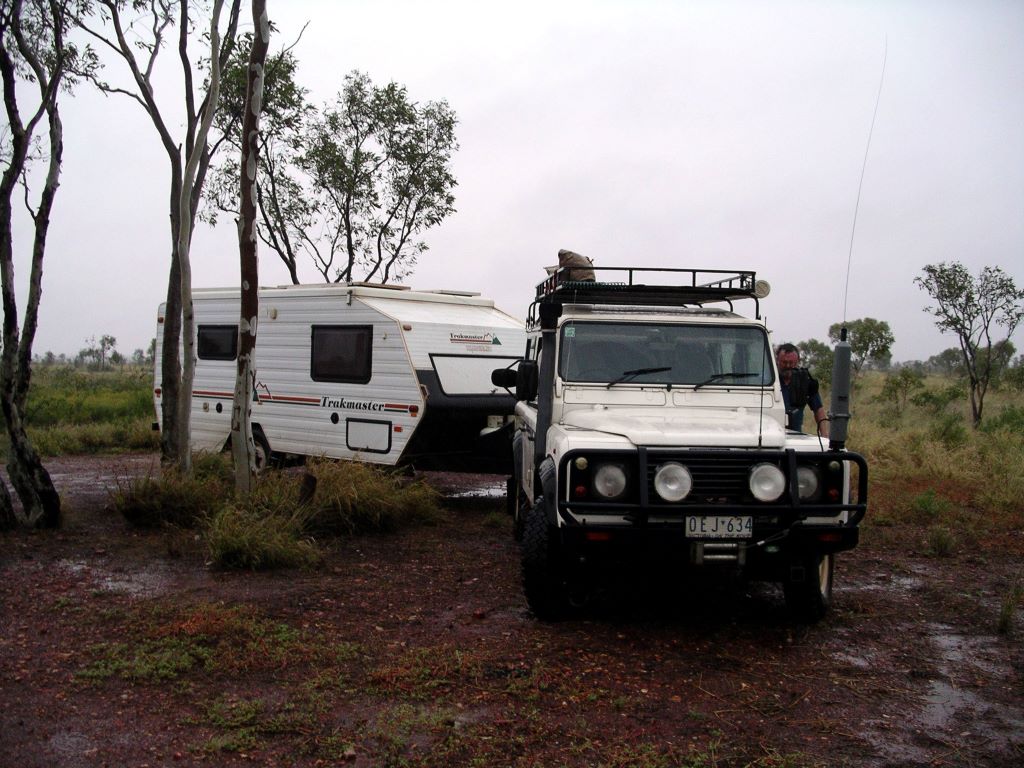
Just a tropical low…..by the Barkly Highway

Category 5 Tropical Cyclone George that crossed the Pilbara (WA) coast in March 2007, passed over the construction camps where we’d worked from September 2006 until February 2007, causing fatalities and massive damage to Rail Village 1. We missed being there by some three weeks, for which we remain forever grateful.
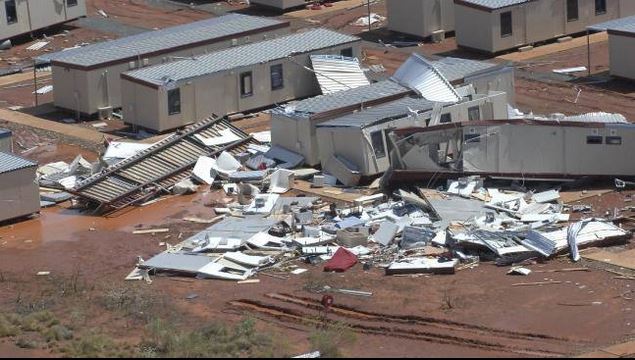
Cyclone damage at Rail Village 1

February 2011 saw us back in Darwin, crossing off a couple of items from John’s Bucket List: travelling on the Ghan train, and experiencing the Wet Season. We overdid the latter somewhat, and were confined to our accommodation for a couple of windy, wild and wet days when Cyclone Carlos passed through town. This was only a Category 1 cyclone but quite big enough for us, thank you. So much rain…
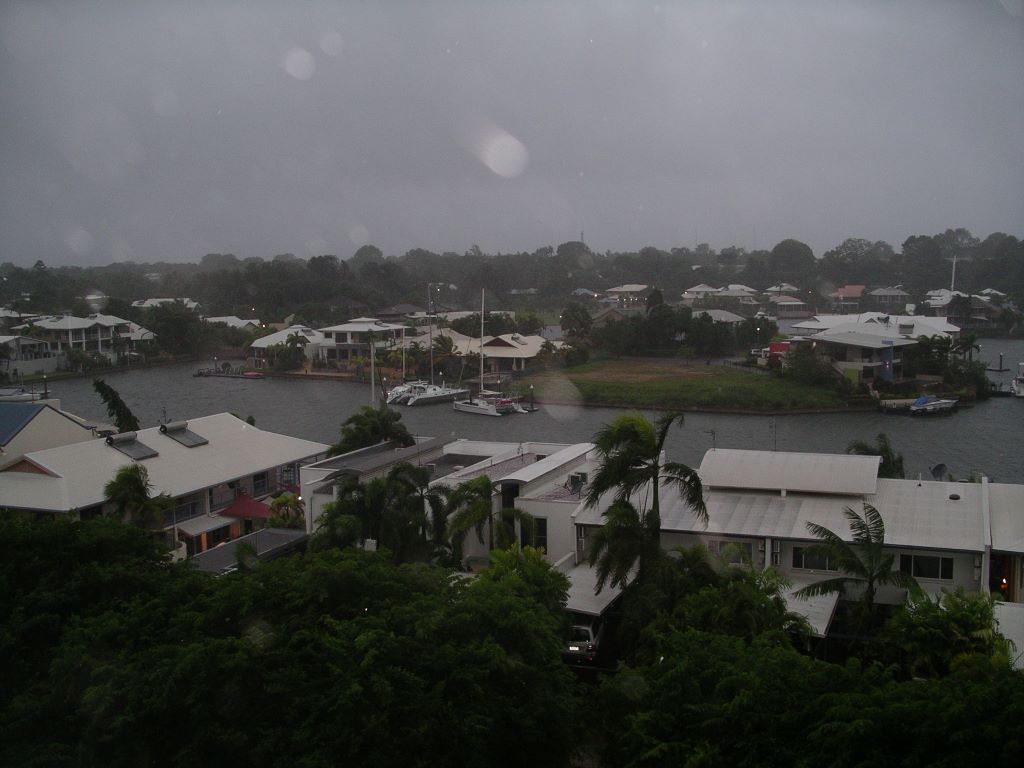
Watching the cyclone from our apartment in Darwin…

Pungalina, so dear to us, was to be hammered again, in March of 2019. This cyclone, named Trevor, really illustrated the unpredictability and sheer bloody mindedness of such systems. It formed on the 11th, way out in the Coral Sea, off PNG. After a week of meandering SW across that Sea,on 19th,  it hit Lockhart River, on Cape York, as a Category 3, bringing strong winds and much rain. By the time it reached Weipa, on the other side of the Cape, (21st) it had declined to a Category 1. Now over water again – the Gulf of Carpentaria – it began to intensify, decided to turn to the SW and made a beeline for the Pungalina area. By the time it crossed the coast there, on 23rd, it had become a Category 4. Over land, it again declined quickly in wind intensity, however bringing much rain to the Barkly region of the NT as it continued SW. But it didn’t want to just continue that way and exhaust itself over the NT interior, so on 24th, it unexpectedly swung to the east. By 26th it was bringing heavy rain to Mt Isa and Cloncurry and continued to do so over areas of north-central Qld over the next couple of days, eventually becoming just another rain bearing low pressure system.
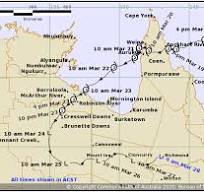
Cyclone Trevor (BOM)

Due to uncertainty about its eventual path, some vulnerable communities around the Gulf, such as Groote Eylandt and Borroloola had largely been evacuated – some 2,500 people in all. The RAAF had been called in to assist with this.

Trevor’s wind gusts reached 250kmh. Associated storm surges in places along the Gulf coast reached almost to 2 metres.

Pungalina had in 2007, been purchased by the Australian Wildlife Conservancy, to add to its portfolio of special and unique environments, to be responsibly managed to conserve their most valuable features. AWC’s research teams had already found some new species of fauna, as well as rare and threatened ones, here.

Cyclone Trevor had obviously provided the AWC resident managers with an “interesting” couple of days. At least this system had been fast moving, so although there were gale force winds and heavy rain, there had not been floods like those of 2006, when the tropical low stalled over the area, deluging it for days.

This photo was posted, taken during the cyclone…
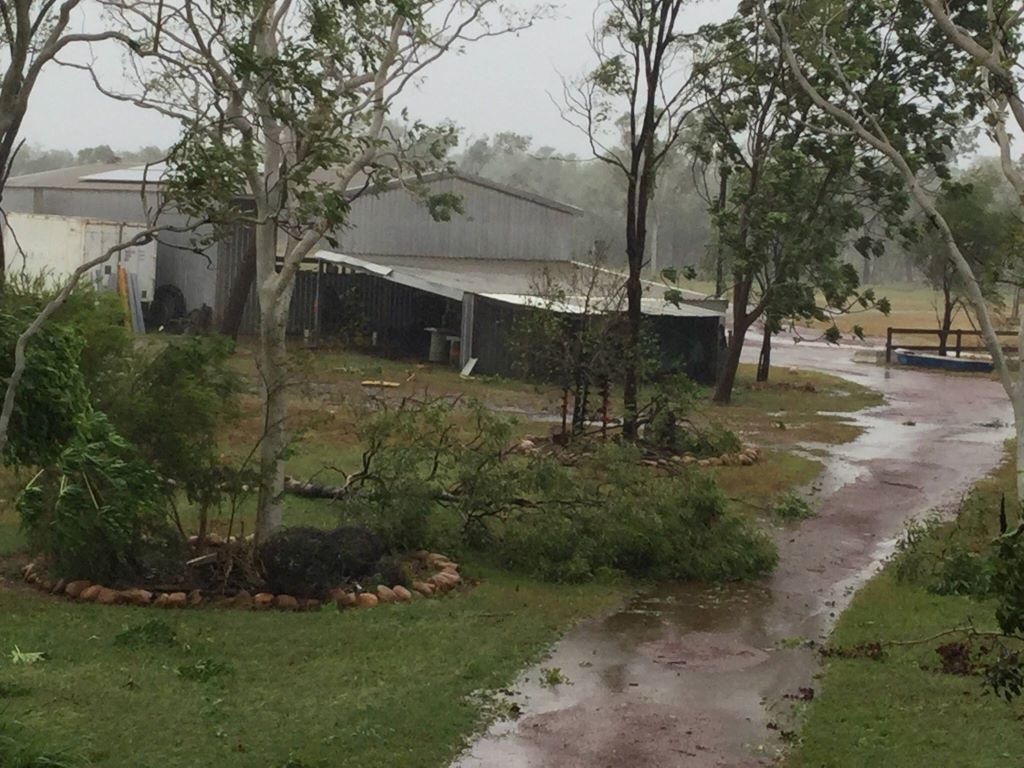
Cyclone Trevor at Pungalina…This machinery shed and yard had been at least a metre under water in 2006.


Leave a comment

March 2019

MARCH 2019

Garden watering continued unabated. When would we get some decent rain?

However, the warm and dry summer weather had resulted in a bumper harvest for John’s first Bendigo tomato crop.

From this…

Every couple of days there was another basket full. We ate chilled tomato soup, tomato salads of various descriptions and complexity. I froze containers of tomato soup and bags of chopped tomatoes for later use. And still they came…. John does have a tendency to get carried away in front of nursery plant displays…

Back in October, there had been no obvious places in the kitchen area to put the two freezers that moved here with us: one upright, one chest. My solution then had been by a power point in the garage. By early summer it had become clear that the less insulated garage was going to be too hot a place to keep a working freezer or two. The upright was moved to the laundry.

I’d had hopes that we might dispense with the chest freezer altogether. The scale of the tomato harvest, though, saw it pressed back into use. Although I didn’t like the visual of it residing in the dining part of our big living area, couldn’t see another option. We got used to it.

The apricot tree, that was here when we moved in, presented us with a surprisingly large crop of fruit. Large, plump, totally delicious apricots. Of course, they all ripened at once, so batches of cooked apricots found their way to a freezer.

We looked forward to the crop from the peach tree – a larger tree than the surprisingly abundant apricot. But – much disappointment, and a new encounter… Fruit fly. We had not had these pests in our plum and fig trees in Melbourne. The peaches ripened, but when we started to pick them, we found that, despite a normal outward appearance, inside was rot – and maggots. Not a single untouched peach could be found. We picked the whole lot, put them in black garbage bags and left these sitting in the sun for a week, before consigning the lot to the rubbish collection.

Research was needed on how to prevent fruit fly infestation next season.

The tomatoes kept coming…

…to this


Leave a comment

2019 Life and Travels February (2)

FEBRUARY 2019   2

We continued regular sampling of local eateries, trying to choose a new place once a month, whilst still returning to those that were fast becoming favourites.

Friend M returned this month for another week long visit.

We decided to try out an hotel not visited before, but which I had read good reviews about. This venue was fairly centrally located in an older, hillier,  part of town. Alas, there was no parking area dedicated to the hotel and we found ourselves cruising the nearby streets, which seemed to go at all angles, looking for a place to squeeze in the car, that was also not too far to walk.

Judging by some of the substantial older homes lining the streets here, this had been an area favoured by the more affluent, back in the golden era. In the strange juxtaposition that one finds in Bendigo, less than a block away had been a major gold mine – the Hustlers Reef Mine. Begun in 1865 and operational until 1921, this mine was dug to a kilometre deep, and its workings  extended outwards for three kilometres under Bendigo. There are still some twenty kilometres of its tunnels down there – and this is just one of the many mines that was located along the Bendigo reefs.

Bendigo might be known as the City in the Forest, but it is also the city sitting on top of an extensive  honeycomb of tunnels and mine workings, for the most part inadequately mapped. This is not a concept that I like to examine too closely

These days, the Hustlers Reef mine site features an interesting heritage walk and is a living memorial to the many miners who died in mining accidents in the Bendigo mines – some 2000.

A few days earlier, I had phoned and made dinner bookings – more as a courtesy thought, at the time, than from expecting the place to be crowded out. How wrong was I? It was absolutely packed. The tables were closely clustered together and the noise level was high. I was amazed. The reviews had been good, but not to warrant these crowds. Then the penny dropped – it was 14 February – bloody St Valentine’s Day! Obviously an occasion strongly celebrated around here.

The food – when it eventually came – was enjoyable enough. It did seem that the kitchen was overwhelmed by the numbers, though, as it took well over an hour from when we ordered to when we got the first of our meals. They didn’t come together. John’s was the last to arrive, by which time I’d finished mine – and I’m a slow eater. I was less than impressed and doubted whether we would return.

In the gold mining period of the last part of the 1800’s, there were over 90 licensed premises in and around Bendigo. Today, about 40 remain operating. If the traveller – or new resident – thinks there are a lot of pubs in Bendigo – there are! It certainly means one is spoiled for choice for great pub counter meals.

A grand old Bendigo hotel – the Shamrock

Maybe once a hotel…

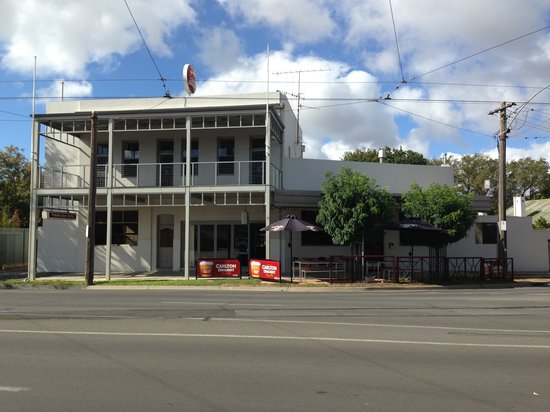
One of the many hotels we have yet to try…

Note to self – never, ever, dine out on 14 Feb.