This Adventurous Age

Adventures travelling and working around Australia.


Leave a comment

2015 Travels July 30

THURSDAY JULY 30       THE BORE BATHS

About two hundred metres from the caravan park are the Lightning Ridge Bore Baths.

Many of the park’s guests walked to the Baths, sometimes wearing their bathers, sometimes wearing clothes that hid more of the ravages of time. The ageing body is not a pretty sight in bathers – I am the first to admit it!
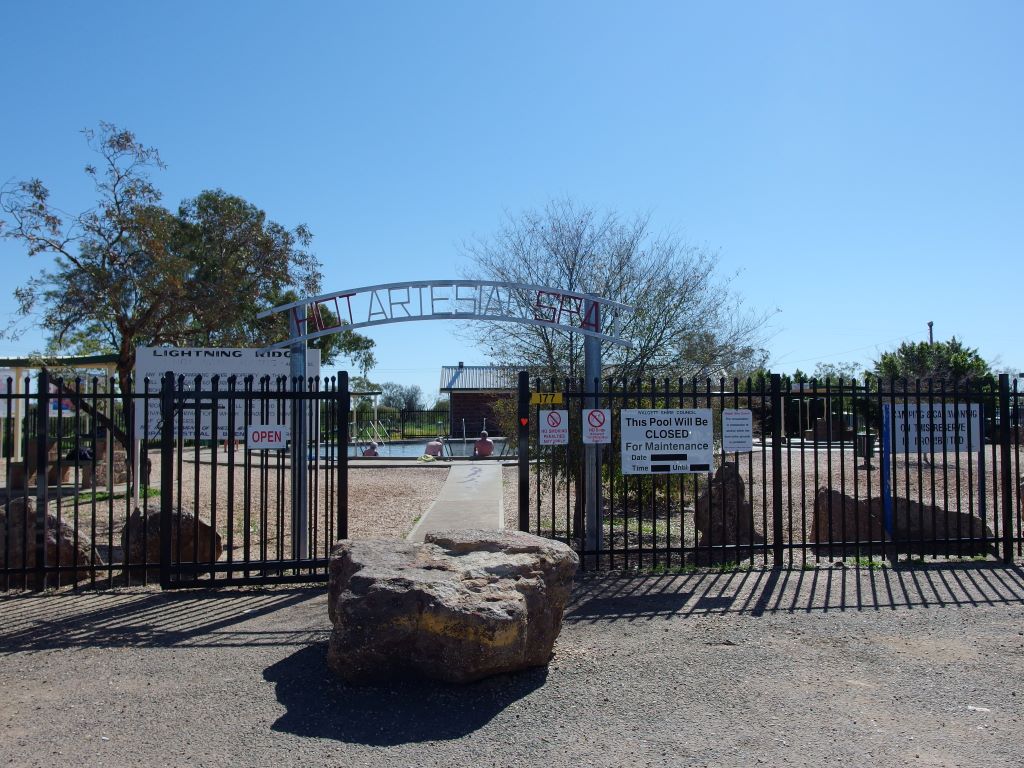
Lightning Ridge Bore Baths – Hot Artesian Spa

There is a string of several such bore baths across northern NSW. They are a real feature at Moree, where they are incorporated into at least one caravan park. Some travellers move from one lot to the next, especially where there is free or cheap camping nearby that enables them to stay for an extended period.

The basis of this popularity is the belief that such bore baths have beneficial or healing properties. The water is warm to hot and, coming from underground as it does, must contain a variety of minerals.

Mid-winter bathers

The artesian water of the bore baths is at least two million years old, in that it is that long since it fell as rain on the intake beds of the eastern highlands, and was absorbed to become groundwater.

The formation and movement of artesian water

In that time, it has moved through the various porous rock beds to places way beyond where it fell as rain. These vast areas of underground water make up the Great Artesian Basin.

Pioneering settlers discovered some places where this water came to the surface naturally – a clue as to what lay below. The mound springs found along the Oodnadatta Track come to mind here.

Map at the Baths showing extent of the Great Artesian Basin

In other places, the pioneers drilled bores down to the artesian waters of the Basin, and up the water came – in vast quantities. And – in some places – at extremely high temperatures, such as we found when we visited Purni Bore on the western edge of the Simpson Desert, in 1999.

The artesian bores watered stock. In some places the water was potable enough to supply drinking water for farms and even towns.

But much of the water that flowed from the thousands of bores that tapped into the Artesian Basin flowed away unused. It is now known that the stores of underground water have been significantly depleted and so bores are being capped, so their flow can be controlled or stopped. Environmentally, this helps conserve the stocks of underground water. However, in places the outflows from bores had created large wetland areas, attracting birds and other wildlife. The capping of some bores has eliminated those.
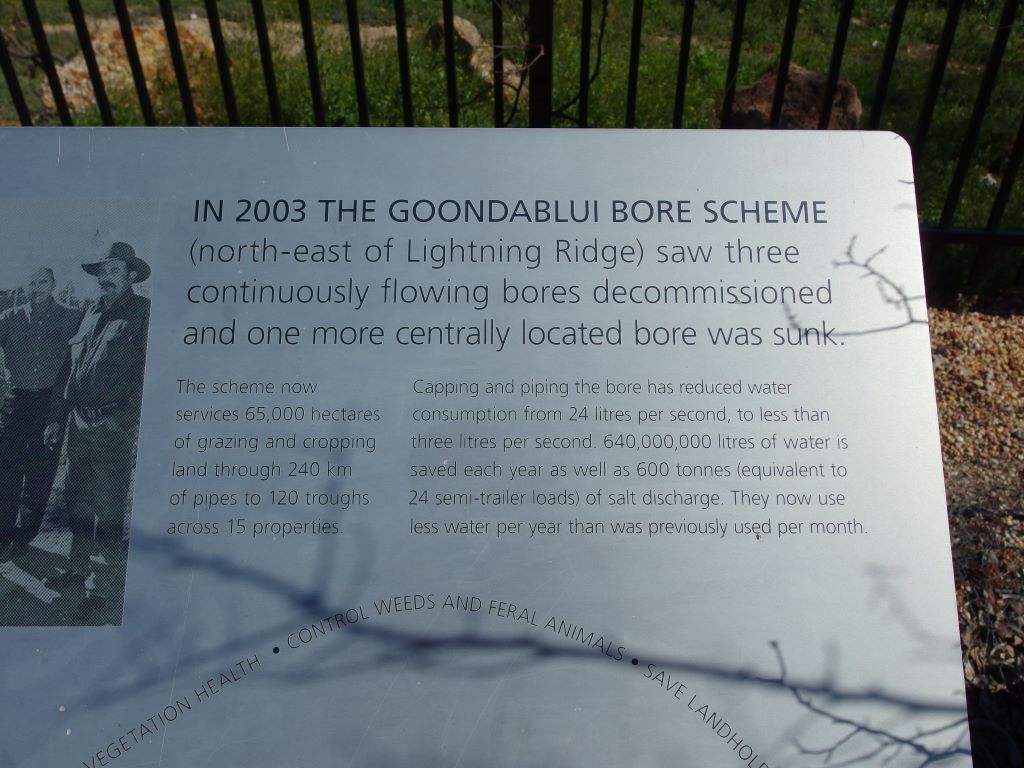
Sign at the Bore Baths

At Lightning Ridge in the early 1960’s, a group of local graziers sunk the bore and constructed the Bore Baths. The water in the baths is in the 37-41 degree range. Use of the Baths is free and they are open 24 hours a day, except for a couple of hours in the mornings when they are cleaned.

There are signs at the Bore Baths saying No camping. For obvious reasons, dogs are not allowed into the baths area.

For many of the opal miners on the fields around the town, this would have been their means of getting clean. It is only more recent that the facility has become an attraction for tourists.

As we were parked near the road to the Baths, I did notice that there was the occasional traffic to the baths, through the night.

The flow of this bore is now controlled, so the flow quantity is reduced, but there is still sufficient through flow to keep the waters hot and clean. By the caravan park fence that is closest to the Baths, there is a large dam, which I thought contained some of the outflow water from the Baths. This was directed off for use by miners in the dirt washing process that was part of opal mining.

Schematic showing effects of bore capping program

We did not partake of the waters. A sign at the entrance warned that people with heart conditions should not venture into water that hot. John eliminated! Even if the two open wounds on my leg did not preclude me, I didn’t find the idea of the baths all that attractive. This was quite illogical, because the through flow probably ensured they were cleaner than the local swimming pool where I used to do water aerobics. I had, in the past, dunked myself in well used watery places like Coward Springs on the Oodnadatta track, and Mataranka. Maybe, next visit, I would venture in?


Leave a comment

2015 Travels July 26

SUNDAY JULY 26     THE SUNDAY MARKETS

Every Sunday morning the markets are held in an area beside the Visitor Information Centre.

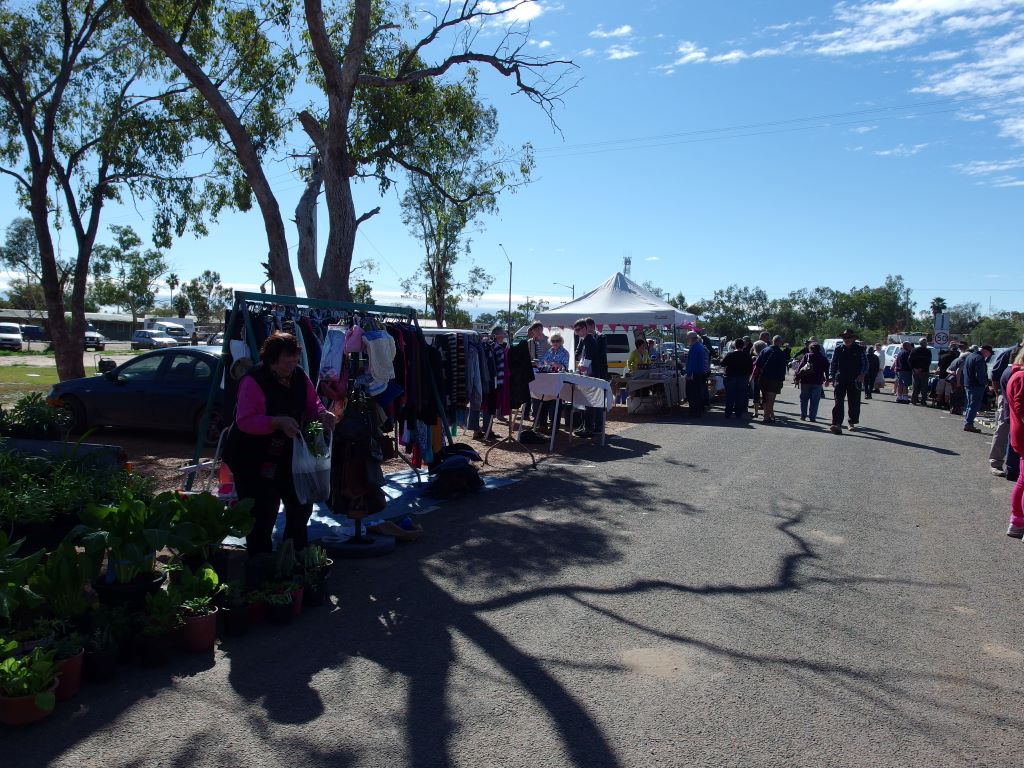
By the time the stalls have set up, along both sides of an old paved road area, there is not much parking space left for customers, so cars tend to park alongside both sides of the main road, fairly haphazardly. If an event like this was held at home, there would have to be traffic control units and marshals wearing high-vis gear. It is quite refreshing in a funny sort of way, to have to just fend for oneself, without the intrusions of the nanny state.

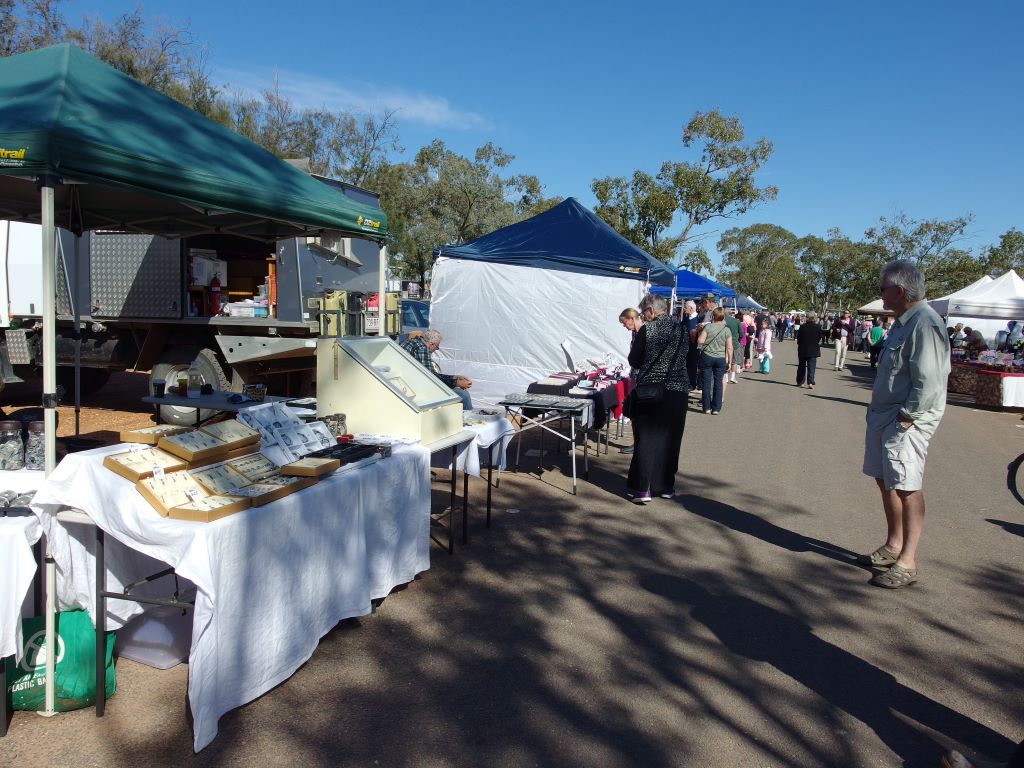
Sunday Markets in full swing

The main focus of the stalls is, of course, opal. Some of the stall holders are miners who offer material they have found themselves, usually in the rough as found, or as “rubs”, where just enough potch and surrounding material has been taken off to give some idea of the opal colour within. Some material is as loose pieces – usually the better quality stuff. Some is filled into bottles and jars and sold as bulk. This latter can be quite tempting, because there may be a couple of really attractive looking bits, in amongst a whole lot of not so good pieces.

Other opal stalls are maintained by those who are middle men – they buy from miners who can’t be bothered selling what they mine, or who are desperate for a cash flow. Some have a mix of their own and others’ material. Generally, there has been a sort of natural filtering effect here, in that these middle men have purchased only stones they think they can profit from, so their offerings are fair quality. But one usually pays more for this, too.

Typical stalls

Then, there are some opal jewellery stalls. Given the general nature of such markets, with cheap overheads, the product here tends to be opal cut to be fitted into pre-cast settings. Often it is doublet or triplet (not solid opal) which is cheap enough to appeal to market patrons – tourists who think they are getting a bargain, and those who do not know that not all “opal” is the same. Some of these stalls do not show on their labelling what is doublet, triplet or solid, and if you do not know to ask, or check for yourself, will not tell you. By comparison, most of the gallery shops in town have signs in their display cases saying what is contained within, or in some cases, state that they sell solid opal only.

Solid opal is, an indicated, a piece of solid stone with opal flashing colour within. There is a grading system for the base or background colour of opal, ranging from the really dark “black” of the best Lightning Ridge opal, through a whole gradation, to the milky white background colour of Coober Pedy opal. The Lightning Ridge black opal is regarded as the best opal and is the most valuable.

A doublet opal is where a thin piece of opal is mounted on top of an uncoloured piece of potch/stone. A triplet contains an even thinner shaving of opal, sandwiched between a dark stone background and a clear cover – quartz or plastic. These are layman’s definitions, not technical ones. As these contain less opal, they are less valuable. A rule of thumb we were told, this trip, was that a doublet stone is about ten percent of the value of a solid of similar size and colour; a triplet about four per cent.

Down there is my favourite cake stall…

Unlike gemstones such as diamonds, sapphires etc, which are uniform enough within themselves to be faceted to a geometric shape, each piece of opal is different. Its best presentation is where the stone is shaped to bring out the colour show. Where opal is cut to fit the cheaper, pre-cast settings, the true colour may not be best brought out. So, often, it is not the best opal that is used for such jewellery. As with most things, one pays a premium for quality – of both stone and setting.

Most of the opal galleries in the town are not represented at the markets.

In amongst the opal stalls are a variety of others. There was a good second-hand book stall, where the books were arranged by author, rather than at random. A few stalls sell an array of used goods – everything from second-hand solar panels to rusty metal of indeterminate purpose. There are the usual market type stalls selling sarong style clothing, knotted scarves, baby booties and the like. One extensive stall sold fresh fruit and vegies – both good quality and good value, I thought. There were a couple of preserves stalls – jams, sauces and chutneys. I saw a plant seller too.

Market stalls with main road across to the left

My favourite stall was that of a lady who sold cakes, slices and the best boiled fruit cake – by the half or whole cake. We gladly parted with $6.50 for a half cake that was so yummy.

On our first Sunday in town, we went to the markets. I wanted to buy cake, John wanted to be tempted by bottles of opal. We came home with cake, some very nice truss tomatoes and other assorted vegetable matter – about which John could not get excited. There was a small jar of chutney to flavour that night’s pork loin roast dinner. It was a good morning’s work, because our loot consisted of what was needed, not multiple impulse purchases of local stone.


Leave a comment

2015 Travels July 25 to August 20

SATURDAY JULY 25 TO THURSDAY AUGUST 20     LIGHTNING RIDGE

We ended up staying at Lightning Ridge for four weeks.

Our original booking was for two weeks – to cover the period around Opal Fest and give us time for any other activities we wanted to do in the area. Then, we had planned, to make our way across to the northern NSW coast, for a “beach fix”.

As our first two weeks were nearing an end, I realized that the state of my leg, still with two open ulcerated areas, would prevent any beach walking and paddling. Hadn’t really thought about how I would deal with sand in wounds before then. Dumb. So John decided we might as well stay put at the Ridge. The weather was beach-like anyway, and we were enjoying the town and this caravan park. And being lazy! The decision was made enough in advance for us to be able to remain on the same site.

Very comfortable on this site

A lot of our days here were uneventful and much the same, so not interesting enough to write up individually. Some special events and aspects will get their own entries, later…

In the meantime, this is how we passed most days…

Each morning, I would wake up about 8am and would take Couey for a walk right around the “settled” area of the park, which was quite extensive and took about 20 minutes, unless we stopped to socialize.

There was always much of interest along this route for Couey to sniff, so it could be a stop-start walk at times. I found plenty of bird life to watch while she worked out who had passed since she was last that way.

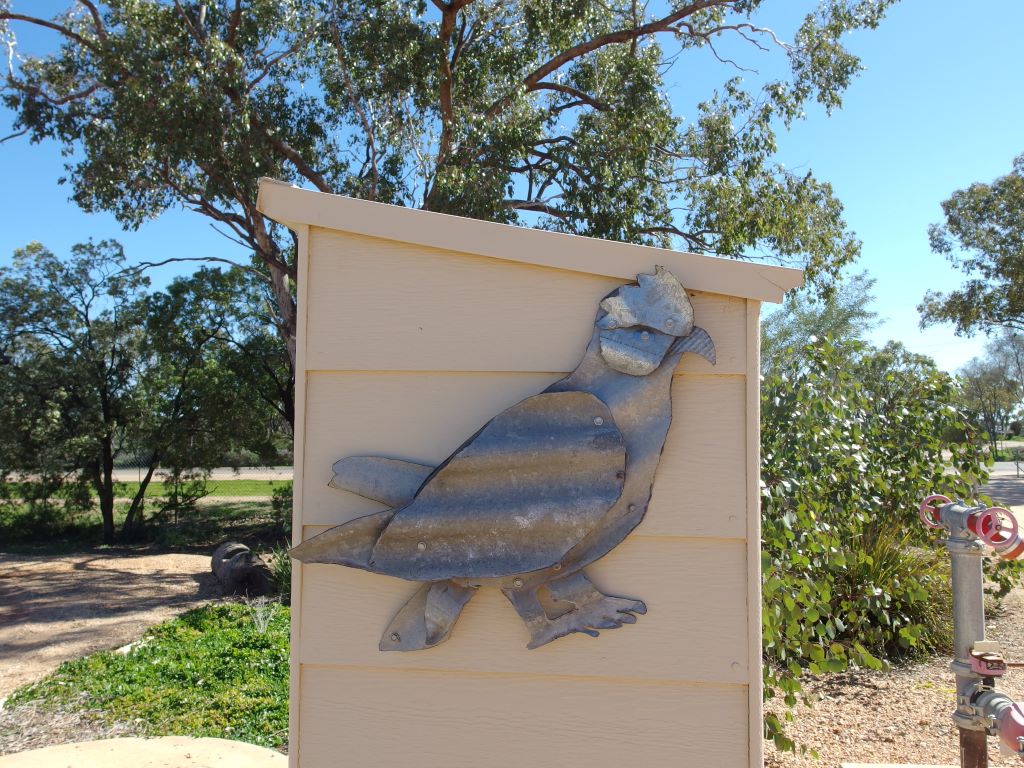
Grey crowned babbler

Because the park’s powered section, of 98 sites, was full every night, and because there were those non-booked arrivals in absolute need of a powered site, who would fit in anywhere they could be placed, it was interesting each morning to see these different arrangements. Someone who was having to wait days for repairs and parts was parked up in front of one of the big work sheds, where a long power lead was fed out to the rig. They had a less than inspiring view of the car wash bay and the dump point – but, hopefully, considered themselves fortunate to have a spot at all.

Metal art by the entrance

There were places on the perimeter road around the powered sections, where there were holding or pumping tanks for the sullage lines, buried to ground level. These had an electric power inlet to make them work. A couple of these had an extra power point and sometimes travellers occupied the adjacent, wide, roadway, like a site. As with the shed, these were provided to help out travellers in real need. However, I was not sure that the man who did the daily rounds emptying the rubbish bins appreciated when these people spread themselves right out across the roadway, blocking it and causing him to have to go bush to get around them. Not just him, either – we walkers were blocked too!

Lots of the park’s native plantings were in flower

Also of interest on my morning perambulations with the dog, was the unpowered section – an extensive area. Around the period of Opal Fest, it was totally full too. No real marked sites here, so it was a bit random and Rafferty’s Rules. Towards the end of our stay, there were fewer rigs there. The majority of those parked there were waiting for a powered site to become available.

Once the ground – that was very boggy when we arrived – dried out, there was usually two or three camps set up in the “bush” section, where people could really space themselves well apart.

Part of the large unpowered section of the park

Once our morning walk was done, it was dog breakfast time. I was having to keep morning and evening blood pressure readings for my doctor, who was still tweaking the combination and dosage of pills to keep that in order. Once that was taken, I could take said pills – and then had to wait at least half an hour before eating or drinking. Then, mostly, by that time I couldn’t be bothered with breakfast, so just had two mugs of plunger coffee, which I really savoured.

John would continue to sleep through all of this. Dog would usually have “asked” to go back in Bus, where she could guard him – and sneak up on my bed to do so. I had learned to cover my bed well, immediately after getting up, with a large old sheet.

Gotta be here to do the guarding properly….

To fill the mornings, I read, wrote up my diary, wrote postcards, embroidered or knitted, most days. Would sit outside under the awning if the weather was dry and warm enough.

Eventually, John would surface and breakfast – late.

I might need to head off to the fairly well stocked IGA for a hunting and gathering session before lunch. The small size of Bus fridge meant that this happened a bit more frequently than I liked. Our diet was heavy in salad and vegetable matter – “added bulk” did not only apply to the dietary label! John also drank quite a lot of milk and I could only accommodate 1 litre bottles of this, so regular replenishment needed. Of course, I am “difficult” or “fussy” – his terms vary – because I cannot stand full cream milk in my coffee. So my bottle of light milk also took up space on the fridge door, that could otherwise be filled by his cans of beer. I was never sure why I was the unreasonably choosy one, when he couldn’t stand light milk? We managed…

Afternoons might be more of the same, punctuated by a couple of dog exercise walks, or we might go off on a little sightseeing jaunt, or a browse of some opal shops.

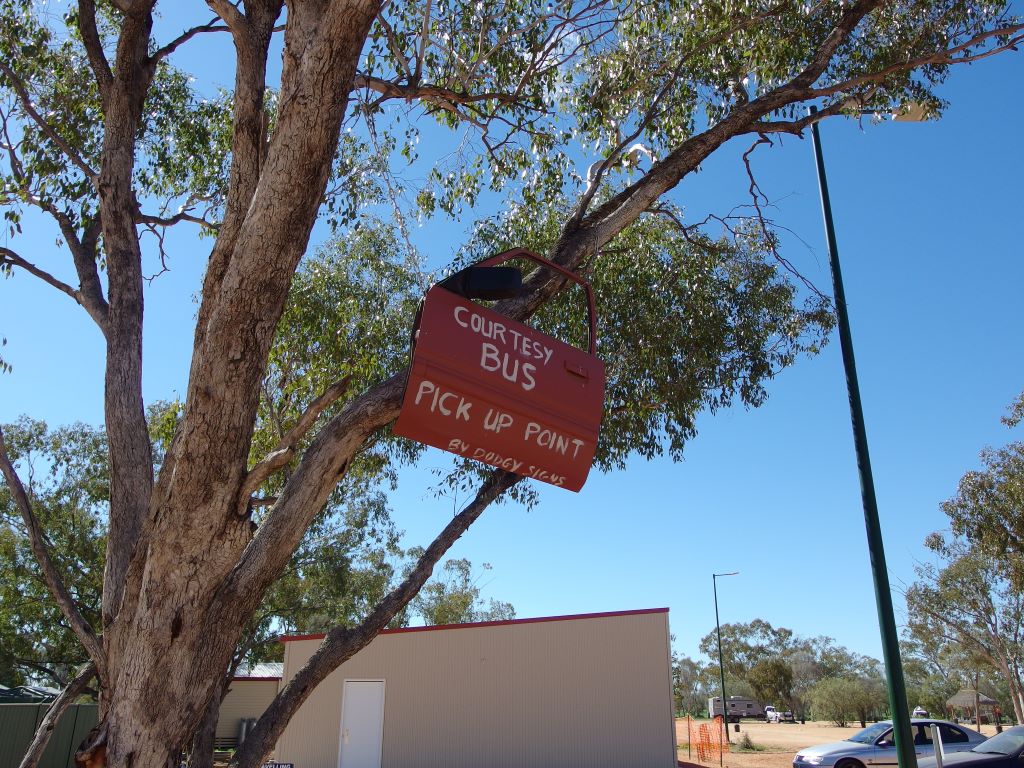
Tour bus collection ….. by Dodgy Signs

Occasionally, the man went off and played bowls.

Couey always got an afternoon walk session where we went over to the bush area, past any campers there, and then she was let off the lead. We walked the length of the perimeter fence and some of the little tracks through the low scrub. She would range ahead, maybe thirty metres or so, then come back and check on me, then range out again. That’s the cattle dog instinct at work.

Great park for the dog

There were plenty of fallen trees and branches in the bush area and we’d taught Couey to hurdle some of these. Such fun that she would seek out things to jump. She always looked longingly at the very big dam on the other side of the fence, that was the outflow from the Bore Baths, we thought. She would just love to go swimming in that – but the fence was very sturdy chain wire mesh, thankfully.

During the early part of our stay, the many large, muddy puddles along the way caused us angst – and her much enjoyment. As the days passed, the puddles shrank and became more muddy and less watery – and we discovered that the car wash bay was good for more than cars… The ensuing hose downs never deterred her from mud wallows, though.

Sometimes in the late afternoon, we would have a happy hour outside before tea – if the weather was particularly nice. If we had sociable neighbours, with them too. I bought a small cask of Sauv Blanc for such occasions, which I preferred to beer.

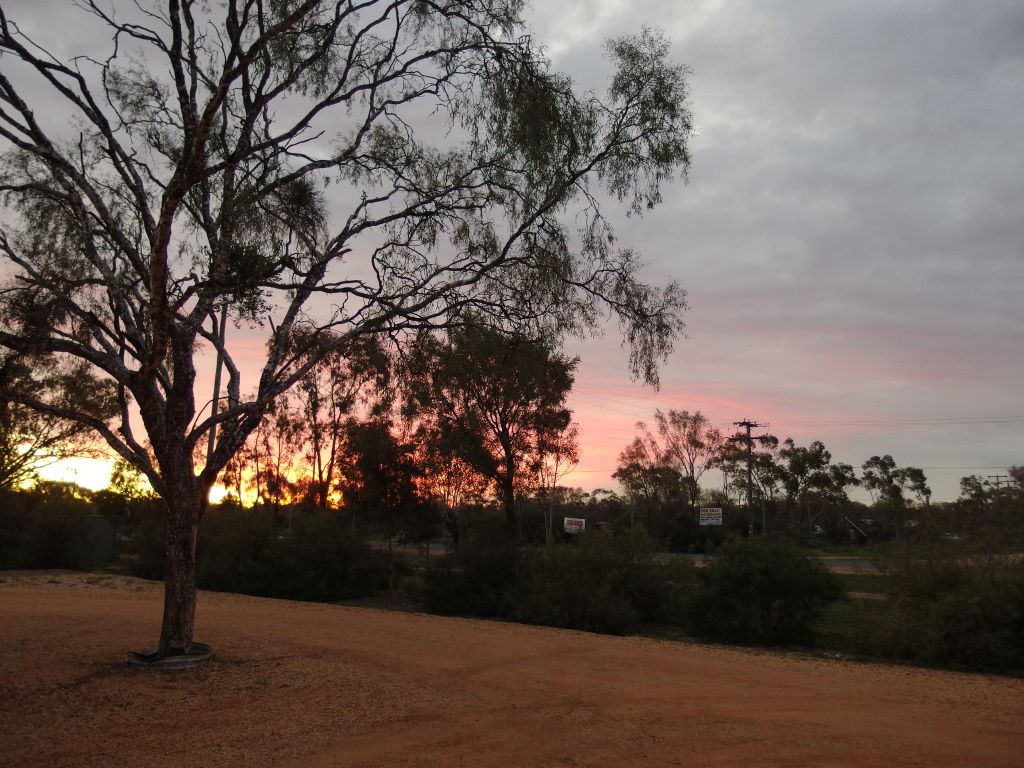
Some brilliant sunsets

Such were our days. Very relaxing, but with some regular gentle exercise.

Every three days I would have to change the dressings on my leg. Back in May/June, this used to take about an hour, as soaking was involved. Now that healing was – finally – well advanced, it was much quicker, taking about half an hour, by the time all the needed stuff was set up. The hard part was peeling off the really tight knee-high stocking – and getting it back on again without dislodging the new dressings. Always a chore I did not look forward to.